The Crown
corona, Kether
Completion, and in the Kabbalistic reading the first sephirah, the point at which the work is no longer yours.
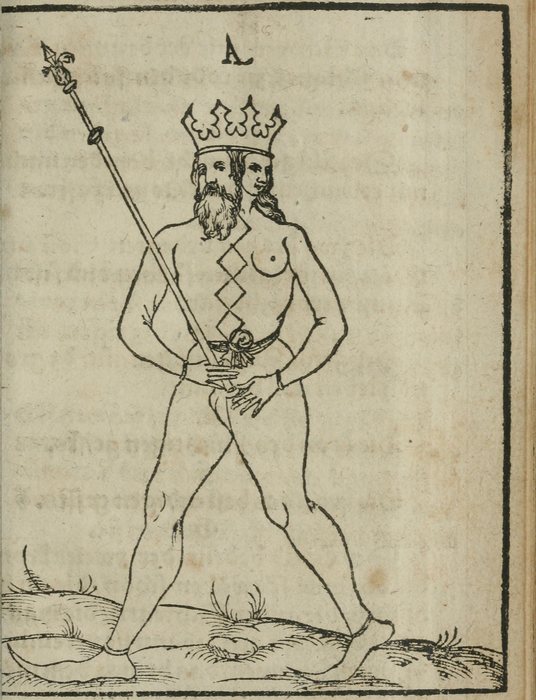
Thirty-five works in this archive carry a crown, and the readings fall into three kinds: the crown as the top of a scale, the crown as a thing that comes off, and the crown that says what office its wearer holds.
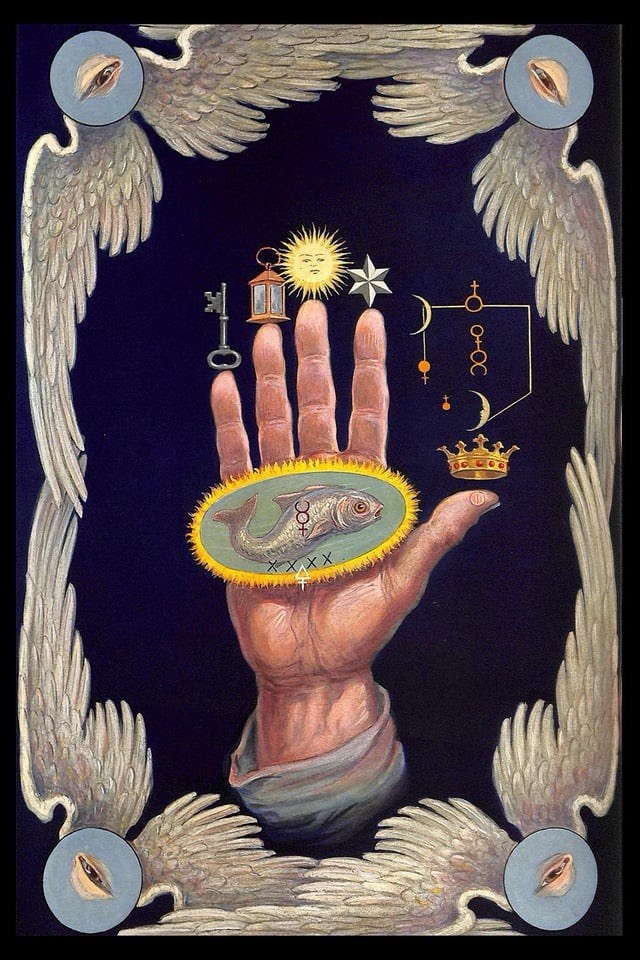
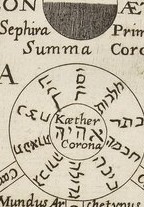
At the top of the scale, Hall on the thumb of the Hand of the Mysteries: the crown is “Absolute Light, unknown and unrevealed, whose power shines through all the lesser lights”. He gives the same position to the same word on the Tree of the Sephiroth, where “The Qabbalistic tree of the Jews also consists of nine branches, or worlds, emanating from the First Cause or Crown, which surrounds its emanations as the shell surrounds the egg.” The crown is not the highest thing in a series there; it is the container the series happens inside. Kircher's Kether, on the plate of 1653, is the same position in Latin: “Primum itaque vestimentum Dei”, the first garment of God, emerging out of the darkness of his infinite essence, and “ab hac omnes Numerationes, illa à nulla procedit”, from it proceed all the Numerations, it proceeds from none. The older Hand of the Philosophers puts something else in the same place and keeps the same logic: the crown is saltpetre, which finishes the work as the thumb finishes the hand. Those are the archive's words for that text and not the text's.
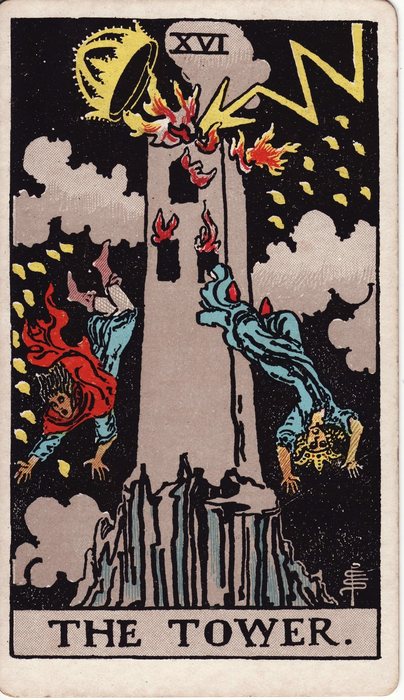
Then the crowns that fall. Waite on Death: “Other heads have been swept from their place previously, but it is, in its current and patent meaning, more especially a card of the death of Kings.” On the Tower a crown is knocked clean off the building, which is on the card and nowhere in his text, so the archive records it and leaves it unread. On Temperance the crown is not worn by anyone: “A direct path goes up to certain heights on the verge of the horizon, and above there is a great light, through which a crown is seen vaguely.” Maier's king of the thirty-first emblem swims in the sea with his crown on, and the crown, he says, weighs his head down, “Rex Diadema caput cui praegravat”: the one crown in the archive that is drawn as a burden.
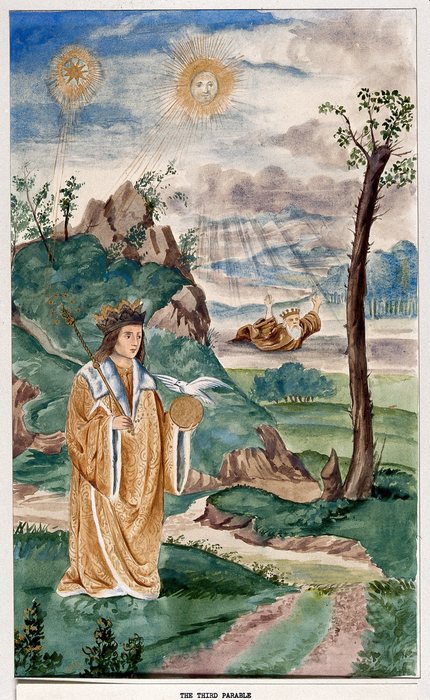
And in the Apocalypse a crown is what gets handed over. Of the first rider, “there was a crown given him”. Of the enthroned king, “And his eyes were as a flame of fire: and on his head were many diadems.” The painter of the sheets after Flamel gives the rider with the bow his crown for that reason, and stacks three on the king with many diadems.
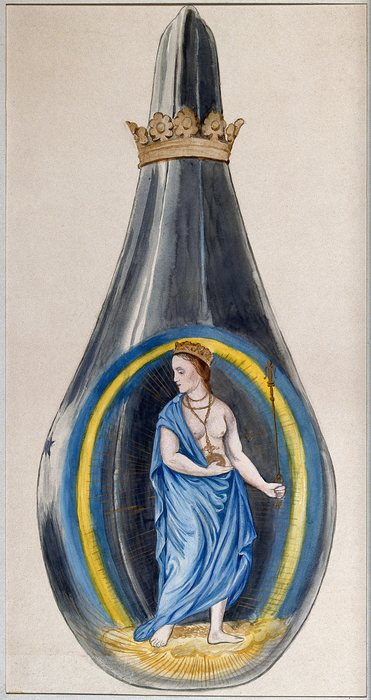
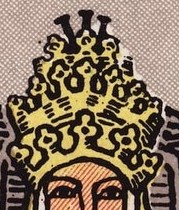
The third kind is worn, and names an office. Waite's Hierophant “wears the triple crown and is seated between two pillars”, and the crown is the papal tiara: “He has been usually called the Pope, which is a particular application of the more general office that he symbolizes.” His Emperor is “a crowned monarch--commanding, stately, seated on a throne”, and stands, Waite says, for “the higher kingship, occupying the intellectual throne”. The Empress's “diadem is of twelve stars, gathered in a cluster”, the crown of the woman clothed with the sun, one of the figures Waite says she “has been correctly described as”; the High Priestess has “a horned diadem on her head, with a globe in the middle place”, which belongs with the moon at her feet. Maier crowns Wisdom herself in his twenty-sixth emblem, with length of days in one hand and riches in the other, and the Gemma manuscript of about 1735 crowns Sophia, “die Himmlische und Irdische Eva, die Mutter aller Creaturen”, the heavenly and earthly Eve, the mother of all creatures: Wisdom drawn as a queen.
The oldest crowns here are horned. On the slabs cut for Ashurnasirpal II at Nimrud in the ninth century BCE, the guardian at the gate and the winged figures along the walls all wear a tall cap with horns wound round it, and the Metropolitan Museum's entry on the lion reads the cap together with the belt below it as a single statement: “The horned cap attests to its divinity, and the belt signifies its power.” Rank above, strength below. Nothing in either about who the creature is or what it is called.
Given, worn, glimpsed, struck off. The one thing no source here says is that a crown is earned.
Contested
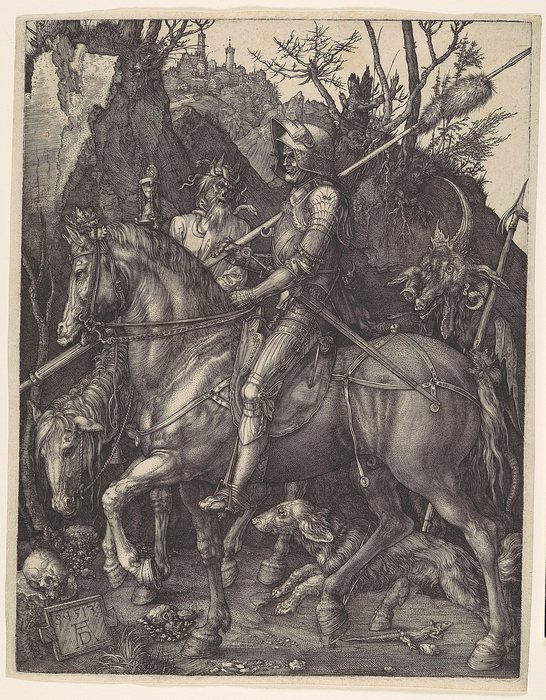
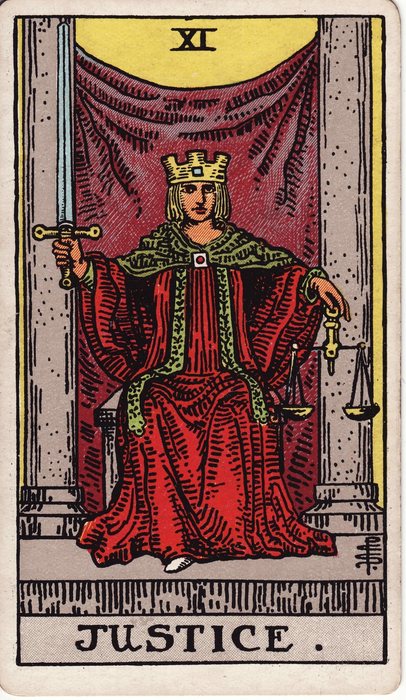
Three crowns in the archive carry no reading at all and say so on their pages: the crown falling from Waite's Tower, the spiked crown on Death in Dürer's Knight, Death and the Devil, which Conway never mentions, and the crown with a square stone on Waite's Justice.
A fourth is contested rather than unread. Conway describes the band on the head of the figure in Melencolia I as a myrtle fillet, “symbolic of right, and therefore unfading, thought”. Whether the leaves are myrtle, watercress or water ranunculus is argued over, and the archive files that band under the Crown as the nearest motif it holds while saying plainly on the record that a fillet is not a crown.
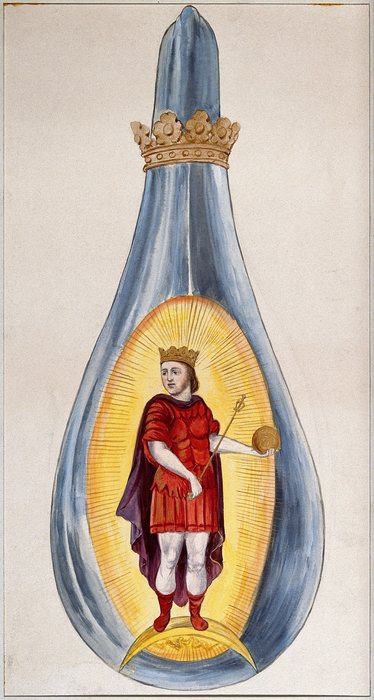
Hall's caption is a transcription not yet read against the printed 1928 page, and the Hollandus material comes through an English translation of 1986 whose authorship is disputed. Kircher's Latin and the Gemma's German are put into English by the archive, with the originals on the records. Neither Hall nor Hollandus is stated here as certain. Maier's crowned kings, the swimmer and the patient, are marked and read on their records; the crown that seals the flask of the peacock is tagged by eye and unread.
Sources
- Manly P. Hall, The Secret Teachings of All Ages, 1928: The plate caption to the Hand of the Mysteries. Transcribed, not yet read against the printed page.
- Hollandus, attributed, The Hand of the Philosophers, 17th c.: Through Leone Muller's English translation, RAMS, 1986. Not yet read against a seventeenth-century printing, and the authorship of the Hollandus texts is disputed. What the archive holds is a reading of the text rather than a quotation from it.
- A. E. Waite, The Pictorial Key to the Tarot, 1911: Part II, on the cards of the 1909 deck drawn by Pamela Colman Smith.
- The Apocalypse of Saint John, Douay-Rheims, Challoner revision: Quoted from the Challoner text, checked verse by verse against the printed edition.
- Conway, Literary Remains of Albrecht Durer, 1889: Chapter IX, his reading of Melencolia I. A Victorian reading, quoted as his and dated so it can be weighed as one.
- Athanasius Kircher, Oedipus Aegyptiacus, 1653: The chapter on the Cabala of the Hebrews in the second volume, Rome 1653, read in the Latin of the Universidad de Sevilla copy with the archive's English beside it: a Jesuit's account of the ten Sephiroth, written to explain his own plate of the tree.
- Arthur Edward Waite, The Pictorial Key to the Tarot: Waite commissioned the 1909 designs and wrote the key to them, so his account is the closest thing the deck has to an author's statement.
- The Apocalypse of Saint John, Douay Rheims, Challoner revision: Quoted from the Challoner revision, the English text the archive uses for the Apocalypse throughout.
- Gemma Sapientiae et Prudentiae, Wellcome Collection MS.2492, c. 1735: The Sophia page of a German Rosicrucian manuscript of about 1735, quoted in the writer's German with the archive's English.
- Michael Maier, Atalanta Fugiens, 1618: The mottoes and epigrams of the fifty emblems, Oppenheim 1618, read against the page images of the Getty Research Institute copy; the English is the archive's own and is marked as such on every record. Maier's discourses, in which he explains each emblem at length, are not yet transcribed.
On the same plate
Where it appears · 35
35 works in the archive carry the Crown. First the 27 where it has been read, with the Crown itself picked out.

The Hand of the Mysteries
The Hierophant (V)
Systema Sephiroticum, the Tree of the Sephiroth
Jungfrau Sophia, the Virgin Wisdom
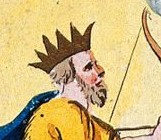
Three Riders on Black, Red and White Lions
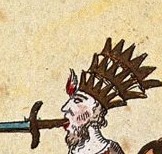
The King with Three Crowns and the Seven-Headed Hydra
The Tree of the Sephiroth
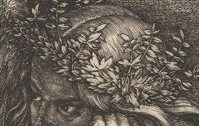
Melencolia I
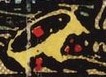
Death (XIII)

Temperance (XIV)
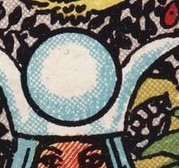
The High Priestess (II)
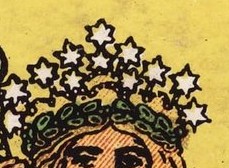
The Empress (III)
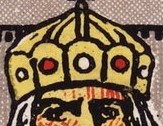
The Emperor (IV)
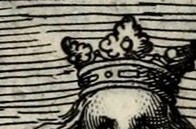
Sapientiæ humanæ fructus Lignum vitæ est
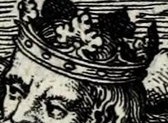
Rex natans in mari, clamans altâ voce: Qui me eripiet, ingens præmium habebit
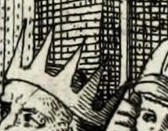
Rex ab aquis potatis morbum, à medicis curatus sanitatem obtinet
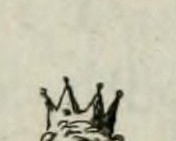
The Force of Justice
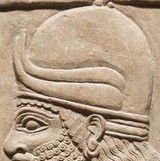
Winged figure with the rosette branch
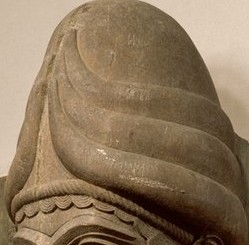
Human-headed winged lion
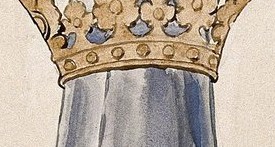
The Peacock in the Flask
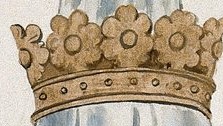
The Three-Headed Monster in the Flask
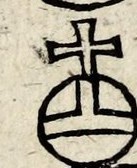
Tabula Smaragdina Hermetis Trismegisti

The sword, the two crowns and the dragon
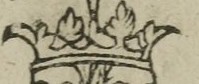
The tree of the sun and the tree of the moon

The winged queen holds out a robe to the black man
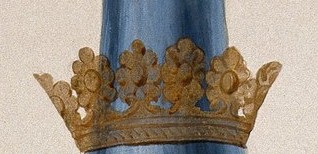
The child pouring the black flask down the dragon
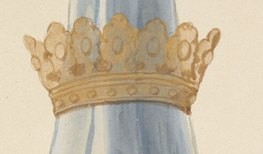
The three-headed bird in the crowned flask
As a detail in 8 more
In these the Crown is somewhere in the picture, tagged by eye, and nobody has read it yet. When one of them is read, it goes out on a Sunday.