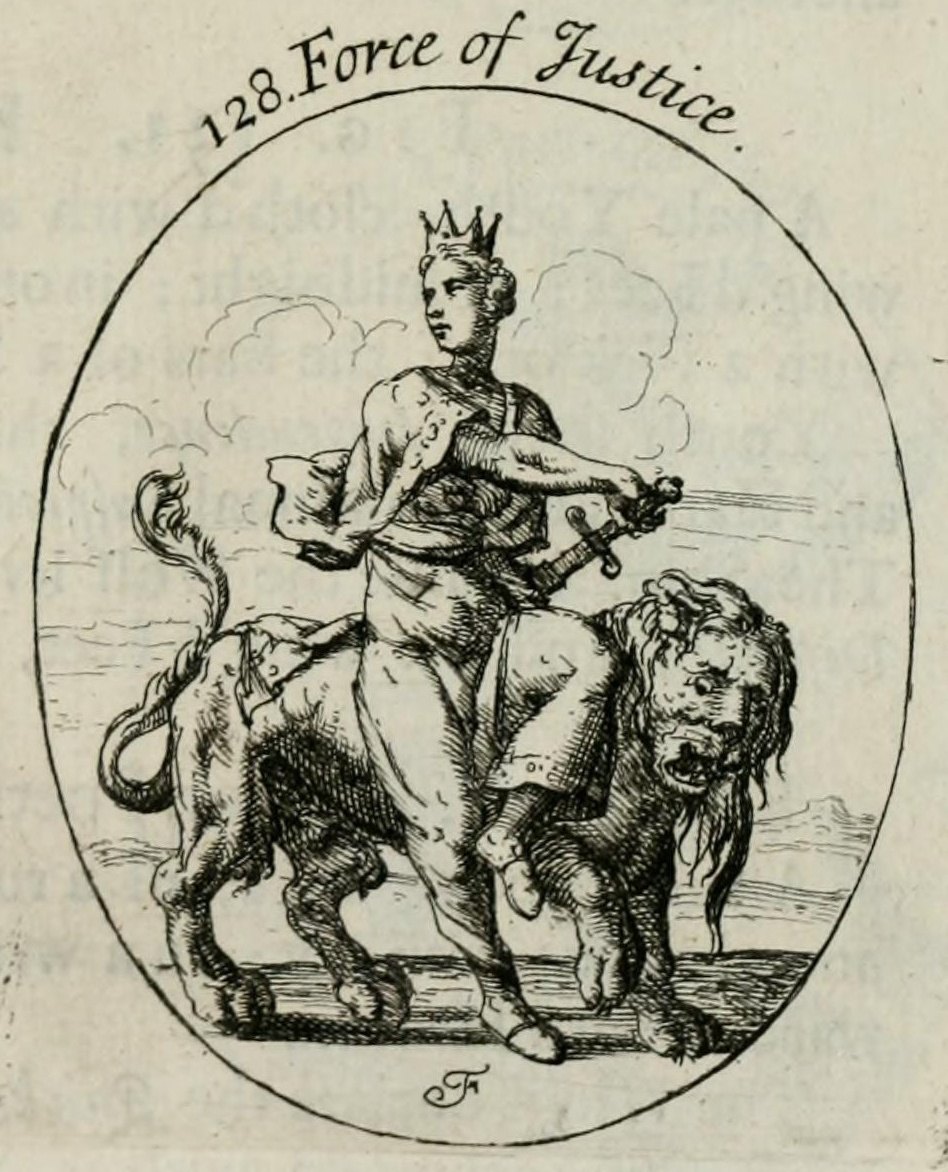
The Force of Justice
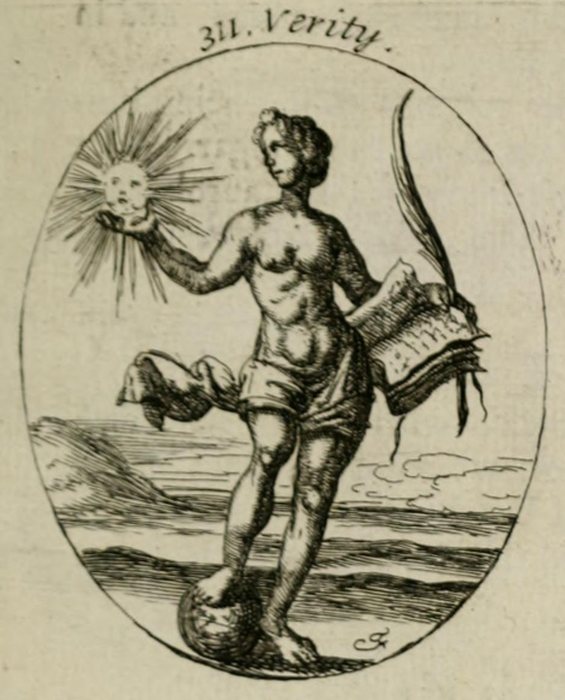
The Lion as the central motif, with the Crown in a secondary part. From Iconologia.
Key · 2 motifs
Tap a motif on the picture, or a line below. Its note opens under the line, with the reading its author gave it.
- Primary motif
- Secondary motifs · 1
The picture
A crowned woman in royal dress lowering herself onto the back of a lion, one hand laid on a sword, the lion's head turned out of the picture. By eye
The reading
The picture read whole, in the archive's words, from the sources quoted on the marks. Read on, and the picture follows: the motif under discussion keeps its colour.
Ripa builds an argument out of two objects and a posture, and then writes down what the argument is. ‘A Lady in Royal Apparel; crown’d; about to sit down upon the Back of a Lion, and seems to lay her Hand upon a Sword, which denotes Justice, as the Lion does Strength; so that the Strength of the latter submits to the former, i. e. Justice.’
The whole of it turns on the words about to sit down. She is not enthroned on the lion and she is not fighting it. She is in the act of taking her seat, which is the moment at which the stronger animal accepts the lighter weight. The engraver has drawn exactly that: her foot is still down, the lion's head is turned out of the picture and its tail is up, and the outcome is not yet settled on the page.
The crown is what makes the sentence work. Ripa's figures argue by rank, and the crowned figure is the one whose claim holds. The lion is the archive's usual emblem of the fixed and the royal, gold in the alchemists and the tribe of Judah in the monitors. Here it is the thing that must give way, and it gives way to a woman with a sword and a crown.
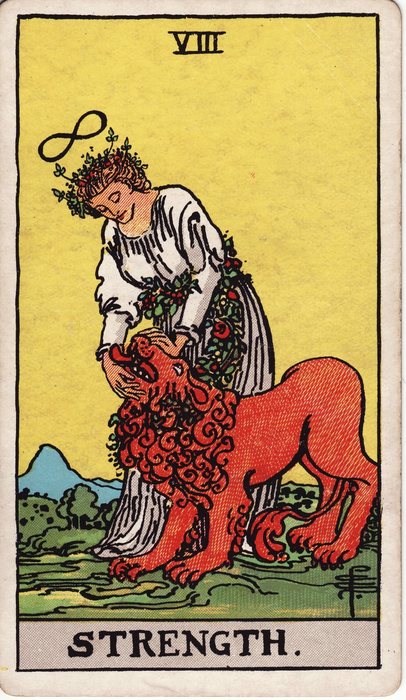
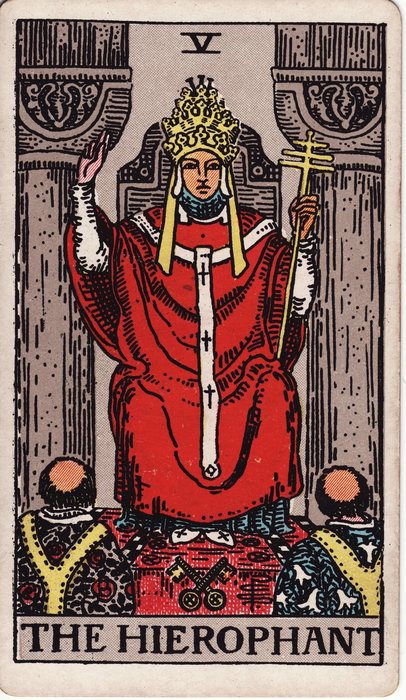
This figure sits three pages from its own opposite. Figure 127, the Force of Eloquence, puts a lion under a speaker's feet and says that force gives place to whoever can talk; figure 126, Strength, is a woman in armour with a lion on her shield. Ripa keeps using the same animal to mean the same thing and changing what it is under, which is a working demonstration of how a symbol carries meaning by arrangement rather than on its own.
Decoded: every motif is marked, and each mark carries the reading its author gave it, quoted from the text, or says that it is observed on the picture and not read. The reading above is the archive's own, made from those sources and no others.
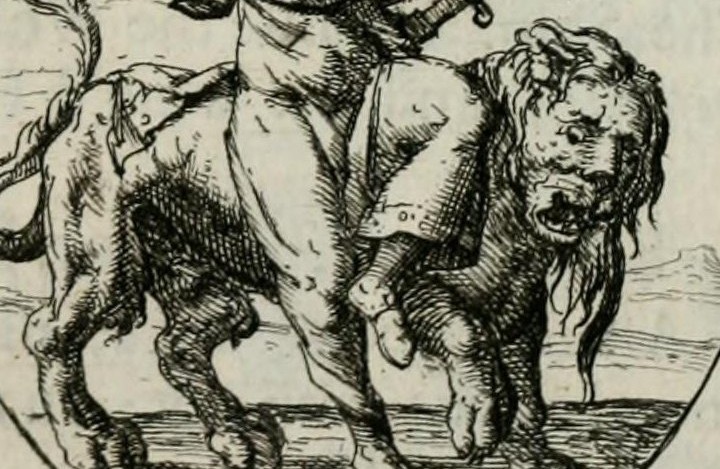
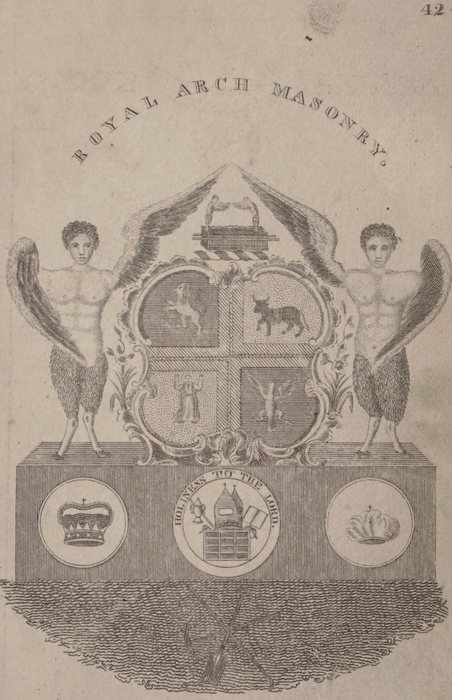
Usually not an animal but one face of a set of four. Count the other three before reading it alone.
In plain words The lion fills the bottom half of the oval and carries her weight. Ripa's sentence makes it an argument rather than a mount: the sword denotes Justice, 'as the Lion does Strength; so that the Strength of the latter submits to the former'. The lion is not being ridden for grandeur. It is being sat on to show which of the two gives way.
Cesare Ripa, 1709 “A Lady in Royal Apparel; crown'd; about to sit down upon the Back of a Lion, and seems to lay her Hand upon a Sword, which denotes Justice, as the Lion does Strength; so that the Strength of the latter submits to the former, i. e. Justice.”
Completion, and in the Kabbalistic reading the first sephirah, the point at which the work is no longer yours.
In plain words She wears a crown and royal dress, which in Ripa's grammar is not a portrait of a monarch but a sign that the thing shown holds authority. It is what lets the picture argue: strength submits to justice because justice is the one wearing the crown.
Cesare Ripa, 1709 “A Lady in Royal Apparel; crown'd; about to sit down upon the Back of a Lion, and seems to lay her Hand upon a Sword, which denotes Justice, as the Lion does Strength; so that the Strength of the latter submits to the former, i. e. Justice.”
Also carrying the Lion
15 works carry it. The 6 where it is the central motif are here. The symbol.
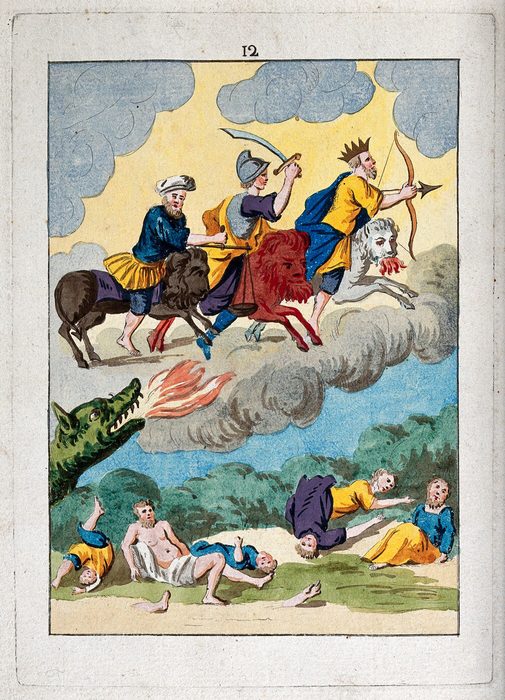
Where the detail is the subject
This is in the picture without being what it is about. Below, one work that is about it.
In the same series
Record
One symbol a week, decoded.
This picture is free at full size from its source, linked above. What an address gets is the Sunday letter: one picture, one symbol marked on it, what it meant and who said so, and the master files of the decoded plates as they are verified. Leave any time.
Free, one letter a week, unsubscribe in one click. How the address is used.
Scroll or pinch to zoom · drag to move · double-tap for 1:1 · 948 by 1172 pixel web copy; the source file is linked under Record