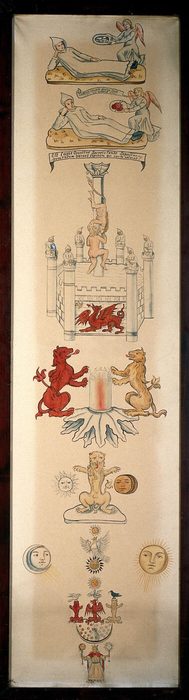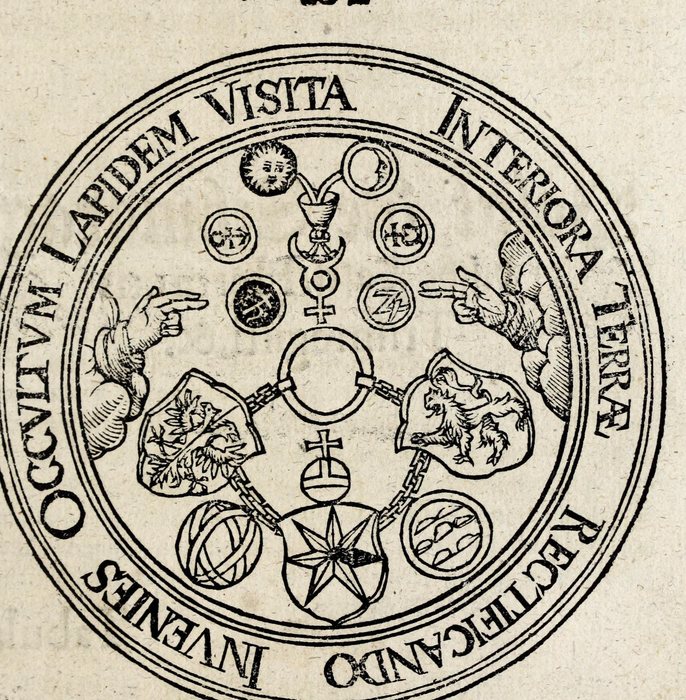
The Lion
the winged lion, the tetramorph lion
Usually not an animal but one face of a set of four. Count the other three before reading it alone.
Sixteen works here carry a lion, and in most of the ones the archive has read it is not really a lion. It is one quarter of a group.
The group is the tetramorph, the four creatures of Ezekiel's vision that Christian writers attached to the evangelists. Waite says so plainly of the card of 1909: “The four living creatures of the Apocalypse and Ezekiel's vision, attributed to the evangelists in Christian symbolism, are grouped about an elliptic garland”. Once you know to count, the lion stops being a beast and becomes a position. It appears at the right of Hall's throne with a bull, a man and an eagle. It appears again as one of the four heads on the Cherub plate. On the Wheel it sits in a corner with a book.
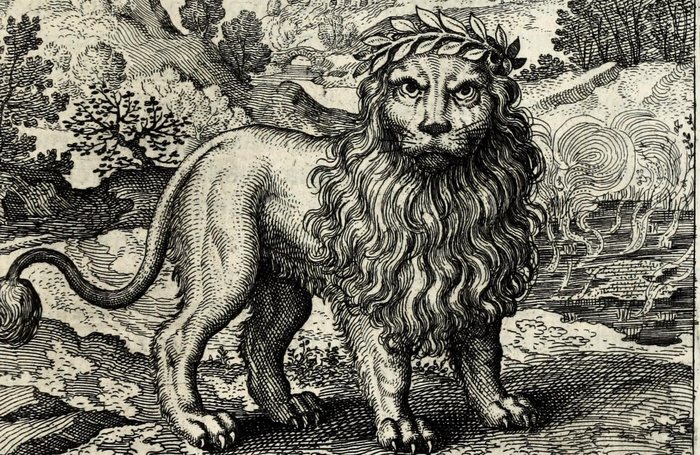
Four works have lions that are lions. On Strength, Waite says, “There is one aspect in which the lion signifies the passions, and she who is called Strength is the higher nature in its liberation”; the woman “is closing the jaws of a lion” already tamed, “which is being led by a chain of flowers”. Fludd sets Leo in the ring of animals on the man's side of his mirror of nature, opposite the eagle on the woman's, and Craven's summary of that ring is that “At either side are the male and female persons and qualities”: the lion is a male quality there, one item in a list. Maier's lions of 1618 argue. In the sixteenth emblem a winged lioness and a wingless lion are joined at the feet, “Ille sed immotus stat humo, retinetque volantem”, but he stands unmoved on the ground and holds the flier back, which Maier calls an image of the way of nature: the fixed holding the volatile. In the thirty-seventh a lion crowned with leaves is the green lion, “Aes Hermetis at est viridis LEO”, the copper of Hermes, and it has an entry of its own.
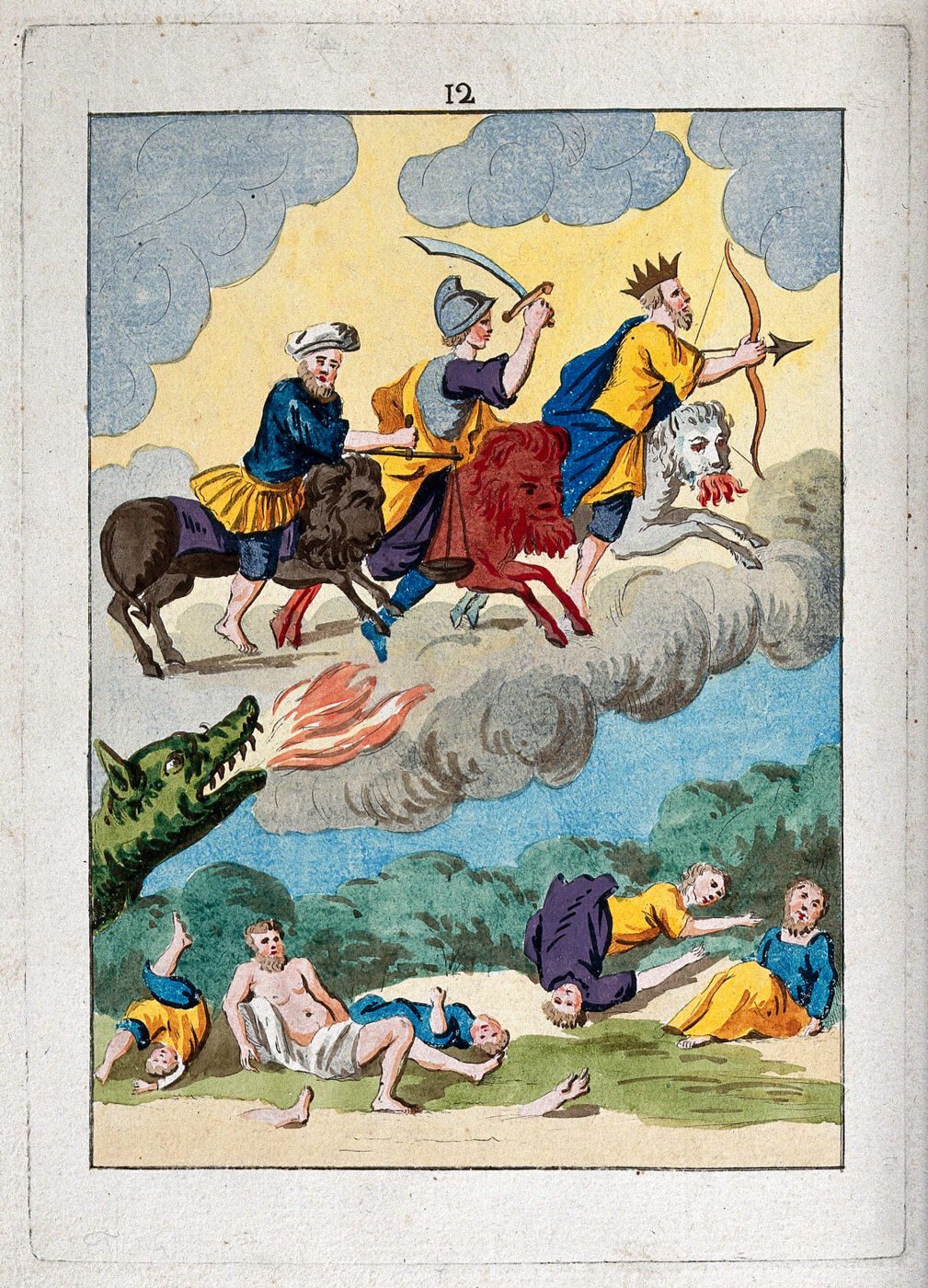
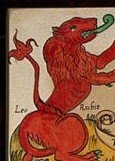
The exception is the sheet after the figures attributed to Flamel, and it is the most interesting thing under this motif. The sixth chapter of the Apocalypse puts its riders on horses, black, red and white: “And there went out another horse that was red.” The painter has put them on lions of those three colours instead. Nobody in the archive explains the substitution, and the record says so rather than inventing a reason for it. What can be said is that the colours were kept and the animal was changed, which means the colours were carrying the meaning and the animal was not.
Contested
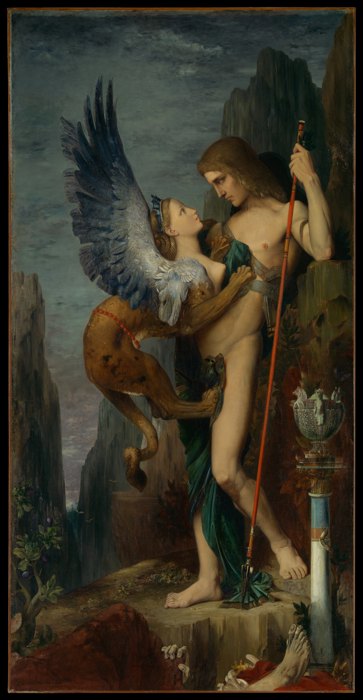
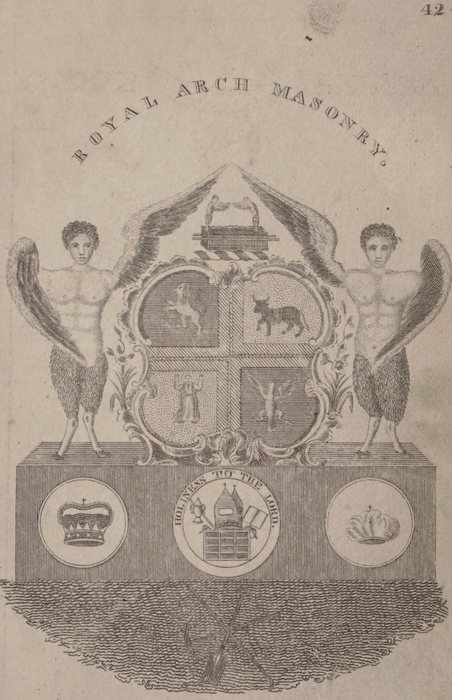
Hall's captions for the throne and the Cherub name neither the tetramorph nor the lion, so the identification of those two comes from counting the four heads on the plates rather than from a source. The lion substitution on the Flamel sheet is unexplained by anything the archive holds. Moreau's sphinx and the lion quartered on the arms of Royal Arch Masonry are tagged by eye and unread. Maier's two lions are read on their records from his epigrams; his discourses are not yet transcribed.
Sources
- Arthur Edward Waite, The Pictorial Key to the Tarot: Waite commissioned the 1909 designs and wrote the key to them, so his account is the closest thing the deck has to an author's statement.
- The Apocalypse of Saint John, Douay Rheims, Challoner revision: Quoted from the Challoner revision, the English text the archive uses for the Apocalypse throughout.
- Manly P. Hall, The Secret Teachings of All Ages: Hall's text and plate captions, 1928. Transcribed here, not yet read against a printed folio.
- Robert Fludd, Utriusque cosmi historia, 1617: The ring of animals on the mirror of nature, Oppenheim 1617, with J. B. Craven's description of the plate from 1902.
- Michael Maier, Atalanta Fugiens, 1618: The mottoes and epigrams of the fifty emblems, Oppenheim 1618, read against the page images of the Getty Research Institute copy; the English is the archive's own and is marked as such on every record. Maier's discourses, in which he explains each emblem at length, are not yet transcribed.
On the same plate
Where it appears · 16
16 works in the archive carry the Lion. First the 11 where it has been read, with the Lion itself picked out.
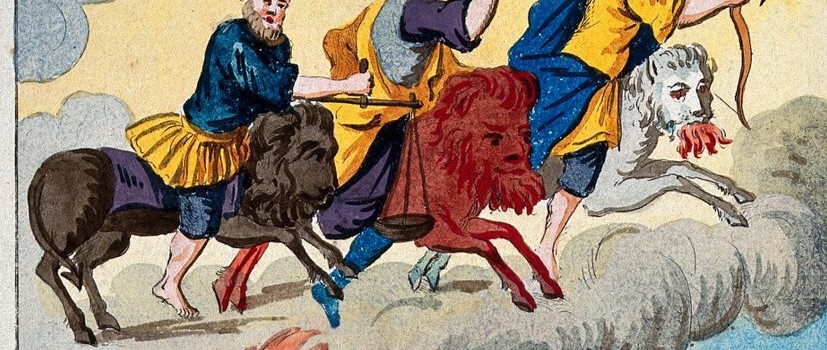
Three Riders on Black, Red and White Lions
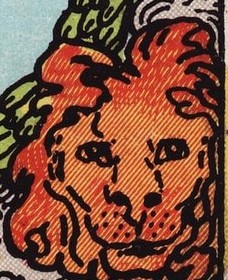
The World (XXI)
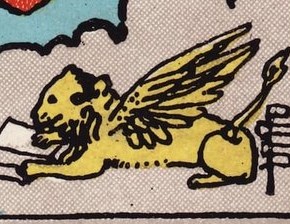
Wheel of Fortune (X)
The Cherub of Ezekiel
The Ancient of the Ancients
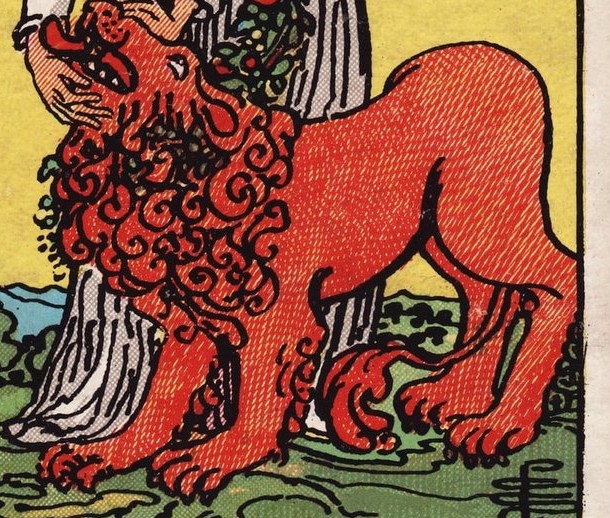
Strength (VIII)

Integrae Naturae Speculum Artisque Imago
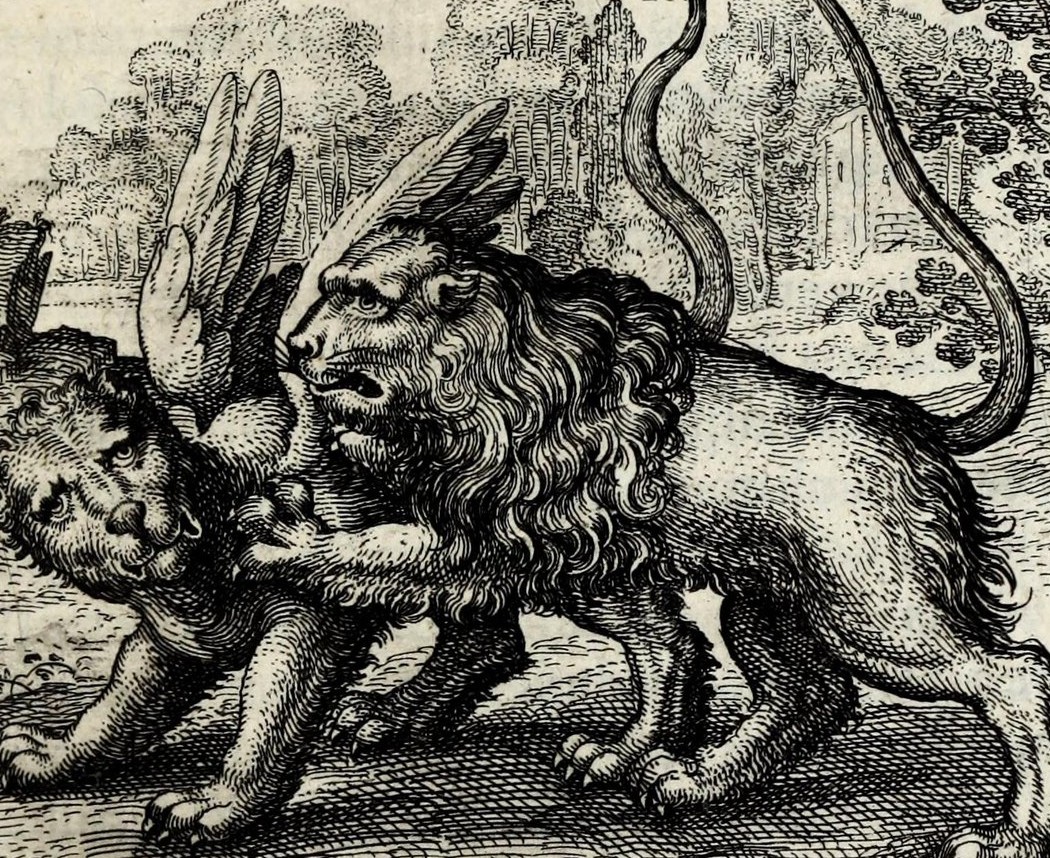
Hic leo, quas plumas non habet, alter habet
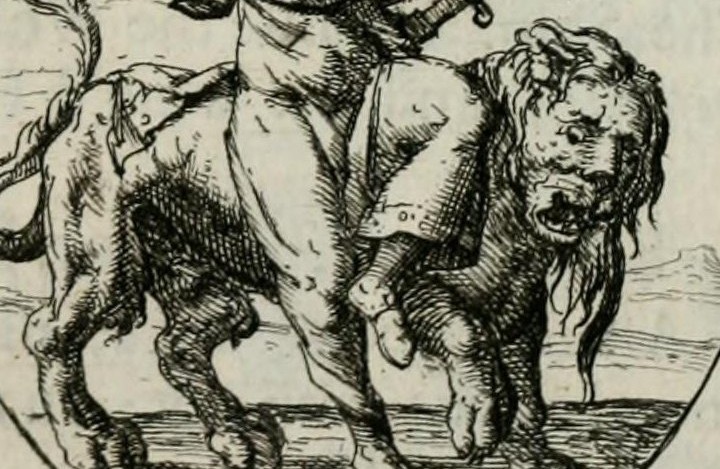
The Force of Justice
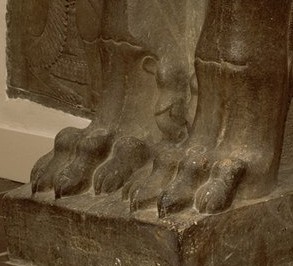
Human-headed winged lion
The Bird of Hermes
As the subject · 3
Works filed under the Lion as their central motif, not yet read symbol by symbol.
 Oedipus and the Sphinx
 Tria sufficiunt ad magisterium, fumus albus, hoc est, aqua, leo viridis, id est, æs Hermetis, & aqua fœtida
 The Arms of Royal Arch Masonry
As a detail in 2 more
In these the Lion is somewhere in the picture, tagged by eye, and nobody has read it yet. When one of them is read, it goes out on a Sunday.