The Bird of Hermes
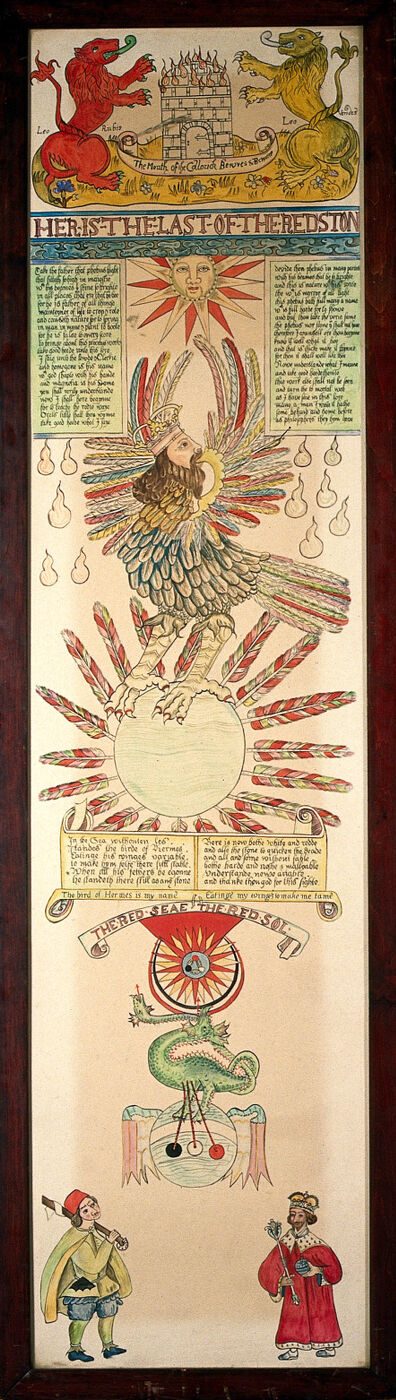
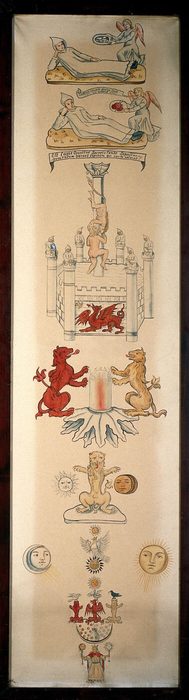
The Bird as the central motif, with the Lion, the Sun and the Moon, the Serpent and the Dragon, and the King and the Queen in a secondary part. From The Ripley Scroll.
Key · 5 motifs
Tap a motif on the picture, or a line below. Its note opens under the line, with the reading its author gave it.
- Primary motif
- Secondary motifs · 4
The picture
Two rearing beasts labelled Leo Rubis and Leo Verides flank a burning tower at the head; below a band of capitals, a rayed face, and a crowned bird with a bearded human face and two ranks of spread feathers standing on a pale sphere; then a lettered banner, a red wheel of rays, a green dragon on a blue sphere with three balls hanging from its feet, black, white and red; a labourer and a crowned king stand at the foot. By eye
The reading
The picture read whole, in the archive's words, from the sources quoted on the marks. Read on, and the picture follows: the motif under discussion keeps its colour.
One line on this sheet is quoted more than everything else in the archive put together, and most people meeting it have no idea it is six hundred years old or that it comes with eleven more lines attached. It is written on a banner about two thirds of the way down: “The bird of Hermes is my name Eatinge my winges to make me tame.”
The bird is above it, crowned, bearded, human-faced, with two ranks of feathers thrown out and its feet on a pale sphere. Directly over the banner is the verse the line comes from, and it is the reason the picture works: “In the Sea withowten les Standes the birde of Hermes Eatinge his winges variable to make hym selfe there full stable When all his fethers be egonne he standeth there still as any stone.” Eating its own wings so that it cannot fly. Stability bought by removing every means of escape.
The other half of the block says what you get for it: “Here is now bothe white and redde and also the stone to quicken the deade and all and some without fable bothe harde and neshe & malleable Understande nowe arighte and thanke thou god for this sighte.” Hard and soft at once, which is the standing description of the stone, and a flat instruction at the end to look properly.
The two beasts at the top are labelled in the same hand, either side of a burning tower: “Leo Rubis” on the left, red, and “Leo Verides” on the right, gold with a green tinge. Those spellings are the scribe's. The green lion has an entry here built out of Maier's emblems of 1618, and this is the same animal earlier, with its name written next to it.
Under the lions a band of capitals runs the width of the sheet: HER IS THE LAST OF THE REDSTON. Everything below that line is the red end of the work, and the sheet says so a second time in the arch over the wheel of rays lower down, “THE RED SEAE THE RED SOL.”
Below the wheel a green dragon stands on a blue sphere with its tail curled back over itself, and from its feet hang three small balls on threads: black, white, red, left to right. Nobody lettered those. Nobody needed to.
And at the foot, on bare ground, two men. A labourer in a red cap with a staff over his shoulder on the left, and a crowned king in red and ermine with a sceptre and an orb on the right. They are drawn the same size and neither is named. After a page of burning towers, self-eating birds and lettered banners, the sheet ends on two people standing still.
Decoded: every motif is marked, and each mark carries the reading its author gave it, quoted from the text, or says that it is observed on the picture and not read. The reading above is the archive's own, made from those sources and no others.
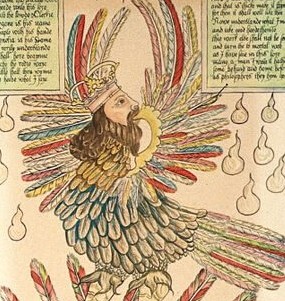
What rises and what comes back down. Note whether the bird is flying, caught, or paired with a second one.
In plain words The bird names itself on the banner under it and says what it is doing, which no other picture in the archive does. It is eating its own wings, and the verse gives the reason: to make itself stable. When the feathers are gone it stops moving and stands there like a stone, and that is the point at which the thing is finished.
The plate “The bird of Hermes is my name Eatinge my winges to make me tame”
The plate “In the Sea withowten les Standes the birde of Hermes Eatinge his winges variable to make hym selfe there full stable When all his fethers be egonne he standeth there still as any stone”
The plate “Here is now bothe white and redde and also the stone to quicken the deade and all and some without fable bothe harde and neshe & malleable Understande nowe arighte and thanke thou god for this sighte”
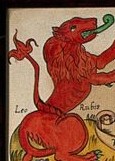
Usually not an animal but one face of a set of four. Count the other three before reading it alone.
In plain words Both are labelled in the hand that wrote everything else here, and the spellings are the scribe's own: Leo Rubis on the left and Leo Verides on the right, the red lion and the green lion, named on the picture and rearing at a burning tower. The archive holds a green lion entry built out of Maier's emblems of 1618, and here is the same animal earlier with its name written beside it.
The plate “Leo Rubis”
The plate “Leo Verides”
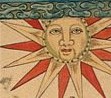
Gold, the perfected metal, and the illuminated intellect. The most overloaded symbol in the tradition.
In plain words Two suns, and the lower one is labelled. The banner arching over the red wheel calls the red sea and the red sun in the same breath, which is the sheet naming its own colour: this is the red end of the work and it says so twice, once here and once in the banner at the top of the sheet.
The plate “THE RED SEAE THE RED SOL”
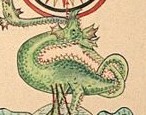
A single creature doing two opposite jobs. Note whether it is bound, killed, or eating itself.
In plain words Under the dragon's feet hang three balls on threads, one black, one white, one red, in that order left to right. The sheet does not letter them. It does not have to: the verse above has already said bothe white and redde, and every other picture in this tradition counts the same three.
The plate “Here is now bothe white and redde and also the stone to quicken the deade”
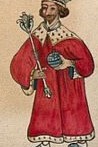
A rank rather than a person. Read the robe, the throne and what comes out of the mouth before you read the face.
In plain words He is the last thing on the sheet and he is not part of the machinery above him. A labourer in a red cap stands opposite him at the same size, carrying a staff over his shoulder. Two men at the bottom of a page whose whole upper half is a bird eating itself, and the sheet puts them at the same height.
Symbolica Neither figure at the foot of the sheet is labelled, and the lettering above them never mentions a king. The archive marks what is drawn and leaves the pairing unread.
Also carrying the Bird
24 works carry it. The 6 where it is the central motif are here. The symbol.
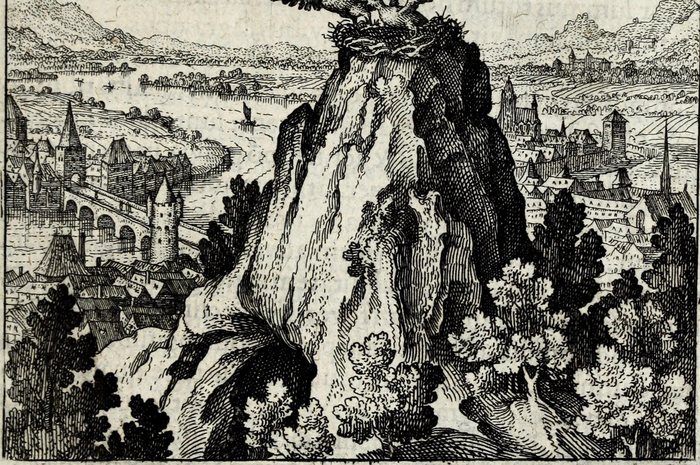 Fit pullus à nido volans, qui iterùm cadit in nidum
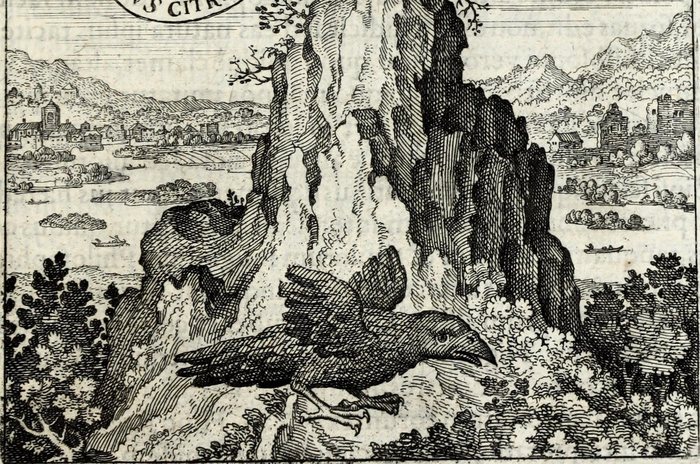 Audi loquacem vulturem, qui neutiquam te decipit
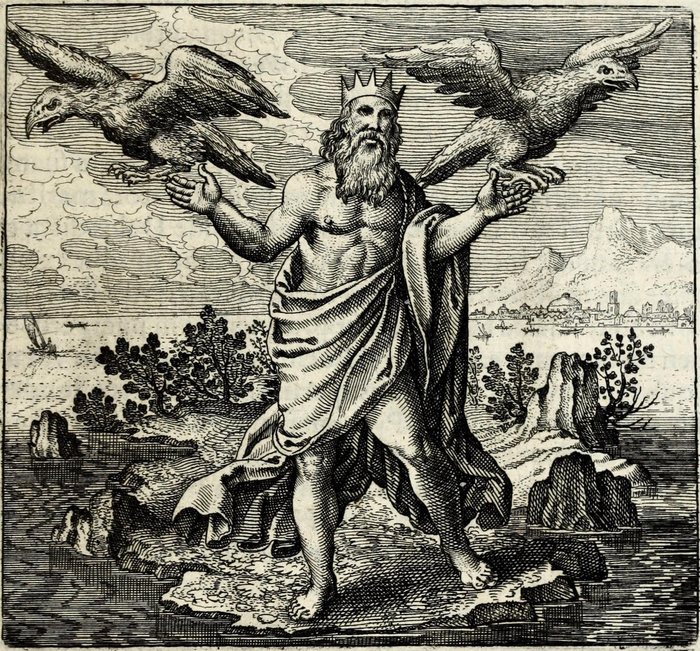 Aquilæ duæ, una ab ortu, altera ab occasu conveniunt
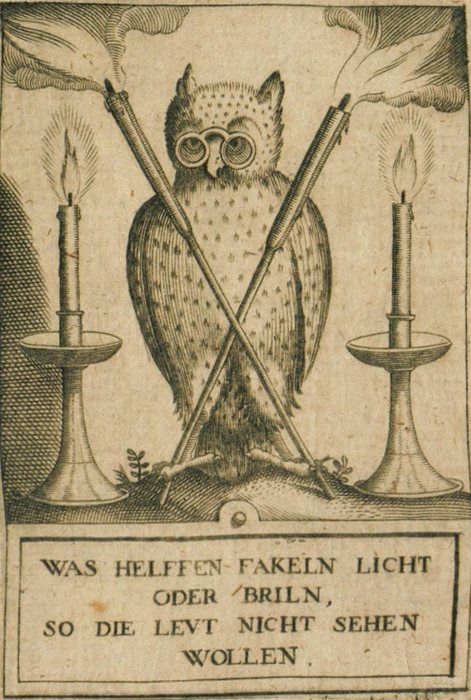 Was helffen Fackeln, Licht oder Brilln, so die Leut nicht sehen wollen
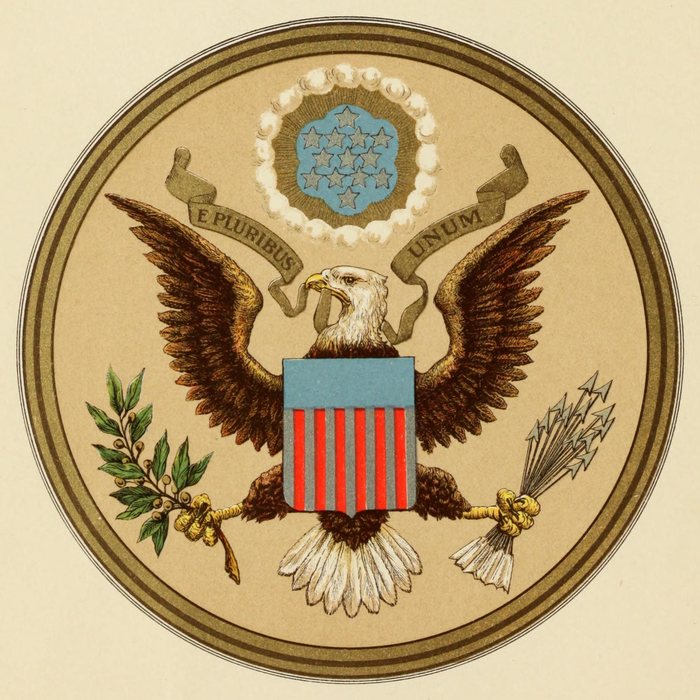 The Great Seal of the United States, the obverse
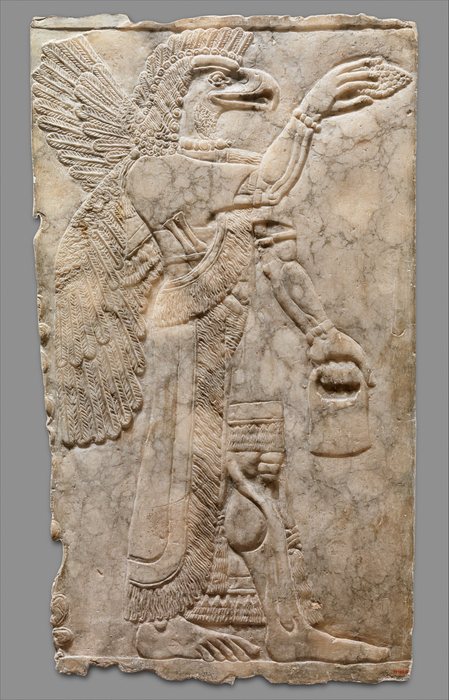 Eagle-headed figure with the bucket and the cone
Where the detail is the subject
the Lion · the Sun and the Moon · the Serpent and the Dragon · the King and the Queen
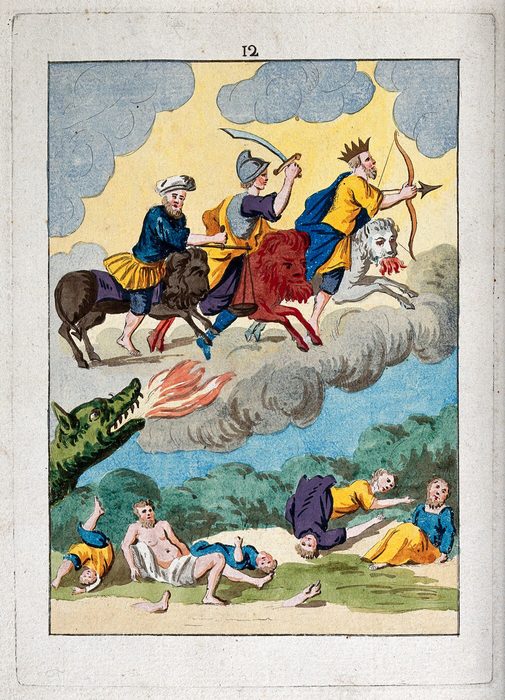
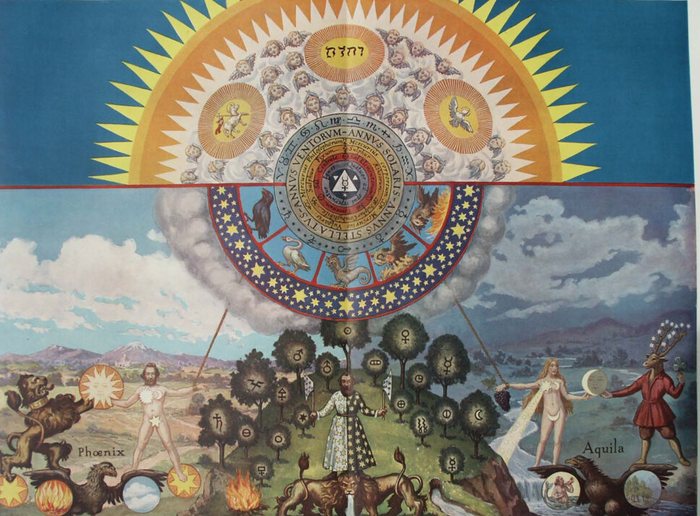
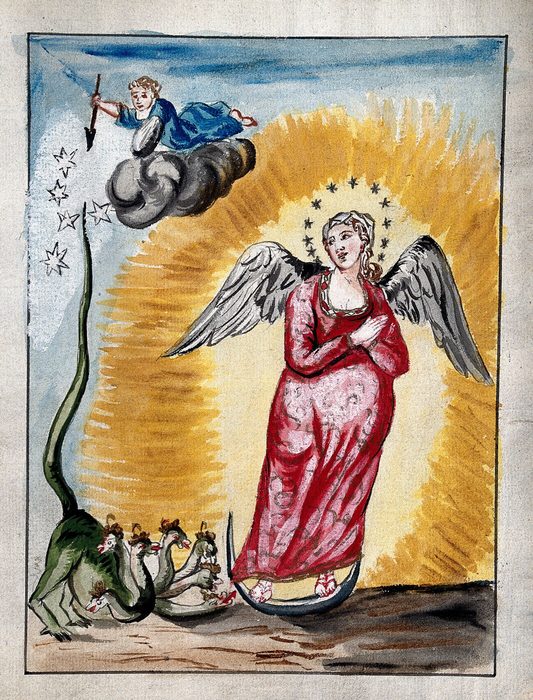
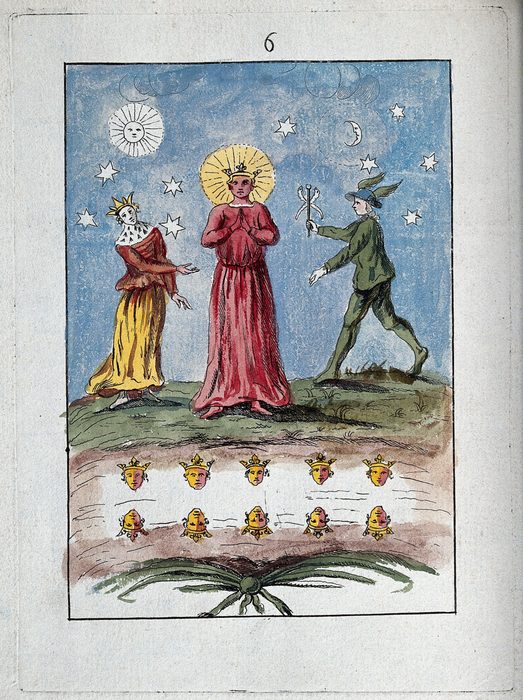
Each of these is in the picture without being what it is about. Below, one work that is about each.
In the same series
Record
One symbol a week, decoded.
This picture is free at full size from its source, linked above. What an address gets is the Sunday letter: one picture, one symbol marked on it, what it meant and who said so, and the master files of the decoded plates as they are verified. Leave any time.
Free, one letter a week, unsubscribe in one click. How the address is used.
Scroll or pinch to zoom · drag to move · double-tap for 1:1 · 396 by 1400 pixel web copy; the source file is linked under Record