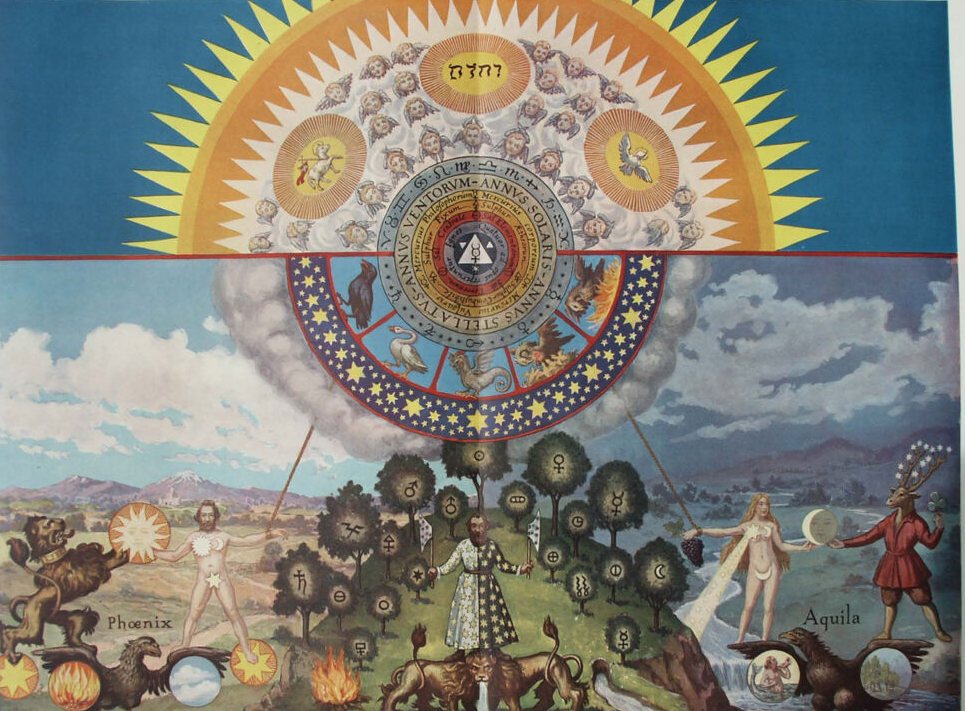
Grand Rosicrucian Alchemical Formula
The Sun and the Moon as the central motif, with the Divine, the Angel and the Wing, the Heavens, the Triangle and the Pyramid, and the Bird in a secondary part. From The Secret Teachings.
What is happening
The plate, 1928 “GRAND ROSICRUCIAN ALCHEMICAL FORMULA.”
The plate, 1928 “Redrawn from Musaeum Hermeticum Reformatum et Amplificatum.”
Symbolica, 2026 Hall set two columns of his own reading under this plate and the archive cannot read them. The only copy it holds is a photograph of the page, and at the largest render served, 9446 pixels across, the caption type will not resolve. It is named here and left unquoted rather than guessed at or run through OCR. What can be read is the picture, and the engraving Knapp copied is in this archive beside it.
Symbolica, 2026 Knapp follows the 1678 plate closely. The Name, the three years, the rings of mercury, sulphur and salt, the triangle at the centre, the trees carrying planetary signs, the collared lion, the stag-headed man, the two named birds and the four globes are all on the engraving. What he adds is colour, a hard red line across the middle where the engraver ruled a plain one, and gold stars on a blue ground where the engraving has white stars on hatching. What he drops is the engraver’s signature and everything printed underneath, which on the 1678 sheet is the Emerald Tablet entire.
Key · 6 motifs
Tap a motif on the picture, or a line below. Its note opens under the line, with the reading its author gave it.
- Primary motif
- Secondary motifs · 5
The picture
A half sun filling the sky with the Name at its top, a lettered disc of three years and three principles hung below it, a triangle of four fires at its centre, winged heads between, and two named birds on the ground. By eye
The reading
The picture read whole, in the archive's words, from the sources quoted on the marks. Read on, and the picture follows: the motif under discussion keeps its colour.
A 1928 colour plate of a 1678 engraving, and the interesting part is what travelled and what did not. Knapp copied the picture almost line for line. He did not copy the page.
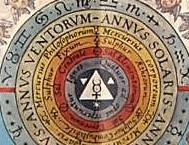
What travelled is all the lettering. Three years round the disc, “ANNVS VENTORVM. ANNVS SOLARIS. ANNVS STELLATVS”, the year of the winds, the solar year and the starry year, with the twelve signs beyond them. Three rings inside, one each for mercury, sulphur and salt, every ring cut into thirds so each substance gets three grades. The four Hebrew letters of the Name at the top of the sun. Phoenix and Aquila written into the ground at either side.
What did not travel is the text. On the 1678 sheet the engraving is only the top half: under it the printer set two Psalms and then the Emerald Tablet entire, ending “Completum est quod dixi de Operatione Solis”, what I have said of the operation of the sun is complete. Knapp’s plate is the picture alone, and the reader of 1928 got Hall’s caption in place of the tablet.
That caption is on the sheet and this archive cannot read it. The only copy held is a photograph of a page, and at the largest render the type will not resolve. So the record names it, quotes its heading and its one legible credit line, “Redrawn from Musaeum Hermeticum Reformatum et Amplificatum”, and leaves the rest blank rather than guessing.
Knapp’s own additions are worth naming because they are the only thing on the sheet that is his. He paints the sun yellow and orange and rules the horizon in hard red, where the engraver drew a plain line. He fills the lower disc with gold stars on deep blue where the engraving has white stars on hatching. He dresses the stag-headed man in red. And he leaves off the engraver’s signature, so the only name on the plate as it reaches a modern reader is his own.
Decoded: every motif is marked, and each mark carries the reading its author gave it, quoted from the text, or says that it is observed on the picture and not read. The reading above is the archive's own, made from those sources and no others.
Gold, the perfected metal, and the illuminated intellect. The most overloaded symbol in the tradition.
In plain words Knapp paints the sun yellow at the spikes and orange at the body and cuts it off square on a red line across the middle of the sheet. Below, on the ground, a sun-face is held between a naked man and a collared lion at the left, and a moon-face between a woman in a starry cloak and a stag-headed man at the right.
Symbolica, 2026 Observed. The engraving rules the same line across the middle and Knapp draws it in red, so the sun above and the starry disc below are each half a circle, cut on one horizon.
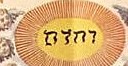
God shown, or pointed at. Look for what stands where a face would be: a name in a cloud, a circle above the top of a diagram, a ring of verses, a sign over a head.
In plain words The four Hebrew letters of the Name sit at the top of the sun in a small burst of their own, which Knapp paints orange against the white cloud of heads.
Symbolica, 2026 The same four letters stand in the same place on the 1678 engraving, and at the centre of the Trinity on FIGURA I of that set. The archive prints them as cut and does not vocalise them.
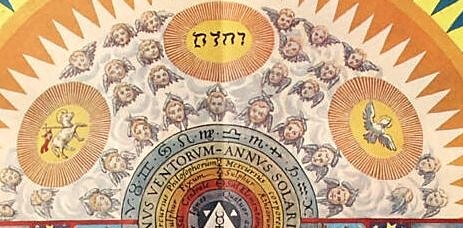
The mark of an errand rather than a nature. Note whether the wings are open, folded, or given to the figure by someone else.
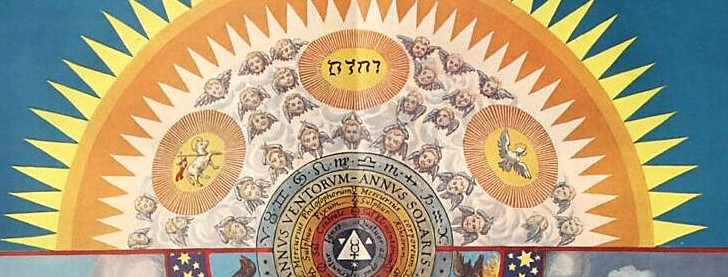
In plain words Winged heads fill the white cloud between the Name and the disc, with two small figures in gold roundels either side. Nothing on the plate names them or ranks them.
Symbolica, 2026 Observed and left unread. Neither Knapp nor the engraving he copied names these heads. FIGURA I of the same 1678 set does name and rank nine orders of angels, and the archive does not carry those names across to this picture.
A diagram of everything, drawn so that a person can be found inside it. Note where the human figure stands in the scheme.
In plain words The disc is written in rings. Three years are named round the outside, the year of the winds, the solar year and the starry year, with the twelve signs beyond. Inside them, three more rings carry mercury, sulphur and salt, each ring cut into thirds with a different grade in each third.
The plate, 1928 “ANNVS VENTORVM. ANNVS SOLARIS. ANNVS STELLATVS.”
Symbolica, 2026 The plate's Latin, put into English here: the year of the winds, the solar year, the starry year.
The engraving it copies, 1678 “Mercurius Philosophorum. Mercurius corporeum. Mercurius Vulgaris. Sulphur Fixum. Sulphur Aethereum. Sulphur Combustibile. Sal Centrale. Sal Elementorum. Sal Terrenum.”
Symbolica, 2026 The engraving's Latin, put into English here: the mercury of the philosophers, bodily mercury, common mercury; fixed sulphur, aethereal sulphur, combustible sulphur; central salt, the salt of the elements, earthly salt. Three substances, three grades apiece.

A number made visible. Count the points and then find what else in the picture comes in threes.
In plain words A triangle sits at the centre of all the rings with alchemical signs inside it, and a line of writing runs round it naming four fires for the work.
The engraving it copies, 1678 “Quatuor Ignes ad opus reperuntur.”
Symbolica, 2026 The engraving's Latin, put into English here: four fires are found for the work. On the 1678 sheet the text printed under this triangle is the Emerald Tablet entire, and its last sentence reads that what has been said of the operation of the sun is complete. Knapp’s plate carries the picture and not that text.
What rises and what comes back down. Note whether the bird is flying, caught, or paired with a second one.
In plain words Two names are painted into the ground, one at each side, each over a bird lying with its wings spread under the globes the figures stand on: Phoenix at the left, Aquila at the right.
The plate, 1928 “Phoenix. Aquila.”
Symbolica, 2026 Both names are cut into the 1678 engraving in the same two places. Neither sheet says which bird stands for what, and the archive leaves it unread.
Also carrying the Sun and the Moon
59 works carry it. The 6 where it is the central motif are here. The symbol.
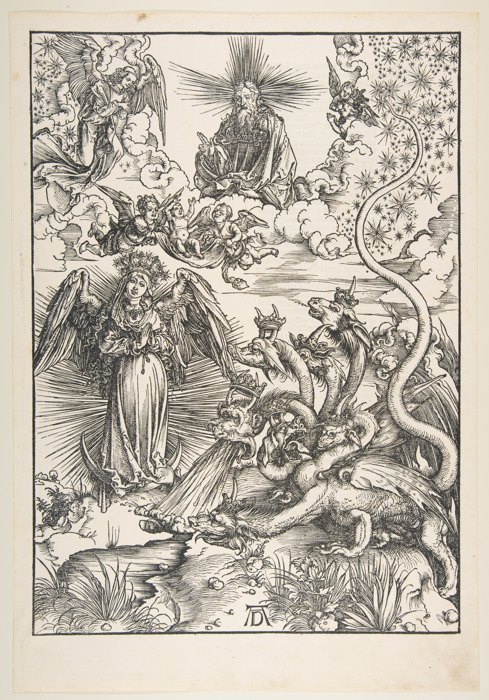
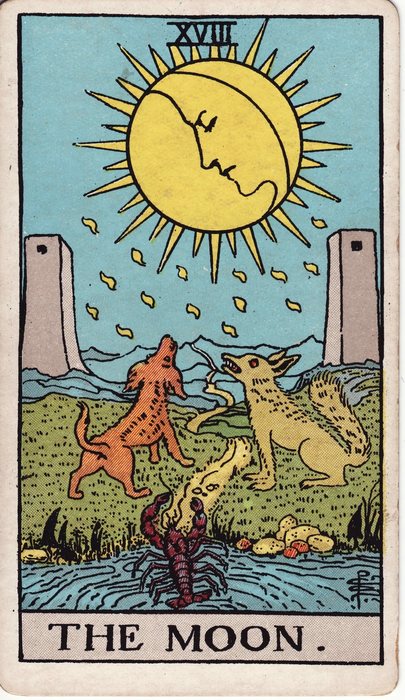
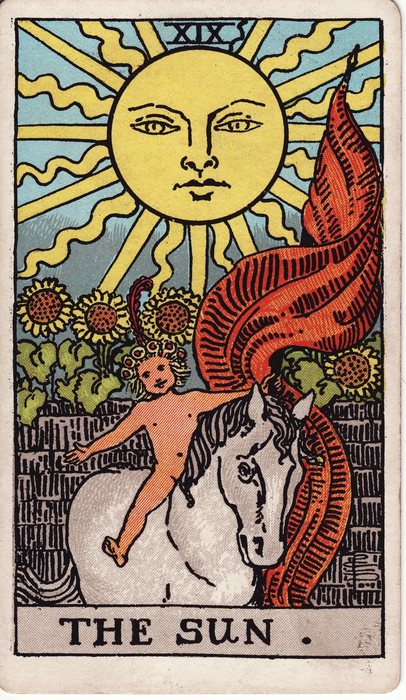
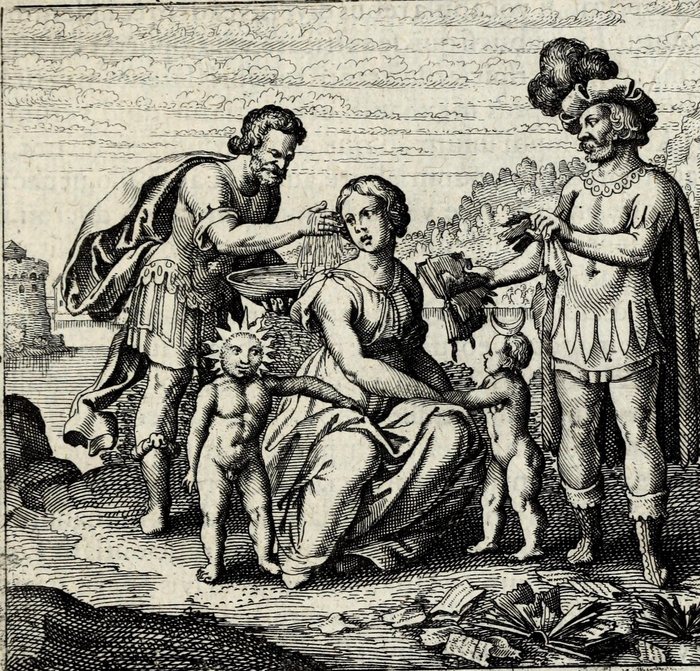
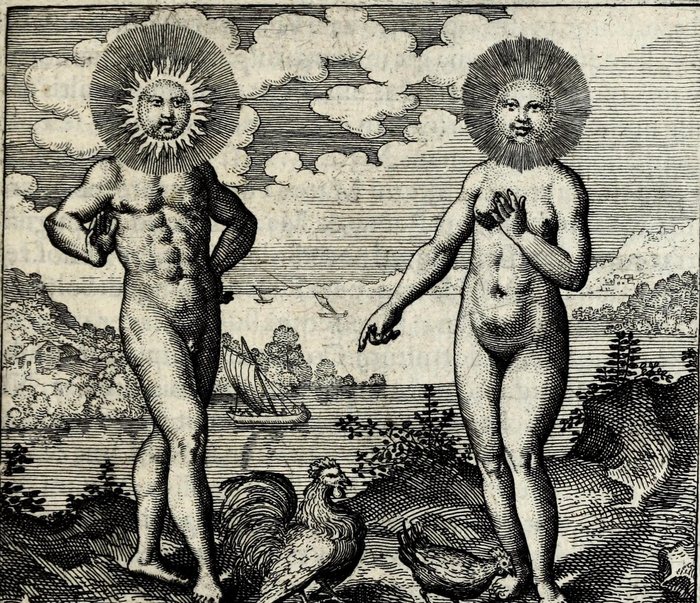
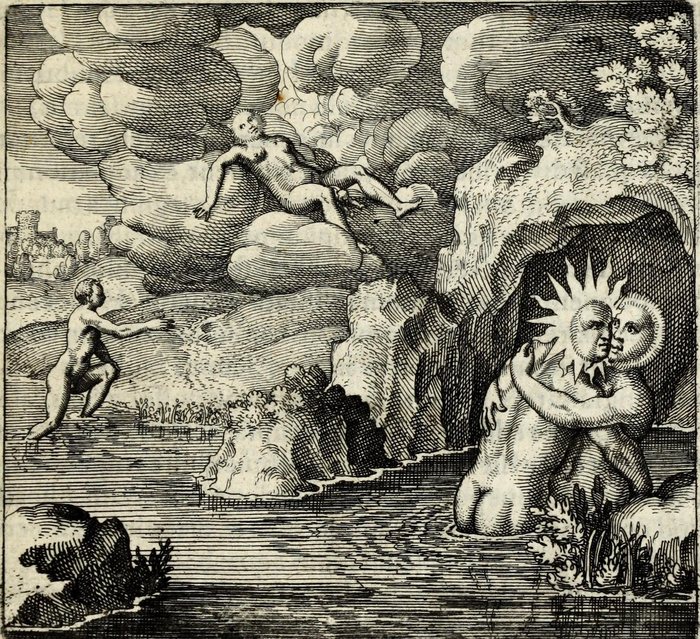
Where the detail is the subject
the Divine · the Angel and the Wing · the Heavens · the Triangle and the Pyramid · the Bird
Each of these is in the picture without being what it is about. Below, one work that is about each.
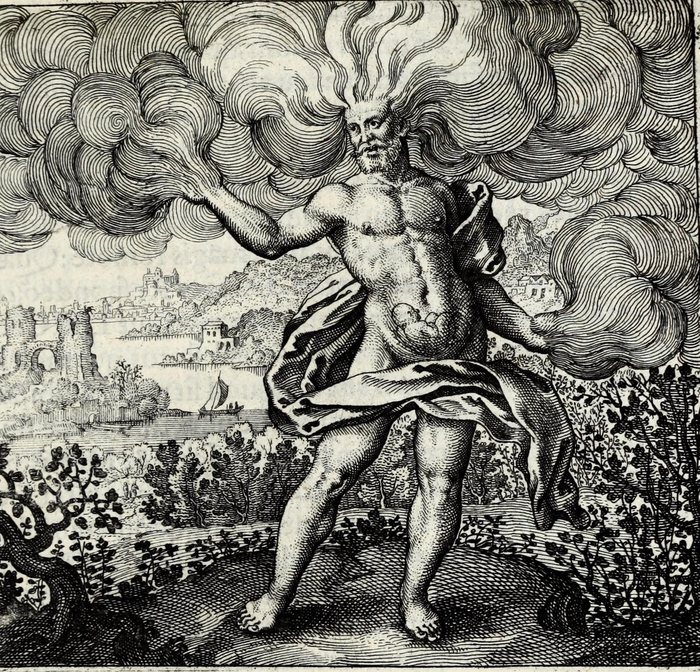 the DivinePortavit eum ventus in ventre suo
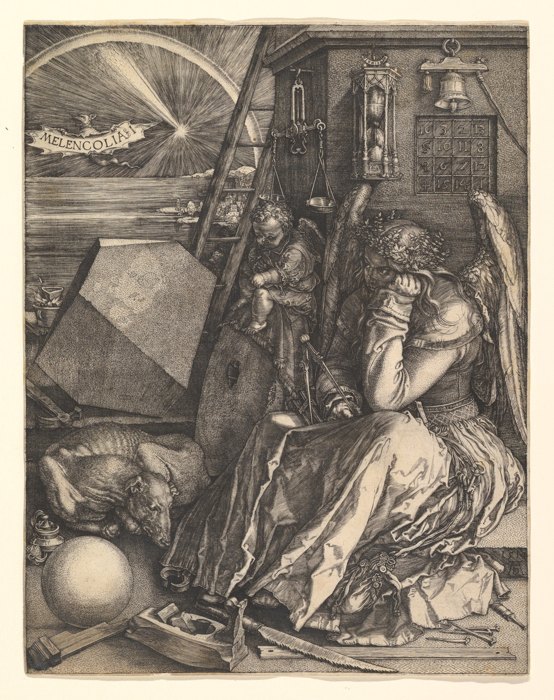 the Angel and the WingMelencolia I
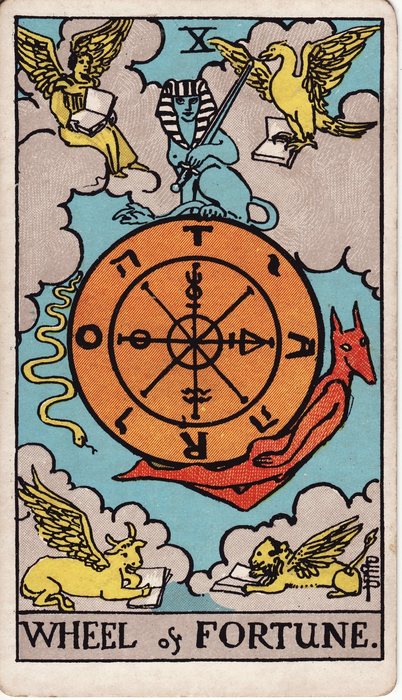 the HeavensWheel of Fortune (X)
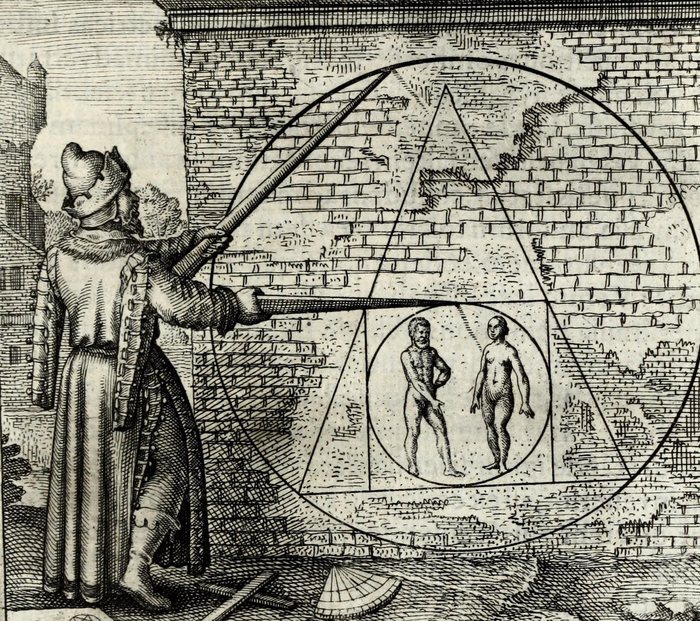 the Triangle and the PyramidFac ex mare & fœmina circulum, inde quadrangulum, hinc triangulum, fac circulum & habebis lap. Philosophorum
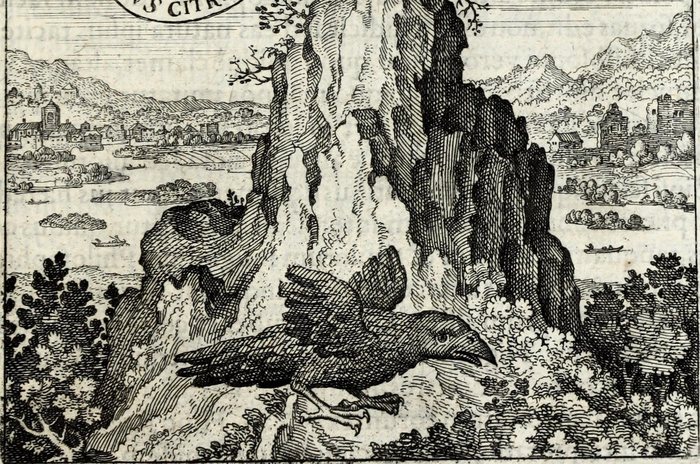 the BirdAudi loquacem vulturem, qui neutiquam te decipit
In the same series
Record
One symbol a week, decoded.
This picture is free at full size from its source, linked above. What an address gets is the Sunday letter: one picture, one symbol marked on it, what it meant and who said so, and the master files of the decoded plates as they are verified. Leave any time.
Free, one letter a week, unsubscribe in one click. How the address is used.
Scroll or pinch to zoom · drag to move · double-tap for 1:1 · 965 by 711 pixel web copy; the source file is linked under Record