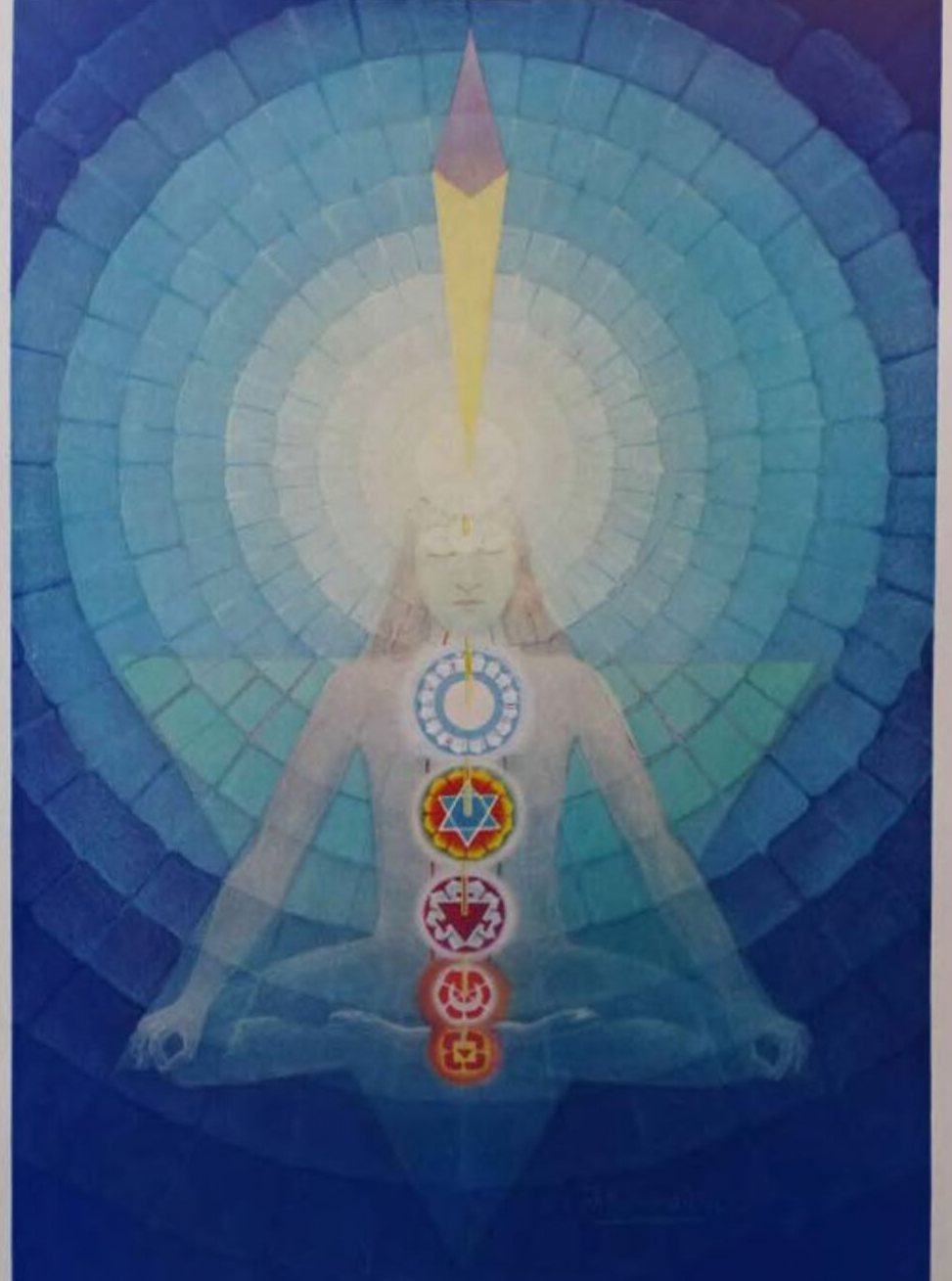
The Seven Spinal Chakras
The Heavens as the central motif. From The Secret Teachings.
What is happening
Hall, 1928 “This painting of the CHAKRAS is based upon a number of native drawings brought from India by Mr. Hall in 1924.”
Key · 1 motif
Tap a motif on the picture, or a line below. Its note opens under the line, with the reading its author gave it.
- Primary motif
The picture
A seated figure in meditation, drawn in outline against concentric rings of blue, the seven chakras marked as coloured wheels up the spine, a point of light like a flame rising from the crown of the head; the Heavens as the central motif, by eye. By eye
The reading
The picture read whole, in the archive's words, from the sources quoted on the marks. Read on, and the picture follows: the motif under discussion keeps its colour.
This is the one plate in the book that Hall says came from living informants rather than from old books: the caption records that the painting of the chakras is based upon a number of native drawings brought from India by Mr. Hall in 1924. Serailian painted a figure in meditation, drawn almost transparently against rings of deepening blue, with seven wheels of colour up the spine and a flame of light standing on the crown of the head.
The wheels are the chakras, and Hall's chapter on plants gives his understanding of them. The Brahmin and Egyptian initiates, he writes, used the lotus blossom to represent the spinning vortices of spiritual energy located at various points along the spinal column and called chakras, or whirling wheels, by the Hindus; seven of these are of first importance and correspond to the nerve ganglia and plexuses. On the plate the lower wheels are painted in reds and orange, the one at the chest carries a six-pointed star, the one at the throat is white and blue, and the last two are not wheels but light: a white glow at the brow and a flame of yellow rising from the crown of the head into a crystal point that leaves the picture.
The rings behind the figure are the reason the archive files the plate under the Heavens rather than under the body. Serailian has set the meditator inside a diagram of concentric spheres, deep blue at the edge and pale at the centre, exactly the scheme the older plates in this archive use for the cosmos, and the body's axis runs up the middle of it like the axis of the world. The claim is the one Hall's whole book makes, that the human being is the universe in small, and here it is made without a word: sit a person in the middle of the spheres and the seven wheels line up with the seven heavens.
That correspondence is the archive's reading, not Hall's sentence, and it is marked as such. What Hall gives is the count, seven, the location, the spine, and the source, drawings carried back from India in 1924. Everything else on the plate, the colours, the star, the flame, is Serailian's, and it has become the standard picture of the chakras in the West largely because this book put it there.
Decoded: every motif is marked, and each mark carries the reading its author gave it, quoted from the text, or says that it is observed on the picture and not read. The reading above is the archive's own, made from those sources and no others.
Seven wheels up the spine, and one painting of 1928 is why a reader can picture them.
In plain words The seven coloured wheels up the spine are the chakras, the Sanskrit word for wheels, which Hall describes as spinning centres of energy at points along the spinal column, seven of them of first importance. The rings of blue light behind the figure are the archive's reason for filing the plate under the Heavens: the body is drawn inside a diagram of concentric spheres, like the old pictures of the cosmos.
Hall, 1928 “The Brahmin and Egyptian initiates, who undoubtedly understood the secret systems of spiritual culture whereby the latent centers of cosmic energy in man may be stimulated, employed the lotus blossoms to represent the spinning vortices of spiritual energy located at various points along the spinal column and called chakras, or whirling wheels, by the Hindus.”
Hall, 1928 “Seven of these chakras are of prime importance and have their individual correspondences in the nerve ganglia and plexuses.”
Also carrying the Heavens
61 works carry it. The 6 where it is the central motif are here. The symbol.
By the same hand
In the same series
Record
One symbol a week, decoded.
This picture is free at full size from its source, linked above. What an address gets is the Sunday letter: one picture, one symbol marked on it, what it meant and who said so, and the master files of the decoded plates as they are verified. Leave any time.
Free, one letter a week, unsubscribe in one click. How the address is used.
Scroll or pinch to zoom · drag to move · double-tap for 1:1 · 973 by 1309 pixel web copy; the source file is linked under Record