The Contents of the Zodiacal Egg
The Zodiacal Egg as the central motif, filed under the Heavens, with the Triangle and the Pyramid, Fire, and the Divine in a secondary part. From The Secret Teachings.
Key · 4 motifs
Tap a motif on the picture, or a line below. Its note opens under the line, with the reading its author gave it.
- Primary motif
- Secondary motifs · 3
The picture
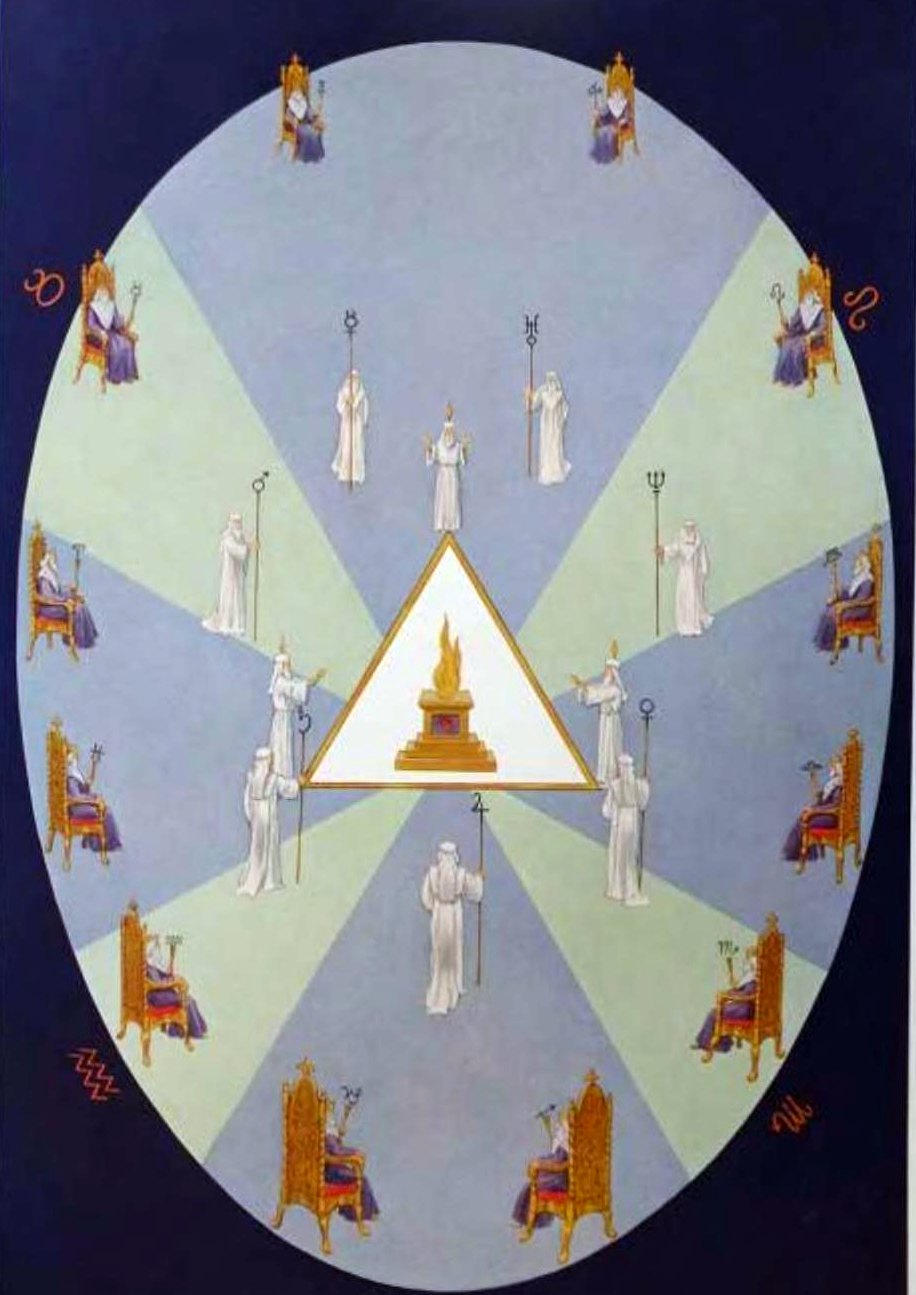
An oval of pale blue rays on dark blue, twelve figures enthroned round its rim with the signs of the zodiac beside them, seven figures in white standing with the signs of the planets on their staffs, a white triangle at the centre holding a stepped altar with a flame, and three white-robed elders with flames on their heads at the triangle's points; the zodiacal egg as the central motif. By eye
The reading
The picture read whole, in the archive's words, from the sources quoted on the marks. Read on, and the picture follows: the motif under discussion keeps its colour.
This is a diagram wearing robes. Hall's caption, printed under the plate, gives the key in its first sentence: ‘In the midst of Cosmos stands the fiery altar of Divinity, its most familiar analogue being the life germ in an egg.’ The oval is the egg, the dark blue round it the shell, the pale rays inside it the white and the yolk, and the flame at the centre the point from which everything else will grow.
Round the rim sit twelve figures on thrones, the signs of the zodiac drawn in red beside them, and nearer the centre stand seven in white with staffs marked with the planets. Hall's chapters give the arrangement its sense: ‘the pagans believed that the zodiac formed the body of the Grand Man of the Universe’, a body ‘divided into twelve major parts, one of which was under the control of the celestial powers reposing in each of the zodiacal constellations’. The twelve are those powers, enthroned; the seven are the planets that move among them.
At the middle, a small flame on a stepped altar inside a white triangle. Hall's account of creation in the Qabbalah starts from this point: ‘the central point - the primitive objectified radiance of the eternal, subjectified life’, about which is ‘darkness caused by the deprivation of the life which is drawn to the center to create the first point, or universal germ’. Knapp paints the darkness as the deep blue outside the egg and the germ as the fire.
The three elders at the triangle's corners, ‘aged men with flames on their heads’, are in Hall's caption ‘the triune aspect of the central One’, who ‘continually adore their own Source’. It is a trinity that worships itself, drawn without irony: the three faces of the fire turned back toward the fire. The caption runs on for several more lines that the archive's copy of the plate is too small to read; what is quoted here is what can be.
Readings quoted
Hall, 1928 “In the secret teachings of the Qabbalah it is taught that man's body is enveloped in an ovoid of bubble-like iridescence, which is called the Auric Egg. This is the causal sphere of man. It bears the same relationship to man's physical body that the globe of AIN SOPH bears to Its created universes.”
Decoded: every motif is marked, and each mark carries the reading its author gave it, quoted from the text, or says that it is observed on the picture and not read. The reading above is the archive's own, made from those sources and no others.
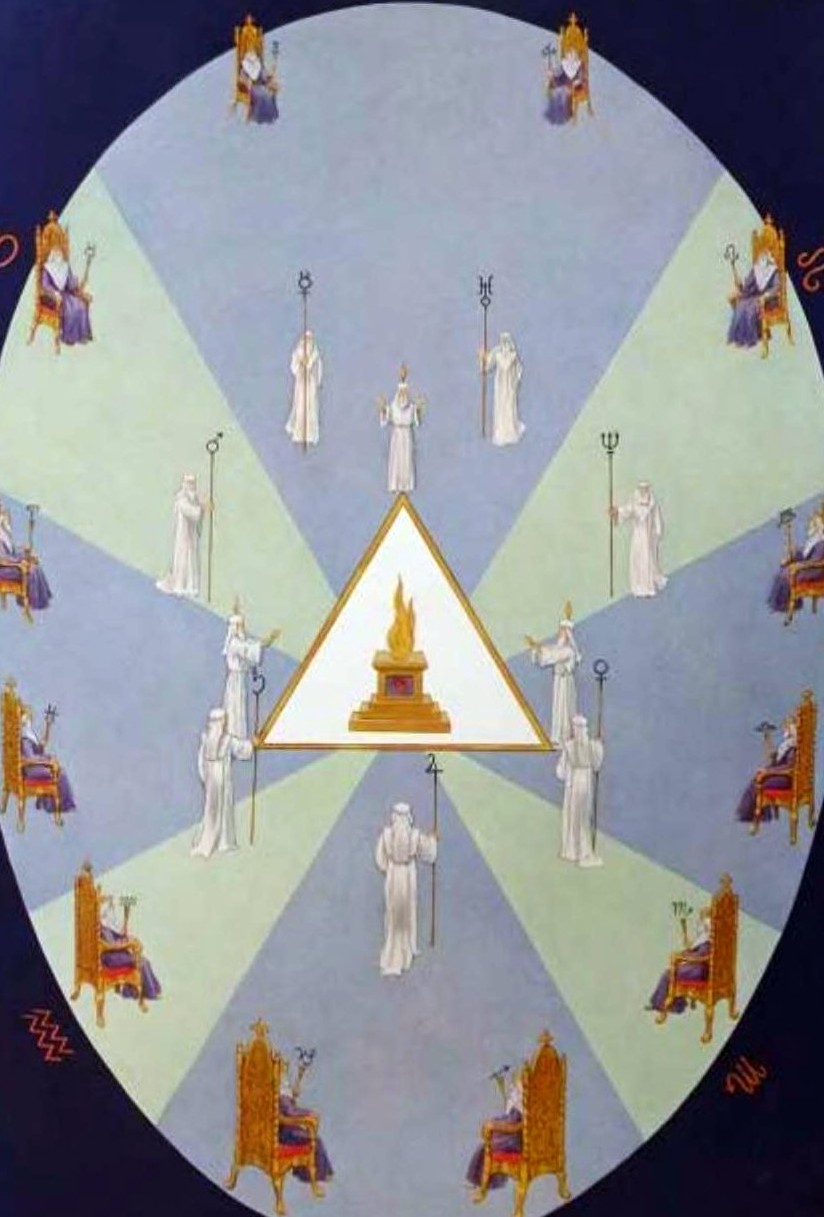
A diagram of everything, drawn so that a person can be found inside it. Note where the human figure stands in the scheme.
In plain words The whole picture is an egg, and its shell is the sky. Twelve crowned figures sit on thrones round the rim, one for each sign of the zodiac, whose symbols are drawn in red beside them; seven figures in white stand nearer the middle, one for each planet the old astronomy knew, each with its planet's sign on the staff. Hall's caption says the egg is the cosmos and the flame at its centre the life germ, the spot in a yolk from which the chick grows.
Hall, 1928 “In the midst of Cosmos stands the fiery altar of Divinity, its most familiar analogue being the life germ in an egg.”
Hall, 1928 “The pagans believed that the zodiac formed the body of the Grand Man of the Universe. This body, which they called the Macrocosm (the Great World), was divided into twelve major parts, one of which was under the control of the celestial powers reposing in each of the zodiacal constellations.”
Hall, 1928 “In the Mysteries, the universe was likened to an egg which the Cosmic Goose had laid in space.”
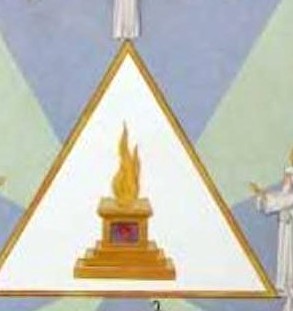
A number made visible. Count the points and then find what else in the picture comes in threes.
In plain words A triangle with an altar inside it, the oldest shape for a threefold god. The three elders at its corners are, in Hall's caption, the three holy powers, the triune aspect of the central one, each with a flame on his head, turned toward the fire they came from.
Hall, 1928 “Three Holy Powers--the triune aspect of the central One--represented as aged men with flames on their heads, continually adore their own Source.”
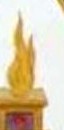
A count, a catastrophe, or the visible part of something that has no body. Note whether the flames are arranged in a number, breaking something, or standing where a figure would be.
In plain words One small flame on a stepped altar, and everything else in the picture is arranged around it. Hall's account of creation in the Qabbalah begins with exactly this: a single point of light in the middle of a dark space, which he calls the universal germ, from which the worlds are laid out in rings.
Hall, 1928 “In the midst of Cosmos stands the fiery altar of Divinity, its most familiar analogue being the life germ in an egg.”
Hall, 1928 “The first condition is the central point - the primitive objectified radiance of the eternal, subjectified life. About this radiance is darkness caused by the deprivation of the life which is drawn to the center to create the first point, or universal germ.”
God shown, or pointed at. Look for what stands where a face would be: a name in a cloud, a circle above the top of a diagram, a ring of verses, a sign over a head.
In plain words Three old men in white, each with a small flame standing on his head, facing inward. Hall's caption makes them the three aspects of the one power at the centre, adoring their own source: a trinity drawn as three worshippers of the fire they are.
Hall, 1928 “Three Holy Powers--the triune aspect of the central One--represented as aged men with flames on their heads, continually adore their own Source.”
Also carrying the Heavens
61 works carry it. The 6 where it is the central motif are here. The symbol.
Where the detail is the subject
the Triangle and the Pyramid · Fire · the Divine
Each of these is in the picture without being what it is about. Below, one work that is about each.
By the same hand
In the same series
Record
One symbol a week, decoded.
This picture is free at full size from its source, linked above. What an address gets is the Sunday letter: one picture, one symbol marked on it, what it meant and who said so, and the master files of the decoded plates as they are verified. Leave any time.
Free, one letter a week, unsubscribe in one click. How the address is used.
Scroll or pinch to zoom · drag to move · double-tap for 1:1 · 916 by 1295 pixel web copy; the source file is linked under Record