The Key to Dante's Divine Comedy
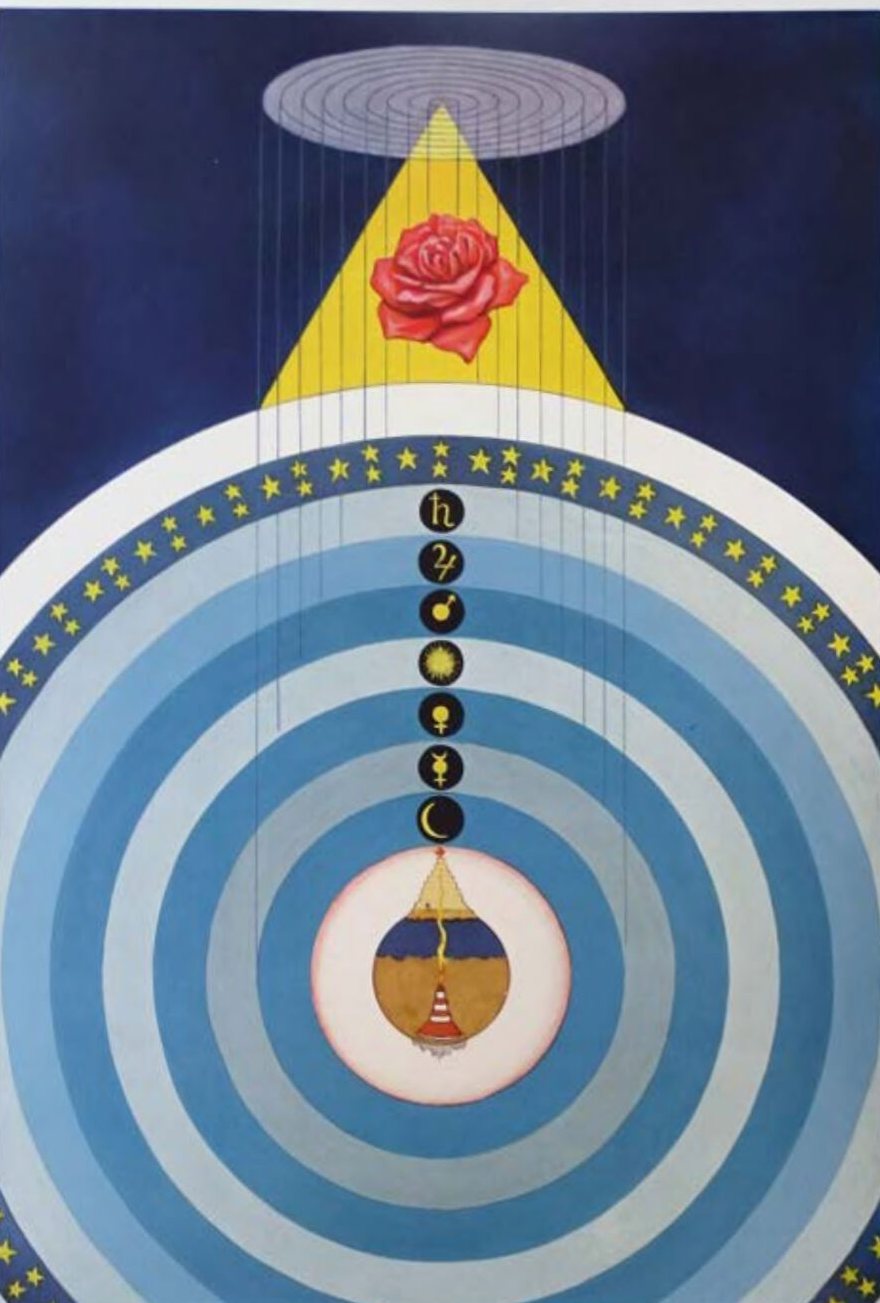
The Heavens as the central motif, with the Triangle and the Pyramid in a secondary part. From The Secret Teachings.
Key · 2 motifs
Tap a motif on the picture, or a line below. Its note opens under the line, with the reading its author gave it.
- Primary motif
- Secondary motifs · 1
The picture
The whole scheme of the poem in one diagram: the earth at the centre with the funnel of Hell bored into it and the terraced mountain of Purgatory rising from it, then the seven planetary spheres up the axis, the ring of fixed stars, and the rose in a golden triangle above them. By eye
The reading
The picture read whole, in the archive's words, from the sources quoted on the marks. Read on, and the picture follows: the motif under discussion keeps its colour.
Dante's Divine Comedy is a journey, and Knapp has drawn the map. The earth is a small globe at the bottom of the plate with the funnel of Hell bored down into it and the mountain of Purgatory rising from its far side; up the axis above it climb the spheres of the seven planets, each marked with its sign; then a band of stars, the eighth heaven; and above that a golden triangle with a red rose in it, and over everything a disc of light spinning like a galaxy. Hall's caption gives the route in one sentence: as the soul climbs the seven steps of Purgatory it is cleansed of the seven mortal sins, and it then ascends through the seven spheres of the Ptolemaic universe.
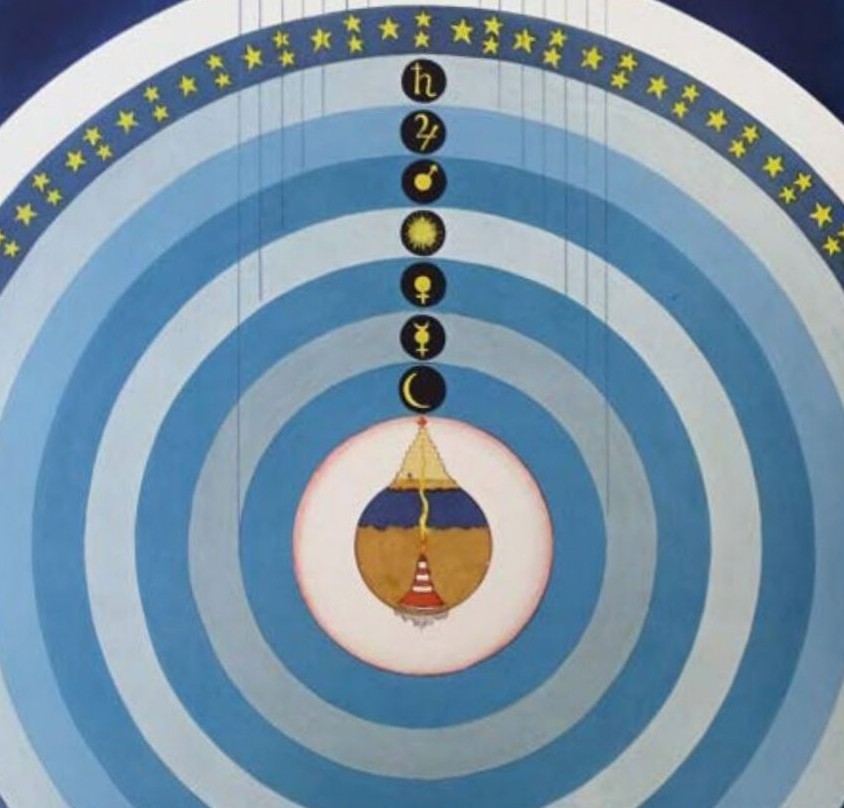
The spheres are the point of calling the plate a key. Dante's universe is Ptolemy's: the earth at the centre, the moon, Mercury, Venus, the sun, Mars, Jupiter and Saturn in their rings around it, the fixed stars beyond them, and beyond them the Primum Mobile that turns the whole machine. In the Paradiso the poet rises through each in turn and meets the blessed sorted by sphere. Knapp paints them as a ladder of coloured rings with the planetary signs on a cord up the middle, and the reader who has the plate can place any canto on it.
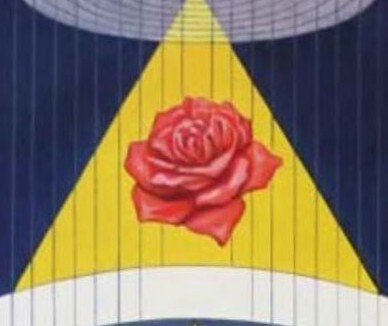
Above the stars the picture stops being astronomy. A golden triangle holds a red rose, and over it turns a disc of light with a vortex at its centre. Hall's caption does not reach this far, so the archive records the two forms as seen. Any reader of the poem knows the rose: the white rose of the blessed in the last cantos, whose petals are the saints, with Mary at its heart. Any reader of Hall's book knows the triangle. Whether Knapp meant the Trinity, or simply the Empyrean, the heaven of pure light that has no place and no motion, the plate does not say, and the archive does not say for it. Hall elsewhere quotes Albert Pike's claim that Dante's heaven is a series of cabalistic circles divided by a cross with a rose blooming at the centre, and a reader may weigh that.
The plate is unusual in this archive because its subject is a book rather than a doctrine, and the book is one everyone has heard of. That is its use. Hall put it in to say that the poem is built on the same scheme of spheres as the rest of the pictures in this collection, and that a reader who learns the ladder here can climb it in Fludd, in Kircher, in the tarot's Wheel and Star, and find the same rungs.
Decoded: every motif is marked, and each mark carries the reading its author gave it, quoted from the text, or says that it is observed on the picture and not read. The reading above is the archive's own, made from those sources and no others.
A diagram of everything, drawn so that a person can be found inside it. Note where the human figure stands in the scheme.
In plain words The whole poem in one picture. The earth is the ball at the bottom, Hell is the funnel bored into it and Purgatory the mountain rising out of it; above them the seven rings are the seven planets of the old astronomy, which the soul climbs one by one; then the band of fixed stars, and above that the heaven that has no place. Hall's caption gives the count: seven steps of Purgatory for seven sins, then seven spheres.
Hall, 1928 “As the soul climbs the seven steps of Purgatory it is cleansed of the seven mortal sins, and it then ascends through the seven spheres of the Ptolemaic universe.”
A number made visible. Count the points and then find what else in the picture comes in threes.
In plain words The golden triangle above the spheres holds a red rose, and over it hangs a whirling disc of light. Hall's caption stops at the spheres and names neither. They are recorded as seen; the rose at the top of Dante's heaven, and the triangle that any reader of this book will take for the Trinity, are the obvious readings, and they are left to the reader.
Symbolica The triangle and the rose above the spheres are on the plate; Hall's caption follows the soul through Purgatory and the spheres and names neither. Observed on the plate, and left unread rather than guessed.
Also carrying the Heavens
61 works carry it. The 6 where it is the central motif are here. The symbol.
Where the detail is the subject
This is in the picture without being what it is about. Below, one work that is about it.
By the same hand
In the same series
Record
One symbol a week, decoded.
This picture is free at full size from its source, linked above. What an address gets is the Sunday letter: one picture, one symbol marked on it, what it meant and who said so, and the master files of the decoded plates as they are verified. Leave any time.
Free, one letter a week, unsubscribe in one click. How the address is used.
Scroll or pinch to zoom · drag to move · double-tap for 1:1 · 880 by 1303 pixel web copy; the source file is linked under Record