The black cube of Saturn: every piece of it is old, and no book here joins them
Saturn is lead in the Encyclopedie, blackness in Maier, the outermost sphere in Fludd and Dee, and Fear on Kircher's tree. Plato hands the cube to earth because earth is the most immoveable thing there is. The hexagon is a storm that Voyager photographed. Every part of the claim turns out to be real and datable, and across five centuries of plates not one of them draws Saturn as a cube.
The claim goes like this. Saturn is the black cube. The cube is matter, and matter is a prison. The hexagon photographed at Saturn's north pole proves the planet is a cube seen from above. The Kaaba is a cube and so are the boxes a Jew straps to his head to pray, and there you have it, one cult running under every religion since the beginning.
Take that apart and something unexpected happens. Almost every piece of it is a real thing with a date and a named author, sitting in books this collection holds. What has no date and no author is the joining.
Saturn is lead, and lead is black
Michael Maier printed the working instruction in 1618, and he leads with colour. His twenty second emblem tells a man what to do with Saturn.
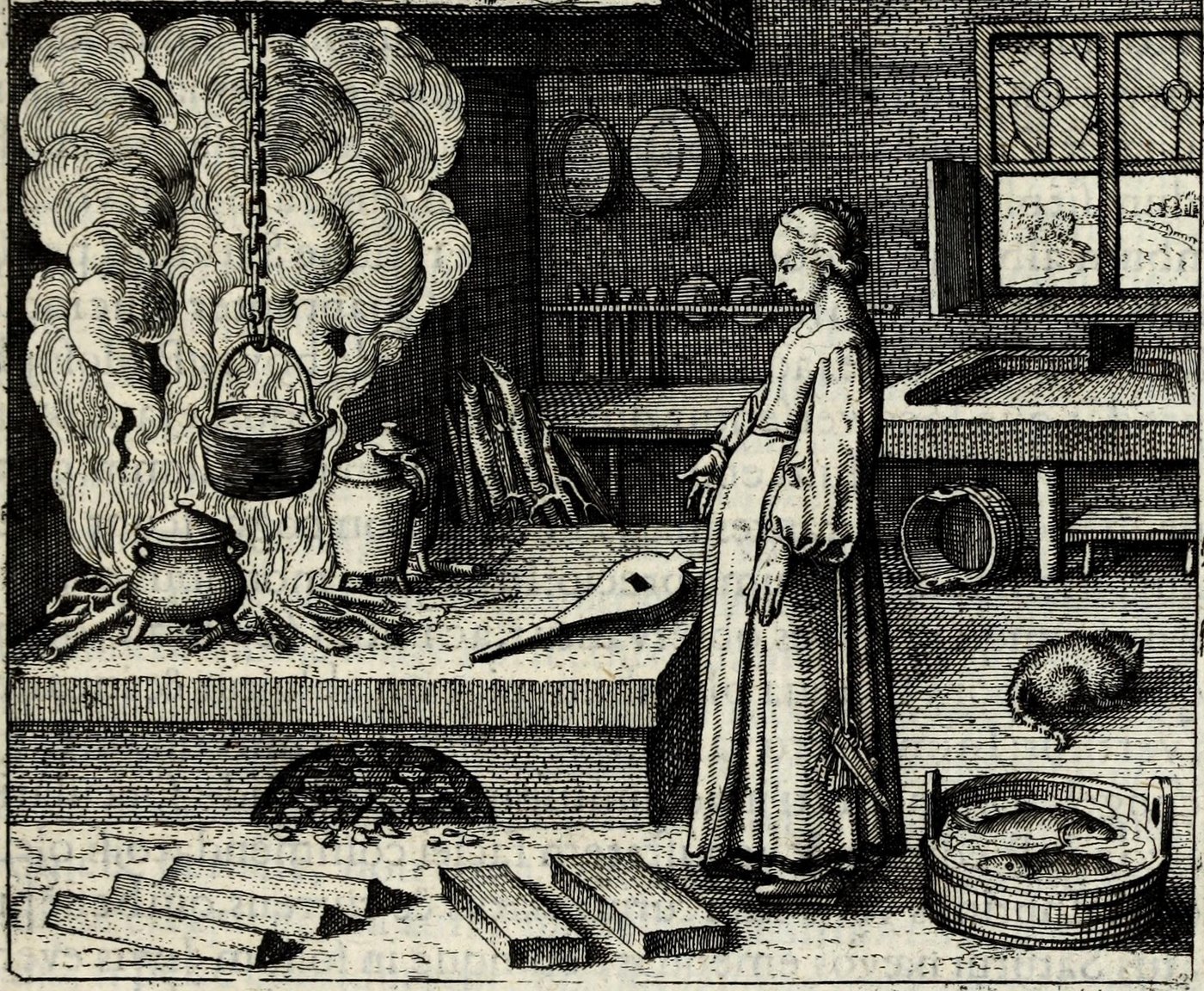
Saturni in faciem (quae nigra) sparge nives: Et dabitur tibi materies albissima plumbi
Michael Maier, Atalanta Fugiens, 1618, emblem XXII. Scatter snow on the face of Saturn, which is black, and you will be given the whitest matter of lead.
Black face, white lead. Saturn is the blackness the work starts from and the metal it starts in, and Maier's instruction is to whiten him. A century and a half later the Encyclopedie's table of chemical characters is still filing him the same way, with no mysticism attached at all: the salts of lead take the sign of Saturn, in the same column where iron takes Mars and tin takes Jupiter.
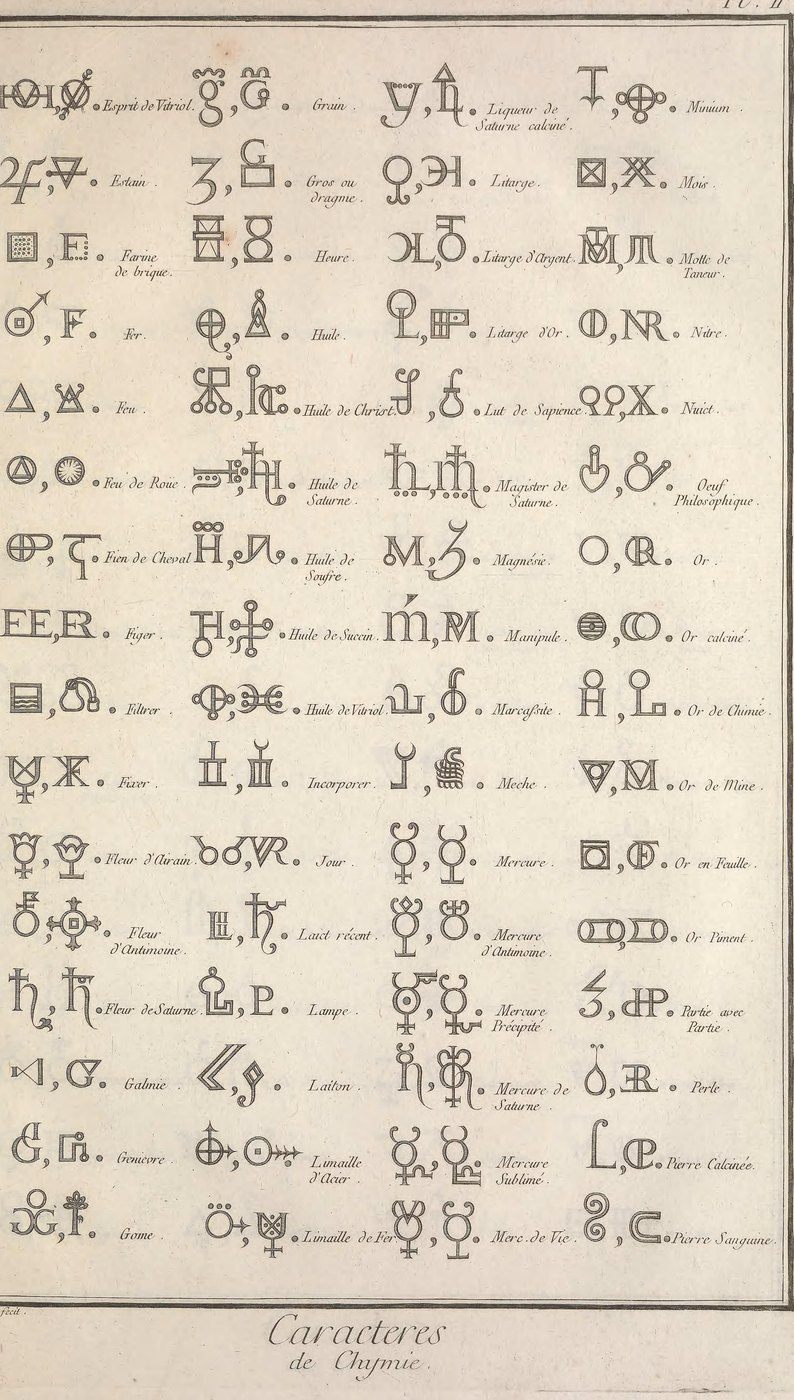
So the first piece of the claim is true and dull. Saturn is lead, Saturn is black, and everybody in the trade knew it because it was printed in the manuals.
And Saturn is the top of the ladder
The second Saturn is a position rather than a substance, and three separate men here draw the same ladder. Robert Fludd's monochord runs the planets up from the moon at the bottom to Saturn at the top. John Dee sends the Monas down the axis of his cosmic egg with Saturn at the head and the moon at the foot. Knapp, charting Dante's universe for Manly Hall in 1928, ends the rings at Saturn before the fixed stars begin.
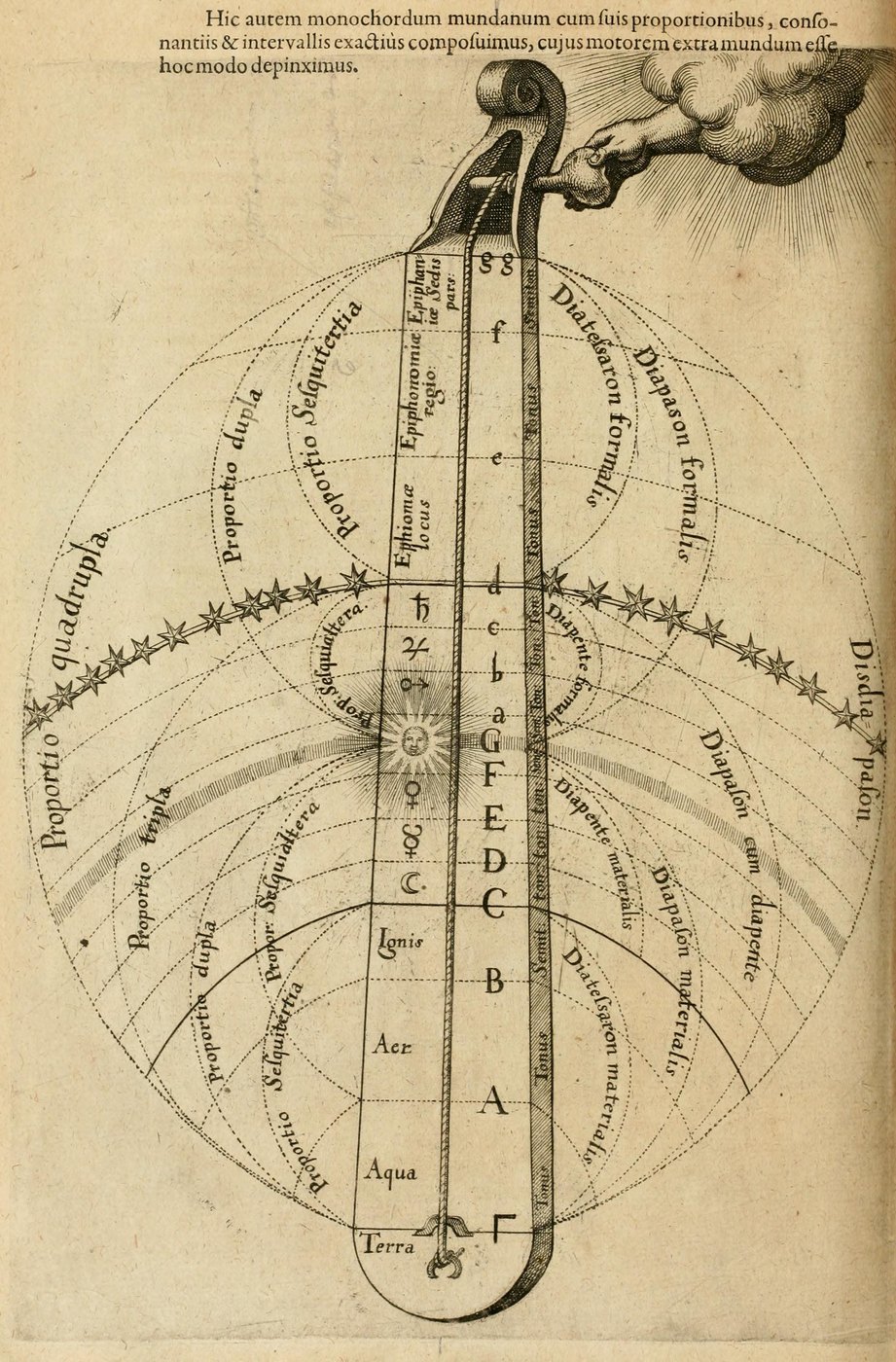
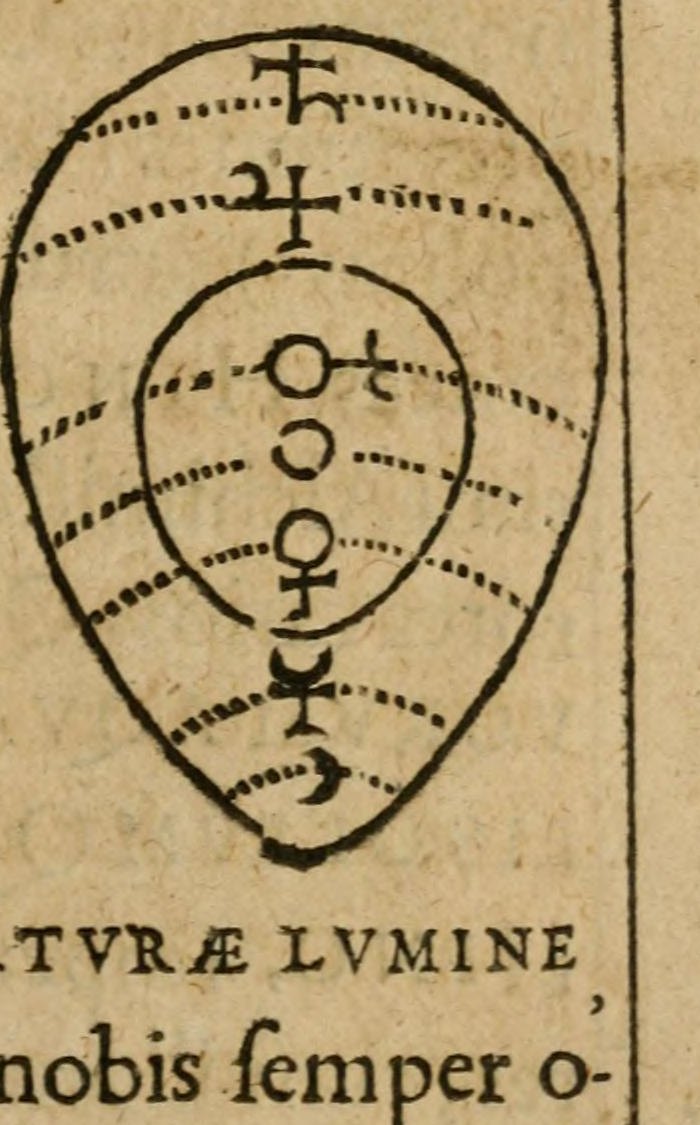
Highest, slowest, coldest, last. And Agrippa, laying the planets over a man's body inside a pentagram in 1533, puts Mercury and Saturn at the feet, which is the other way of saying the same thing. Saturn is the heavy end.
Kircher puts him next to Fear
In 1653 an engraver working for Athanasius Kircher ran the seven planets down the Tree of the Sephiroth and had to decide which power each one answered to. He gave Jupiter to Mercy. He gave Saturn to Fear.
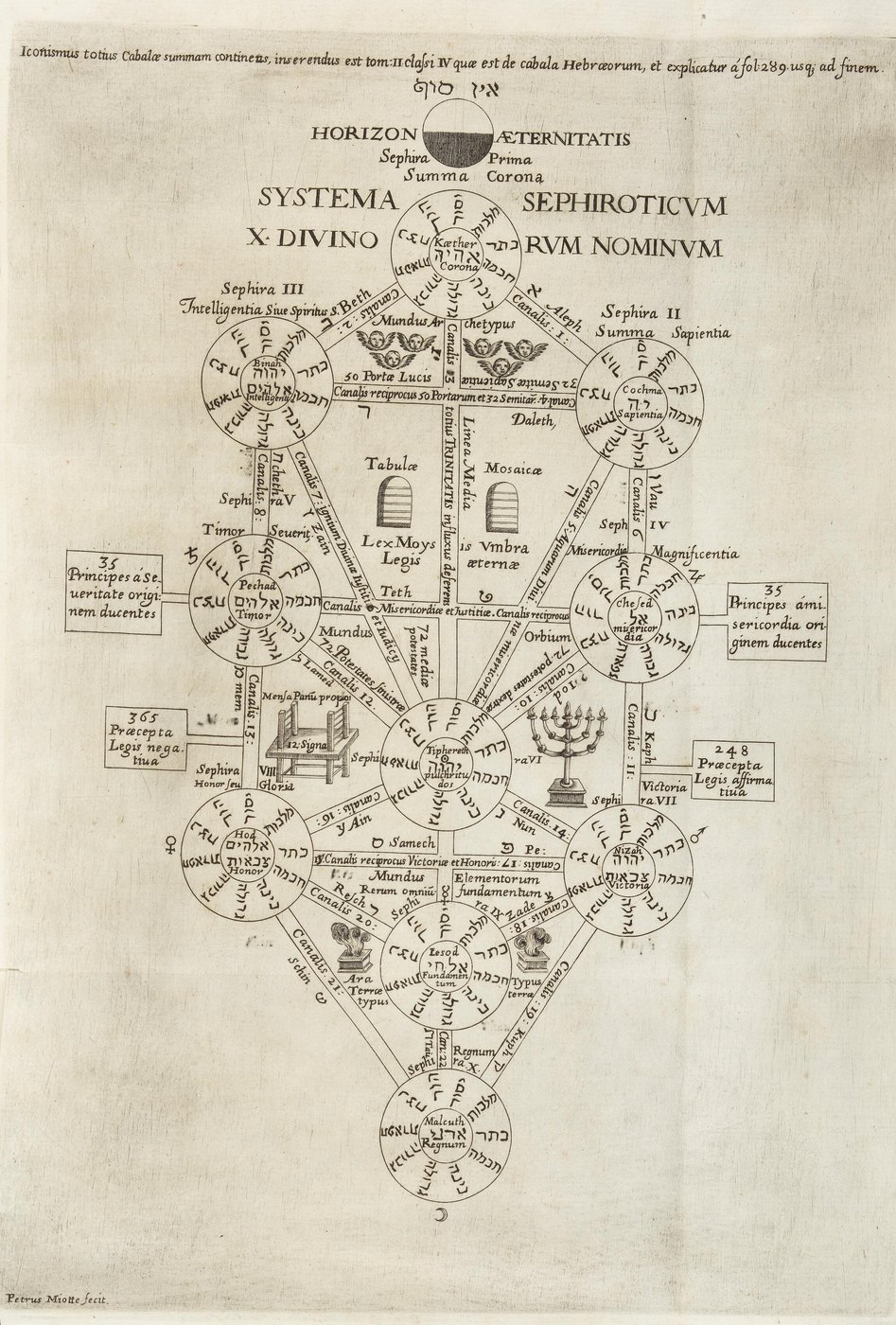
That is as close as this material comes to making Saturn sinister, and notice what it actually is. Severity is a quality God is said to have, sitting opposite mercy, and a tree that did not have it would be lopsided. Kircher is not warning anybody about a planet. He is balancing a diagram.
The cube belongs to Plato, and it belongs to earth
Now the cube, which is not in any of these books at all. It comes from a different place entirely, and Plato is unusually direct about why.
To earth, then, let us assign the cubical form; for earth is the most immoveable of the four and the most plastic of all bodies, and that which has the most stable bases must of necessity be of such a nature.
Plato, Timaeus, in Benjamin Jowett's translation. The cube is given to earth among the five regular solids.
Read the reason rather than the assignment. The cube gets earth because a cube sits flat and will not roll, and earth is the element that stays put. Plato is arguing about stability. Nothing in the passage mentions prisons, or matter as a trap, or Saturn, whose name he does not raise anywhere near it. The cube is the shape of the thing that holds still.
The hexagon is weather
The hexagon is the piece people find most convincing, because a six sided shape at the pole of a planet does look like something arranged. NASA describes what it is.
The hexagon is similar to Earth's polar vortex, which has winds blowing in a circular pattern around the polar region. On Saturn, the vortex has a hexagonal rather than circular shape.
NASA Jet Propulsion Laboratory, 27 March 2007, on the Cassini images
A vortex nearly twenty five thousand kilometres across, first imaged by the Voyager craft at the start of the nineteen eighties and photographed properly by Cassini a quarter of a century later. It is a jet stream. Nobody who drew Saturn before 1980 had seen it or could have, which puts it outside every book on this page by three hundred years or more.
So who joined them?
Every part of the claim is documented and not one of the documents connects to another. Maier never mentions a cube. Plato never mentions Saturn. The Encyclopedie is a chemistry table. Kircher is balancing a tree. The hexagon is a photograph of weather taken after every one of them was dead.
The joining is recent, and it happened in lectures, videos and forum posts rather than in books, which is exactly why it arrives without a citation. Nobody is hiding a source. There is no source to hide. Somebody in the last few decades noticed that Saturn is dark in the old chemistry, that a cube is heavy in Plato, and that the pole of the planet has six sides in the photographs, and stacked them, and the stack has been passed along ever since with the joins invisible.
What this collection can say is narrow and worth saying. A hundred and seventy one works, five centuries, and Saturn turns up in them as a sign, a metal, a colour, a sphere, a severity and a god. He is never once a cube. Not in Maier, not in Fludd, not in Dee, not in Kircher, not in Agrippa, not in the Encyclopedie. The pieces are real and the picture was never drawn.
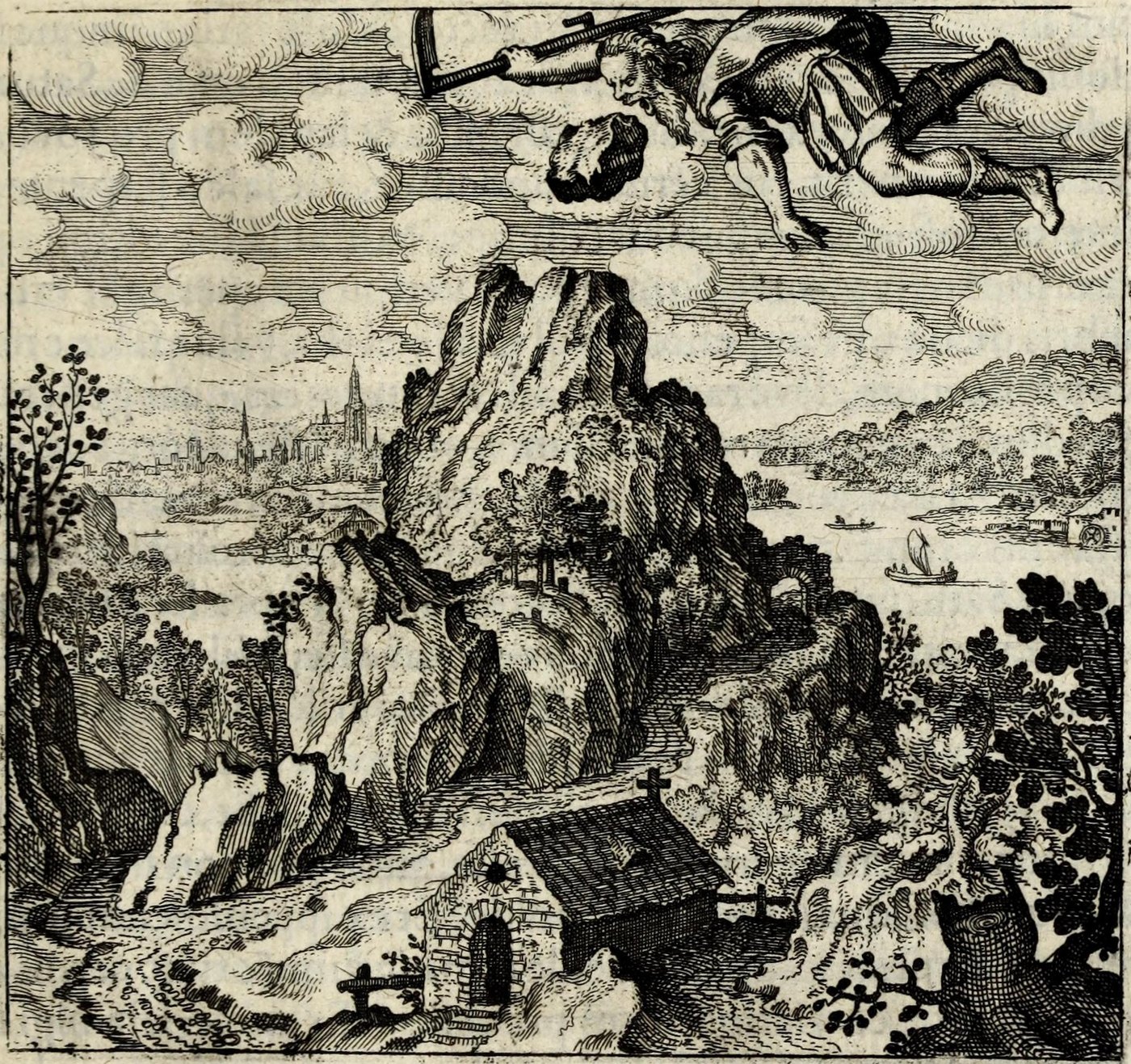
Maier's Saturn does have a stone in him, as it happens. He swallowed it in place of his son, brought it back up, and they carried it to Helicon and stood it there as a monument for mortals. It is not black and it is not a cube, and Maier printed underneath it exactly what it was for, so nobody ever had to decode it.