Monochordum Mundanum, the Divine Monochord
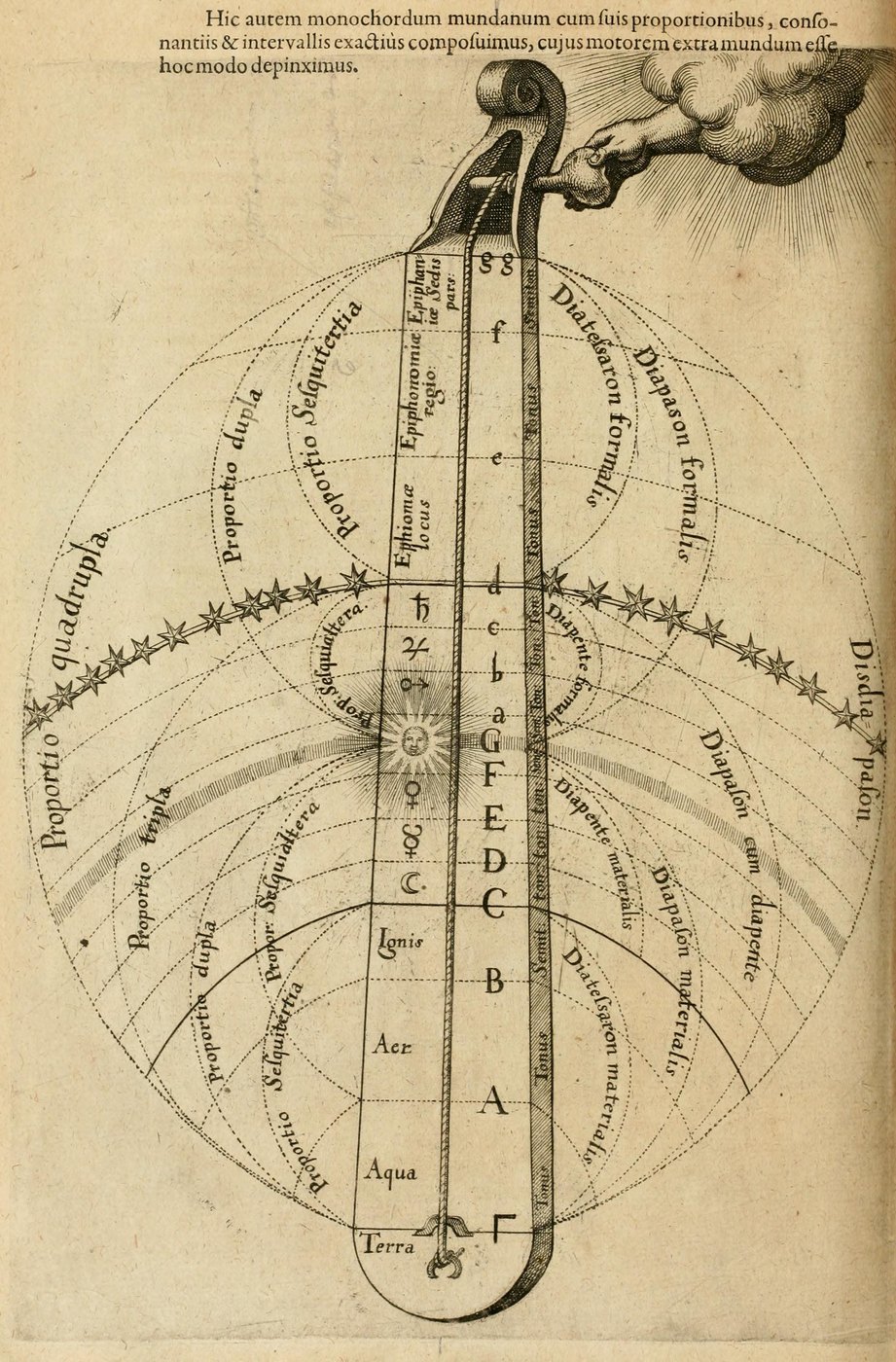
The world monochord as the central motif, filed under the Heavens, with the Hand, the Sun and the Moon, and Fire in a secondary part. From Fludd's history of the two worlds.
What is happening
Symbolica, 2026 Fludd's Latin, put into English here: Here, moreover, we have set out the world monochord more exactly, with its proportions, consonances and intervals, and we have depicted its mover as being outside the world, in this way.
Robert Fludd, 1617 “ambas verò consonantias Diatessaron in partibus mundi exterioribus constitui & consonantiam Diapason in Sole, Disdiapason autem in ipso DEO inveniri. Haec itaque est machinae universalis harmonia naturalis, quam nemo hactenus, quod sciam, ita succinctè atque dilucidè explicavit.”
Symbolica, 2026 Fludd's Latin, put into English here: but that both consonances of the fourth are set in the outer parts of the world, that the consonance of the octave is found in the Sun, and the double octave in God himself. This, then, is the natural harmony of the universal machine, which no one until now, so far as I know, has explained so briefly and so clearly.
Robert Fludd, 1617 “Generationes igitur omnes sub sole fiunt vimque suam ab inferiori solis sphaerae semitonio minori, quod materiale suprà appellavimus, accipiunt; At verò regenerationes omnes à Semitonio orbis solaris superiori ortum habent, à quo ad spiritualis summitatem fit sublimatio.”
Symbolica, 2026 Fludd's Latin, put into English here: All generations, then, take place beneath the sun and receive their force from the lower minor semitone of the sun's sphere, which we called material above; but all regenerations have their origin from the upper semitone of the solar orb, from which the sublimation is made to the summit of the spiritual.
Hall, 1928 “In this chart is set forth a summary of Fludd's theory of universal music.”
Key · 4 motifs
Tap a motif on the picture, or a line below. Its note opens under the line, with the reading its author gave it.
- Primary motif
- Secondary motifs · 3
The picture
A single string stretched down a long board from a tuning peg at the top, which a hand reaching out of a cloud is turning; the string lettered with the elements, the planets' signs, the sun with its rays at its midpoint, a belt of stars and three heavens of angels, and arcs on either side naming the musical intervals between them; the world monochord as the central motif. By eye
The reading
The picture read whole, in the archive's words, from the sources quoted on the marks. Read on, and the picture follows: the motif under discussion keeps its colour.
Fludd's third book in the history of the great world is about the music of the world, and this is its summary. He tells the reader plainly what he has done: here we have set out the world monochord more exactly, with its proportions, consonances and intervals, and we have depicted its mover as being outside the world. A monochord is a teaching instrument, a single string over a ruled board, on which the Pythagoreans showed that music is number. Fludd makes the universe one.
The string runs from the earth at the bottom to the top of the highest heaven, and every station of the cosmos is a note on it. Earth, water, air and fire come first, lettered on the left. Then the seven planets by their signs, the moon lowest, Saturn highest. Then the belt of stars. Then three regions of the empyrean, the heavens of the angels, named in a Greek of Fludd's own making. The whole length is two octaves, a disdiapason, and Fludd writes that the proportion between the earth and the outer surface of the spiritual world is certainly fourfold, since its semidiameter is a double octave, and that he has made that semidiameter the string of his macrocosmic monochord. The arcs on either side name the intervals: the material fourth, fifth and octave below the sun, the formal ones above.
The sun sits at G, exactly halfway. On a real monochord a finger pressed at the midpoint sounds the octave in both directions, and Fludd says that is why the sun is where it is. The material octave descends from it to the earth; the formal octave rises from it to God. The Sun, the god of nature but a created one, he concludes, receives all its light and power from God through the upper octave, and the earth receives God's influences from the sun through the lower, and so stands in the same correspondence to the sun as the sun does to God most high. Hall put it more briefly in 1928: the sun is the lower octave of the highest heaven and the earth the lower octave of the sun.
The four elements fill the first four notes, and the distance from earth to fire is a fourth, the diatessaron. Fludd calls the earth the base of the material consonances and the sun the foundation of the spiritual ones. Fire is the ceiling of the elemental world; above it the planets begin, and the intervals change their character from material to formal.
At the top, a hand comes out of a cloud and turns the tuning peg. The caption calls it the mover, placed outside the world. The instrument is the whole of creation, and its player is not part of it and cannot be reached by climbing the string: beyond the summit, Fludd writes, nothing exists except the one and only God. Everything else in the picture is measured. The hand is not.
Fludd drew the monochord on the eve of a quarrel. Kepler read this volume and attacked its harmonies in an appendix to his Harmonices Mundi of 1619; Fludd answered, Kepler replied, and Fludd answered again in 1623 with a book called the Monochord of the World. Kepler wanted the ratios to come out of measured orbits. Fludd wanted them to come out of the nature of light and matter, and said so here, calling his scheme the natural harmony of the universal machine, which no one until now, so far as I know, has explained so briefly and so clearly. One of them was doing astronomy. This page is the other thing, and it says on its face what it means.
Decoded: every motif is marked, and each mark carries the reading its author gave it, quoted from the text, or says that it is observed on the picture and not read. The reading above is the archive's own, made from those sources and no others.

A diagram of everything, drawn so that a person can be found inside it. Note where the human figure stands in the scheme.
In plain words Read the string from the bottom: earth, water, air, fire, then the moon and the planets, then the stars, then three heavens of angels. The whole distance from the earth to the top is two octaves. Fludd's universe is a scale, and every part of it is a note at a fixed distance from every other.
The plate, 1617 “Terra. Aqua. Aer. Ignis. Ephiomae locus. Epiphonomiae regio. Epiphaniae Sedis pars.”
Robert Fludd, 1617 “Ex quibus certum est, quadruplam esse proportionem inter terram & convexam mundi spiritualis superficiem, cùm ex duplici Diapason confletur ejus Semidiameter, quem in demonstratione sequenti, monochordi nostri Macrocosmici chordam esse finximus.”
Symbolica, 2026 Fludd's Latin, put into English here: From which it is certain that the proportion between the earth and the convex surface of the spiritual world is fourfold, since its semidiameter is made up of a double octave; and in the demonstration that follows we have made that semidiameter the string of our macrocosmic monochord.
Hall, 1928 “The interval between the element of earth and the highest heaven is considered as a double octave, thus showing the two extremes of existence to be in disdiapason harmony.”
Hall, 1928 “'If struck in the more spiritual part,' writes Fludd, 'the monochord will give eternal life; if in the more material part, transitory life.'”
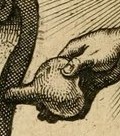
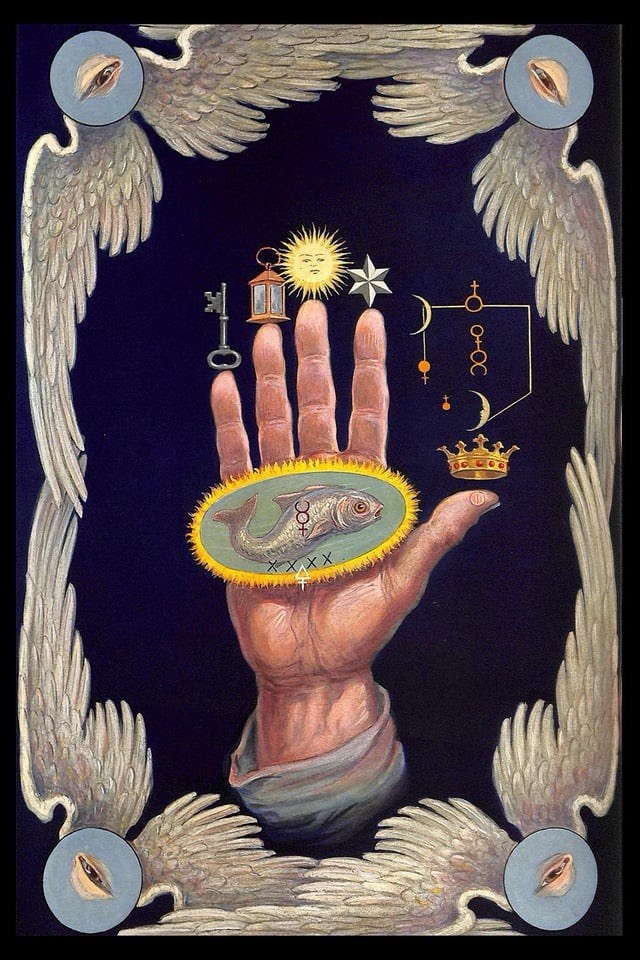
The hand as a sign in itself: what it holds, where it points, which fingers are raised. On the Hand of the Mysteries every finger carries a sign of its own.
In plain words A hand comes out of a cloud and turns the tuning peg. That is the whole theology of the picture: the player is outside the instrument. God is not one of the notes; he tunes the string.
Robert Fludd, 1617 “Hic autem monochordum mundanum cum suis proportionibus, consonantiis & intervallis exactiùs composuimus, cujus motorem extra mundum esse hoc modo depinximus.”
Symbolica, 2026 Fludd's Latin, put into English here: Here, moreover, we have set out the world monochord more exactly, with its proportions, consonances and intervals, and we have depicted its mover as being outside the world, in this way.
Robert Fludd, 1617 “Est igitur summum totiùs perfectionis, altitudinis & puritatis mundanae fastigium, ultra quod nihil praeter unicum & solum DEUM existit.”
Symbolica, 2026 Fludd's Latin, put into English here: It is therefore the highest summit of all the world's perfection, height and purity, beyond which nothing exists except the one and only God.
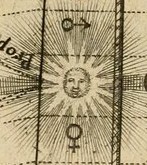
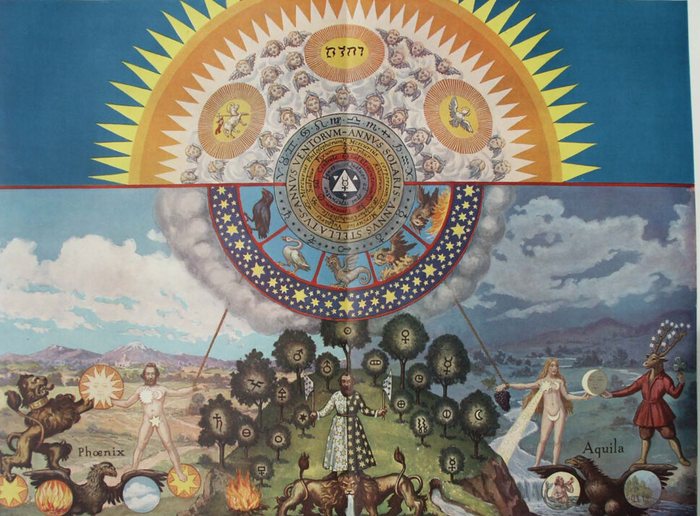
Gold, the perfected metal, and the illuminated intellect. The most overloaded symbol in the tradition.
In plain words The sun sits exactly halfway up the string, where a finger pressed on a real monochord makes the octave. Below it the material octave runs down to the earth; above it the formal octave climbs to God. The sun is an octave below God and an octave above the earth, and Fludd calls it the god of nature, created.
Robert Fludd, 1617 “Concludimus igitur Solem naturae DEUM, sed creatum, virtute harmoniae spiritualis, per Diapason formale cum intervallis suis proportionaliter ordinatum, accipere omnem formalem & lucidam virtutem à DEO omnium maximo, supernaturali creatore increato; terram verò per Diapason materiale ejusdem DEI influentias accipere, indéque habere eandem cum Sole correspondentiam, quam habet Sol cum DEO excelsissimo.”
Symbolica, 2026 Fludd's Latin, put into English here: We conclude, then, that the Sun, the god of nature but a created one, ordered proportionally through the formal octave with its intervals by the power of spiritual harmony, receives all its formal and luminous power from God, greatest of all, the supernatural and uncreated creator; and that the earth receives the influences of the same God through the material octave, and so stands in the same correspondence to the Sun as the Sun does to God most high.
Robert Fludd, 1617 “ad exactam sphaerae aequalitatis compositionem concurrunt, in qua centrum corporis solaris, animae mundi vehiculum, libratis ponderibus suspenditur”
Symbolica, 2026 Fludd's Latin, put into English here: they concur to make up exactly the sphere of equality, in which the centre of the solar body, the vehicle of the soul of the world, hangs with balanced weights.
Hall, 1928 “The sun is the lower octave of the highest heaven and the earth the lower octave of the sun.”

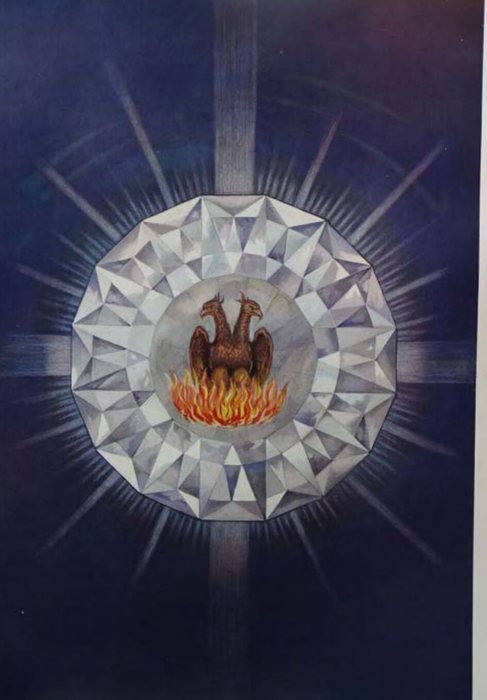
A count, a catastrophe, or the visible part of something that has no body. Note whether the flames are arranged in a number, breaking something, or standing where a figure would be.
In plain words Earth, water, air and fire take up the first four notes, and the distance from earth to fire is a fourth, the interval Fludd calls a diatessaron. Fire is the top of the elemental world; above it the planets begin.
The plate, 1617 “Ignis. Diatessaron materialis.”
Robert Fludd, 1617 “Nam terra est basis consonantiarum Diatessaron & Diapente materialium, constituentium Diapason materiale: At ipse orbis solaris est fundamentum, super quod Diapente, Diatessaron & Diapason spiritualia elevantur.”
Symbolica, 2026 Fludd's Latin, put into English here: For the earth is the base of the material consonances of the fourth and the fifth, which make up the material octave; but the orb of the sun itself is the foundation on which the spiritual fifth, fourth and octave are raised.
Hall, 1928 “Fludd emphasizes the fact that as the elements ascend in series of two and a half tones, the diatessaron is the dominating harmonic interval of the elements.”
Also carrying the Heavens
61 works carry it. The 6 where it is the central motif are here. The symbol.
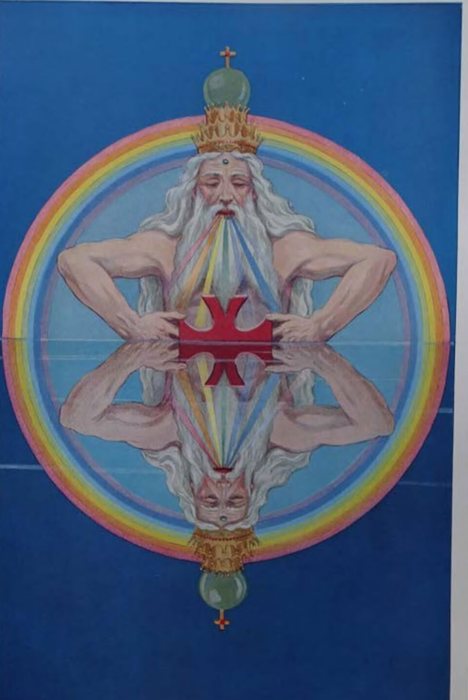
Where the detail is the subject
the Hand · the Sun and the Moon · Fire
Each of these is in the picture without being what it is about. Below, one work that is about each.
In the same series
Record
One symbol a week, decoded.
This picture is free at full size from its source, linked above. What an address gets is the Sunday letter: one picture, one symbol marked on it, what it meant and who said so, and the master files of the decoded plates as they are verified. Leave any time.
Free, one letter a week, unsubscribe in one click. How the address is used.
Scroll or pinch to zoom · drag to move · double-tap for 1:1 · 921 by 1400 pixel web copy; the source file is linked under Record