The Hand of the Mysteries
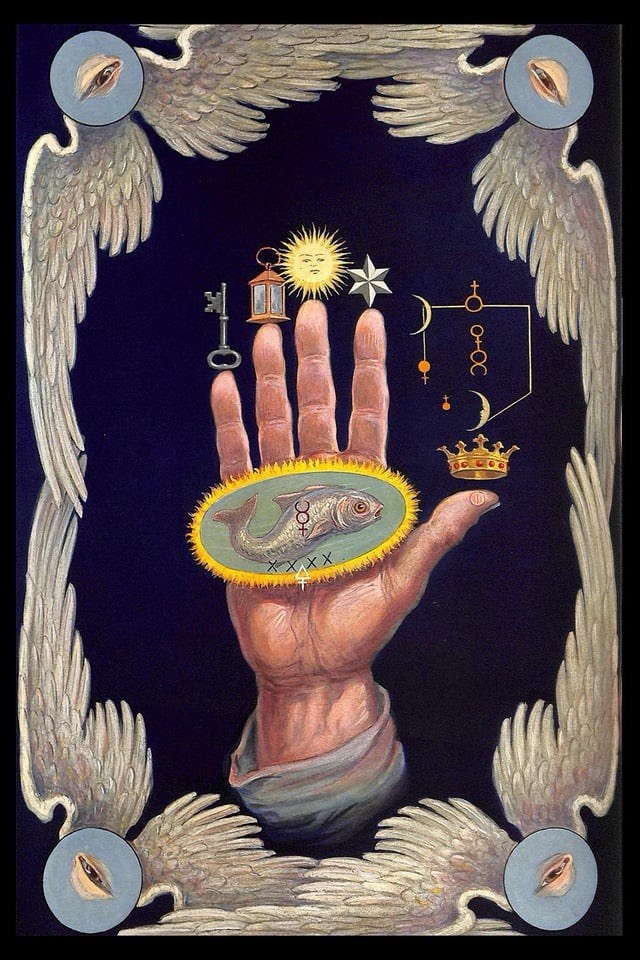
An open hand held up against a field of night, each fingertip bearing a symbol, a fish burning in the palm, and four eyes watching from the corners.
Also called The Hand of the Philosopher, The Hand of the Master Mason
Key · 8 marks
Tap a symbol on the plate, or a line below. Its note opens under the line; nothing leaves the page until you ask for the entry.
- Primary motif
- Secondary motifs · 7
- ·The wings that frame the plate and the column of glyphs down the right edge are left unmarked rather than guessed. Hall's caption names neither.
The composition
Read on, and the plate follows: the symbol under discussion keeps its colour.
Two men have read this hand and they did not read the same object.
Hall's caption of 1928 calls it the drawing ‘designated the hand of the philosopher which is extended to those who enter into the Mysteries’, and in his reading every fingertip is a kind of light: absolute light on the crowned thumb, ‘the Universal Light which reveals cosmic and celestial verities’ on the index, the luminescence of creation on the middle finger, human knowledge on the ring, the Mysteries themselves on the little finger. The older Hand of the Philosophers gives the same five fingers, in the same order, a different list altogether: saltpetre, Roman vitriol, sal ammoniac, alum, common salt. One man is describing a mind. The other is describing a shelf. Both are certain they are describing this picture.
The palm settles nothing, and is not meant to. Where the fingers carry a list, the centre carries a process: a fish swimming in a ring of fire. ‘The fish is mercury and the flame-bounded sea in which it swims is sulphur’, Hall writes, and on this one point the older text agrees with him. List at the edges, work at the middle.
The gesture is the argument. An open hand is an offer, and both readings make the offer conditional: Hall's is extended to those who enter, and the older hand, as the archive reads it, stays shut to anyone who has not first taken the oath. The plate shows you everything at once and tells you that seeing is not enough.
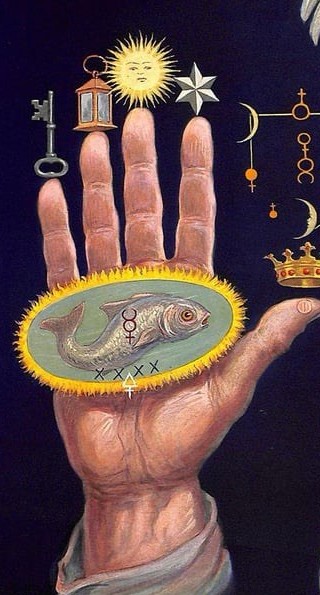
The hand as a sign in itself: what it holds, where it points, which fingers are raised. On the Hand of the Mysteries every finger carries a sign of its own.
Hall, 1928 “designated the hand of the philosopher which is extended to those who enter into the Mysteries”
Hall, 1928 “the figure symbolizes the hand of a Master Mason with which he raises the martyred Builder of the Divine House”
Hall, 1928 To the Qabbalist, Hall adds, the crowned thumb is the One Power and the four fingers with their emblems are the four worlds.
Hollandus, 17th c. Nobody understands the hand and its secret signs, Hollandus writes, without first taking the philosophers' oath.

Access to what is deliberately closed. In hermetic imagery the key is almost never a key to a door.
Hall, 1928 “the Mysteries themselves, without whose aid man cannot unlock the numerous chambers of his own being”
Hollandus, 17th c. On the same finger of the older hand the key is common salt: salt, Hollandus writes, is the key in this Art.

Light that is carried rather than received. The attribute of the Hermit, and of anyone who has to go into the dark on purpose.
Hall, 1928 “human knowledge, for it is a spark of the Universal Fire captured in a man-made vessel”
Hollandus, 17th c. In the older hand the lantern is alum, without which no perfect work can be accomplished.

Gold, the perfected metal, and the illuminated intellect. The most overloaded symbol in the tradition.
Hall, 1928 “the luminescence of creation through which man may learn the mystery of all creatures which express through form and number”
Hollandus, 17th c. In the older hand the sun is sal ammoniac, the most powerful thing in the work after saltpetre and vitriol.

Guidance from something that does not move. Count the points before reading it: five, six and eight are all here, and no source treats them as one sign.
Hall, 1928 “the Universal Light which reveals cosmic and celestial verities”
Hollandus, 17th c. In the older hand the star is Roman vitriol, without which no perfect work can be completed.

Completion, and in the Kabbalistic reading the first sephirah, the point at which the work is no longer yours.
Hall, 1928 “Absolute Light, unknown and unrevealed, whose power shines through all the lesser lights”
Hollandus, 17th c. In the older hand the crown is saltpetre, which finishes the work as the thumb finishes the hand.
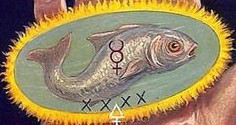
Living substance in a hostile element. In the flaming oval it is philosophical mercury, marked with Mercury's own glyph.
Hall, 1928 “The fish is mercury and the flame-bounded sea in which it swims is sulphur”
Hollandus, 17th c. The same in the older hand: the fish is mercury, the beginning, middle and end of the work, and the fire it swims in is sulphur.

Attention from outside the frame. Note it is almost always placed at a boundary rather than at the centre.
Symbolica Four eyes, one in each corner, each set in a disc among the wings. Hall's caption does not mention them, and the Hollandus hand has none. They are left unread rather than guessed.
Where the hand comes from
Sources: Hall's 1928 caption. Its title and credit line have been read on the Archive's photograph of the printed page, leaf 24; the paragraph under them is below the resolution of that photograph and is still quoted from two online transcriptions. Hollandus is in Leone Muller's English translation (RAMS, 1986), not yet against a seventeenth-century printing. Both are listed under Record.
The Hand has an ancestor. An older emblem, the Hand of the Philosophers, printed in the seventeenth century under the name of Isaac Hollandus as Die Hand der Philosophen, carries the same seven signs on the same fingers: a crown on the thumb, a star on the index, a sun on the middle finger, a lantern on the ring finger, a key on the little finger, and a fish in fire on the palm. Hall says as much in his caption: the drawing his plate was taken from is designated the hand of the philosopher.
The two texts read the fingers differently. For Hollandus the signs are the substances of the laboratory: saltpetre, vitriol, sal ammoniac, alum and common salt, with mercury for the fish and sulphur for the fire, and nobody understands the hand, he writes, without first taking the philosophers' oath. Hall keeps the fish and the fire (mercury and sulphur) and turns the fingers into lights: the key is the Mysteries, the lantern human knowledge, the sun the light of the world, the star the Universal Light, the crown Absolute Light. Knapp painted the hand for Hall in 1928. His plate also carries what neither text mentions: four eyes in the corners, and the wings.
That is why this plate is the first in the archive: the same seven signs, two readings, roughly two and a half centuries apart in print, and each note on this page says which reading it is quoting.
Also carrying the Hand
24 works carry it. The 4 where it is the central motif are here. The symbol.
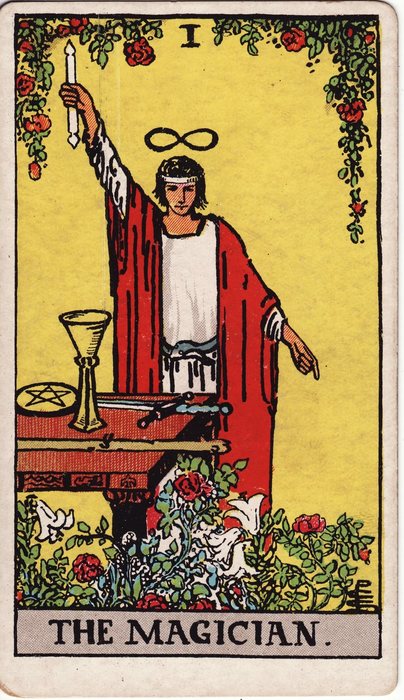
Where the detail is the subject
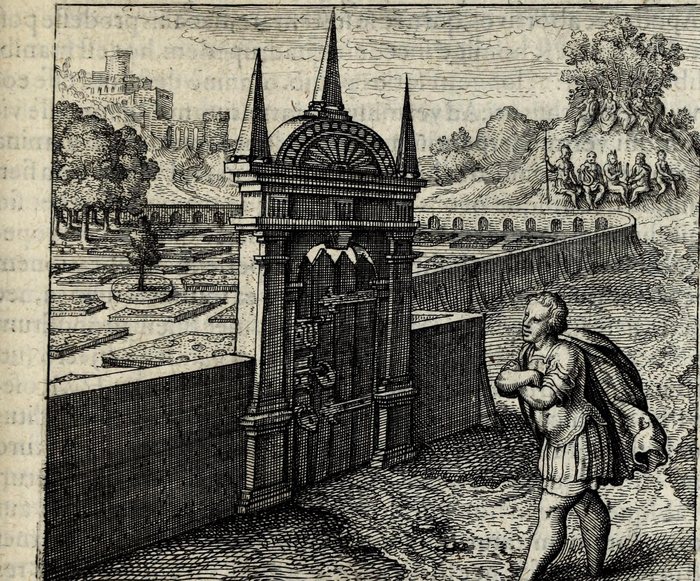
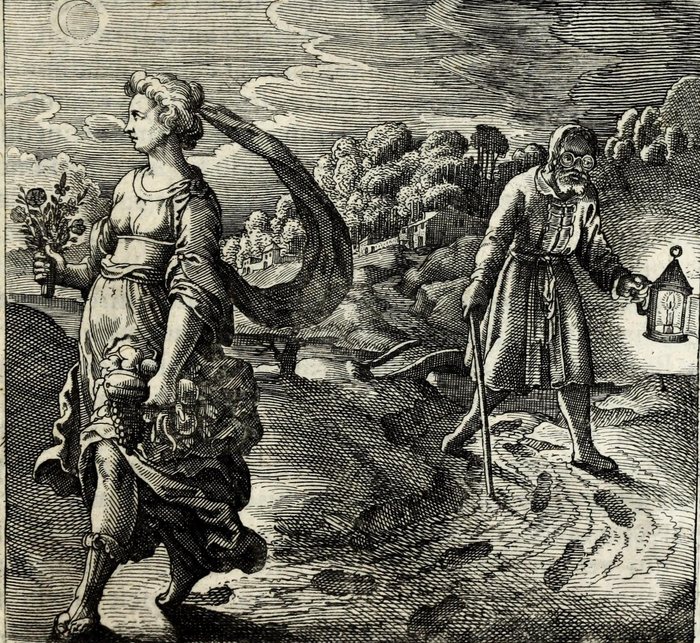
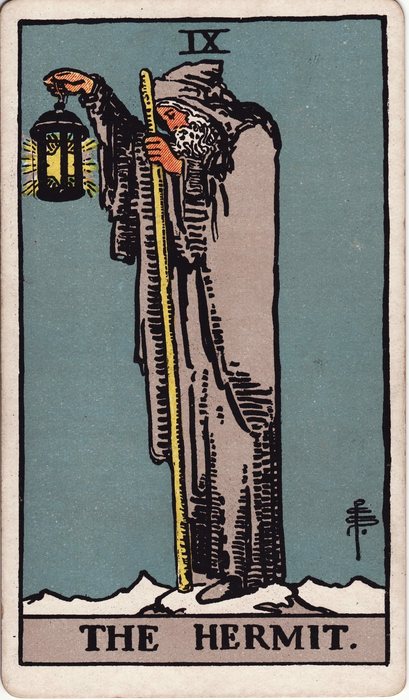
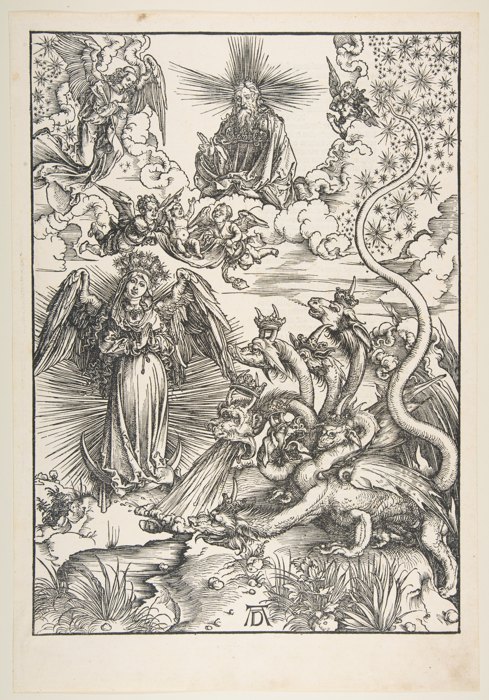
the Sun and the Moon · the Crown · the Eye · the Angel and the Wing
Each of these is in the picture without being what it is about. Below, one work that is about each.
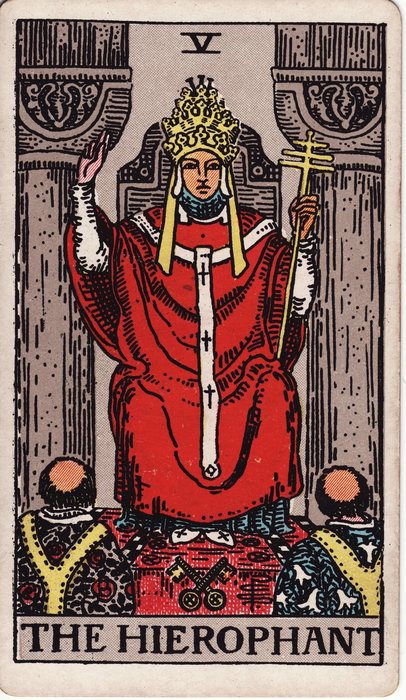
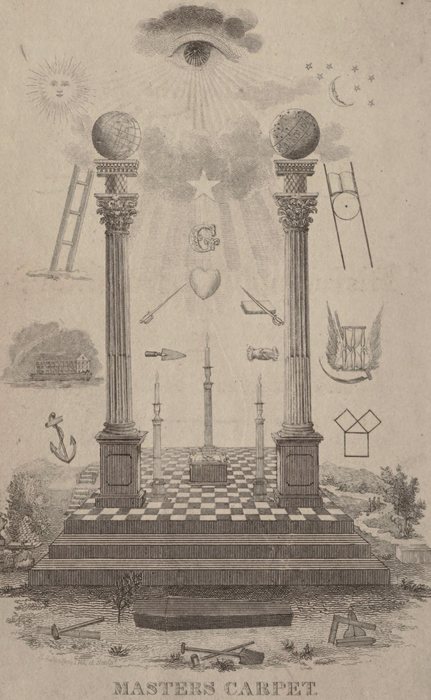
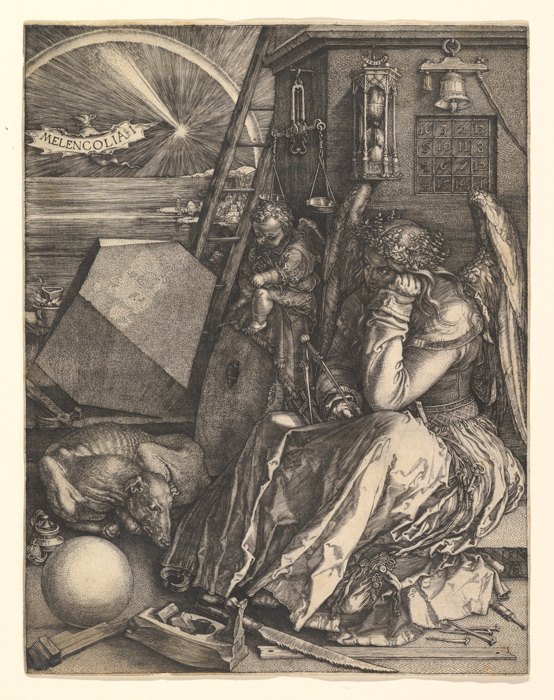
In the same series
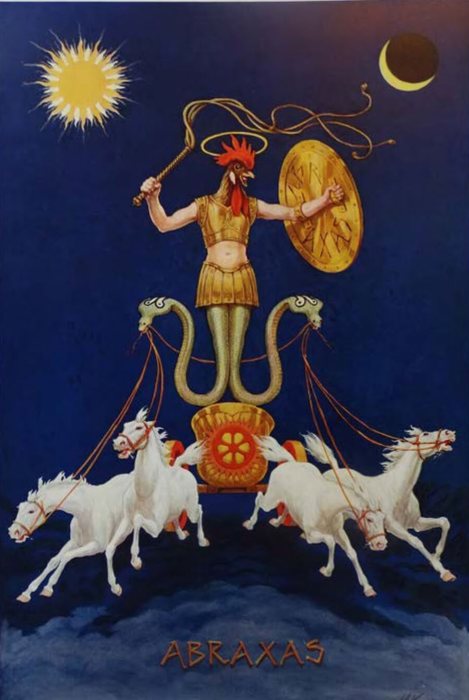
Record
One symbol, decoded, every Sunday.
This picture is free at full size from Share, and from its source, linked above. What an address gets is the Sunday letter: one picture, one symbol marked on it, what it meant and who said so. Leave any time.
Free, one letter a week, unsubscribe in one click. How the address is used.
- Manly P. Hall, The Secret Teachings of All Ages, 1928. Plate caption: the drawing is designated the hand of the philosopher; the fish is mercury and the flame-bounded sea is sulphur; each finger bears the emblem of a Divine Agent; the crowned thumb is the One Power in the four worlds. Public domain in the United States since 2024. Text. Check: transcription, not yet read against the printed 1928 page.
- Isaac Hollandus (attributed), Die Hand der Philosophen (The Hand of the Philosophers), 1667 edition. Thumb crown, saltpetre. Index star, Roman vitriol. Middle sun, sal ammoniac. Ring lantern, rock alum. Little finger key, common salt. Fish, mercury. Fire, sulphur. Nobody understands the hand and its secret signs without first taking the philosophers' oath. Text. Check: Leone Muller's English translation (RAMS, 1986), not yet read against a seventeenth-century printing. Editions are cited as 1659 and 1667; the authorship of the Hollandus texts is disputed.
Scroll or pinch to zoom · drag to move · double-tap for 1:1 · 640 by 960 pixels, the whole of the Archive’s photograph of the plate