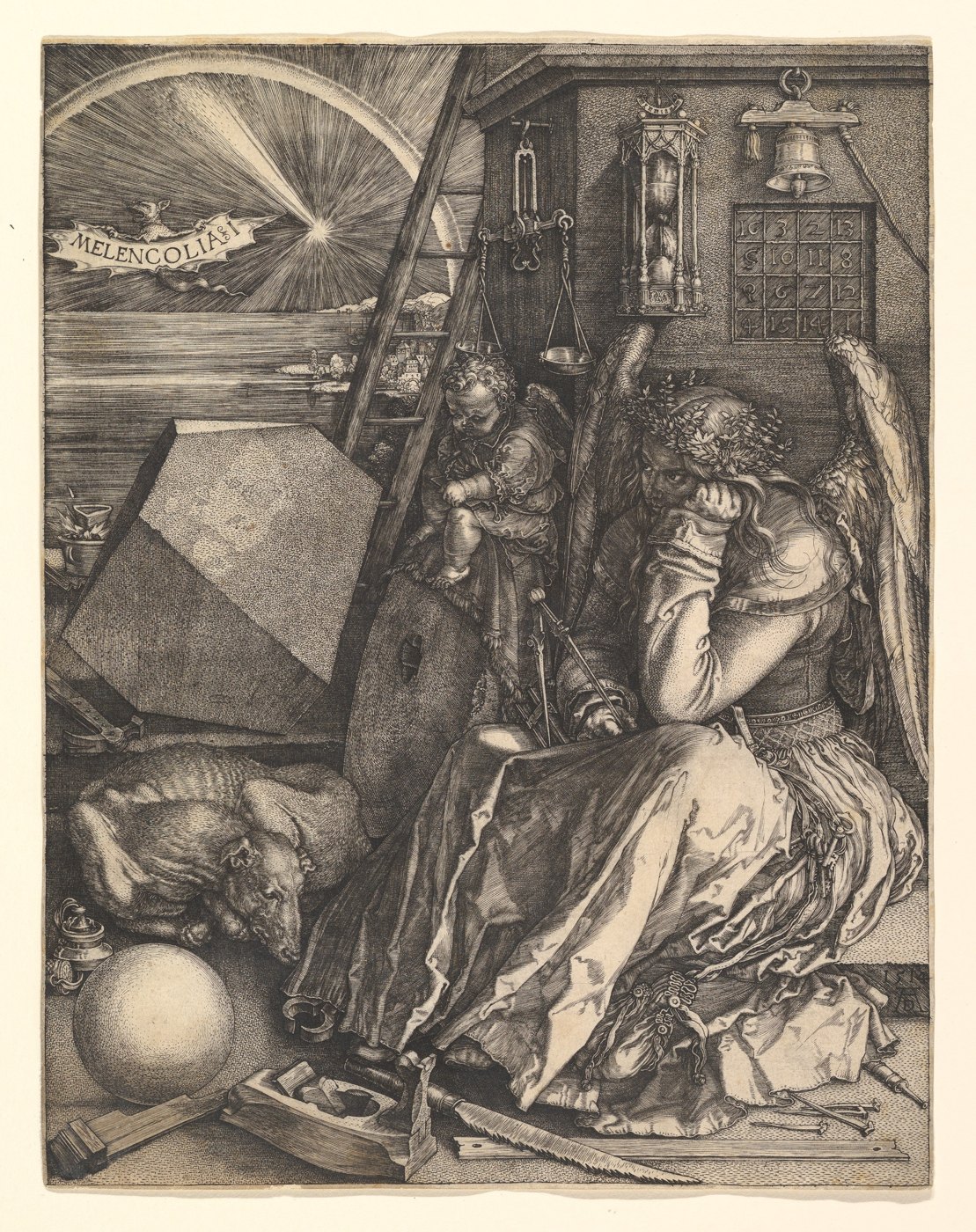
Melencolia I
The Angel and the Wing as the central motif, with the Heavens, the Demon and the Monster, the Crown, the Water, and the Triangle and the Pyramid in a secondary part. From Single sheets.
What is happening
Conway, 1889 “Action implies contemplation, and contemplation is the subject of the 'Melencolia.'”
Conway, 1889 “Around her lie the symbols of the liberal and industrial arts.”
Conway, 1889 “They were intended to represent the Sanguine and Melancholic temperaments and to shadow forth the religious and intellectual spirits of the day.”
Key · 6 motifs
Tap a motif on the picture, or a line below. Its note opens under the line, with the reading its author gave it.
- Primary motif
- Secondary motifs · 4
The picture
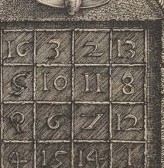
A winged figure sits with her head on her hand, a wreath of leaves in her hair, wings folded behind her; instruments of geometry and building lie about her, a comet and a rainbow stand over the bay, and a bat carries the title across the sky. The square of numbers on the wall is four by four, every row, column and diagonal making thirty-four, with fifteen and fourteen, the year, in the middle of the bottom row; the reading that names that square is modern and is not the archive's to give, so it is recorded and left unread. By eye
The reading
The picture read whole, in the archive's words, from the sources quoted on the marks. Read on, and the picture follows: the motif under discussion keeps its colour.
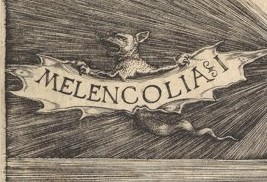
The engraving carries its own name, MELENCOLIA I, on a banner flown across the sky by a creature that is half bat and half something else, and almost nothing else in the picture is labelled. A winged woman sits on a low step with her head on her fist, a compass idle in her other hand, keys and a purse at her belt. Around her lie the tools of building and measuring: a plane, a saw, nails, a hammer, a ruler, a moulding, an inkpot, a sphere, a great block of stone cut into a polyhedron, a millstone with a winged child scribbling on it, a ladder against an unfinished tower, and on the tower's wall a bell, an hourglass, a pair of scales and a square of numbers. A dog sleeps curled at her feet. Beyond, over a bay, a comet blazes under a rainbow. Conway's account of 1889, which the archive holds, says the print's subject in one word: contemplation.
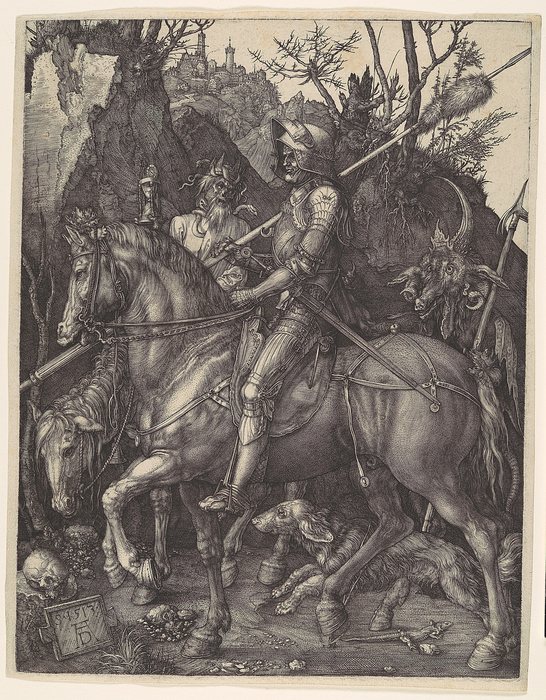
Conway reads her as the melancholic temperament, the student's temperament, and pairs the print with the Knight, Death and the Devil of the year before, whose armoured rider is the sanguine man of action: the two together, he says, were meant to shadow forth the religious and intellectual spirits of the day. The great genius with her mighty wings sits there, wrapt in thought. The wings are the whole point of the figure. She is a being who could rise and has not; the instruments are all put down; the child on the millstone is the only one working, and he is a child.
The wreath round her head Conway calls a myrtle fillet, symbolic of right, and therefore unfading, thought. Later scholars have wanted the leaves to be watercress or water ranunculus, wet plants prescribed against the dry heat of the melancholy humour, which would make the wreath a remedy she wears rather than a laurel she has earned. The plate does not say which, and the archive files the leaves under the Crown as the nearest thing it has, with the caveat on the mark.
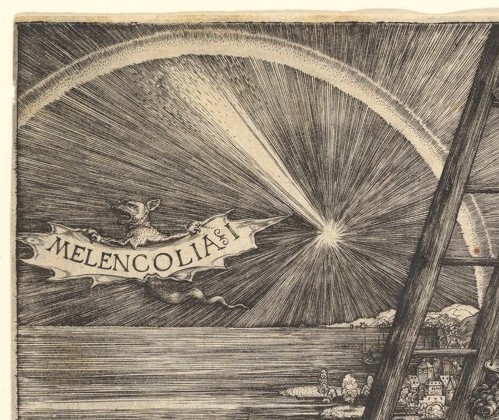
The sky is the one part of the picture that moves. A comet with a long tail falls towards the water and a rainbow stands over it, and the light comes into the scene from that quarter. Conway's chapters do not mention either. The archive records them as seen. Comets were read as omens and rainbows as covenants in 1514 as in every other year, and a reader who finds the two together over a woman who cannot work is entitled to think about that; the print does not do the thinking for you.
The creature with the banner is the only thing in the picture that seems to know what the picture is called. It has a bat's wings, a beast's body and a long tail, and it flies out of the light of the comet with the name spread under it. Conway does not name it. Whether it is a bat, the animal of night and of the melancholy humour, or a small demon, or the spirit of the temperament itself, is not for the archive to decide, and the mark says so.
One thing on the wall can be checked rather than interpreted, because it is arithmetic. The square is four by four and every row, every column and both diagonals add to thirty four, with 15 and 14 in the middle of the bottom row to give the year. Dürer did not invent it. Agrippa prints the same sixteen numbers as the table of Jupiter, and Dürer's square is that table with the rows reversed and the two middle columns exchanged. Agrippa's paragraph promises the table gain and riches, favour and love, peace and concord among men. The reading everybody knows, which makes it a charm hung against Saturn, was written in the twentieth century and is not quoted here.
What is left is what Conway saw and what Agrippa can account for: a winged intelligence with every means of making something in reach, making nothing, wearing the humour that its own century assigned to the slowest and highest of the planets, under a sky full of signs.
Decoded: every motif is marked, and each mark carries the reading its author gave it, quoted from the text, or says that it is observed on the picture and not read. The reading above is the archive's own, made from those sources and no others.
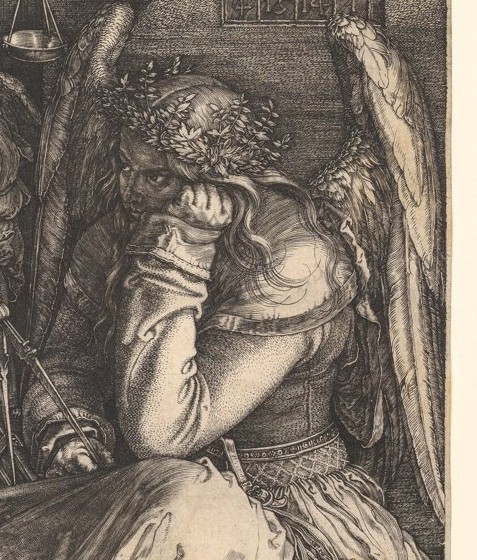
The mark of an errand rather than a nature. Note whether the wings are open, folded, or given to the figure by someone else.
In plain words A winged woman sits with her chin on her fist, staring past everything on the ground around her. Conway, writing in 1889, calls her the great genius wrapt in thought, and melancholic in the old sense: not sad, but sunk in the kind of thinking that stops the hands. The wings say she could fly and is not flying. Melancholy is Saturn's humour, and Agrippa's book of 1533 says why the two belong together: Saturn is cold and dry as the humour is, pours it into a man daily and keeps it up, and is himself the author of secret contemplation, a stranger to every public business, who calls the soul back from outward duties to what is innermost.
Conway, 1889 “The great genius with her mighty wings sits there, wrapt in thought.”
Conway, 1889 “Melancholic is she; for the solemnity of a pondering mind, held silent in its holy passion, is upon her.”
Conway, 1889 “the first representing the melancholic or student's temperament, the second the sanguine temperament characteristic of the man of action”
Heinrich Cornelius Agrippa, 1533 “maxime autem si iuuetur influxu aliquo coelesti, praecipue Saturni, qui cum ipse frigidus sit atque siccus, qualis est humor melancholicus, illum quotidie influit, auget atque conseruat.”
Symbolica Agrippa's Latin, put into English here: and most of all if it is helped by some heavenly influence, above all Saturn's, who, being himself cold and dry as the melancholy humour is, pours it in daily, increases it and keeps it up.
Heinrich Cornelius Agrippa, 1533 “Praeterea cum sit ipse arcanae contemplationis autor, ab omni publico negotio alienus, ac planetarum altissimus, animam ipsam cum ab externis officiis ad intima semper reuocat, tum ab inferioribus ascendere facit, trahendo ad altissima, scientiasque ac futurorum praesagia largitur.”
Symbolica Agrippa's Latin, put into English here: Besides, since he is himself the author of secret contemplation, a stranger to every public business, and the highest of the planets, he calls the soul back from outward duties to what is innermost, makes it climb from lower things, drawing it to the highest, and grants it knowledge and forecasts of what is to come.
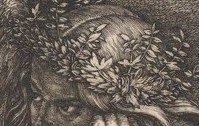
Completion, and in the Kabbalistic reading the first sephirah, the point at which the work is no longer yours.
In plain words The leaves round her head are a wreath, not a crown; the archive files them here because it has no group for wreaths. Conway calls them myrtle and reads them as right and therefore unfading thought. Botanists have argued for watercress or water ranunculus, herbs against melancholy, and the print cannot settle it.
Conway, 1889 “Her head is bound about with a myrtle fillet, symbolic of right, and therefore unfading, thought.”
Symbolica Conway calls the leaves myrtle. Whether they are myrtle, watercress or water ranunculus is argued over, and the entry decides nothing here that the plate cannot show.
A diagram of everything, drawn so that a person can be found inside it. Note where the human figure stands in the scheme.
In plain words Over the bay a comet blazes and a rainbow arches above it. Conway does not mention them. Observed on the print and left unread: the obvious thought, that the sky is doing something portentous while she does nothing, is the reader's to have.
Symbolica Conway's chapters read the figure and the instruments and name neither the comet nor the rainbow. Observed on the print, and left unread rather than guessed.
Almost always a composite and almost always subordinate. Note what it is made of and whether it is bound.
In plain words The title is not written on the plate but carried across the sky on a banner by a bat-like creature with a rat's tail. Conway does not name it. Observed on the print; the archive does not decide whether it is a bat, a demon, or the melancholy humour itself flying by night.
Symbolica The title is not lettered on the plate but carried across it by a winged animal. Conway names the wings, the fillet and the instruments and does not name this creature. Observed on the print, and left unread rather than guessed.
A figure a maker expects the reader to construct. In this material geometry is an instruction rather than an ornament, and the makers say so on the page.
In plain words Four by four, and every row, every column and both diagonals add to thirty four. The two middle cells of the bottom row read 15 and 14, which is the year of the print. It is not Dürer's invention: Agrippa prints the same sixteen numbers as the table of Jupiter, and Dürer's square is that one with the row order reversed and the two middle columns exchanged. What Agrippa's own paragraph promises for it is gain and riches, favour and love, peace and concord among men. The reading that makes it a charm against Saturn is a twentieth century one and is not quoted here.
Heinrich Cornelius Agrippa, 1533 “Secunda dicitur tabula Iouis, quae constat quaternario in se ducto, continens numeros, particulas sexdecim, & in quauis linea atque diametro quatuor, constituentes triginta quatuor: omnium autem summa centum triginta sex.”
Symbolica Agrippa's Latin, put into English here: The second is called the table of Jupiter, which is made of four multiplied into itself, holding sixteen numbers, four in every line and diameter, making thirty four; and the sum of them all, a hundred and thirty six.
Symbolica The square on the wall is checked here against the table printed on page CXLIX of the Cologne edition of 1533, nineteen years after the engraving. Reversing the order of Agrippa's four rows and exchanging his two middle columns gives Dürer's square exactly.
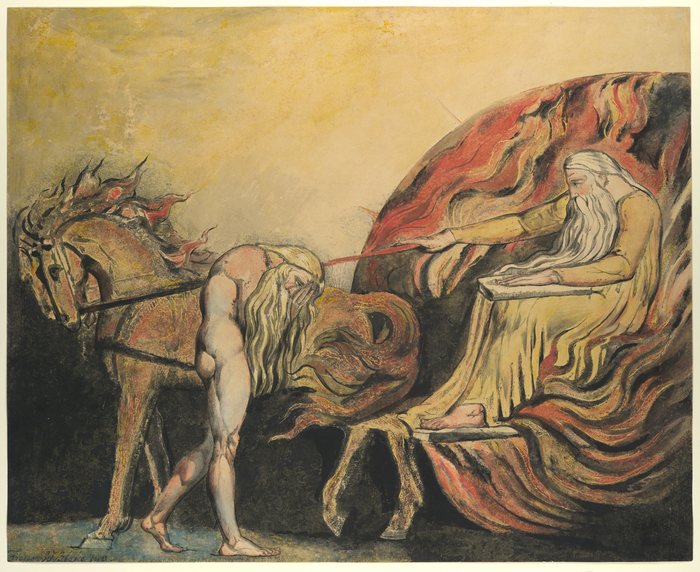
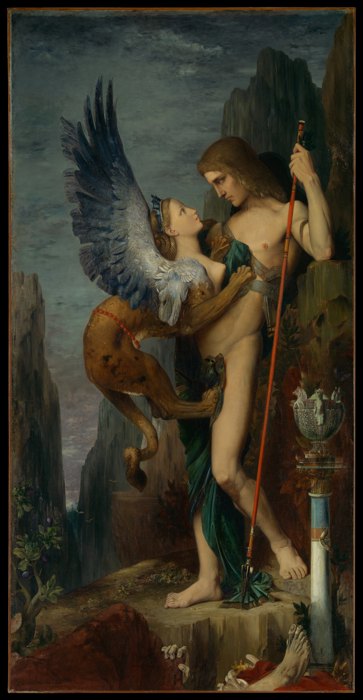
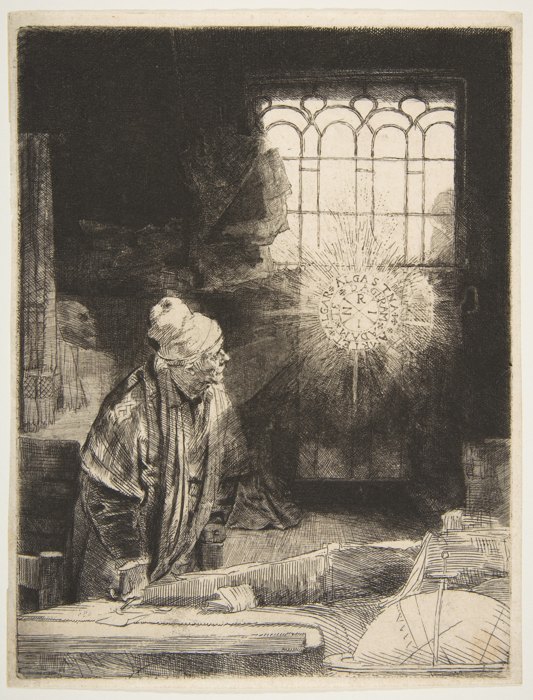
Also carrying the Angel and the Wing
42 works carry it. The 6 where it is the central motif are here. The symbol.
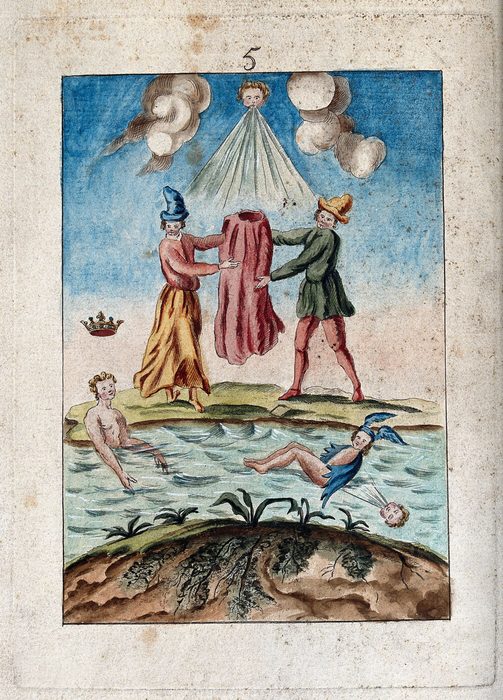
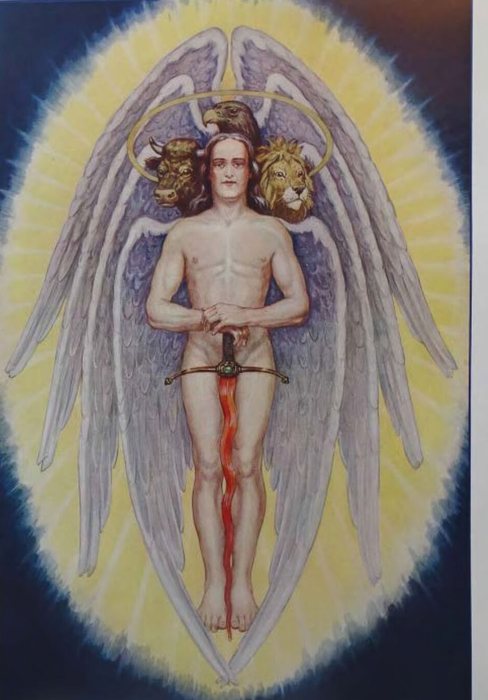
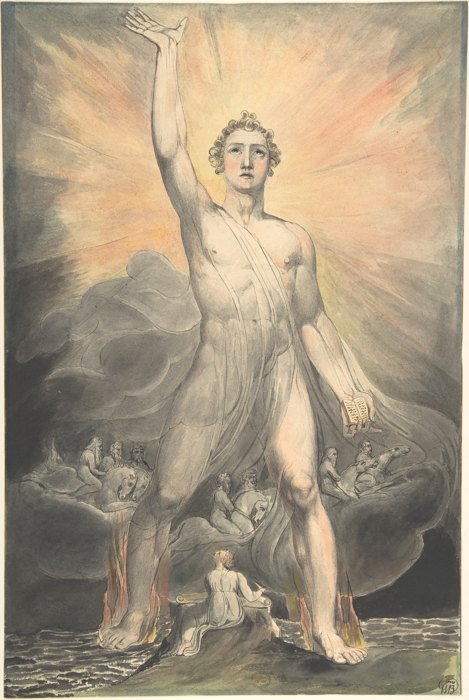
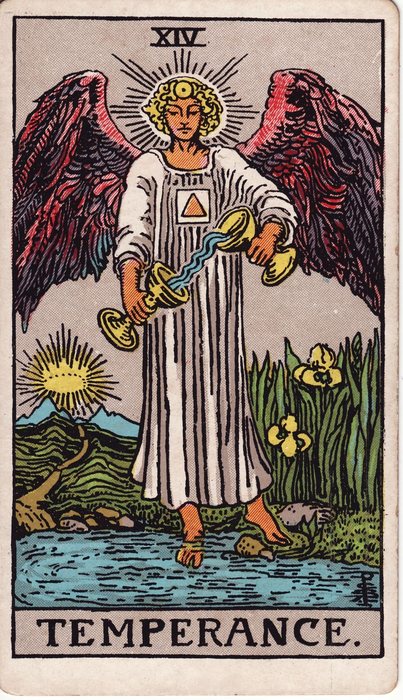
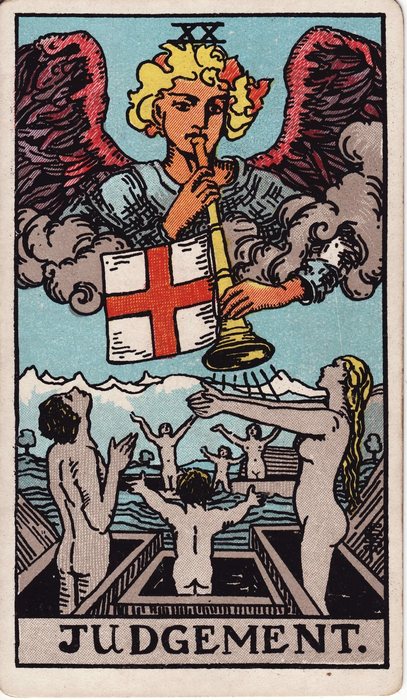
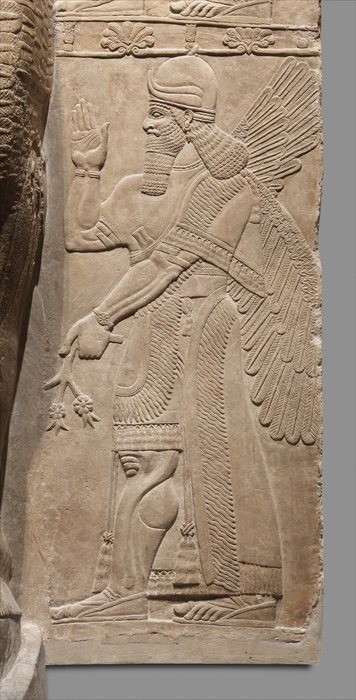
Where the detail is the subject
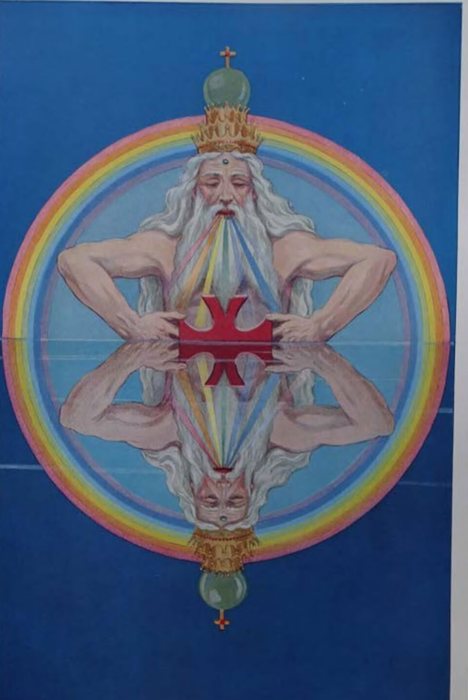
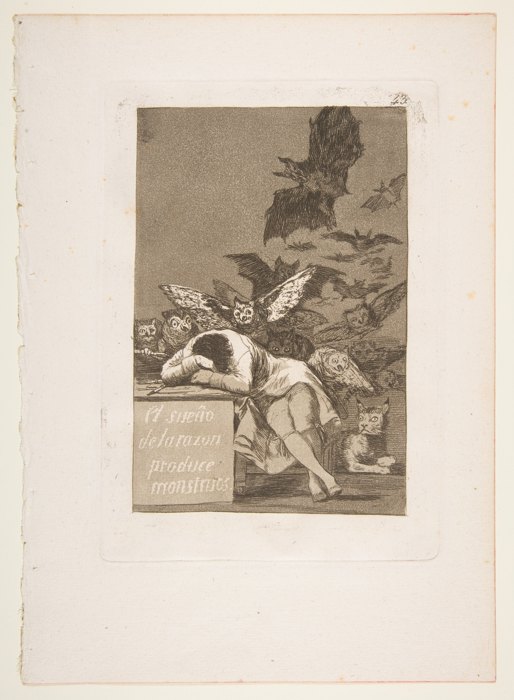
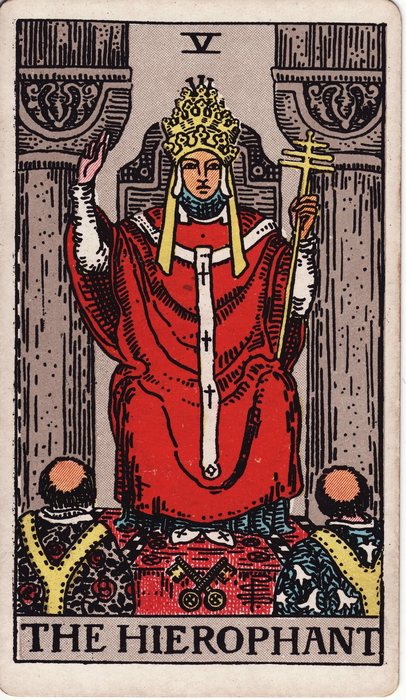
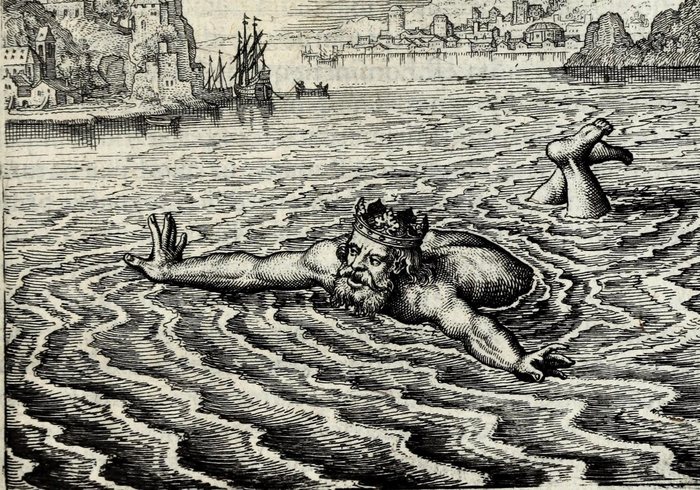
the Heavens · the Demon and the Monster · the Crown · the Water · the Triangle and the Pyramid
Each of these is in the picture without being what it is about. Below, one work that is about each.
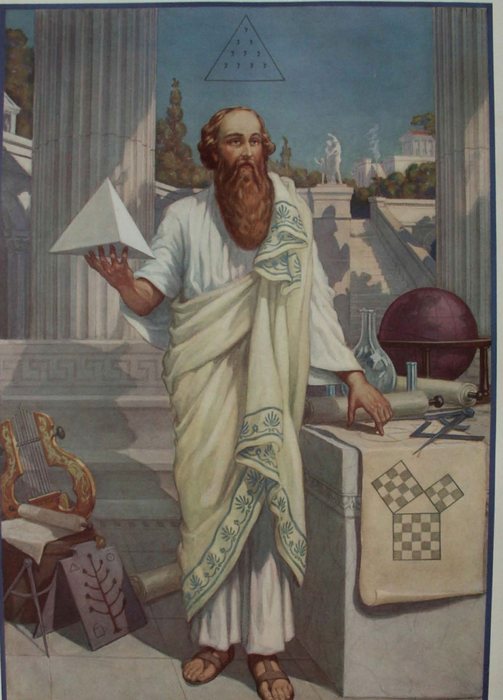
By the same hand
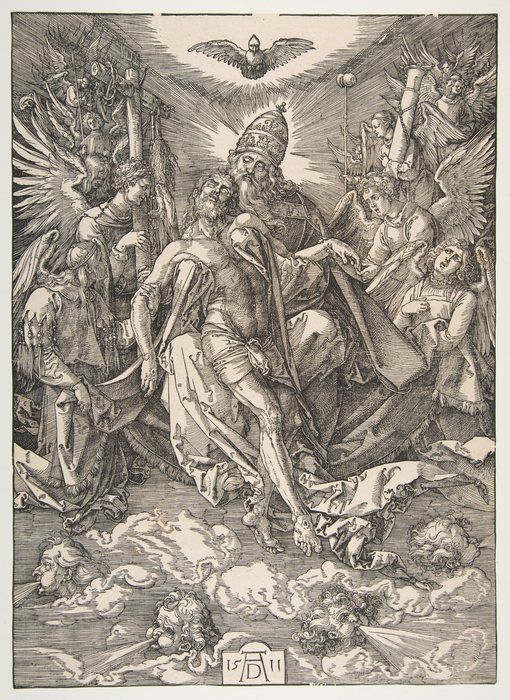
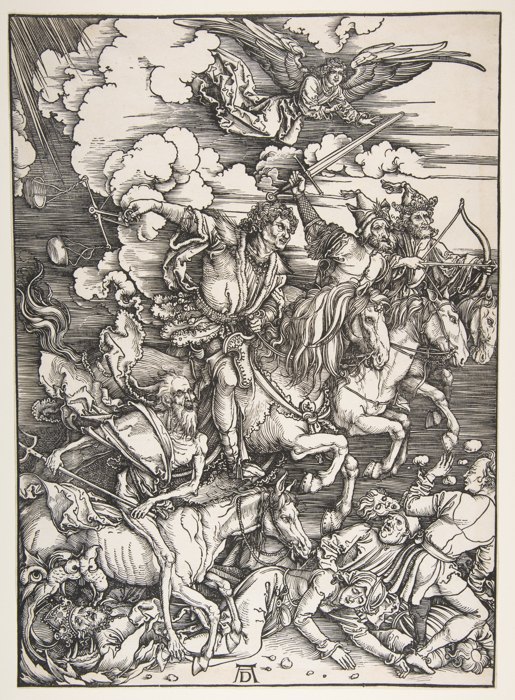
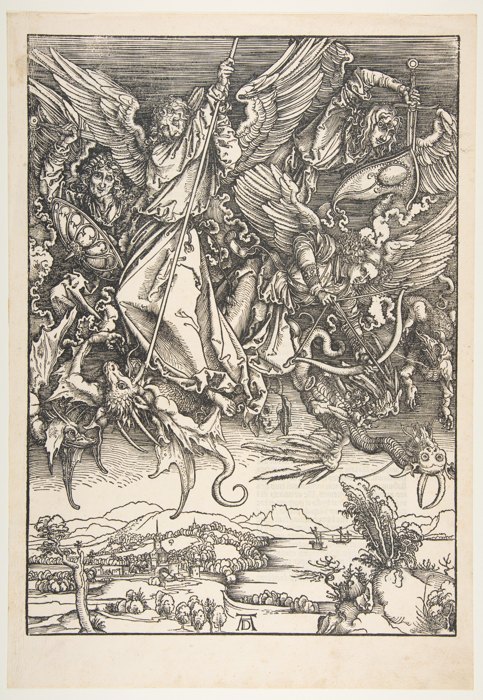
In the same series
Record
One symbol a week, decoded.
This picture is free at full size from its source, linked above. What an address gets is the Sunday letter: one picture, one symbol marked on it, what it meant and who said so, and the master files of the decoded plates as they are verified. Leave any time.
Free, one letter a week, unsubscribe in one click. How the address is used.
Scroll or pinch to zoom · drag to move · double-tap for 1:1 · 1109 by 1400 pixel web copy; the source file is linked under Record