Pythagoras of Crotona
The Triangle and the Pyramid as the central motif. From The Secret Teachings.
What is happening
Hall, 1928 “All too lightly the world has passed over the achievements of the first "philosopher" to whom it is indebted for so many of the basic theorems of mathematics, music, and astronomy.”
Key · 1 motif
Tap a motif on the picture, or a line below. Its note opens under the line, with the reading its author gave it.
- Primary motif
The picture
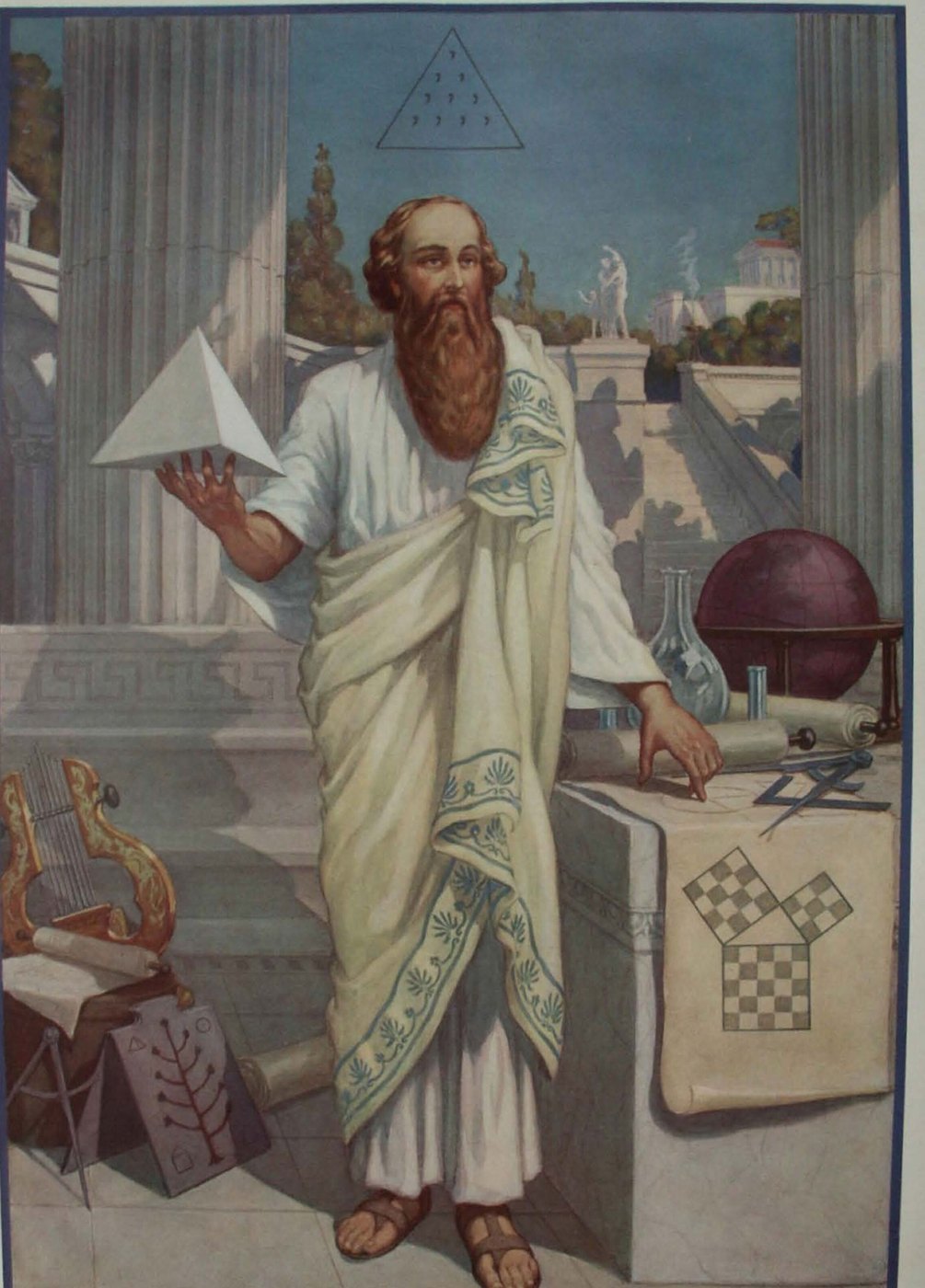
Pythagoras holds a white pyramid; above him the tetractys, the triangle of ten points; a sphere, a lyre and a checkered pavement design around him; by eye. Hall's caption is about the man and his school, not the objects. By eye
The reading
The picture read whole, in the archive's words, from the sources quoted on the marks. Read on, and the picture follows: the motif under discussion keeps its colour.
Knapp painted the philosopher as a lecturer among his instruments, and Hall's caption complains on his behalf: all too lightly the world has passed over the achievements of the first philosopher to whom it is indebted for so many of the basic theorems of mathematics, music, and astronomy. The plate is that complaint set right. Pythagoras stands in a white robe between classical columns, with a temple and a statue behind him, and everything round him is a proof.
Over his head, in a small triangle on the wall, are ten dots in four rows: one, two, three, four. This is the tetractys, and Hall explains it in two places in the book, once as the sign of the number ten, which Pythagoras held to be the most perfect of all numbers, and once through Theon of Smyrna, who said that to the discerning mind the ten dots revealed the mystery of universal nature. The white pyramid in the philosopher's left hand is the same figure lifted off the page, a triangle in every face. He holds it up the way a teacher holds up the thing he is about to explain.
The rest of the picture is the syllabus. A lyre stands at the left, because Pythagoras found that the intervals of music are ratios of small whole numbers; beside it lie a set square, compasses and a scroll with a branching figure drawn on it. On the table a celestial globe rests on its stand next to a glass flask, and a scroll hangs over the edge with the squares on the three sides of a right-angled triangle drawn out in chequers, the theorem that still carries his name; his right hand points a pair of compasses at it. The plate gathers arithmetic, geometry, music and astronomy round one man because that is the quadrivium, the four mathematical arts of the medieval schools, and Hall wanted his reader to see where it began.
The archive keeps only one mark on this plate, because Hall's caption is about the man and his school and does not read the objects one by one; the tetractys and the pyramid are the exception, since the book explains them elsewhere. The lyre, the globe, the flask and the theorem are described here as seen, and they mean what any student of the last two thousand years would take them to mean. That is the plate's argument: that we are all still in this room.
Decoded: every motif is marked, and each mark carries the reading its author gave it, quoted from the text, or says that it is observed on the picture and not read. The reading above is the archive's own, made from those sources and no others.
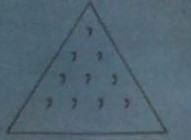
A number made visible. Count the points and then find what else in the picture comes in threes.
In plain words The ten dots over his head are the tetractys, four rows of one, two, three and four, which add up to ten. Pythagoras held ten to be the most perfect number, and this triangle of dots was his sign for it. The white pyramid in his hand is the same idea in three dimensions.
Hall, 1928 “Pythagoras taught that 10, or the unit of the decimal system, was the most perfect of all numbers, and he symbolized the number ten by the lesser tetractys, an arrangement of ten dots in the form of an upright triangle.”
Hall, 1928 “Theon of Smyrna declares that the ten dots, or tetractys of Pythagoras, was a symbol of the greatest importance, for to the discerning mind it revealed the mystery of universal nature.”
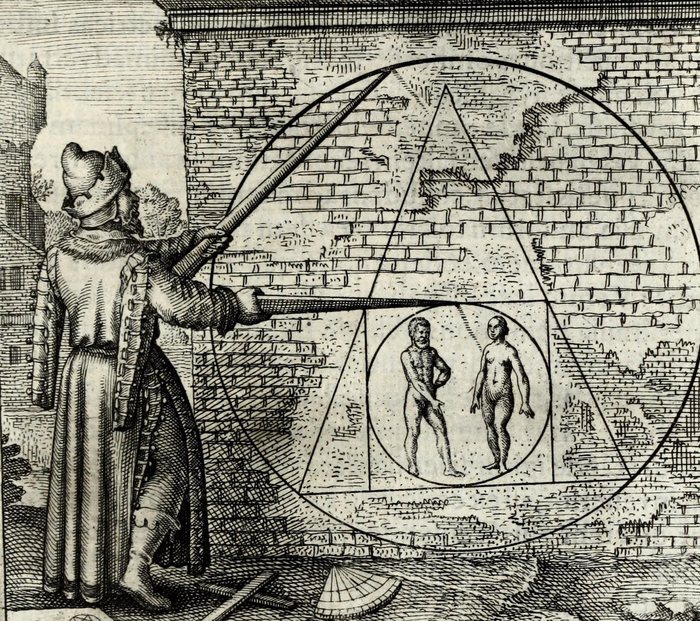
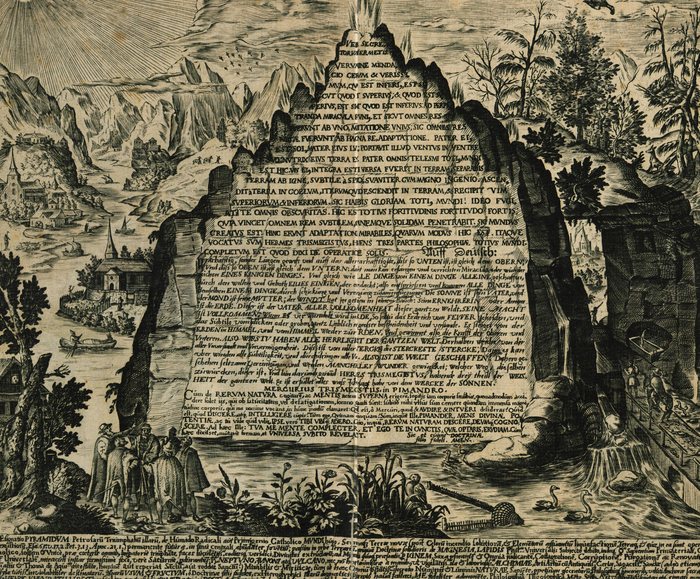
Also carrying the Triangle and the Pyramid
25 works carry it. The 5 where it is the central motif are here. The symbol.
By the same hand
In the same series
Record
One symbol a week, decoded.
This picture is free at full size from its source, linked above. What an address gets is the Sunday letter: one picture, one symbol marked on it, what it meant and who said so, and the master files of the decoded plates as they are verified. Leave any time.
Free, one letter a week, unsubscribe in one click. How the address is used.
Scroll or pinch to zoom · drag to move · double-tap for 1:1 · 1005 by 1400 pixel web copy; the source file is linked under Record