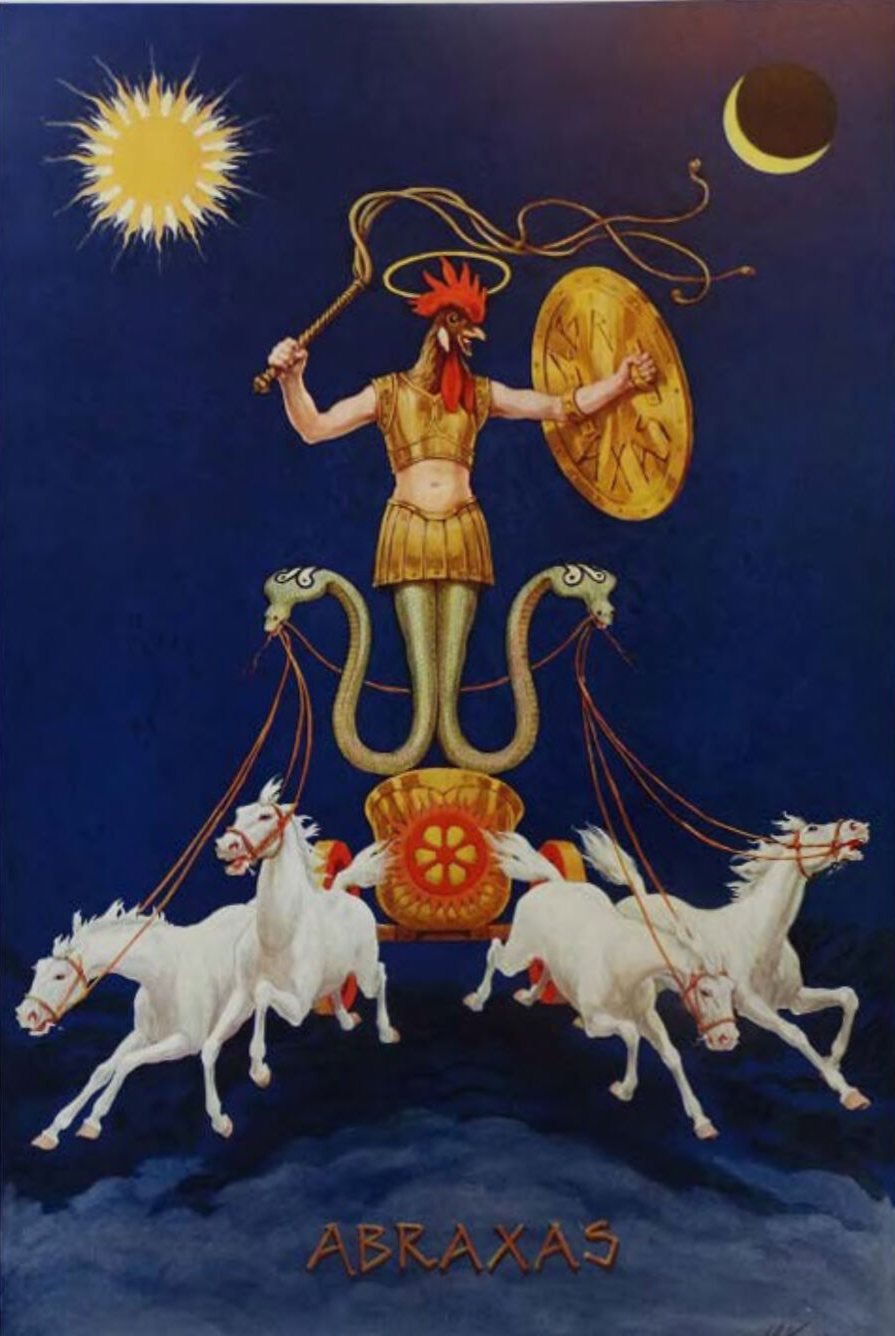
Abraxas, a Gnostic Pantheos
The Demon and the Monster as the central motif, with the Sun and the Moon, the Serpent and the Dragon, the Horse, and the Bird in a secondary part. From The Secret Teachings.
What is happening
Hall, 1928 “The seven-lettered name of ABRAXAS is symbolically significant of his seven-rayed power.”
Hall, 1928 “Basilides taught that the powers of the universe were divided into 365 Æons, or spiritual cycles, and that the sum of all these together was the Supreme Father, and to Him he gave the Qabbalistical appellation Abraxas, as being symbolical, numerologically, of His divine powers, attributes, and emanations.”
Key · 5 motifs
Tap a motif on the picture, or a line below. Its note opens under the line, with the reading its author gave it.
- Primary motif
- Secondary motifs · 3
The picture
A rooster-headed figure in armour, whip raised and shield on the arm, stands in a chariot drawn by four white horses, his legs two serpents; the sun at the upper left, a crescent moon at the upper right, the name ABRAXAS lettered below; the Sun and the Moon as the central motif by Hall's reading of the figure as solar, the Serpent and the Horse by eye; one body made of a rooster, a man and two serpents. By eye
The reading
The picture read whole, in the archive's words, from the sources quoted on the marks. Read on, and the picture follows: the motif under discussion keeps its colour.
The name is written under the picture in red capitals, and the name is most of the point. ABRAXAS has seven letters, and Hall's caption says the seven letters stand for a seven-rayed power; in the Greek way of counting letters as numbers the word adds up to 365, the days of the year, and Basilides of Alexandria, the second-century teacher Hall credits with the idea, divided the powers of the universe into 365 spiritual cycles and called their sum Abraxas. The picture is a word made into a body.
Knapp painted the body as the old gems show it: a rooster's head on the armoured trunk of a man, a whip raised in one hand and a round shield on the other arm, and two serpents in place of legs. Hall calls it a Gnostic Pantheos, an all-god, and quotes the nineteenth-century explanation of C. W. King, who took each part as one of the five emanations of Basilides' system. The rooster's head is Foresight, the bird of vigilance. The shield is Wisdom and the whip is Power.
The serpents are Mind and Word, Nous and Logos, the two supporters that spring from the divine body, and King adds that this is why the Greeks gave the serpent to Pallas Athena. The creature stands on thought and speech. That is a very Gnostic thing to say with a picture, and it is why the figure, which looks like a demon to anyone raised on later devils, was cut on amulets to protect their wearers.
Knapp put the whole figure into a chariot and gave it four white horses, which no ancient gem does. Hall's caption explains the addition: the four horses are the four ethers by which the solar power circulates through every part of the universe. The chariot is the sun's, and the composite god drives it.
In the corners are a blazing sun and a crescent moon, and about these Hall says nothing. They are recorded here as seen. A reader who wants to take them as the two lights between which a solar god rides is welcome to, but the archive does not put that in Hall's mouth. What the picture does say, on its own face and in its author's words, is that a god can be spelled: seven letters, five parts, four horses, 365 days, one name.
Decoded: every motif is marked, and each mark carries the reading its author gave it, quoted from the text, or says that it is observed on the picture and not read. The reading above is the archive's own, made from those sources and no others.
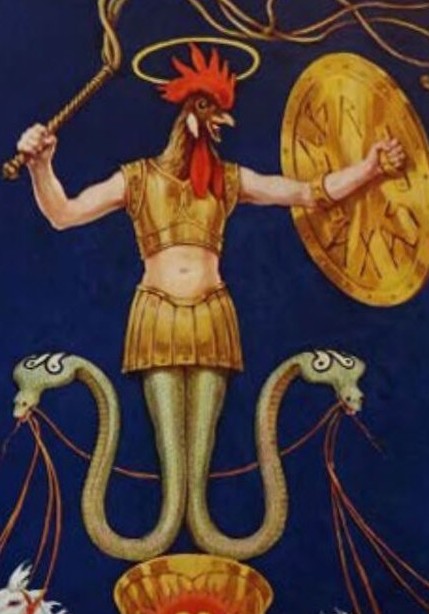
Almost always a composite and almost always subordinate. Note what it is made of and whether it is bound.
In plain words One creature made of three: a rooster's head on a man's armoured body, and where the legs should be, two serpents. It is not a monster in the story sense. The Gnostic teachers who used the name Abraxas built the figure as a diagram of God's powers, each part a word in a sentence.
Hall, 1928 “Abraxas is usually symbolized as a composite creature, with the body of a human being and the head of a rooster, and with each of his legs ending in a serpent.”
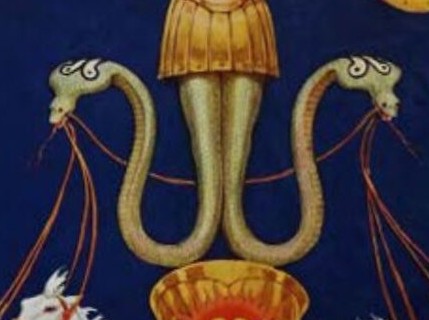
A single creature doing two opposite jobs. Note whether it is bound, killed, or eating itself.
In plain words The two serpents that serve him for legs are, in the old explanation Hall quotes, Mind and Word, the two supports of the divine body. Read them as what he stands on: thought and speech.
King, quoted by Hall, 1928 “From the human body, the usual form assigned to the Deity, spring the two supporters, Nous and Logos, expressed in the serpents, symbols of the inner senses, and the quickening understanding; on which account the Greeks had made the serpent the attribute of Pallas.”
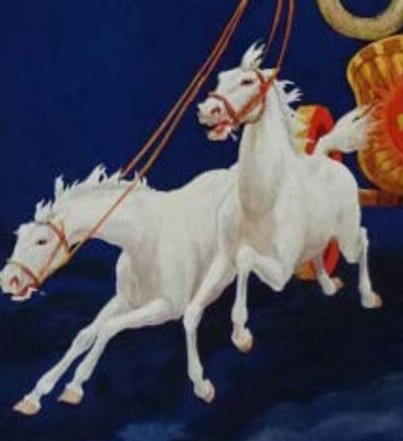
Almost never the subject. Read the rider, then read what the colour of the horse is doing.
In plain words The four white horses are, in Hall's caption, the four ethers, the fine substances through which the power of the sun was believed to travel to every part of the universe. Abraxas rides them because his power is solar, and it has to get everywhere.
Hall, 1928 “The four white horses drawing the chariot of ABRAXAS symbolize the four ethers by means of which the solar power, ABRAXAS, is circulating through all parts of the universe.”
Gold, the perfected metal, and the illuminated intellect. The most overloaded symbol in the tradition.
In plain words The sun and the crescent moon sit in the two upper corners like a date stamp. Hall does not mention them. They are the archive's observation only, and the likeliest reading, that a solar god is shown between the two lights, is left as a guess.
Symbolica Hall's caption reads the figure itself as the solar power and does not name the sun and the moon painted in the corners. Observed on the plate, and left unread rather than guessed.
Also carrying the Demon and the Monster
23 works carry it. The 6 where it is the central motif are here. The symbol.
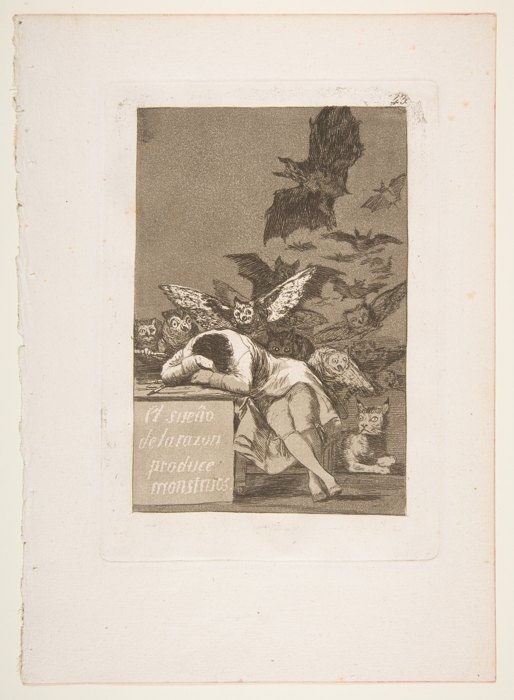 The Sleep of Reason Produces Monsters
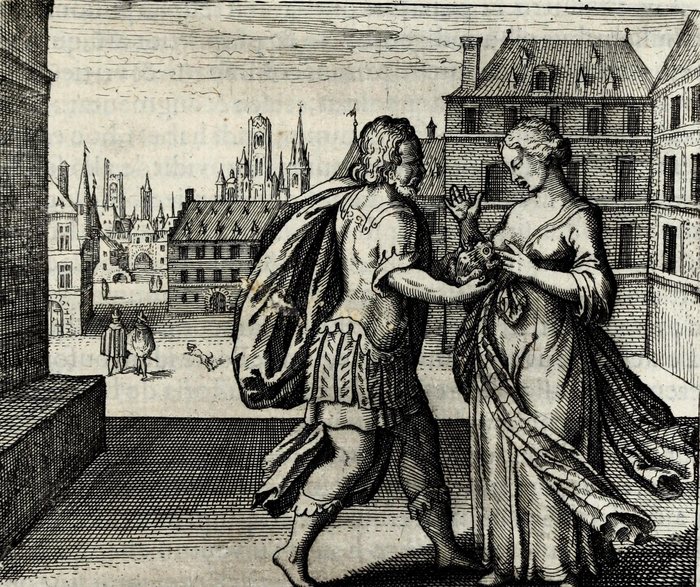 Appone mulieri super mammas bufonem, ut ablactet eum, & moriatur mulier, sitque bufo grossus de lacte
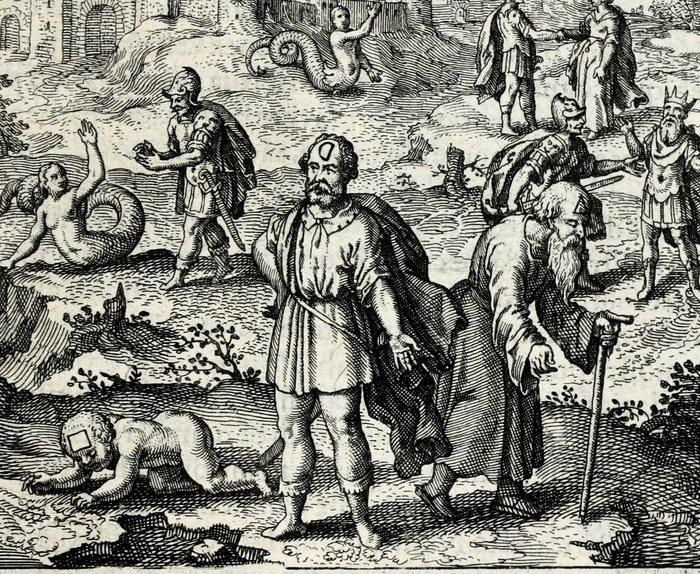 Oedypus Sphynge superata & trucidato Lajo patre matrem ducit in uxorem
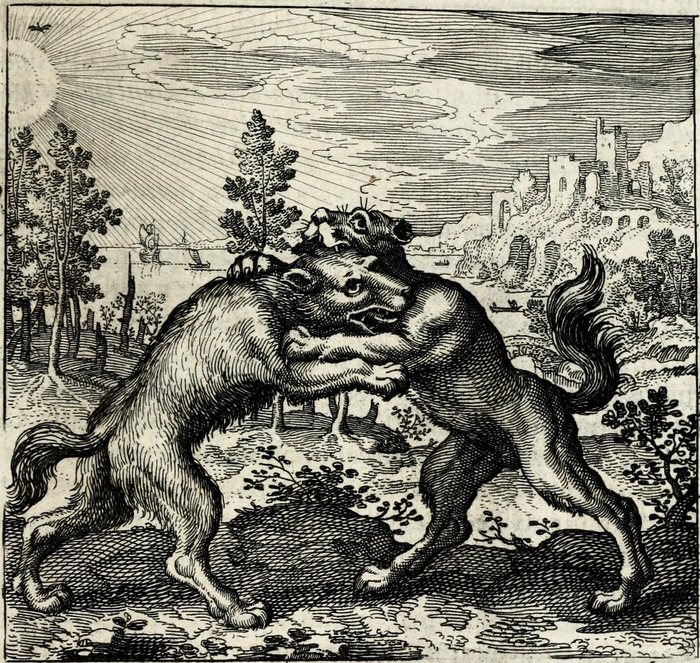 Lupus ab Oriente & Canis ab Occidente venientes se invicem momorderunt
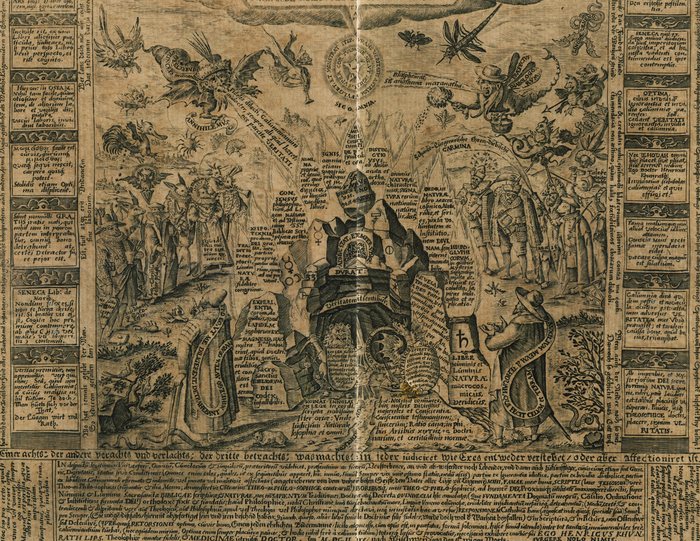 Against the slanderers, by right of retort
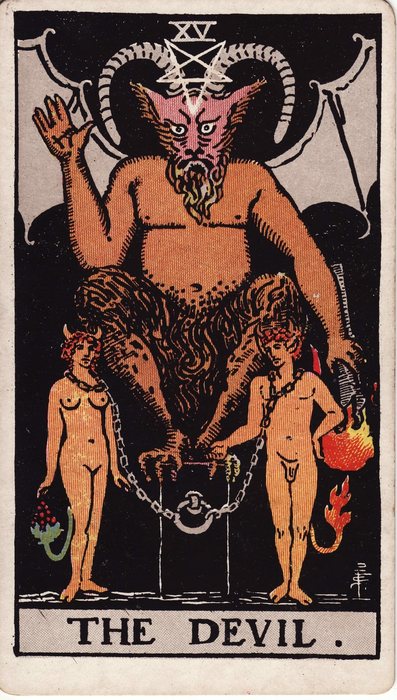 The Devil (XV)
Where the detail is the subject
the Sun and the Moon · the Serpent and the Dragon · the Horse · the Bird
Each of these is in the picture without being what it is about. Below, one work that is about each.
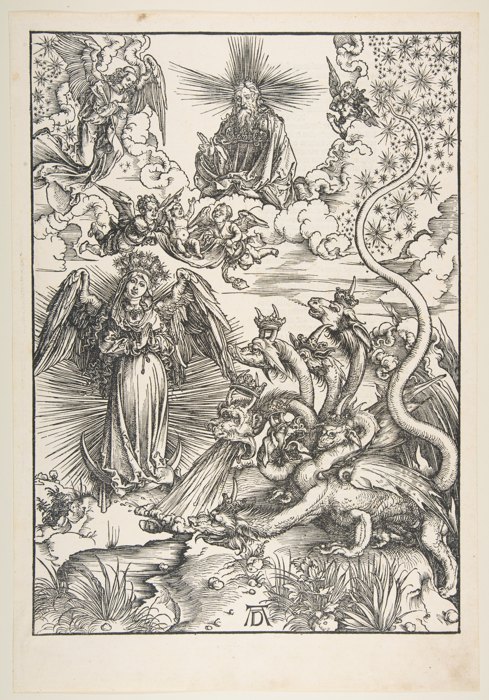
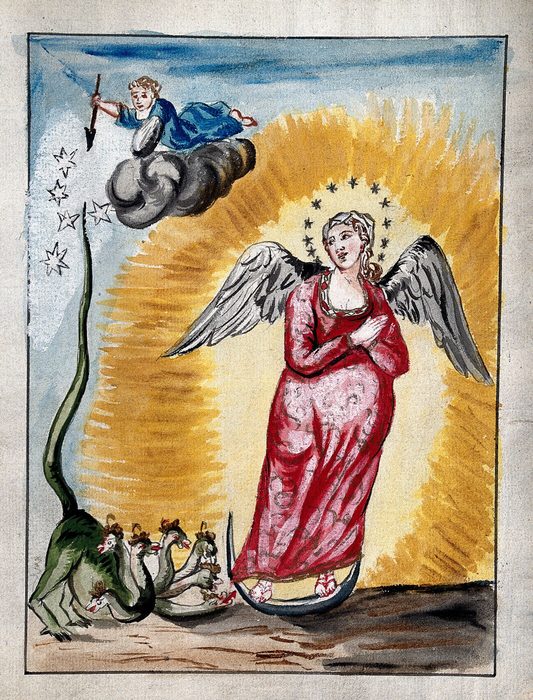
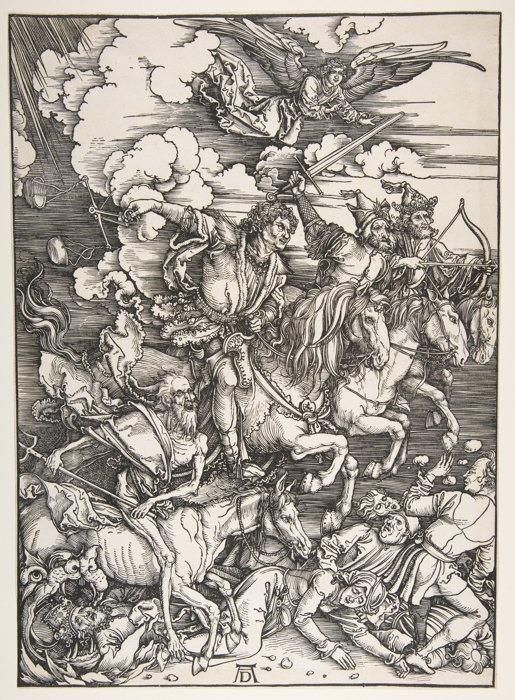
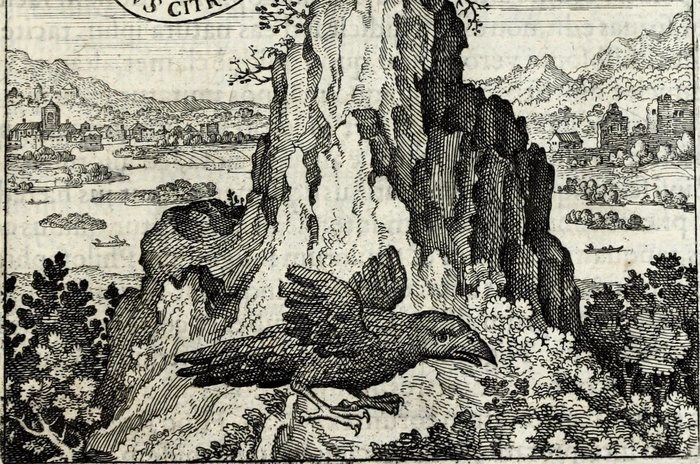
By the same hand
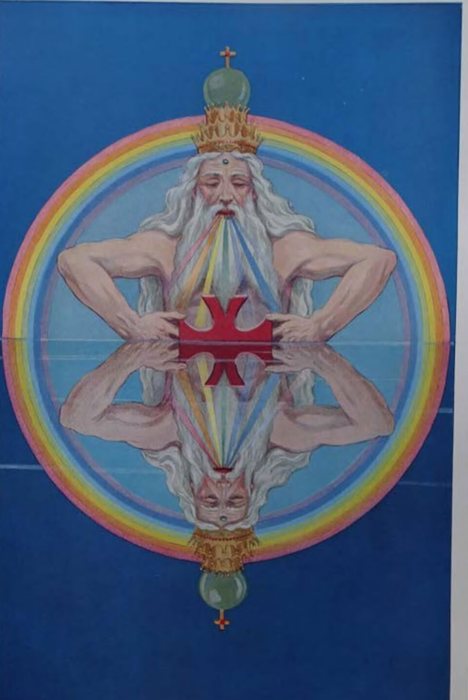
In the same series
Record
One symbol a week, decoded.
This picture is free at full size from its source, linked above. What an address gets is the Sunday letter: one picture, one symbol marked on it, what it meant and who said so, and the master files of the decoded plates as they are verified. Leave any time.
Free, one letter a week, unsubscribe in one click. How the address is used.
Scroll or pinch to zoom · drag to move · double-tap for 1:1 · 895 by 1336 pixel web copy; the source file is linked under Record