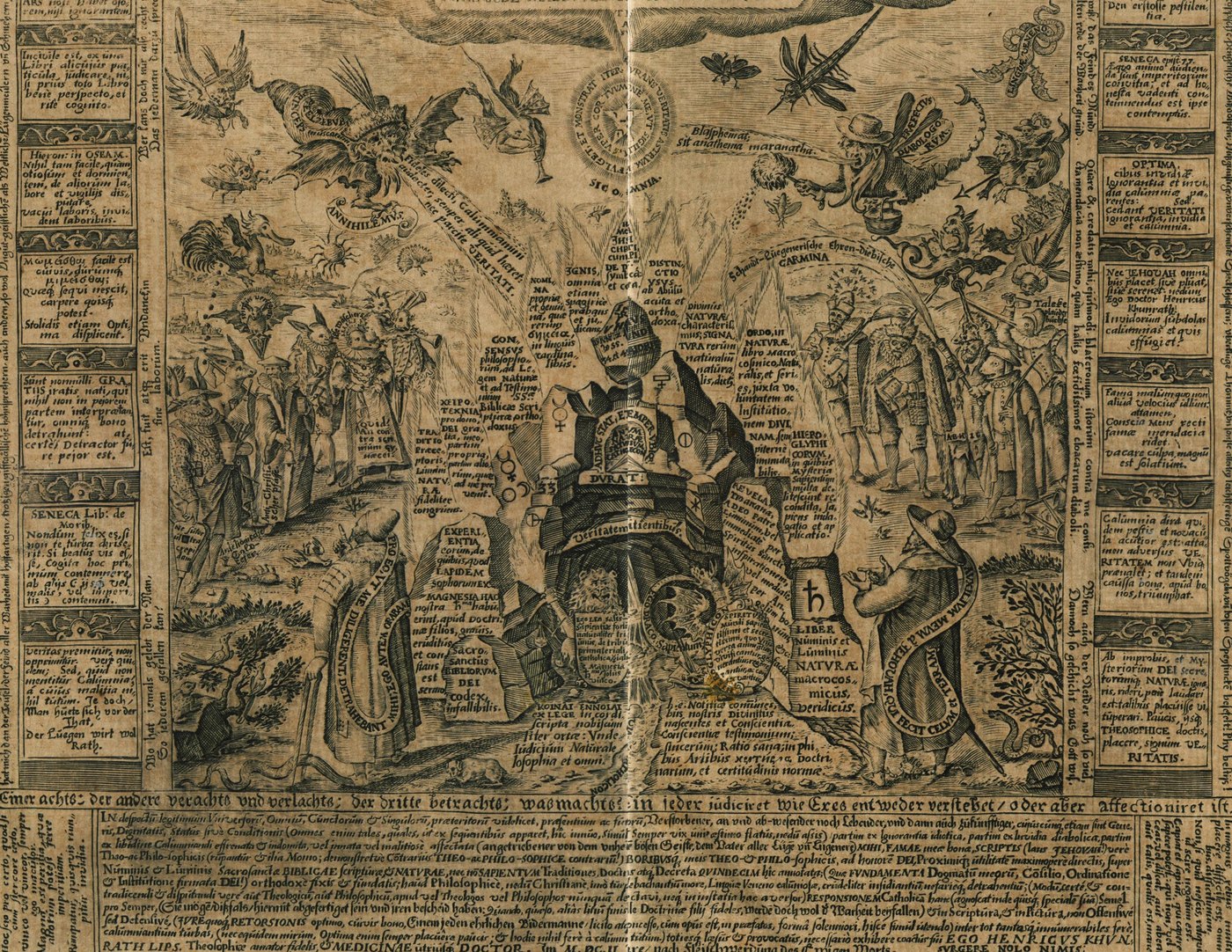
Against the slanderers, by right of retort
The Demon and the Monster as the central motif, with the Serpent and the Dragon, the Triangle and the Pyramid, and the Divine in a secondary part. From Amphitheatrum.
What is happening
Heinrich Khunrath, 1602 “Jure quoque Retorsionis optimo.”
Heinrich Khunrath, 1602 “Henricus Khunrath Lips. Theosophiae amator fidelis, et Medicinae utriusque Doctor. Im M.DC.II.”
Symbolica, 2026 Khunrath's Latin, put into English here: also by the best right of retort. The serpent is lettered with the poison of the tongue. The caption is Khunrath's answer to those who slandered him, and the winged creatures over the scene are the slanderers. The title given is the archive's description; the caption is transcribed here only in part.
Heinrich Khunrath, 1602 “Nec IEHOVAH omnibus placet, sive pluat, sive serenet: nedum Ego Doctor Henricus Khunrath! Invidorum subdolas calumnias et quis effugiet?”
Key · 4 motifs
Tap a motif on the picture, or a line below. Its note opens under the line, with the reading its author gave it.
- Primary motif
- Secondary motifs · 3
The picture
The winged things in this sky are flies, dragonflies and devils in hats, not birds, so the bird tag is gone; the divine tag is new, because the Name at the head of the plate was outside the archive's earlier cut. By eye
The reading
The picture read whole, in the archive's words, from the sources quoted on the marks. Read on, and the picture follows: the motif under discussion keeps its colour.
This is the one sheet in the Amphitheatrum that is not about the work at all. It is about the people who attack the man doing it, and Khunrath signs it as a legal act: also by the best right of retort.
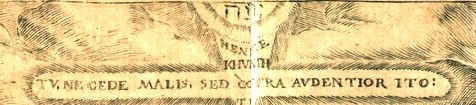
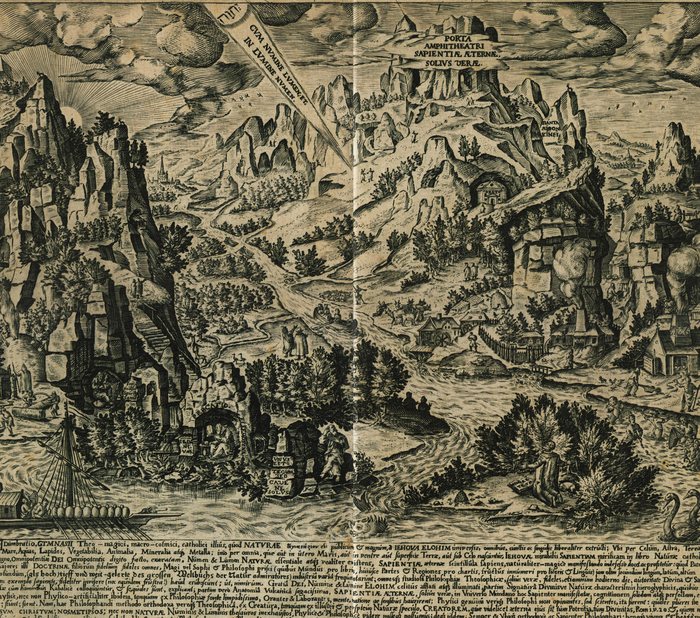
The picture is built as a courtroom stacked vertically. At the top, in a radiance among the clouds, is the Name in Hebrew, and cut directly beneath it, in the vocative, is Henrice Khunrath. That is a remarkable thing to put on a plate: not a dedication and not a prayer, but the Name turned to face the author by name, above his head, while below him the air fills with his enemies. Under both runs a line of Virgil, yield not to evils but go against them more boldly. The archive lost all three of these for a while, because the cut it held began below them.
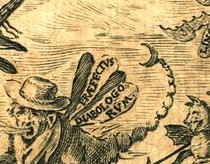
The sky is the second storey and it belongs to the slanderers. They are flies, dragonflies, and devils in scholars' hats, and the chief of them is given an office on a banner across his wings, prefect of the devil-talkers, while he sprinkles filth from a bucket over everything beneath. Nothing here is grand. Khunrath's point is that abuse is vermin: numerous, airborne, and beneath argument.
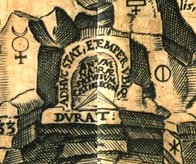
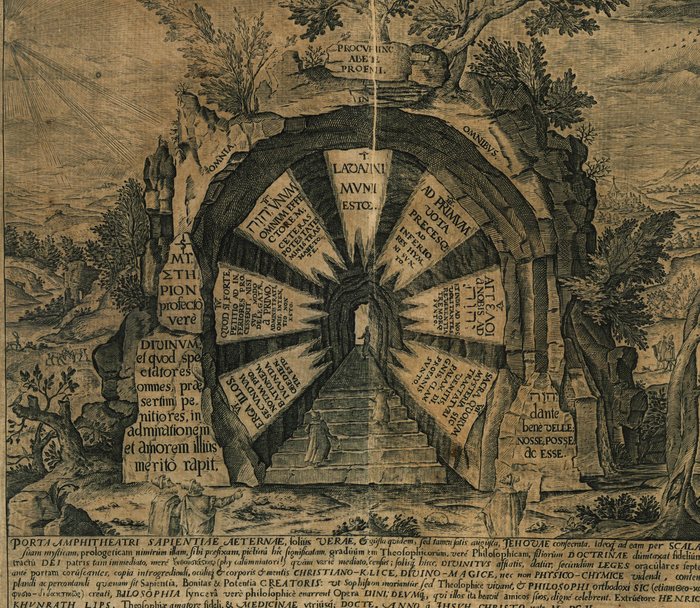
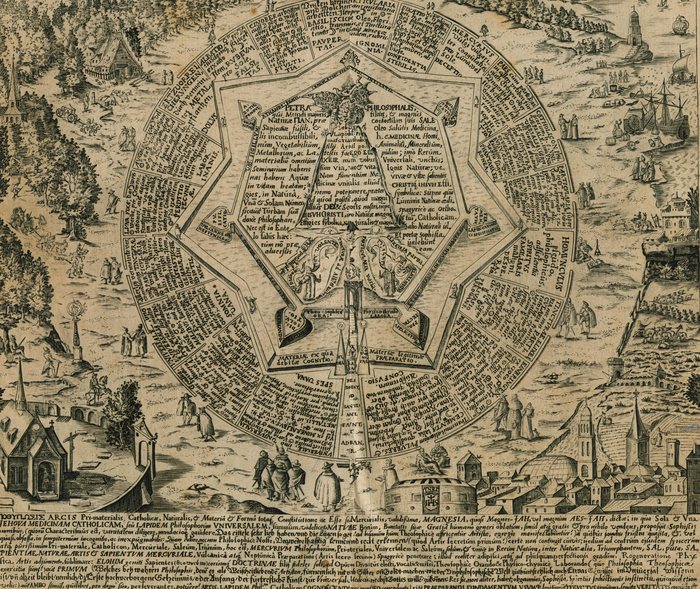
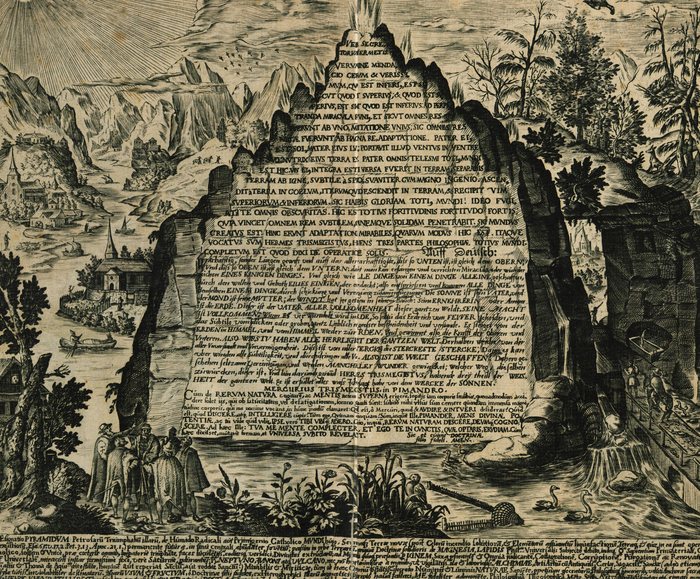
The ground floor is the rock at the centre, and the rock is the answer to all of it. An arch cut into it says the thing still stands and always and everywhere endures, and inside the arch, over a small pediment, is what the thing is. Around the rock, on stones and scrolls and tablets, Khunrath letters where knowledge actually comes from, and the list is the most useful thing on the sheet: fire, which proves and judges everything even spagyrically; the proper and genuine names of things; the consensus of philosophers, agreeing with the law of nature and with the testimony of Scripture; handwork, partly his own and partly what came to him from others; the teaching handed down by a master; experience; the sharp distinction of use from abuse; the signature of natural things; the order of the macrocosmic book of nature; the patient reading of hieroglyphs; and revelation. A man defending himself against the charge of making things up answers by printing his sources.
Down both margins, in ruled boxes, the defence is conducted by other people: Jerome on Hosea, that nothing is easier than to judge, idle and asleep, the labour and the vigils of others; Seneca, that the abuse of the ignorant is to be heard with an even mind and that a man walking toward honourable things must despise contempt itself; and one box that is Khunrath's alone, and is the best sentence on the plate. Not even Jehovah pleases everybody, he writes, whether he rains or clears the sky: much less I, Doctor Henricus Khunrath. And who shall escape the sly slanders of the envious?
At the right edge one enemy is given a body rather than a face, a coiled form with two words wound along it, the poison of the tongue. Under everything, filling the foot of the sheet, is a long German paragraph in which the same argument is made again at length for readers with no Latin, which tells you who Khunrath expected to be reading the attacks.
Decoded: every motif is marked, and each mark carries the reading its author gave it, quoted from the text, or says that it is observed on the picture and not read. The reading above is the archive's own, made from those sources and no others.
Almost always a composite and almost always subordinate. Note what it is made of and whether it is bound.
In plain words The slanderer is drawn as a devil in a scholar's hat, sprinkling filth from a bucket, and the banner across his wings gives him an office: prefect of the devil-talkers. Round him the air is full of flies, dragonflies and lesser devils, which is the plate's argument about what abuse actually is. A second banner nearby pronounces the sentence on blasphemy in the words of Saint Paul.
Heinrich Khunrath, 1602 “PRAEFECTVS DIABOLOGORVM”
Heinrich Khunrath, 1602 “Blasphemat: sit anathema maranatha.”
God shown, or pointed at. Look for what stands where a face would be: a name in a cloud, a circle above the top of a diagram, a ring of verses, a sign over a head.
In plain words The plate opens with the divine Name in Hebrew, set in a radiance in the clouds. Directly under it the engraver has cut a name in the vocative, Henrice Khunrath, so the Name is not merely present but addressed to the man whose book this is, and under that runs a line of Virgil. This is a defence, and it begins by placing the defendant under the Name and giving him a Roman poet's nerve.
Heinrich Khunrath, 1602 “TV NE CEDE MALIS, SED CONTRA AVDENTIOR ITO:”
Heinrich Khunrath, 1602 “HENRICE KHVNRATH”
A number made visible. Count the points and then find what else in the picture comes in threes.
In plain words At the centre of the picture is a rock, and cut into it an arch over a small pediment. The arch says the thing stands and endures; inside it, in four lines, is what the thing is, the light of nature or the catholic right; along the foot of the rock it is offered to those who are thirsty for truth. The first word inside the arch falls on the fold of the scan and is not read here.
Heinrich Khunrath, 1602 “ADHVC STAT, ET SEMPER VBIQ. DVRAT!”
Heinrich Khunrath, 1602 “NATVRAE, SIVE IVS CATHOLICON”
Heinrich Khunrath, 1602 “Veritatem sitientibus.”
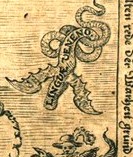
A single creature doing two opposite jobs. Note whether it is bound, killed, or eating itself.
In plain words At the right edge a coiled body carries a banner of two words, the poison of the tongue. It is the one place on a crowded sheet where the abuse is given a body rather than a face, and the body chosen is the oldest one there is for a mouth that does harm.
Heinrich Khunrath, 1602 “Lingue veneno.”
Also carrying the Demon and the Monster
23 works carry it. The 6 where it is the central motif are here. The symbol.
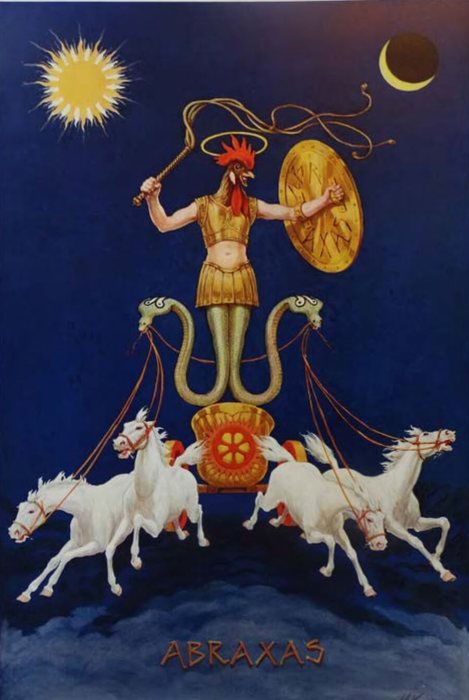 Abraxas, a Gnostic Pantheos
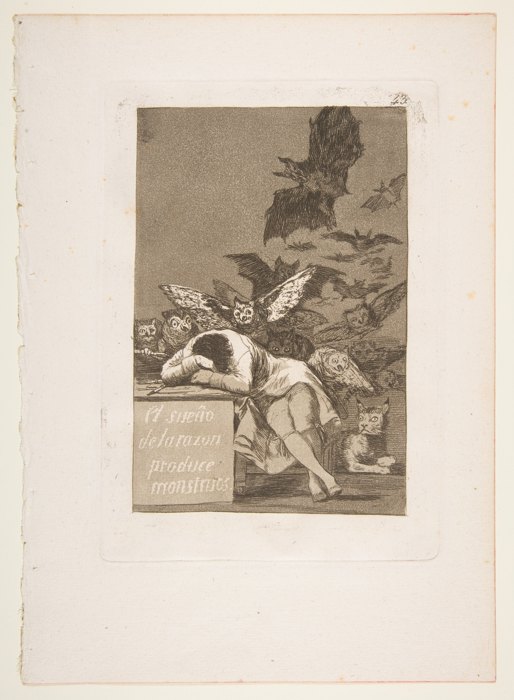 The Sleep of Reason Produces Monsters
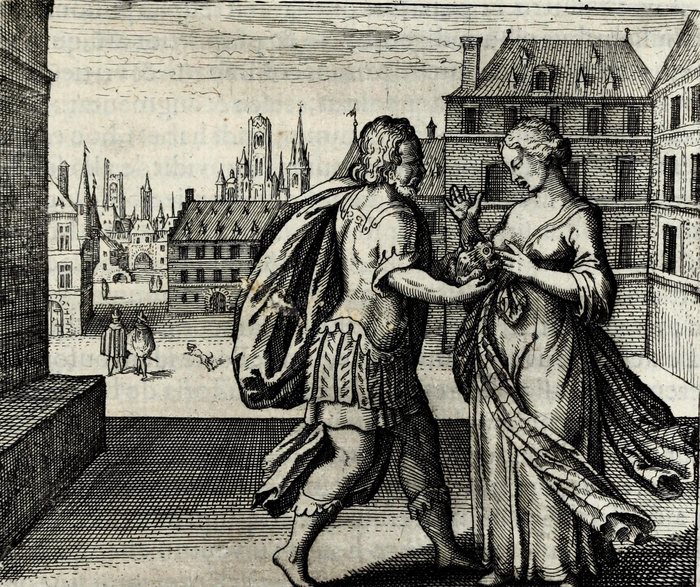 Appone mulieri super mammas bufonem, ut ablactet eum, & moriatur mulier, sitque bufo grossus de lacte
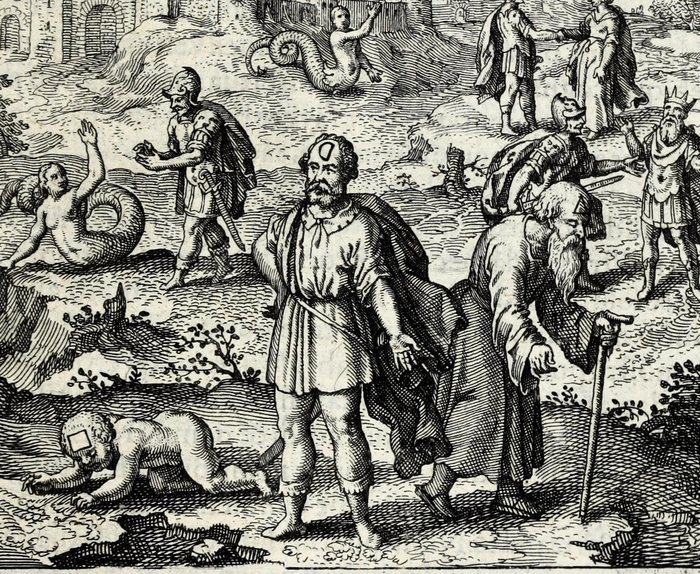 Oedypus Sphynge superata & trucidato Lajo patre matrem ducit in uxorem
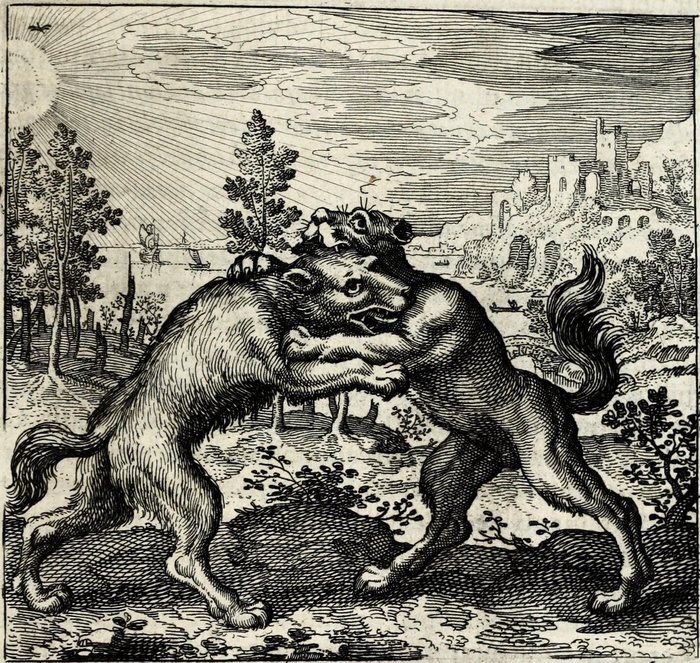 Lupus ab Oriente & Canis ab Occidente venientes se invicem momorderunt
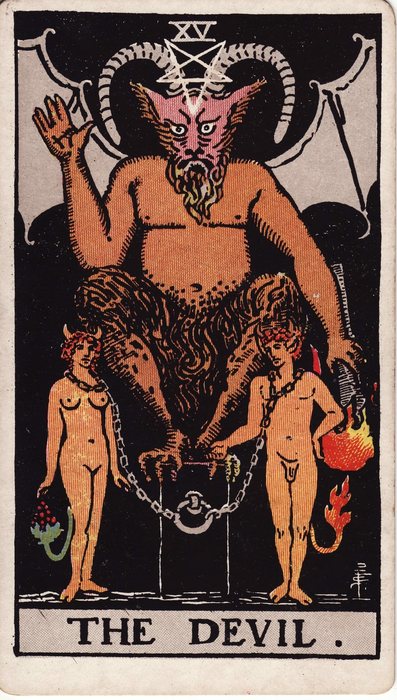 The Devil (XV)
Where the detail is the subject
the Serpent and the Dragon · the Triangle and the Pyramid · the Divine
Each of these is in the picture without being what it is about. Below, one work that is about each.
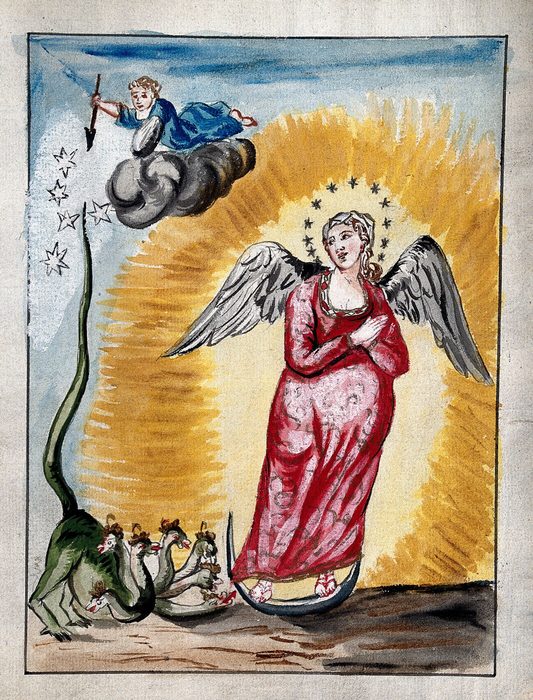
In the same series
Record
One symbol a week, decoded.
This picture is free at full size from its source, linked above. What an address gets is the Sunday letter: one picture, one symbol marked on it, what it meant and who said so, and the master files of the decoded plates as they are verified. Leave any time.
Free, one letter a week, unsubscribe in one click. How the address is used.
Scroll or pinch to zoom · drag to move · double-tap for 1:1 · 1400 by 1169 pixel web copy; the source file is linked under Record