Heinrich Khunrath
physician and theosopher of Leipzig, about 1560 to 1605, who devised the plates of the Amphitheatrum and wrote their captions; the Oratory and Laboratory was drawn by Hans Vredeman de Vries and engraved by Paullus van der Doort in 1595.
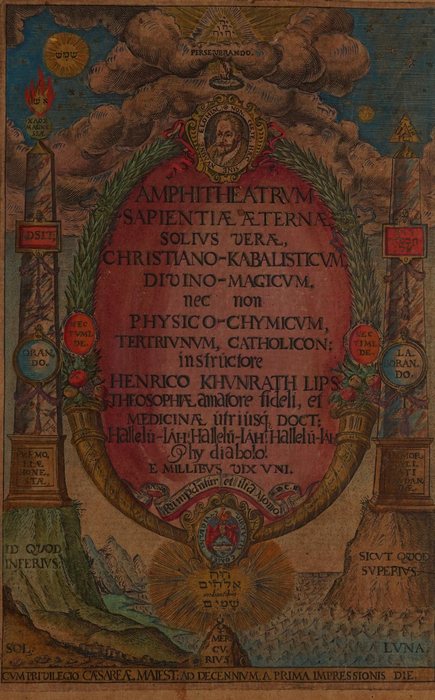 The engraved title of the Amphitheatrum Sapientiae Aeternae
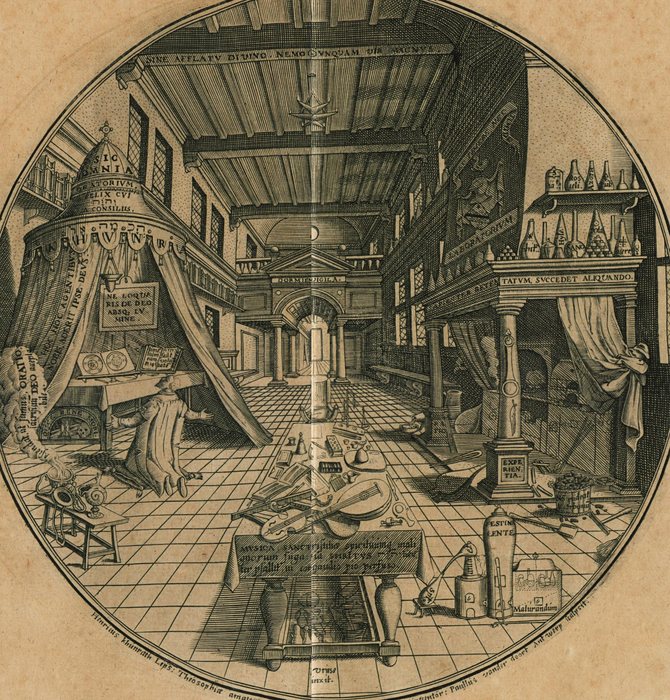 The Oratory and the Laboratory
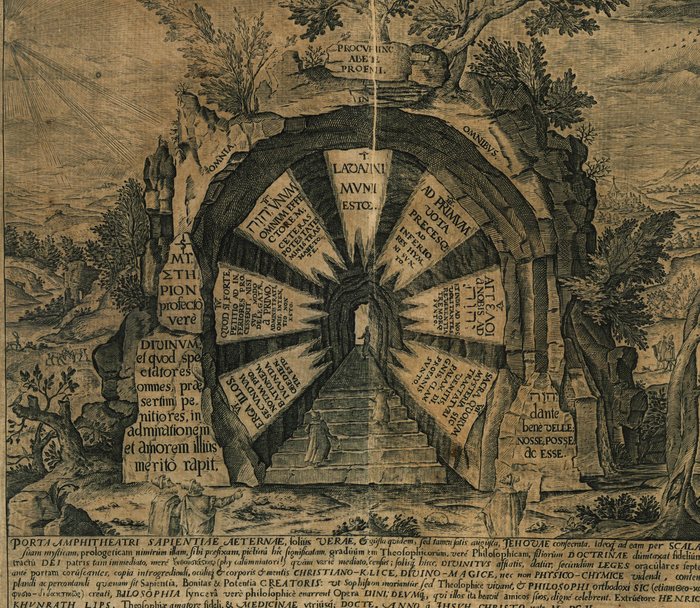 Porta Amphitheatri Sapientiae Aeternae
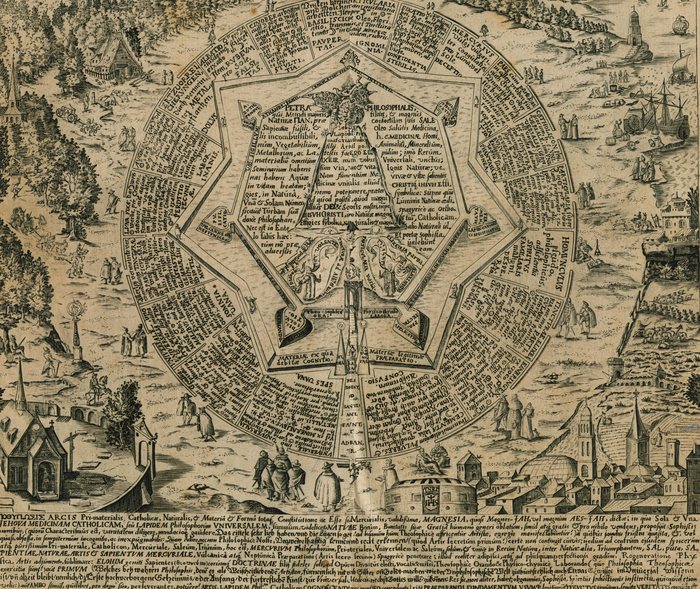 Typosis Arcis Pri-materialis
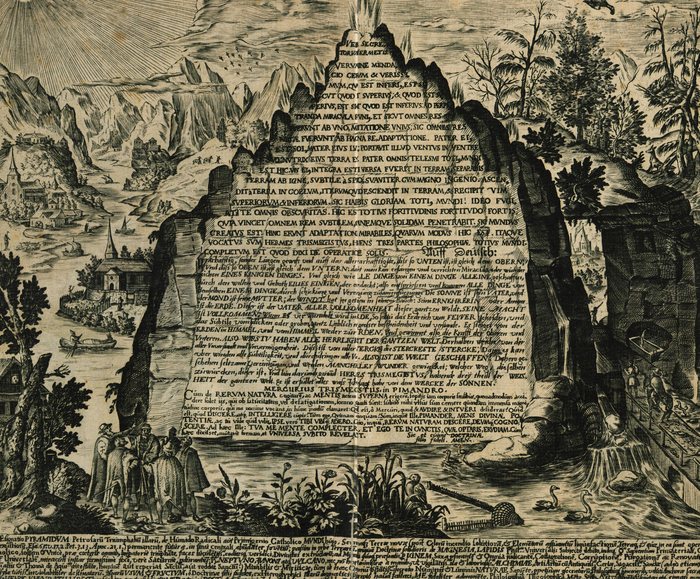 Designatio Pyramidum Petrosarum Triumphalium
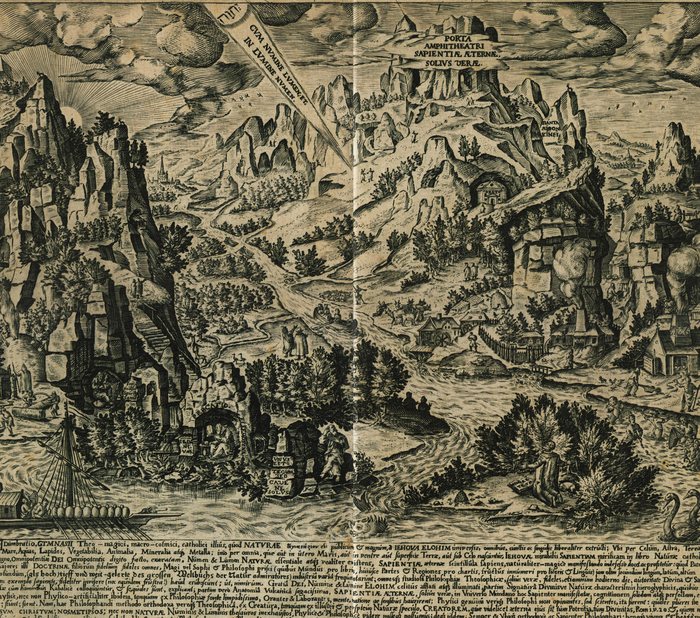 Adumbratio Gymnasii Theo-magici, macro-cosmici, catholici
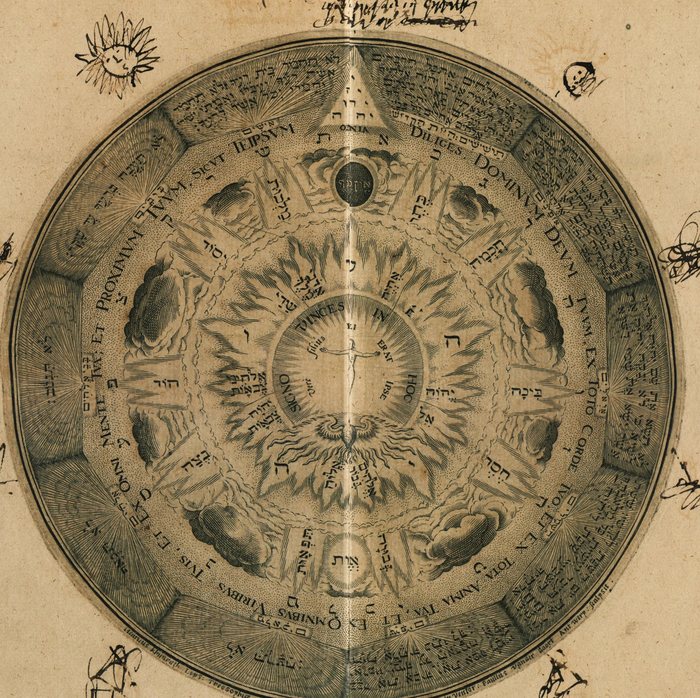 The Name in the pyramid, Christ in the sun, and the two commandments round the rim
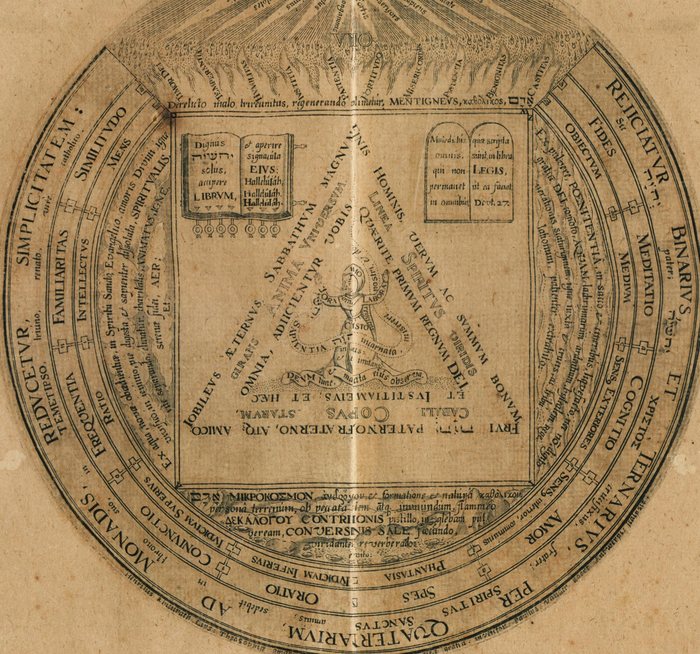 The regenerate man, Ora and Labora lettered on his arms, with the Book and its seals
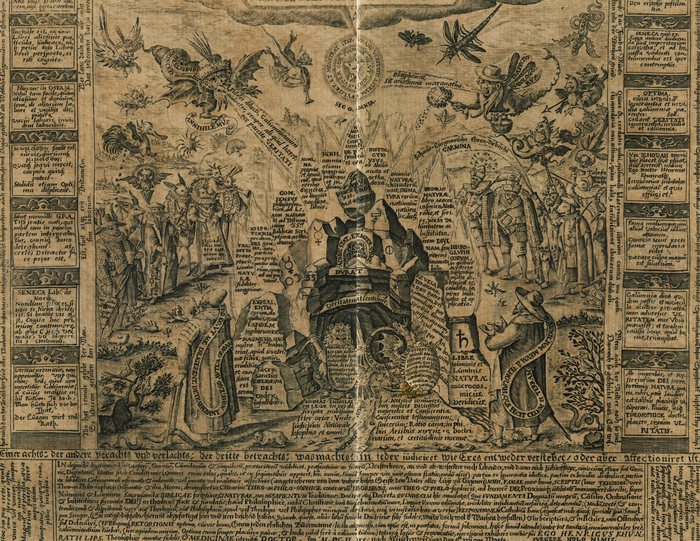 Against the slanderers, by right of retort
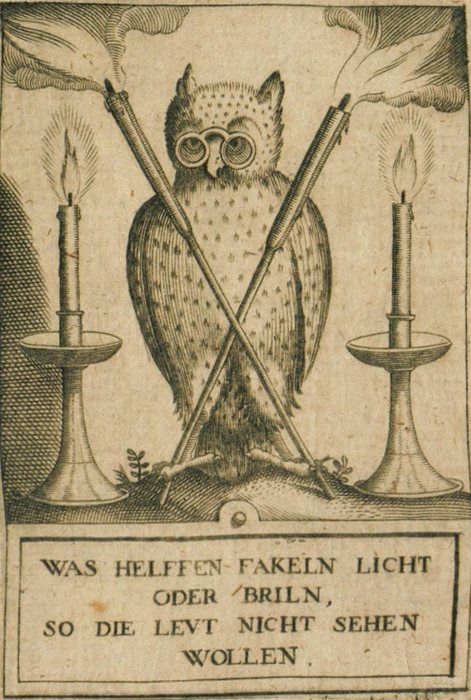 Was helffen Fackeln, Licht oder Brilln, so die Leut nicht sehen wollen
Readings given
85 passages on 10 pictures in the archive, from Amphitheatrum Sapientiae Aeternae.
-
The engraved title of the Amphitheatrum Sapientiae Aeternae
the engraved title, the words in the oval
“Amphitheatrum Sapientiae Aeternae, solius verae, Christiano-Kabalisticum, Divino-Magicum, nec non Physico-Chymicum, Tertriunum, Catholicon.”
lettered on the medallions of the two obelisks, the left and the right
“Orando. Laborando.”
on the tablet of the left obelisk; the tablet of the right carries the Name in Hebrew
“Adsit.”
in the small ovals on the two obelisks, the left and the right
“Nec tumide. Nec timide.”
on the bases of the two obelisks, the left and the right
“Memoriae honestae. Immortalitati laudandae.”
cut in the ground at the feet of the obelisks, the left half under the left and the right half under the right
“Id quod inferius. Sicut quod superius.”
at the feet of the two obelisks, below that
“Sol. Luna.”
on the globe at the head of the left obelisk, the first word in Greek; a flame lettered with the Hebrew for fire burns on the globe
“Chaos Magnesiae.”
on the cloud beneath the Name in its triangle of light at the top
“Perseverando.”
round Khunrath's portrait in its medallion, read clockwise from the lower left
“Sine numine Elohim non certe haec.”
in the glory at the foot of the oval, in Hebrew with one Latin word between, transliterated here
“Jehovah Elohim, mediantibus Schamajim.”
on the stone triangle at the foot, under the sign of Mercury
“Mercurius.”
round the arms in the medallion at the foot of the oval
“Invidia virtutis comes.”
the strip along the foot of the plate
“Cum privilegio Caesareae Maiestatis ad decennium a prima impressionis die.”
-
The Oratory and the Laboratory
lettered along the roof beam of the hall
“Sine afflatu divino, nemo unquam vir magnus.”
lettered on the tablet hanging in the oratory tent
“Ne loquaris de Deo absque lumine.”
lettered along the edge of the tent
“Hoc agentibus aderit ipse Deus.”
lettered on the cloth of the table of instruments, in part; the fold of the plate crosses the middle words
“Musica sanctissima spirituumque malignorum fuga. Libenter psallit in corde gaudio pio perfuso.”
lettered on the beam over the furnace
“Laboratorium.”
lettered on the lintel of the furnace hood
“Sapienter retentatum, succedet aliquando.”
on the placard by the furnaces
“Maturandum.”
on the pillar base at the right
“Experientia.”
lettered on the band of the oratory tent, with the Name in Hebrew, transliterated here
“Oratorium. Felix cui Jehovah a consiliis.”
lettered on the smoke rising from the censer before the kneeling man
“Ascendat ut fumus oratio, sacrificium Deo acceptabile.”
over the arch beneath the oratory table, which holds an hourglass and a skull
“Disce bene mori.”
over the door at the far end of the hall
“Dormiens vigila.”
on the flasks of the laboratory shelves, as far as the labels can be read
“Ros coeli. Azoth. Hyle. Sang. Vital. Terr.”
on the tall flask standing on the furnace
“Festina lente.”
on the base of the left column of the laboratory, answering Experientia on the right
“Ratio.”
-
Porta Amphitheatri Sapientiae Aeternae
the caption engraved beneath the plate, its opening
“Porta Amphitheatri Sapientiae Aeternae, solius verae, angusta quidem, sed tamen satis augusta, Jehovae consecrata.”
the same caption, on the seven rays
“secundum leges oraculares septem ante portam coruscantes, copia introgrediendi.”
the same caption, its close
“Extructore Henrico Khunrath Lips. Theosophiae amatore fideli, et Medicinae utriusque Doctore. Anno a Ihsvh Christo nato M.DC.II.”
lettered on the second of the seven rays, the Name in Hebrew at its head and transliterated here
“Jehovah, unum omnium effectorem; ceteras potestates ministras habeto.”
lettered on the third of the seven rays
“Ad Primum vota precesque, ad inferiores hymni sunto.”
cut in the rock at the right of the gate, the Name in Hebrew and transliterated here
“Jehovah dante, bene velle, nosse, posse ac esse.”
cut in the rock at the left of the gate, the first word in Greek and transliterated here
“Mysterion profecto vere divinum, et quod spectatores omnes, praesertim penitiores, in admirationem et amorem illius merito rapit.”
cut in the rock over the gate
“Procul hinc abeste profani.”
-
the caption engraved beneath the plate, its opening
“Typosis Arcis Pri-materialis, Catholicae, Naturalis, et Materia et Forma totaque Constitutione ac Esse sui Mercurialis, validissimae, Magnesia, quasi Magnes-Jah, vel magnum Aes-Jah, dictae; in qua Sola et Una Jehova Medicinam Catholicam, seu Lapidem Philosophorum Universalem, summum videlicet Naturae Bonum, proposuit.”
the same caption, further on
“Theosophice Orando et Physico-chymice Laborando.”
lettered at the centre of the plan, the opening of the text on the Stone, one word in Greek and transliterated here
“Petra Philosophalis, qui Mundi majoris filius, et magnus Naturae Pan.”
the same text, further on
“Seminarium habens Ignis Naturae; venas habens Aquae vivae et vitae salientis in vitam beatam.”
the same text, its close
“Et portae Sophistarum non praevalebunt adversus eam.”
lettered on the road into the citadel, at its gate
“Theosophice ora. Physico-chymice labora.”
on the two pyramids at either side of the gate
“Fides. Taciturnitas.”
on the two tablets inside the outer wall, at either side of the road
“Materiae ex qua debitae cognitio. Materiae legitimae praeparatio.”
in the outer ring, among the false ways it names
“Spes vana. Confusio. Perditio pecuniae. Labor inanis.”
-
Designatio Pyramidum Petrosarum Triumphalium
the caption engraved beneath the plate, its opening
“Designatio Pyramidum Petrosarum Triumphalium illarum, de Humido Radicali aut Primigenio Catholico Mundi hujus.”
the same caption, the scriptures it cites
“Esa. 65 v. 17, 2 Pet. 3. 13, Apoc. 21. 1.”
carved on the face of the rock, the head of the Emerald Tablet
“Verba secretorum Hermetis. Verum sine mendacio, certum et verissimum: quod est inferius, est sicut quod est superius; et quod est superius, est sicut quod est inferius, ad perpetranda miracula rei unius.”
the same, further down the rock
“Pater eius est Sol, mater eius Luna; portavit illud ventus in ventre suo; nutrix eius Terra est.”
the same, further down
“Separabis terram ab igne, subtile a spisso, suaviter cum magno ingenio.”
the same, its close
“Itaque vocatus sum Hermes Trismegistus, habens tres partes philosophiae totius mundi.”
beneath the Tablet and its German, the heading of a second text carved on the rock
“Mercurius Trismegistus in Pimandro.”
-
Adumbratio Gymnasii Theo-magici, macro-cosmici, catholici
the caption engraved beneath the plate, its opening
“Adumbratio Gymnasii Theo-magici, macro-cosmici, catholici illius, quod Naturae est publicum.”
the same caption, in German, on what the picture is
“des grossen Weltbuchs der Natur.”
lettered on the beam of light that comes down from the Name at the upper left
“Cum Numine Lumen, et in Lumine Numen.”
lettered on the mountain at the upper right, over a gate in the rock
“Porta Amphitheatri Sapientiae Aeternae, solius verae.”
in Greek on a crag at the right, transliterated here
“Panta lithon kinei.”
the same caption, the things of Nature it lists
“Mare, Aquas, Lapides, Vegetabilia, Animalia, Mineralia atque Metalla.”
on the hermit's cell at the water's edge and the rocks beside it
“Precatio. Eleemosyna. Ieiunium. Unus esto tecum, sed cave ne solus.”
-
The Name in the pyramid, Christ in the sun, and the two commandments round the rim
lettered round the rim, read in two stretches; the fold and the curve take a few words
“Diliges Dominum Deum tuum ex toto corde tuo, et ex tota anima tua, et ex omnibus viribus tuis. Et proximum tuum sicut teipsum.”
lettered round the sun at the centre, and inside it about the figure of Christ; the fold takes a letter
“In hoc signo vinces. Dei Filius vere erat ipse.”
beneath the pyramid of the Name at the top
“Omnia.”
in Hebrew, on the clouds, the names the plate gives them
“Binah. Chesed. Geburah. Hod. Elohim. El. Emeth.”
in Hebrew on the dark globe in the cloud beneath the pyramid of the Name, transliterated here
“Ain Soph.”
in Hebrew at either side of the pyramid, the first and the last letters of the alphabet
“Aleph. Tav.”
-
The regenerate man, Ora and Labora lettered on his arms, with the Book and its seals
lettered on the arms and body of the central figure
“Ora. Labora. Christo.”
lettered in the open book at the left, with the name of Jesus in Hebrew letters
“Dignus Yehoshuah solus, accipere Librum, et aperire signacula eius: Hallelujah, Hallelujah, Hallelujah.”
lettered on the streams of drops that fall from the glory above, ten of them
“Timor Dei. Temperantia. Humilitas. Justitia. Patientia. Fortitudo. Misericordia. Prudentia. Benignitas. Castitas.”
on the ribbon beneath the figure
“Deum time, et mandata eius observa.”
lettered in the rings, read in part
“Cognitio. Amor. Spes. Phantasia. Sensus exteriores. Sensus interior. Simplicitatem. Similitudo. Mens. Familiaritas. Intellectus. Et Ternarius per Spiritus Sanctus, Quaternarius.”
lettered along the three sides of the triangle that frames the man
“Quaerite primum Regnum Dei, et iustitiam eius, et haec omnia adiicientur vobis.”
in the dotted rings about the man, at either side of Christo
“Sapientia incarnata.”
-
Against the slanderers, by right of retort
the caption engraved beneath the plate
“Jure quoque Retorsionis optimo.”
lettered on the serpent at the right edge
“Lingue veneno.”
the same caption, its close
“Henricus Khunrath Lips. Theosophiae amator fidelis, et Medicinae utriusque Doctor. Im M.DC.II.”
in the cartouche at the right margin, third from the top
“Nec IEHOVAH omnibus placet, sive pluat, sive serenet: nedum Ego Doctor Henricus Khunrath! Invidorum subdolas calumnias et quis effugiet?”
lettered on the banner beneath the Name
“TV NE CEDE MALIS, SED CONTRA AVDENTIOR ITO:”
engraved in the clouds under the Name, in the vocative
“HENRICE KHVNRATH”
lettered on the banner across the figure's wings
“PRAEFECTVS DIABOLOGORVM”
on the banner to the left of the figure
“Blasphemat: sit anathema maranatha.”
cut in the arch of the rock, the abbreviation the engraver used
“ADHVC STAT, ET SEMPER VBIQ. DVRAT!”
within the arch, in four lines; the first word falls on the fold of the scan and is not read
“NATVRAE, SIVE IVS CATHOLICON”
along the base of the rock
“Veritatem sitientibus.”
-
Was helffen Fackeln, Licht oder Brilln, so die Leut nicht sehen wollen
the motto engraved on the tablet beneath the owl
“Was helffen Fackeln, Licht oder Brilln, so die Leut nicht sehen wollen.”