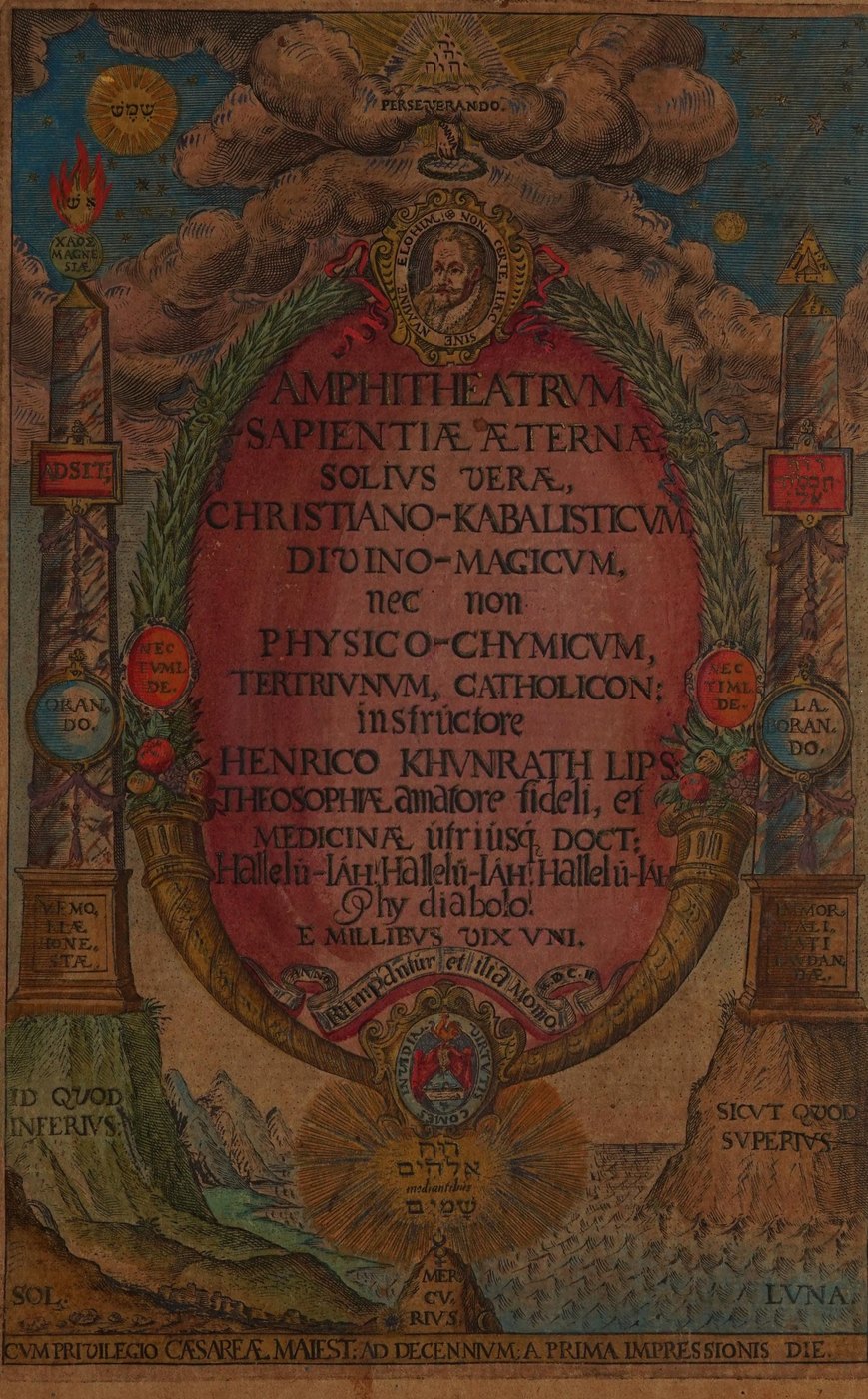
The engraved title of the Amphitheatrum Sapientiae Aeternae
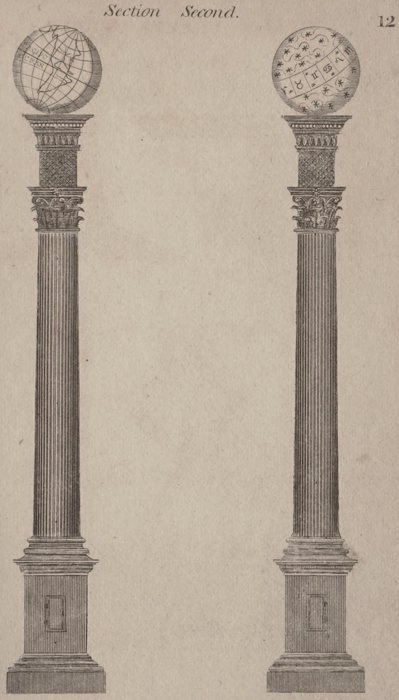
The Pillar as the central motif, with the Sun and the Moon, the Divine, Fire, and the Triangle and the Pyramid in a secondary part. From Amphitheatrum.
What is happening
Heinrich Khunrath, 1609 “Invidia virtutis comes.”
Heinrich Khunrath, 1609 “Cum privilegio Caesareae Maiestatis ad decennium a prima impressionis die.”
Symbolica, 2026 Khunrath's Latin, put into English here: The Amphitheatre of Eternal Wisdom, the only true one, Christian-Kabbalistic, Divine-Magical, and also Physico-Chemical, Threefold-One, Universal. The two words at the foot of the pillars are Sol and Luna, and the copy is the Wellcome Library's hand-coloured one. Read again at the size of the archive's image, the two pillars are obelisks and they are lettered from head to foot. On their medallions Orando and Laborando, by praying and by working; on the left tablet Adsit, may he be present, and on the right the Name in Hebrew; in the small ovals Nec tumide, nec timide, neither proudly nor timidly; on the bases Memoriae honestae and Immortalitati laudandae, to honourable memory and to praiseworthy immortality; and cut in the ground at their feet Id quod inferius, sicut quod superius, that which is below, as that which is above, the sentence of the Emerald Tablet split across the two sides, with Sol and Luna beneath. The left obelisk is headed by a globe lettered Chaos Magnesiae, the Chaos of Magnesia, with a flame on it lettered with the Hebrew for fire; the right by a small triangle lettered in Hebrew under the moon. At the top the Name fills a triangle of light with Perseverando, by persevering, on the cloud beneath, and the words round Khunrath's portrait say that these things are certainly not done without the divine power of Elohim. In the glory at the foot, Jehovah Elohim, through the mediation of the heavens; under it the sign of Mercury on a stone triangle lettered Mercurius; in the arms, Envy is the companion of virtue; and along the foot, With the privilege of his Imperial Majesty for ten years from the day of first printing.
Key · 5 motifs
Tap a motif on the picture, or a line below. Its note opens under the line, with the reading its author gave it.
- Primary motif
- Secondary motifs · 4
The picture
The title in an oval wreath between two obelisks lettered Orando and Laborando, Sol at the left foot and Luna at the right, the Name in a triangle of light above with Khunrath in a medallion beneath it, and a second glory with the sign of Mercury on a stone triangle at the foot. By eye
The reading
The picture read whole, in the archive's words, from the sources quoted on the marks. Read on, and the picture follows: the motif under discussion keeps its colour.
‘Amphitheatrum Sapientiae Aeternae, solius verae, Christiano-Kabalisticum, Divino-Magicum, nec non Physico-Chymicum, Tertriunum, Catholicon.’ The title fills an oval wreath of palm, and everything round the oval is a diagram of how Khunrath means the book to be read.
Two obelisks flank it. The left is lettered ‘Orando’ on its medallion and ‘Adsit’ on its tablet, by praying, and may he be present; the right is lettered ‘Laborando’, by working, with the Name in Hebrew on its tablet. Both carry the small ovals ‘Nec tumide. Nec timide.’, neither proudly nor timidly, and their bases read ‘Memoriae honestae. Immortalitati laudandae.’, to honourable memory and to praiseworthy immortality. At their feet the sentence of the Emerald Tablet is cut in two across the plate, ‘Id quod inferius’ under the left, ‘Sicut quod superius’ under the right: that which is below, as that which is above. Prayer and work are the two columns the book stands on, and Khunrath's plate of the citadel will put the same two words, ora and labora, on the only road into the fortress.
The sun hangs in the sky over the pillar of prayer, its Hebrew name in its disc, and the moon over the pillar of work; at the foot of the plate ‘Sol. Luna.’ are lettered under the same two obelisks. Prayer under the sun, work under the moon, and the title between the lights.
Over the left obelisk a flame burns on a globe lettered ‘Chaos Magnesiae’, the chaos of Magnesia, which is what the caption of the citadel calls the first matter; the flame itself is lettered with the Hebrew for fire. The right obelisk is headed by a small triangle lettered in Hebrew, under the moon.
The Name is at the top, its four letters filling a triangle of light in the clouds, with ‘Perseverando’ on the cloud beneath and a hand reaching down out of it. Under the hand Khunrath's portrait sits in a medallion whose motto, read round from the lower left, is ‘Sine numine Elohim non certe haec’: not, certainly, without the divine power of Elohim, these things. At the foot of the oval a second glory answers the first, ‘Jehovah Elohim, mediantibus Schamajim’, Jehovah Elohim through the mediation of the heavens, in Hebrew with the one Latin word between.
Under that glory the sign of Mercury stands on a stone triangle lettered ‘Mercurius’. Name above, mercury below, the title between: the plate is a ladder, and it reads from the Hebrew at the top to the Latin at the foot. The medallion of arms above the glory says ‘Invidia virtutis comes’, envy is the companion of virtue, which is Khunrath's answer in advance to the plate against his slanderers later in the book. The strip along the foot, ‘Cum privilegio Caesareae Maiestatis ad decennium a prima impressionis die’, is the imperial privilege for ten years.
The copy is the Wellcome Library's, coloured by hand. The lettering was read at the size of the archive's own image, and the two inscriptions in Hebrew are given in transliteration.
Decoded: every motif is marked, and each mark carries the reading its author gave it, quoted from the text, or says that it is observed on the picture and not read. The reading above is the archive's own, made from those sources and no others.

Two columns, and the thing that matters is between them. Note what stands there, and whether the pillars are told apart.
In plain words Two obelisks stand for the two halves of Khunrath's method. The left one carries Orando, by praying, on its medallion and Adsit, may he be present, on its tablet; the right carries Laborando, by working, and a tablet with the Name in Hebrew. Both say Nec tumide, nec timide, neither proudly nor timidly. At their feet the sentence of the Emerald Tablet is cut in two, that which is below under the left and as that which is above under the right, so that the pillars themselves say what the book will say: pray, work, and the two worlds answer each other.
Heinrich Khunrath, 1609 “Orando. Laborando.”
Heinrich Khunrath, 1609 “Adsit.”
Heinrich Khunrath, 1609 “Nec tumide. Nec timide.”
Heinrich Khunrath, 1609 “Memoriae honestae. Immortalitati laudandae.”
Heinrich Khunrath, 1609 “Id quod inferius. Sicut quod superius.”
Symbolica The Latin, put into English here: by praying; by working; may he be present; neither proudly nor timidly; to honourable memory, to praiseworthy immortality; that which is below, as that which is above.
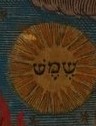
Gold, the perfected metal, and the illuminated intellect. The most overloaded symbol in the tradition.
In plain words The sun stands in the sky over the pillar of prayer, lettered in Hebrew with its own name, and the moon over the pillar of work. At the foot of the plate the two words Sol and Luna answer them under the same two obelisks, so that praying is set under the sun and working under the moon, and the whole title between the two lights.
Heinrich Khunrath, 1609 “Sol. Luna.”
Symbolica Sol and Luna are the sun and the moon; the Hebrew in the sun's disc is its name, shemesh, read at the size of the archive's image and given no further.
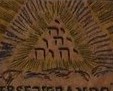
God shown, or pointed at. Look for what stands where a face would be: a name in a cloud, a circle above the top of a diagram, a ring of verses, a sign over a head.
In plain words God is present as a name, written four times. At the top the four Hebrew letters of the Name fill a triangle of light in the clouds, with Perseverando, by persevering, on the cloud under it and a hand reaching down out of the cloud. The same letters are on the tablet of the pillar of work. At the foot a second glory reads Jehovah Elohim, through the mediation of the heavens. And round Khunrath's own portrait the motto says that none of this is done without the power of Elohim.
Heinrich Khunrath, 1609 “Amphitheatrum Sapientiae Aeternae, solius verae, Christiano-Kabalisticum, Divino-Magicum, nec non Physico-Chymicum, Tertriunum, Catholicon.”
Heinrich Khunrath, 1609 “Perseverando.”
Heinrich Khunrath, 1609 “Sine numine Elohim non certe haec.”
Heinrich Khunrath, 1609 “Jehovah Elohim, mediantibus Schamajim.”
Symbolica The Latin, put into English here: by persevering; not, certainly, without the divine power of Elohim, these things; Jehovah Elohim, through the mediation of the heavens. Schamajim is the Hebrew for the heavens, in Khunrath's own spelling.

A count, a catastrophe, or the visible part of something that has no body. Note whether the flames are arranged in a number, breaking something, or standing where a figure would be.
In plain words A flame burns on the globe that tops the pillar of prayer, and the globe is lettered Chaos Magnesiae, the chaos of Magnesia, which is Khunrath's name for the first matter on his plate of the citadel. The fire carries its own Hebrew name, as the sun above it does. Fire over chaos is the beginning of the work, and it is set over the obelisk that says pray.
Heinrich Khunrath, 1609 “Chaos Magnesiae.”
Symbolica Chaos Magnesiae is the Chaos of Magnesia; the caption of the citadel plate calls the first matter Magnesia, as it were the magnet of God. The word in the flame is the Hebrew for fire, esh.
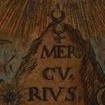
A number made visible. Count the points and then find what else in the picture comes in threes.
In plain words Three triangles, top, right and foot. The one at the top is made of light and holds the Name. The one at the foot is stone, lettered Mercurius, with the sign of Mercury standing on its point: the Name above, the mercury of the philosophers below, and the whole title between them. Khunrath's later plate of the Name sets the same four letters as a pyramid of one, two, three and four.
Heinrich Khunrath, 1609 “Mercurius.”
Symbolica Mercurius is Mercury, the metal and the planet; the sign above the word is the planet's.
Also carrying the Pillar
10 works carry it. The 3 where it is the central motif are here. The symbol.
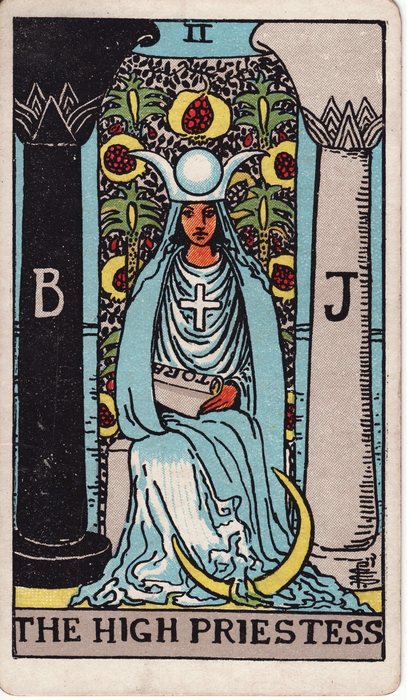
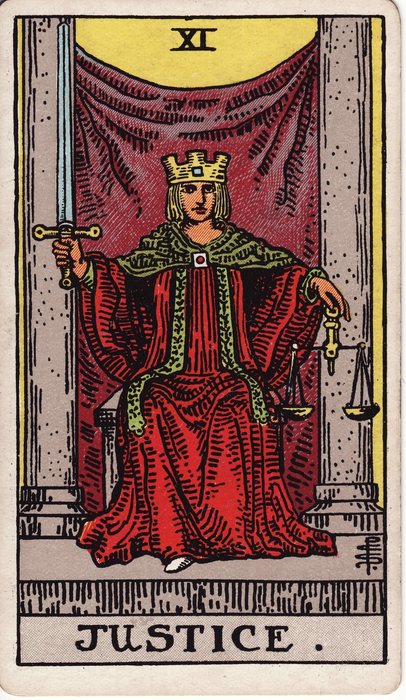
Where the detail is the subject
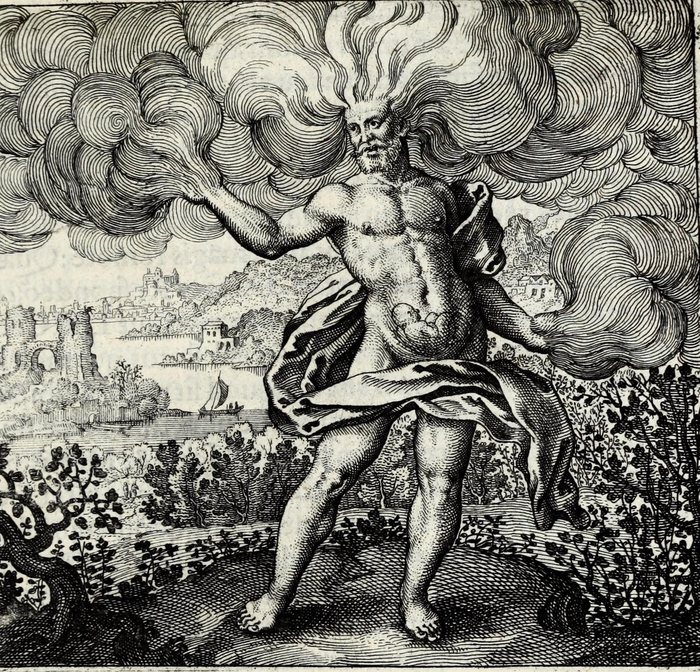
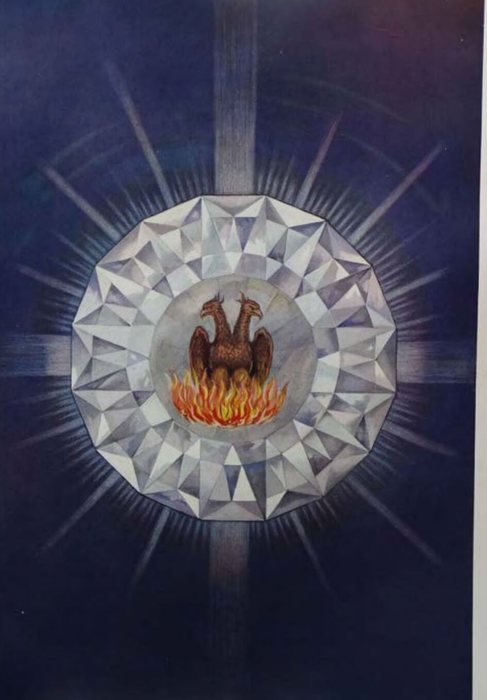
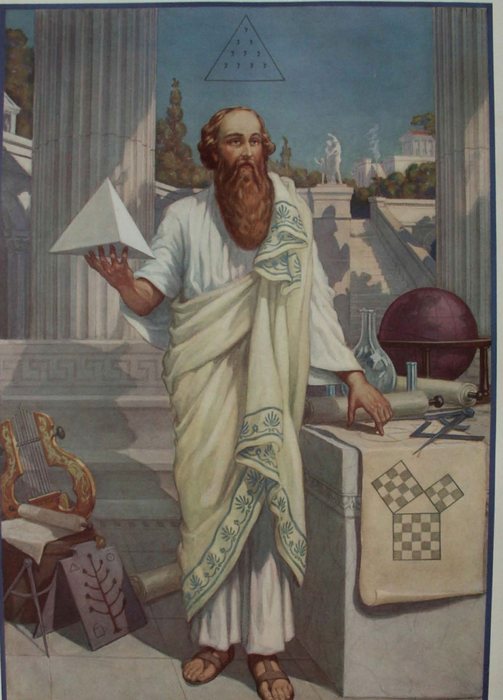
the Sun and the Moon · the Divine · Fire · the Triangle and the Pyramid
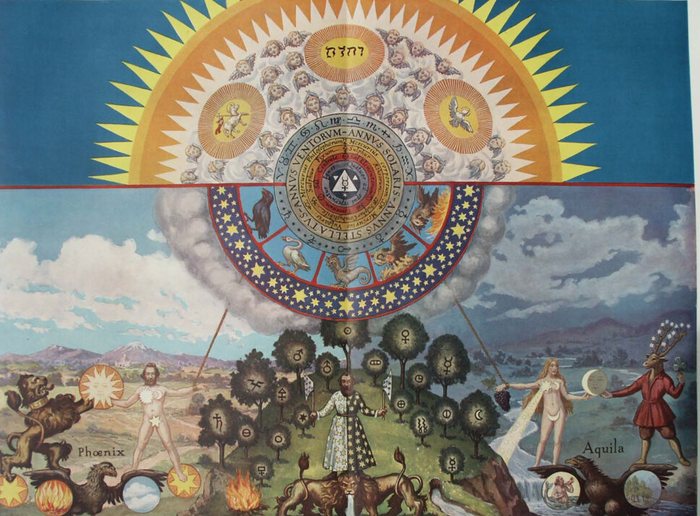
Each of these is in the picture without being what it is about. Below, one work that is about each.
In the same series
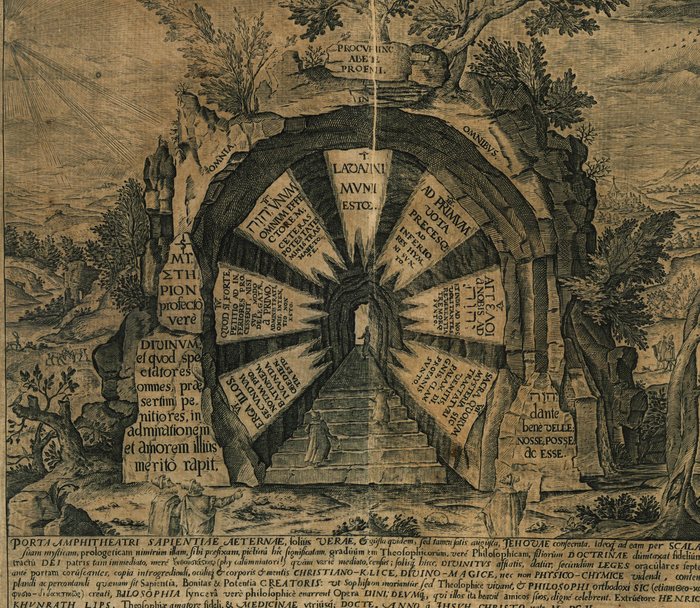
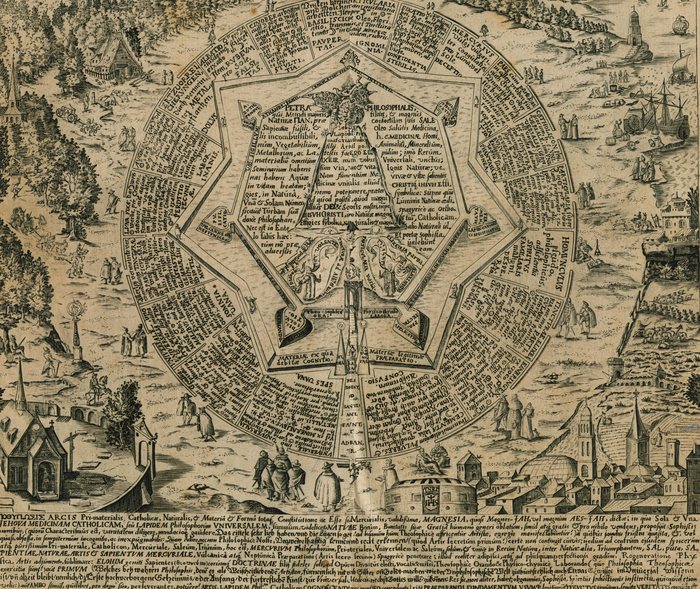
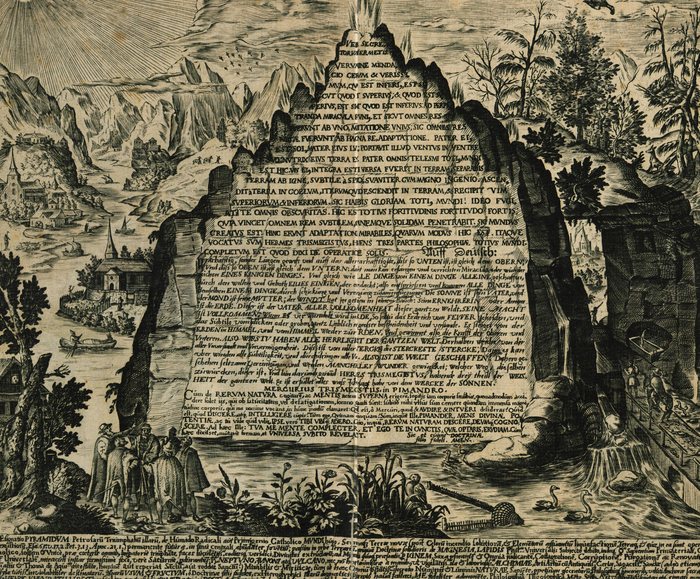
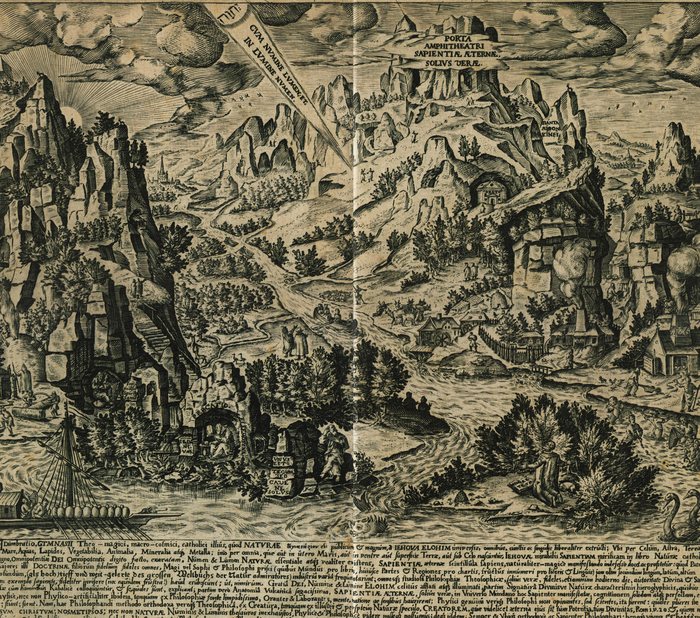
Record
One symbol a week, decoded.
This picture is free at full size from its source, linked above. What an address gets is the Sunday letter: one picture, one symbol marked on it, what it meant and who said so, and the master files of the decoded plates as they are verified. Leave any time.
Free, one letter a week, unsubscribe in one click. How the address is used.
Scroll or pinch to zoom · drag to move · double-tap for 1:1 · 869 by 1400 pixel web copy; the source file is linked under Record