The Two Pillars
Jachin and Boaz, the pillars of the porch, the twin columns
Two columns, and the thing that matters is between them. Note what stands there, and whether the pillars are told apart.
Eleven works here draw pillars, across three centuries, and the pair is older than all of them. The verse is 3 Kings 7:21: “And he set up the two pillars in the porch of the temple: and when he had set up the pillar on the right hand, he called the name thereof Jachin: in like manner he set up the second pillar, and called the name thereof Booz.” The Challoner note glosses the names: “Jachin.... That is, firmly established. Booz.... That is, in its strength.”
Waite puts the letters on them. Of the High Priestess of 1909 he writes that she “is seated between the white and black pillars--J. and B.--of the mystic Temple, and the veil of the Temple is behind her: it is embroidered with palms and pomegranates.” The pomegranates are Solomon's too: the verse before the naming counts two hundred of them round the capitals. Pamela Colman Smith painted one pillar black and one white, which the verse does not say, and Waite does not explain. His Hierophant sits between two pillars as well, “but they are not those of the Temple which is guarded by the High Priestess”, and his Justice “is seated between pillars, like the High Priestess”, which is why, he says, he has to explain the difference between her justice and the spiritual kind.
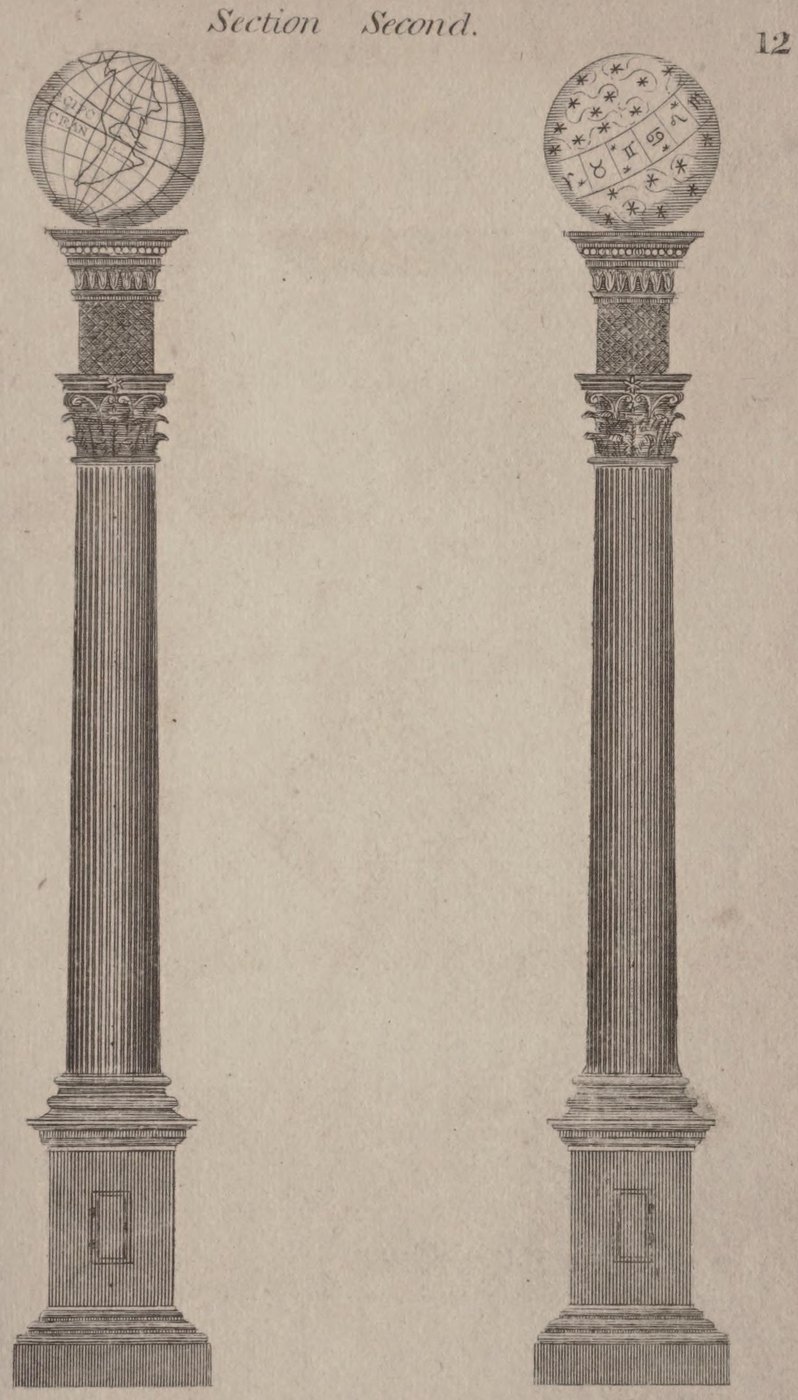
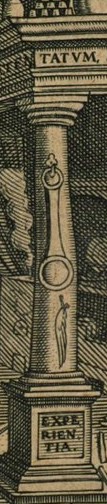
Cross's chart gives the pillars globes instead of letters, the terrestrial on one and the celestial on the other. His monitor is silent about the pillars themselves except to call them “those two famous brazen pillars” when the temple is sacked, but the globes it explains at length: “The Globes are two artificial and spherical bodies; on the convex surface of which are represented, the countries, seas, and various parts of the earth, the face of the heavens, the planetary revolutions, and other particulars.” Khunrath's title of 1609 sets the whole book between two obelisks and letters them from head to foot. Their medallions read “Orando. Laborando.”, by praying and by working; the left carries the tablet “Adsit.”, may he be present, and the right the Name in Hebrew; both say “Nec tumide. Nec timide.”, neither proudly nor timidly; and at their feet “Sol. Luna.” stand under the two halves of the Emerald Tablet's sentence, “Id quod inferius. Sicut quod superius.”, that which is below, as that which is above. The entrance to his book is a doorway between prayer and work, with the sun over one post and the moon over the other. On his Oratory of 1595 the laboratory has two columns of its own, and their bases are lettered “Ratio.” and “Experientia.”, reason and experience.
Kircher's Tree of the Sephiroth of 1653 has three columns, not two, and Hall, reading the plate in 1928, gives the outer pair Solomon's names: “The column on the right, which is called Jachin, has its foundation on Chochmah, the outpouring Wisdom of God; the three globes suspended from it are all masculine potencies. The column at the left is called Boaz.” Kircher himself calls them by the qualities they carry, “columna dextera”, the right column, among the attributes of Victory, and “mysterium columnae, ac pedis sinistri”, the mystery of the column and of the left foot, among those of Honour, with the Linea Media running between them. Hall's names are not on Kircher's plate. They are the temple's, laid over the tree.
What the pillars mean, then, is a doorway, and every maker here decides what to put in it. Solomon puts the temple. Waite puts a priestess and a veil. Cross puts nothing, and lets the two globes say that the door is between earth and heaven. Kircher puts a whole third column. The one constant is that the two are told apart, right from left, and that they are not quite the same.
Contested
The verse and its note are quoted from the Challoner revision, which the archive uses for scripture throughout. Waite's account is his own; Smith left no statement about the colours of her pillars. Cross's monitor does not explain the pillars of plate 12; the sentence naming them comes from a different part of the book, and the globes are explained in the section the plate heads. Khunrath's obelisks and columns are read from the words engraved on them, put into English by the archive; that the title's pair makes a doorway is the archive's reading of where they stand. Hall's naming of Kircher's outer columns as Jachin and Boaz is Hall's; Kircher's chapter does not use the names, and his Latin is put into English by the archive.
Sources
- 3 Kings 7:21, Douay-Rheims, Challoner revision: The verse and Challoner's note to it, from the edition the archive uses for scripture; checked against the Project Gutenberg text of that edition.
- Arthur Edward Waite, The Pictorial Key to the Tarot: Waite commissioned the 1909 designs and wrote the key to them, so his account is the closest thing the deck has to an author's statement.
- Jeremy L. Cross, The True Masonic Chart, or Hieroglyphic Monitor: The 1826 monitor, read on the page; it names the pillars once and does not explain the plate.
- Heinrich Khunrath, Amphitheatrum Sapientiae Aeternae: The words engraved on the title and the Oratory plate, read off the 1609 pages.
- Athanasius Kircher, Oedipus Aegyptiacus, 1653: The chapter on the Cabala of the Hebrews in the second volume, Rome 1653, read in the Latin of the Universidad de Sevilla copy with the archive's English beside it: a Jesuit's account of the ten Sephiroth, written to explain his own plate of the tree.
- Manly P. Hall, The Secret Teachings of All Ages: Hall's chapter on the Tree of the Sephiroth, 1928, which reads Kircher's plate and names its columns. Transcribed here, not yet read against a printed folio.
On the same plate
Where it appears · 11
11 works in the archive carry the Two Pillars. First the 10 where it has been read, with the Two Pillars itself picked out.

The Two Pillars

The High Priestess (II)

The engraved title of the Amphitheatrum Sapientiae Aeternae
The Ancient of the Ancients

Master's Carpet
The Oratory and the Laboratory
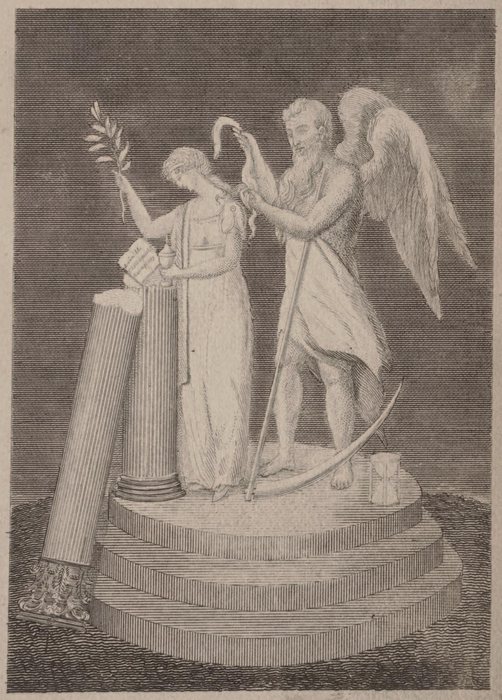
The Weeping Virgin, the Broken Column and Time

The Hierophant (V)

Justice (XI)
Systema Sephiroticum, the Tree of the Sephiroth
As a detail in 1 more
In these the Two Pillars is somewhere in the picture, tagged by eye, and nobody has read it yet. When one of them is read, it goes out on a Sunday.