The Eye
the all-seeing eye, the eye of Providence, the eye in the triangle, oculus
Attention from outside the frame. Note it is almost always placed at a boundary rather than at the centre.
Nine works here carry an eye, and the archive has read the eye on six of them: Hall's plate of the third eye, three pages of one German manuscript of about 1735, one of Cross's Masonic emblems, and Khunrath's owl in its spectacles.
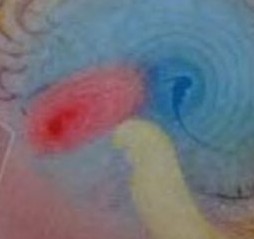
Hall is unusually literal about his. The eye he means is an organ: “In the human brain there is a tiny gland called the pineal body, which is the sacred eye of the ancients, and corresponds to the third eye of the Cyclops.” His plate of the head of Minerva “shows, in part, the activities of the pineal gland and the pituitary body at the time of the phenomenon commonly termed the opening of the Third Eye”, and the opening is conditional rather than automatic: “As its name signifies, the pineal gland is the sacred pine cone in man - the eye single, which cannot be opened until CHiram (the Spirit Fire) is raised through the sacred seals which are called the Seven Churches in Asia.” An eye that is a gland, and a gland that is a door that stays shut until something climbs the spine.
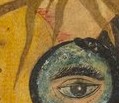
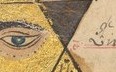
The manuscript is the Gemma Sapientiae et Prudentiae, and it has the eye most people arrive looking for, the eye in the triangle. On the page titled Figura divina it sits at the centre of a ring of red and blue, on a disc of gold, with six verses of scripture copied round the ring, and beside it the writer set the riddle from Proverbs, “Wie heist er, und wie heiset sein Sohn, weistu das?”, what is his name, and what is his son's name, if thou knowest? A question about a father and a son, answered with a triangle. On the page headed “Christus. 3. 6.” the eye is at the centre of a six-pointed star, between two prophecies of a light in the sky, “Ein Stern aus Jacob. Ein Licht zu erleuchten die Heyden.” Those two eyes are God's by the writer's own captions. The third, on the Tree of the Knowledge of Good and Evil, watches from between two circles under the roots, a triangle with a cross in the gold one, lettered “Glaube. Liebe. Gehorsamb.”, faith, love, obedience, and a triangle turned over with a serpent in the dark one; the motto beside it is “O Mensch, erkenne dich selbst”, O man, know thyself, and the eye sits between the two ways that knowledge can go.
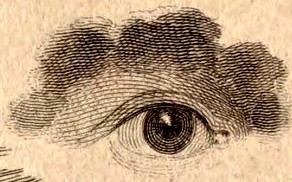
Jeremy Cross's chart of 1819 gives the eye its Masonic sense, and his monitor prints the lecture that goes with the plate: “that All-seeing Eye, whom the Sun, Moon, and Stars obey, and under whose watchful care even Comets perform their stupendous revolutions, pervades the inmost recesses of the human Heart, and will reward us according to our merits.” The eye on that plate is at the top, in a glory of rays, and the naked heart of the lecture is at the foot of the page, drawn without the sword. It is the plainest statement in the archive of what an eye at the edge of a picture is for: it watches, and it judges.
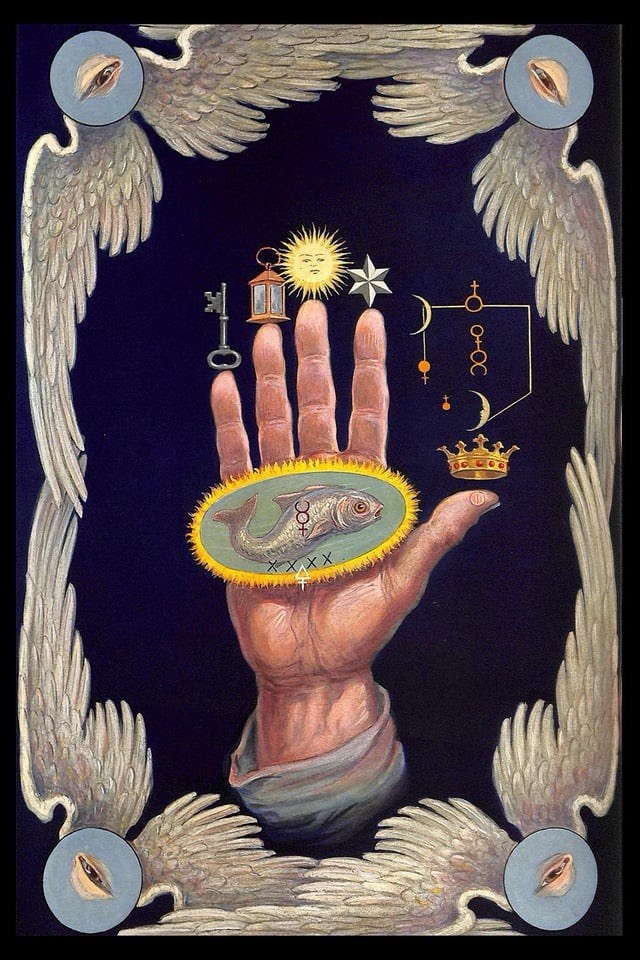
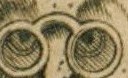
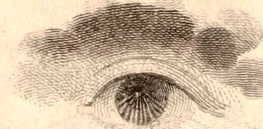
The most conspicuous eyes in the archive are still unread, and they are on its own flagship. The Hand of the Mysteries has four, one in each corner, each set in a disc among the wings. Hall's caption walks through the thumb, the four fingers, the fish and the flaming sea and never mentions them once. The older Hand of the Philosophers has no eyes at all. So the four eyes on the most decoded picture in this archive are recorded as observed and left unread, which is what this entry can honestly say about them. Cross's Master's Carpet, where the same eye looks out of a cloud over the two pillars, is unread for a different reason: the monitor prints no lecture for that plate. Khunrath's owl of 1609 is filed here for its spectacles, and its motto is the one sentence in the archive about the eye that refuses: “Was helffen Fackeln, Licht oder Brilln, so die Leut nicht sehen wollen.”, what use are torches, light or spectacles, if people will not see. The bird that sees in the dark is given every help a day creature could want, and the plate reports that it still will not look.
An organ, a Godhead, a judge, a bird that will not look, and four silences on one hand.
Contested
Hall's identification of the pineal gland with the eye of older traditions is his claim rather than a finding, and his caption is a transcription not yet read against the printed 1928 page. The Gemma's captions are the writer's own, in German and Latin, put into English by the archive; who the writer was is not known, and the eye in the triangle is read here from what the page says round it, not from any statement about the device itself. Cross's lecture is printed in his monitor for the plate of the eye, the sun, the moon, the comet and the heart, and it names a sword the plate does not draw; the Master's Carpet has no lecture, and its eye is filed on what is engraved. Khunrath's owl is read from its own motto, in his German, put into English by the archive.
The four eyes on the Hand of the Mysteries are the standing example of the rule this archive runs on. They are the most visible thing on the most examined picture we have, and no source we hold names them, so they stay unread.
Sources
- Manly P. Hall, The Secret Teachings of All Ages, 1928: The plate caption to the Hand of the Mysteries. Transcribed, not yet read against the printed page.
- Hollandus, attributed, The Hand of the Philosophers, 17th c.: Through Leone Muller's English translation, RAMS, 1986. Not yet read against a seventeenth-century printing, and the authorship of the Hollandus texts is disputed. What the archive holds is a reading of the text rather than a quotation from it.
- Gemma Sapientiae et Prudentiae, Wellcome Collection MS.2492, c. 1735: A German Rosicrucian manuscript of about 1735 whose five coloured figures carry their own captions and Bible references; quoted in the writer's German with the archive's English. The Wellcome's catalogue matches four figures to the plates printed at Altona in 1785 as the Geheime Figuren der Rosenkreuzer.
- Jeremy L. Cross, The True Masonic Chart, or Hieroglyphic Monitor, 1826: The lecture on the All-seeing Eye in the third section of the Master Mason degree, New Haven 1826, which the monitor prints beside the plate of the eye, the sun, the moon, the comet and the heart.
- Heinrich Khunrath, Amphitheatrum Sapientiae Aeternae, 1609: The lettering of the plates of the Amphitheatrum, Hanau 1609, read off the page images of the Wellcome and Paris copies at the size of the archive's own images; the Hebrew and Greek are given in transliteration and the English is the archive's.
On the same plate
Where it appears · 9
9 works in the archive carry the Eye. First the 9 where it has been read, with the Eye itself picked out.

The Hand of the Mysteries

Figura Divina: Theosophia, Cabalia, Chimia
The Tree of the Knowledge of Good and Evil, Microcosma
Christus 3. 6., the Star and the Book of Numbers
The Opening of the Third Eye
The All-Seeing Eye, the Sun, the Moon, the Comet and the Heart
Was helffen Fackeln, Licht oder Brilln, so die Leut nicht sehen wollen
Master's Carpet
The Great Seal of the United States, the reverse