The Star
stella, the fixed point
Guidance from something that does not move. Count the points before reading it: five, six and eight are all here, and no source treats them as one sign.
Six works here carry a star that is a sign rather than a piece of sky, and the gloss on this page warns you to count before you read. Five, six and eight point in different directions in this material, and the archive holds no source that treats them as interchangeable.
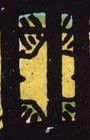
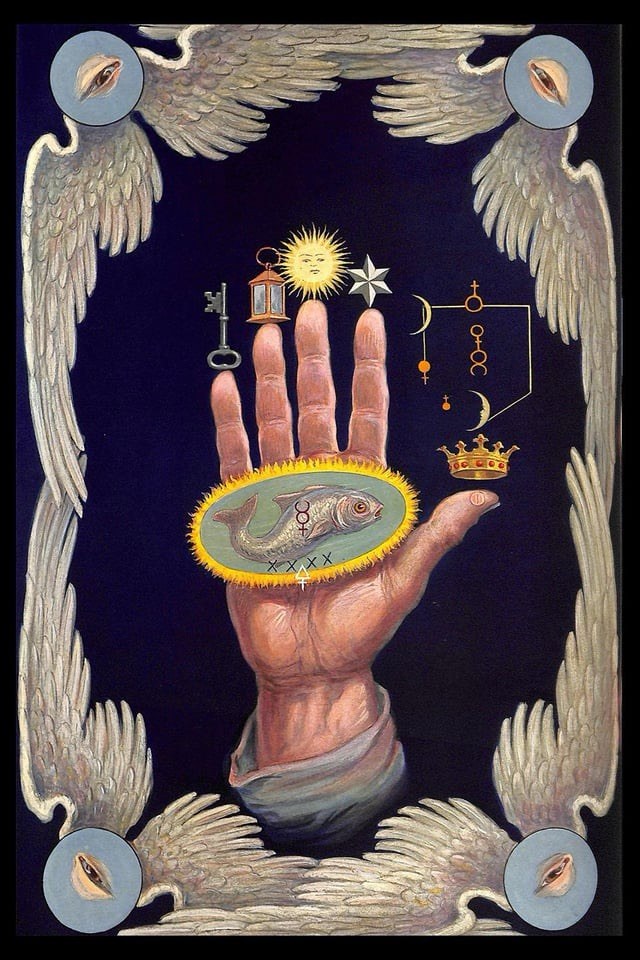
The star on the index finger of the Hand of the Mysteries has six points. Hall reads this one as “the Universal Light which reveals cosmic and celestial verities”. Set that beside his lantern on the next finger, which is a spark of the universal fire in a man-made vessel, and beside his crown on the thumb, which is absolute light unknown and unrevealed. Three lights on one hand, ranked: light that cannot be known, light that reveals, and light somebody carries. The star is the middle term, and the only one of the three whose job in the sentence is to show you something.
The seventeenth-century Hand of the Philosophers puts Roman vitriol on the same finger, without which no perfect work can be completed. The archive's words for that text, not its own. The formula is the same as for the crown, the lantern and the key: name the substance, then say the work fails without it.
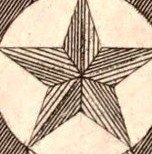
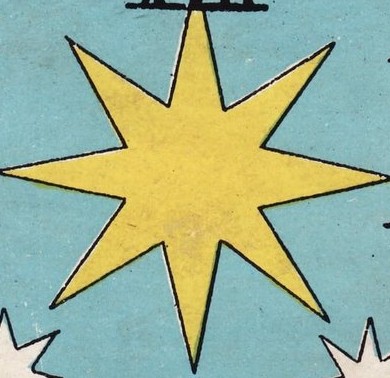
Waite's stars of 1909 are two. The Hermit's lantern holds one in place of a flame, six-pointed, and Waite says only “It is a star which shines in the lantern”, setting aside the older reading that the lantern holds the light of occult science. The Star card's is eight-rayed, “A great, radiant star of eight rays, surrounded by seven lesser stars--also of eight rays”, and Waite names its ancestry: “The star is l'étoile flamboyante, which appears in Masonic symbolism, but has been confused therein.” The blazing star he means is in this archive, on Cross's chart of 1819, five-pointed in a white disc at the centre of the Mosaic pavement, and Cross's monitor gives it two readings at once: it “is commemorative of the Star which appeared, to guide the wise men of the East to the place of our Saviour's nativity”, and it is “Divine Providence, which is hieroglyphically represented by the blazing star in the centre”.
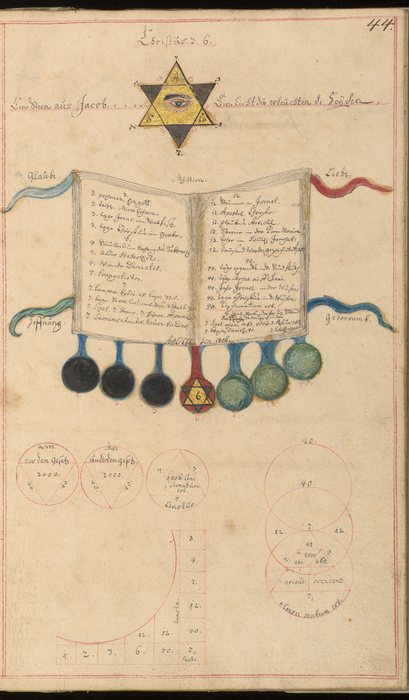
The Gemma manuscript of about 1735 makes its star out of two triangles, writes “Christus. 3. 6.” over it and the two prophecies either side, “Ein Stern aus Jacob. Ein Licht zu erleuchten die Heyden.”, a star out of Jacob, a light to lighten the Gentiles, and sets an eye at its centre.
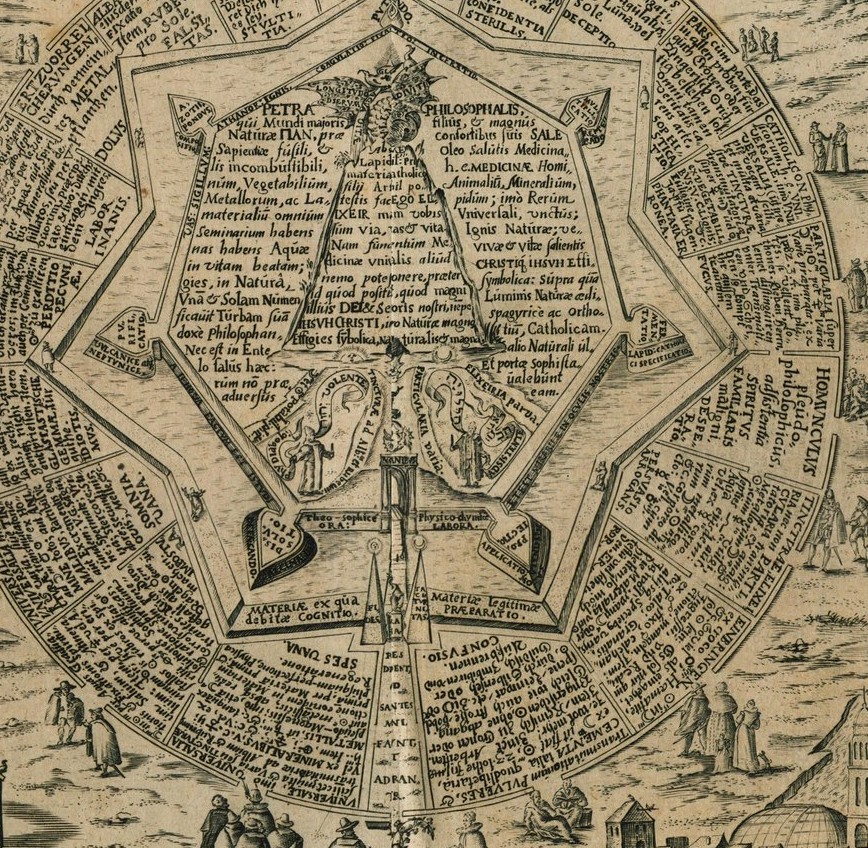
Khunrath's citadel of the first matter of 1609 is a star by plan rather than by name. The fortress is drawn from above, its bastions running out into points inside a ring, and the text at its centre calls what it holds “Petra Philosophalis, qui Mundi majoris filius, et magnus Naturae Pan.”, the Philosophers' Stone, son of the greater world and the great Pan of Nature; the only road in passes between two pyramids lettered “Fides. Taciturnitas.” and is itself lettered “Theosophice ora. Physico-chymice labora.” The archive files the plan here for its shape; Khunrath calls it a citadel, Arx, and never a star.
So the star in this archive is a light that shows, a bottle on a shelf, a star in a lamp, the star of the Magi, Christ, and a fortress seen from above; and it has six points, eight, five, six again, and as many as a citadel has bastions. The picture will not adjudicate, and the count is the first thing to check.
Contested
Hall's caption is a transcription not yet read against the printed 1928 page. The Hand of the Philosophers reaches us through Leone Muller's English of 1986, not yet read against a seventeenth-century printing, and the authorship of the Hollandus texts is disputed; what the archive holds of the older hand is a reading of it rather than a quotation from it, and the entry says so wherever it draws on it.
The count of points is not read by any source here. Hall does not say six and the older hand does not describe the shape at all; the counts are the archive's own, made by looking. Waite says the blazing star has been confused in Masonic symbolism and does not say how; Cross's monitor of 1826, which is where the archive reads the blazing star, mentions no confusion. Whether the six points of the Hermit's star and the six of the Gemma's mean the same thing, no source here says. Khunrath's plan is filed as a star on the archive's count of its bastions; his caption calls it a citadel.
Sources
- Manly P. Hall, The Secret Teachings of All Ages, 1928: The plate caption to the Hand of the Mysteries. Transcribed, not yet read against the printed page.
- Hollandus, attributed, The Hand of the Philosophers, 17th c.: Through Leone Muller's English translation, RAMS, 1986. Not yet read against a seventeenth-century printing, and the authorship of the Hollandus texts is disputed. What the archive holds is a reading of the text rather than a quotation from it.
- Arthur Edward Waite, The Pictorial Key to the Tarot: Waite's accounts of the Hermit and the Star, 1911, including his remark that the Star card's star is the blazing star of Masonic symbolism.
- Jeremy L. Cross, The True Masonic Chart, or Hieroglyphic Monitor, 1826: The printed lectures of Cross's monitor, New Haven 1826, read against the page images of the Library of Congress copy; each emblem's sentence is quoted where the monitor carries it, and the plates whose lectures went unprinted say so.
- Gemma Sapientiae et Prudentiae, Wellcome Collection MS.2492, c. 1735: The Christus page of a German Rosicrucian manuscript of about 1735, quoted in the writer's German with the archive's English.
- Heinrich Khunrath, Amphitheatrum Sapientiae Aeternae, 1609: The lettering of the plates of the Amphitheatrum, Hanau 1609, read off the page images of the Wellcome and Paris copies at the size of the archive's own images; the Hebrew and Greek are given in transliteration and the English is the archive's.
On the same plate
Where it appears · 6
6 works in the archive carry the Star. First the 6 where it has been read, with the Star itself picked out.