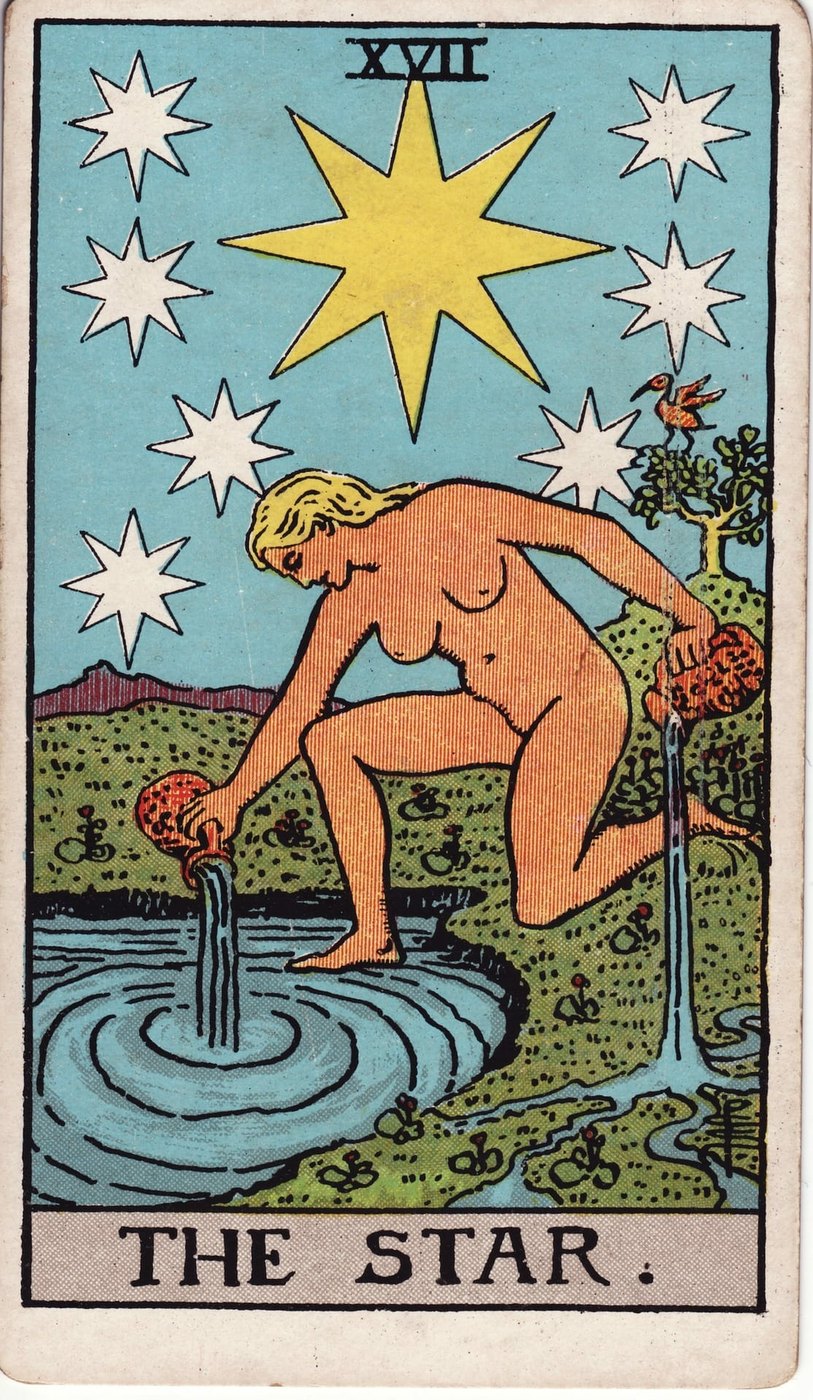
The Star (XVII)
The Heavens as the central motif, with the Vessel, the Bird, the Tree and the Water in a secondary part. From The 1909 tarot.
What is happening
Waite, 1911 “The female figure in the foreground is entirely naked. Her left knee is on the land and her right foot upon the water.”
Waite, 1911 “For the majority of prepared minds, the figure will appear as the type of Truth unveiled, glorious in undying beauty, pouring on the waters of the soul some part and measure of her priceless possession. But she is in reality the Great Mother in the Kabalistic Sephira Binah, which is supernal Understanding, who communicates to the Sephiroth that are below in the measure that they can receive her influx.”
Key · 5 motifs
Tap a motif on the picture, or a line below. Its note opens under the line, with the reading its author gave it.
- Primary motif
- Secondary motifs · 1
The picture
A great yellow eight-pointed star with seven smaller white stars; a nude woman kneels at a pool, one knee on the land and one foot on the water, pouring from two ewers onto land and water; a tree with a bird behind her; the Heavens as the central motif, the Vessel by eye. By eye
The reading
The picture read whole, in the archive's words, from the sources quoted on the marks. Read on, and the picture follows: the motif under discussion keeps its colour.
Freemasons argued for two centuries over what the blazing star in the lodge stood for, and Waite thought none of them had it. It is ‘l'étoile flamboyante, which appears in Masonic symbolism, but has been confused therein’, he writes, and then puts it in the sky over a woman with two jugs.
Pamela Colman Smith drew what he specified, ‘a great, radiant star of eight rays, surrounded by seven lesser stars’, and gave the seven small ones eight rays apiece as well, so the whole sky is one figure repeated. Eight, not the pentagram's five, which is why the archive files it under the Heavens and not the Pentagram. Underneath, a naked woman kneels with her left knee on the land and her right foot on the water, which is the position the card is about.
The two ewers are the action. She pours ‘Water of Life from two great ewers, irrigating sea and land’, and Waite endorses the two mottoes attached to the card, Waters of Life freely and Gifts of the Spirit. What lands on the ground runs off in five rivulets; what lands in the pool makes rings. What she is communicating to the scene, he says, is the substance of the heavens and the elements. The stars are above her and she is handing them down.
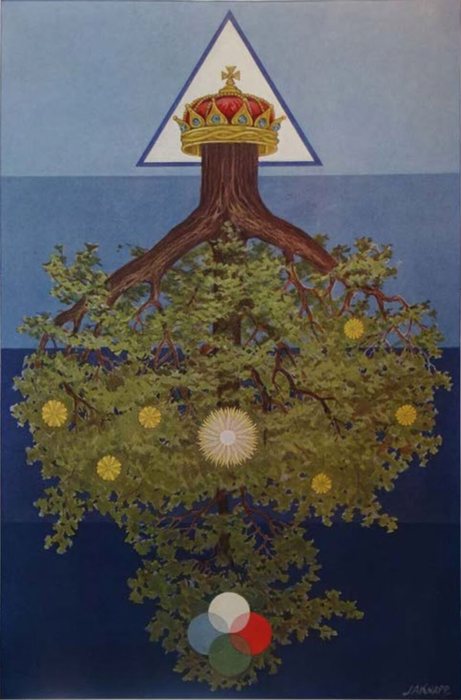
Who she is depends on how far a reader wants to go, and Waite builds two floors. On the first, for the majority of prepared minds, ‘the figure will appear as the type of Truth unveiled, glorious in undying beauty, pouring on the waters of the soul some part and measure of her priceless possession’. On the second she is Cabalistic: the Great Mother in the Sephira Binah, supernal Understanding, who gives to the circles below her as much as they can take. Binah is the third circle on the tree Kircher engraved and Knapp painted upside down, both of them in this archive, and Waite is saying the woman with the jugs is that circle doing its work.
Behind her the ground rises to a shrub or tree with a bird alighting on it, which Waite mentions and does not read; readers have called it an ibis and it is marked here as a bird. The card has been the deck's picture of hope for a century, because she is calm and the water does not run out, and that is a fair thing to see in it. What Waite drew was a diagram of how anything from heaven reaches the ground: somebody kneels between the two and pours.
Decoded: every motif is marked, and each mark carries the reading its author gave it, quoted from the text, or says that it is observed on the picture and not read. The reading above is the archive's own, made from those sources and no others.
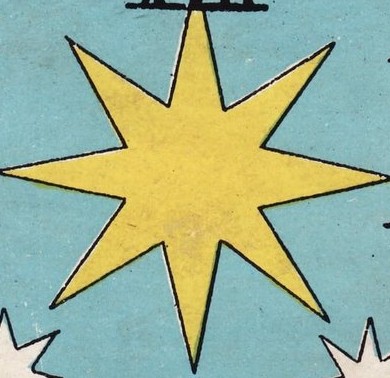
Guidance from something that does not move. Count the points before reading it: five, six and eight are all here, and no source treats them as one sign.
In plain words One great eight-pointed star with seven smaller ones round it. Waite calls the big one the blazing star of the Freemasons, l'étoile flamboyante, and says its meaning has been muddled in the lodges. Eight points, not five: this is not the pentagram.
Waite, 1911 “A great, radiant star of eight rays, surrounded by seven lesser stars--also of eight rays.”
Waite, 1911 “The star is l'étoile flamboyante, which appears in Masonic symbolism, but has been confused therein.”
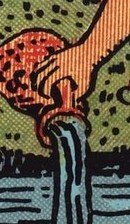
Never the subject. What is inside it is.
In plain words She pours from two jugs, one onto the land and one into the pool. Waite says she pours Water of Life, irrigating sea and land, and gives the card its two mottoes: Waters of Life freely, and Gifts of the Spirit.
Waite, 1911 “She pours Water of Life from two great ewers, irrigating sea and land.”
Waite, 1911 “It has been said truly that the mottoes of this card are "Waters of Life freely" and "Gifts of the Spirit."”
Also carrying the Heavens
61 works carry it. The 6 where it is the central motif are here. The symbol.
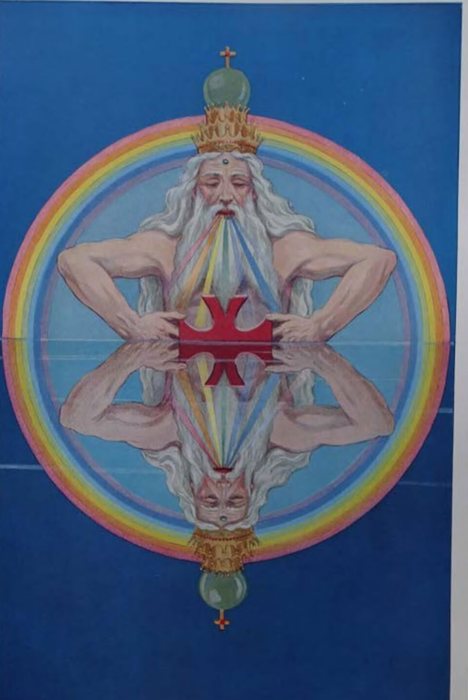
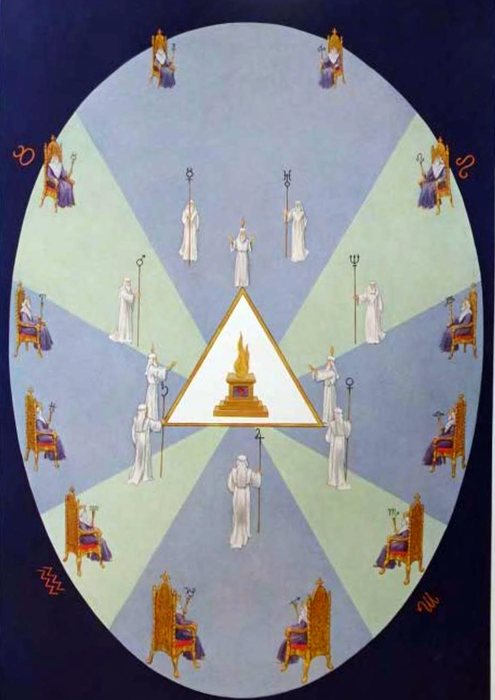
Where the detail is the subject
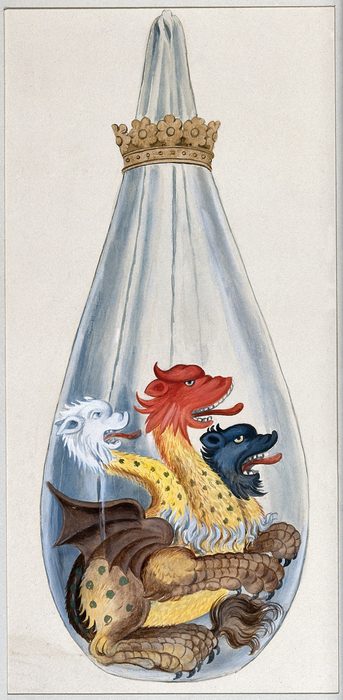
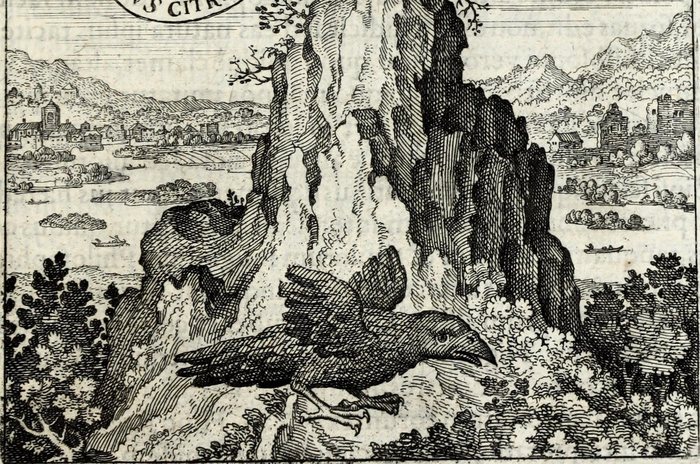
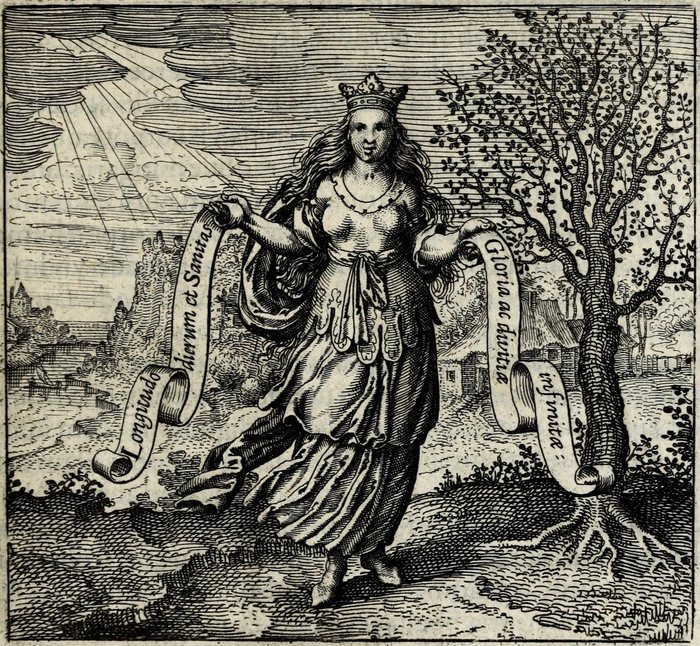
the Vessel · the Bird · the Tree · the Water
Each of these is in the picture without being what it is about. Below, one work that is about each.
In the same series
Record
One symbol a week, decoded.
This picture is free at full size from its source, linked above. What an address gets is the Sunday letter: one picture, one symbol marked on it, what it meant and who said so, and the master files of the decoded plates as they are verified. Leave any time.
Free, one letter a week, unsubscribe in one click. How the address is used.
Scroll or pinch to zoom · drag to move · double-tap for 1:1 · 813 by 1400 pixel web copy; the source file is linked under Record