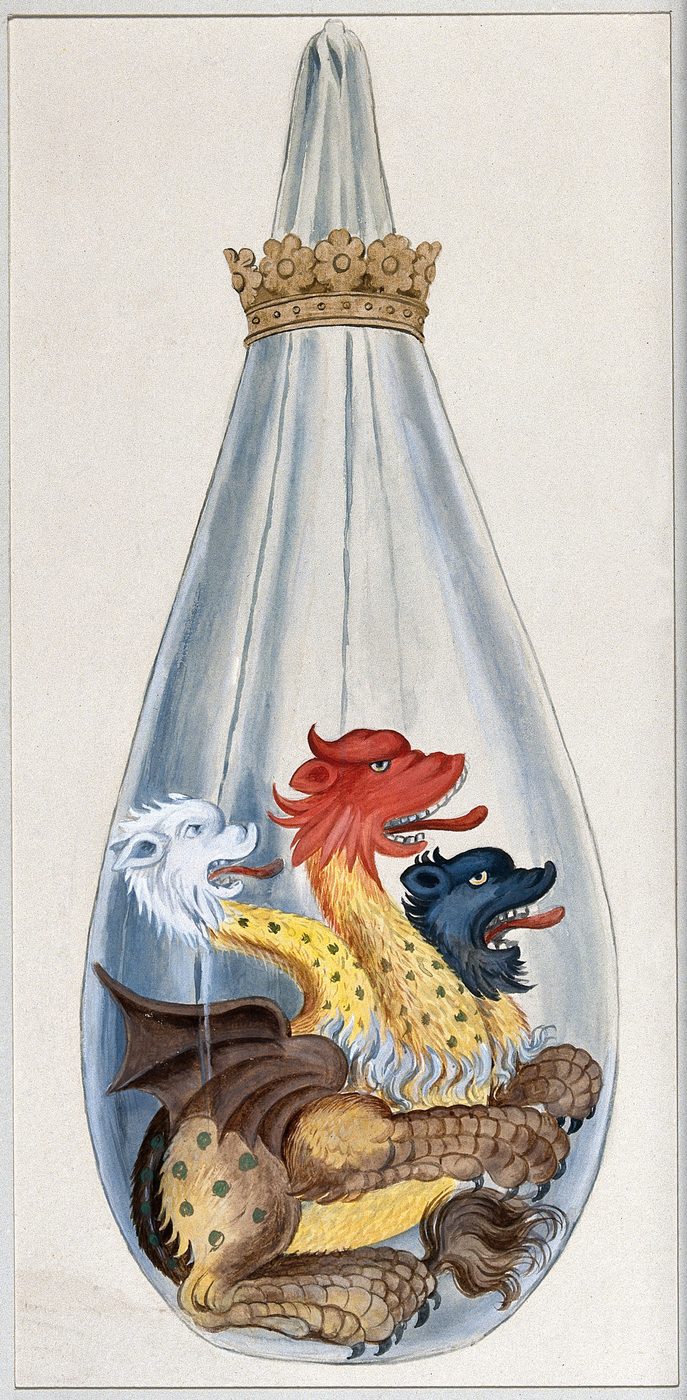
The Three-Headed Monster in the Flask
The Vessel as the central motif, with the Serpent and the Dragon, and the Crown in a secondary part. From Splendor Solis.
Key · 3 motifs
Tap a motif on the picture, or a line below. Its note opens under the line, with the reading its author gave it.
- Primary motif
- Secondary motifs · 2
The picture
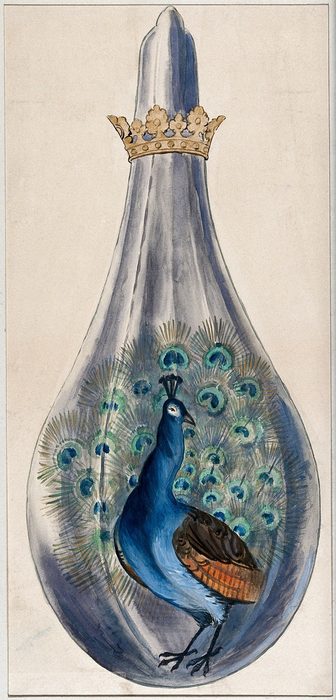
A sealed glass flask, a gold crown clasped round its neck, holding a scaled beast with one wing and three heads on long green-speckled necks, white nearest, red in the centre, blue-black behind. By eye
The reading
The picture read whole, in the archive's words, from the sources quoted on the marks. Read on, and the picture follows: the motif under discussion keeps its colour.
Count the heads, then count the colours, then read the order. White nearest, red in the middle, blue black at the back, on three long necks speckled green, all of them growing out of one scaled body with a single wing. The 1920 English names those three colours in that order and does not say why.
The reason is fifty pages later, in a chapter on the colours that appear in the preparation of the stone, and it is an instruction about fire. Lucas the Philosopher, quoted there out of the Turba: “Beware of great heat, for if you make the fire too fierce in the beginning, then will it arise red before its time, which is useless, for in the commencement of its government you ought to have first the black, then the white and lastly the red.” Black, white, red, and a cook who rushes it gets the last colour first and has ruined it.
So the three heads are one process shown all at once. The same chapter says the white has to be pulled out of the black by the fire of calcination, and the red out of the white after that, so the heads are not three animals sharing a body but three moments of one animal that cannot be told apart in a picture any other way.
Everything is happening inside a closed glass and the glass is the point. Ibbs copied it out of the manuscript and left the rest of the page behind: in Harley 3469 this cucurbit stands in a crimson niche with the Sun in Leo driving over it in a chariot and a king holding court underneath. None of that is here. The flask and its animal are.
And a gold crown is clasped round the neck of the glass, a quarter of the way down, in the same place on every one of the seven flasks in the sequence. It is not worn by the dragon. It belongs to the vessel, and it shuts it.
The heads are turned to the right and all three are open-mouthed, as though the argument between them were still going on. Nothing in the book says which one wins, because the book has already said it: lastly the red.
Decoded: every motif is marked, and each mark carries the reading its author gave it, quoted from the text, or says that it is observed on the picture and not read. The reading above is the archive's own, made from those sources and no others.
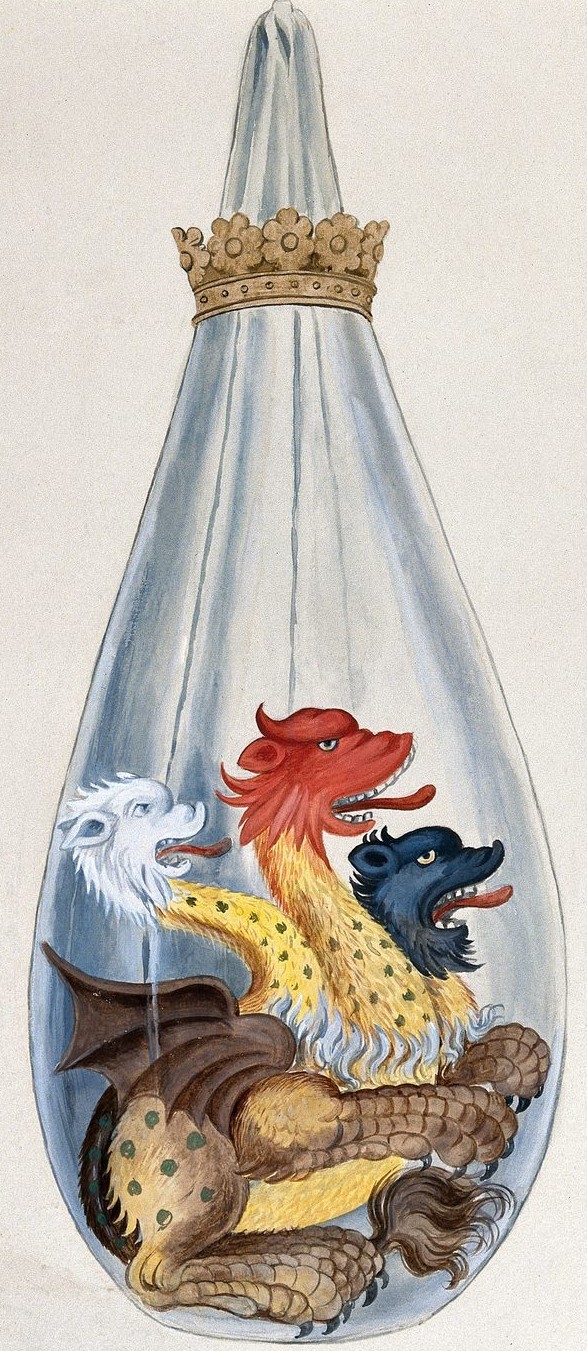
Never the subject. What is inside it is.
In plain words Ibbs copied the flask and left everything else out. In the manuscript page this glass stands in a crimson niche with the Sun in Leo riding over it and a court scene underneath. What survives here is the thing that matters and none of the furniture: a closed glass with an animal in it.
J. K., who wrote the 1920 elucidation, 1920 “In the Cucurbit is a Monster Dragon, having three heads, and long necks attached to one body”
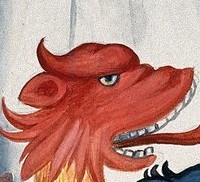
A single creature doing two opposite jobs. Note whether it is bound, killed, or eating itself.
In plain words Three heads, one body, and the three colours are not decoration. The Fifth Treatise gives the order they must arrive in and the reason the order matters: black first from the mildest heat, then white, then red, and a fire too fierce at the start brings the red up before its time and wastes the work.
J. K., who wrote the 1920 elucidation, 1920 “In the Cucurbit is a Monster Dragon, having three heads, and long necks attached to one body, similar to that in the twelfth Picture. The heads are turned to the right, that nearest us is white, the centre one is red, the farthest one is black, the necks are all speckled green.”
Salomon Trismosin, 1920 “Beware of great heat, for if you make the fire too fierce in the beginning, then will it arise red before its time, which is useless, for in the commencement of its government you ought to have first the black, then the white and lastly the red.”
Salomon Trismosin, 1920 “the white is a sign of approaching Fixation, it needs to be extracted from the black by means of the fire of calcination”
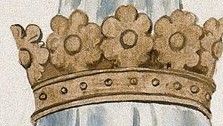
Completion, and in the Kabbalistic reading the first sephirah, the point at which the work is no longer yours.
In plain words The crown is on the glass, not on anything inside it. In the manuscript this flask stands in a niche with a planet driving over it, and every one of the seven flasks wears the same band at the same height. It marks the vessel as royal, and it seals it.
J. K., who wrote the 1920 elucidation, 1920 “A similar cucurbit set in a crimson niche upon the margin of which is painted strawberries, peapod, flowers and a bird.”
Also carrying the Vessel
32 works carry it. The 6 where it is the central motif are here. The symbol.
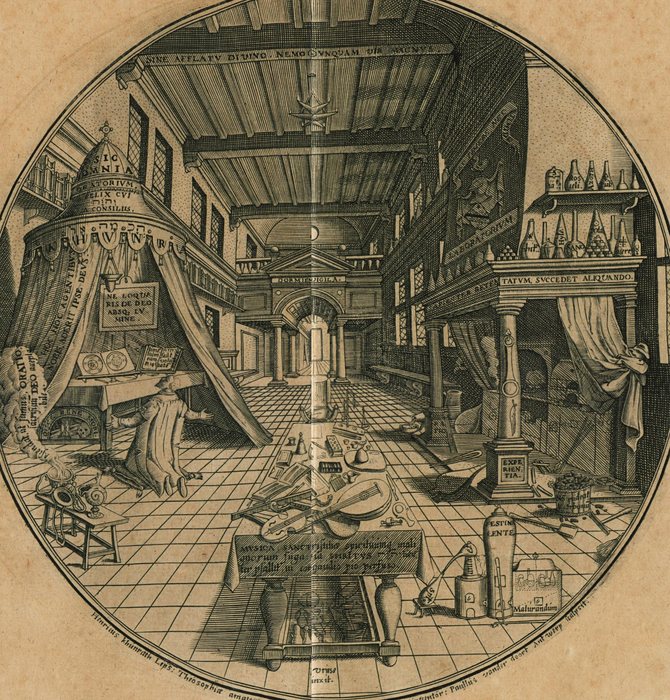
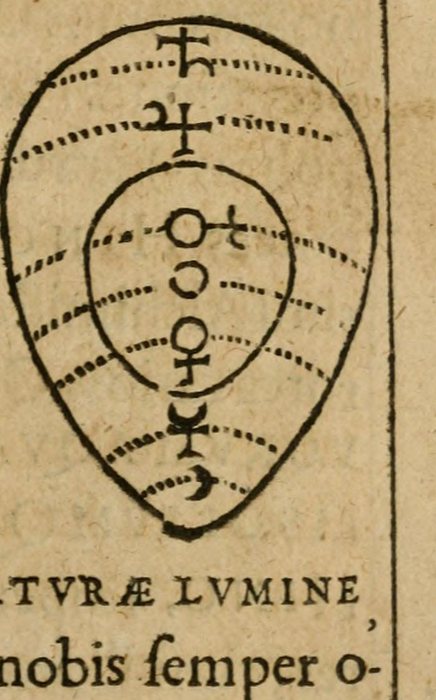
Where the detail is the subject
the Serpent and the Dragon · the Crown
Each of these is in the picture without being what it is about. Below, one work that is about each.
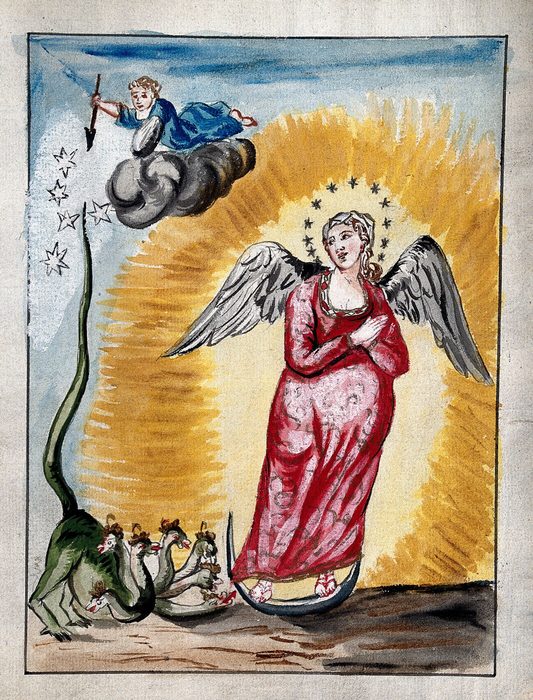
By the same hand
In the same series
After Splendor Solis, watercolours by Edith A. Ibbs, 1900 to 1909
Record
One symbol a week, decoded.
This picture is free at full size from its source, linked above. What an address gets is the Sunday letter: one picture, one symbol marked on it, what it meant and who said so, and the master files of the decoded plates as they are verified. Leave any time.
Free, one letter a week, unsubscribe in one click. How the address is used.
Scroll or pinch to zoom · drag to move · double-tap for 1:1 · 687 by 1400 pixel web copy; the source file is linked under Record