The young king with the sceptre of seven stars
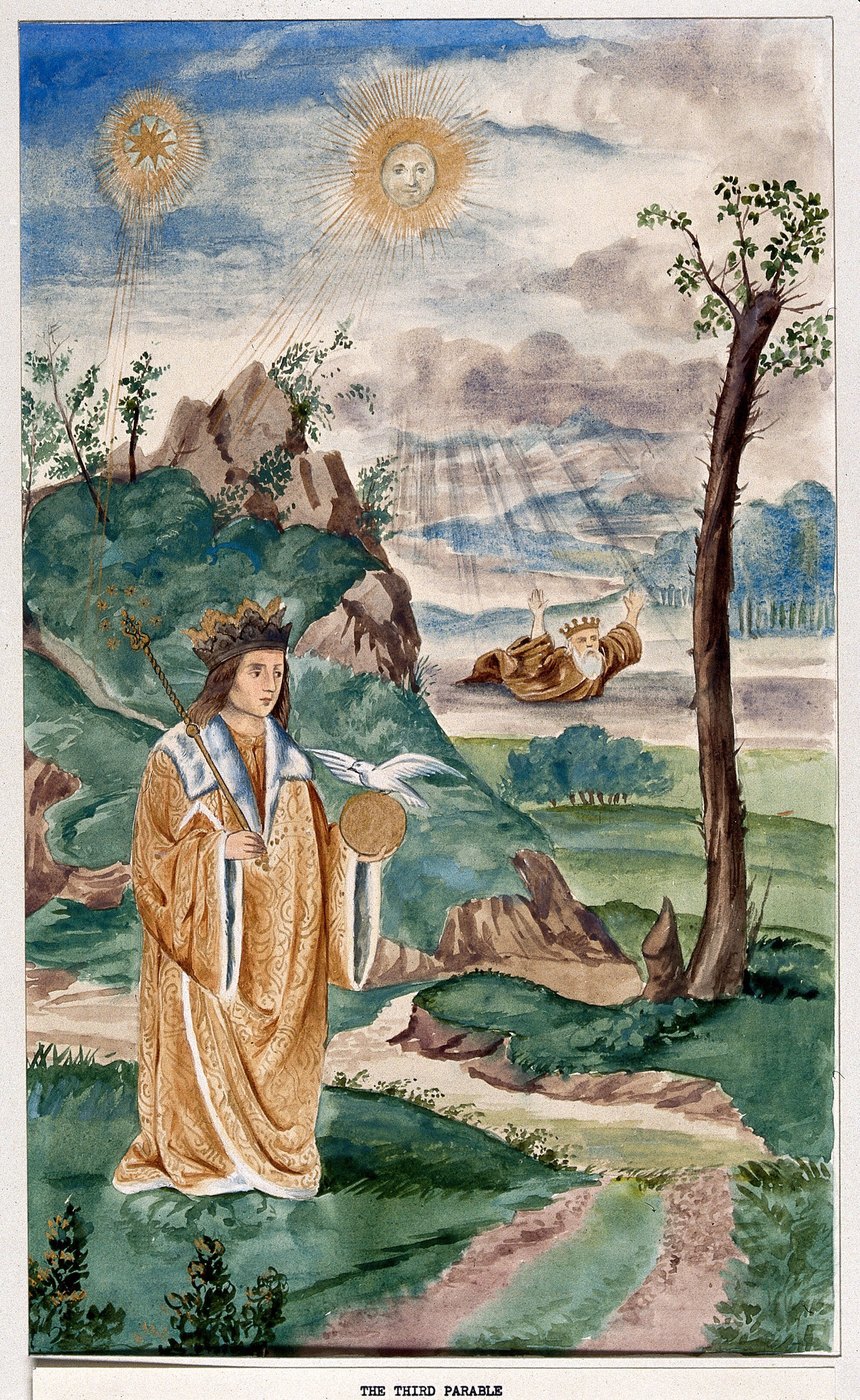
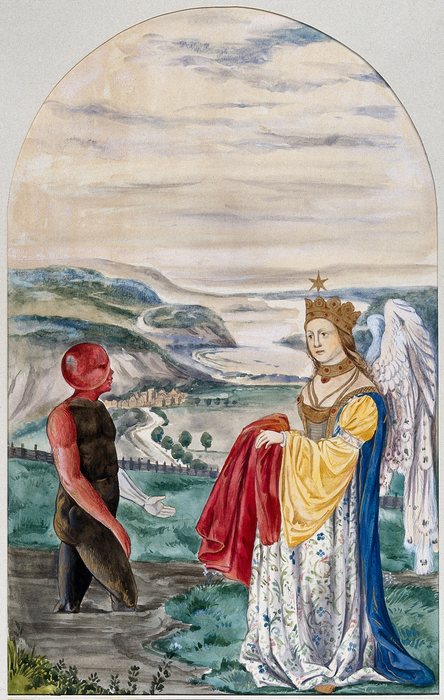
The King and the Queen as the central motif, with the Crown, the Sun and the Moon, the Heavens, and the Water in a secondary part. From Splendor Solis.
What is happening
J. K., who wrote the 1920 elucidation, 1920 “Represents a Queen, or young King, draped in Ermine and Gold enbroidered robe, loose and flowing, holding in right hand a sceptre surmounted by seven Golden Stars, and in left a golden ball. In the middle distance a King is seen swimming or drowning in the sea, and reaching his arms out as if for help to save his life.”
J. K., who wrote the 1920 elucidation, 1920 “A Golden Sun shines overhead, throwing its rays downwards towards the Queen. To the Sun’s left is a luminous Star surrounded by a golden halo, which is also directing its rays towards the Queen, or young King.”
Symbolica J. K. could not decide whether the crowned figure is a queen or a young king and wrote both down, twice, in the same paragraph. The archive keeps his indecision rather than choosing for him. The sheet itself carries a caption under the image, THE THIRD PARABLE, printed in small capitals, which places the plate in the book rather than reading it.
Key · 5 motifs
Tap a motif on the picture, or a line below. Its note opens under the line, with the reading its author gave it.
- Primary motif
- Secondary motifs · 4
The picture
One crowned figure upright on the bank with a starred sceptre and an orb, another crowned man sinking behind him with both arms raised, two lights in the sky aimed at the first of them, a dead tree at the right edge, and a printed caption under the image. By eye
The reading
The picture read whole, in the archive's words, from the sources quoted on the marks. Read on, and the picture follows: the motif under discussion keeps its colour.
Ibbs kept this one whole, landscape and all, and the sheet carries a printed caption under the image: THE THIRD PARABLE. One crowned figure stands on dry ground in a heavy embroidered robe. Another, crowned too, goes under the water behind him with both arms raised.
“Represents a Queen, or young King, draped in Ermine and Gold enbroidered robe, loose and flowing, holding in right hand a sceptre surmounted by seven Golden Stars, and in left a golden ball”. J. K. wrote Queen and young King in one phrase and repeated the pair twice more on the page rather than settle it. The archive keeps his doubt where he left it.
“In the middle distance a King is seen swimming or drowning in the sea, and reaching his arms out as if for help to save his life”. Swimming or drowning. One king in the sea and one on the shore, and the plate declines to say whether the first will be pulled out.
Two lights hang over the scene and both of them point. “A Golden Sun shines overhead, throwing its rays downwards towards the Queen”. [sym:cosmos] “To the Sun’s left is a luminous Star surrounded by a golden halo, which is also directing its rays towards the Queen, or young King”. The sun has a face and no ring; the star has a ring and no face. Both sets of rays land on the figure standing up.
Decoded: every motif is marked, and each mark carries the reading its author gave it, quoted from the text, or says that it is observed on the picture and not read. The reading above is the archive's own, made from those sources and no others.
A rank rather than a person. Read the robe, the throne and what comes out of the mouth before you read the face.
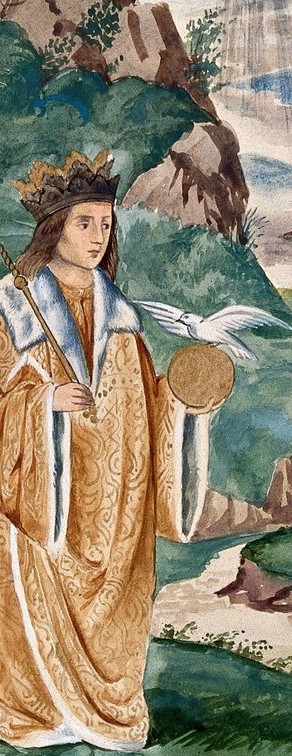
In plain words A young figure in a heavy embroidered robe, crowned, holding a sceptre in the right hand and a golden ball in the left. J. K. calls this figure a queen and a young king in the same breath.
J. K., who wrote the 1920 elucidation, 1920 “Represents a Queen, or young King, draped in Ermine and Gold enbroidered robe, loose and flowing, holding in right hand a sceptre surmounted by seven Golden Stars, and in left a golden ball.”
Symbolica Ermine, a sceptre and an orb are the furniture of a coronation. The figure has just come into something.
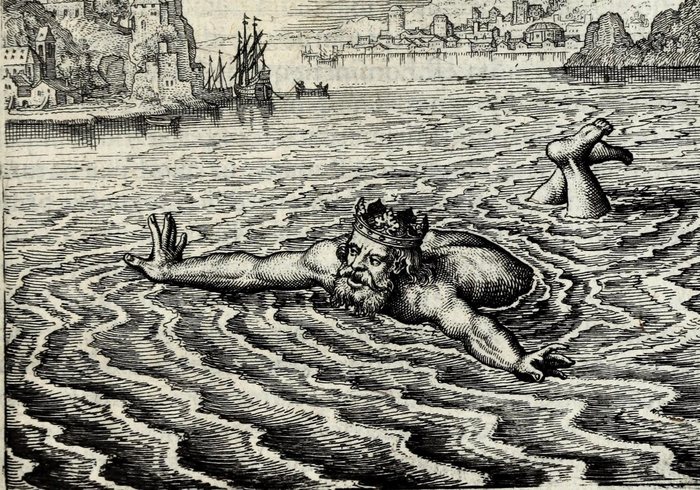
Where a thing is taken apart rather than destroyed. Note whether the figure is in the water, on it, or pouring it.
In plain words A crowned man in the water behind the standing figure, both arms raised. He is going under while the young one stands on the bank.
J. K., who wrote the 1920 elucidation, 1920 “In the middle distance a King is seen swimming or drowning in the sea, and reaching his arms out as if for help to save his life.”
Symbolica J. K. writes swimming or drowning and lets the ambiguity stand. The succession is the picture: one king in the water, one on the shore.
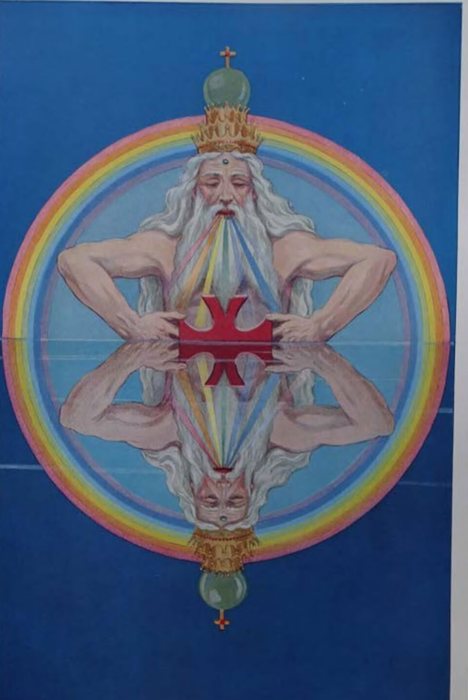
Completion, and in the Kabbalistic reading the first sephirah, the point at which the work is no longer yours.
In plain words A worked golden crown, low on the brow, over long hair.
Symbolica The crown sits on the sheet and J. K. names it only inside the sentence about the robe. Recorded as observed and read no further.
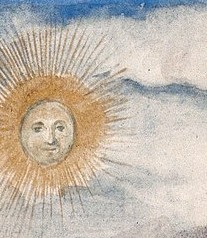
Gold, the perfected metal, and the illuminated intellect. The most overloaded symbol in the tradition.
In plain words A gold disc with a human face and long rays, set high on the right of the sky.
J. K., who wrote the 1920 elucidation, 1920 “A Golden Sun shines overhead, throwing its rays downwards towards the Queen.”
Symbolica The rays fall on the figure on the bank and not on the man in the water.
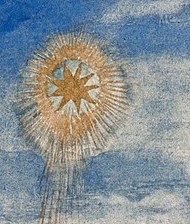
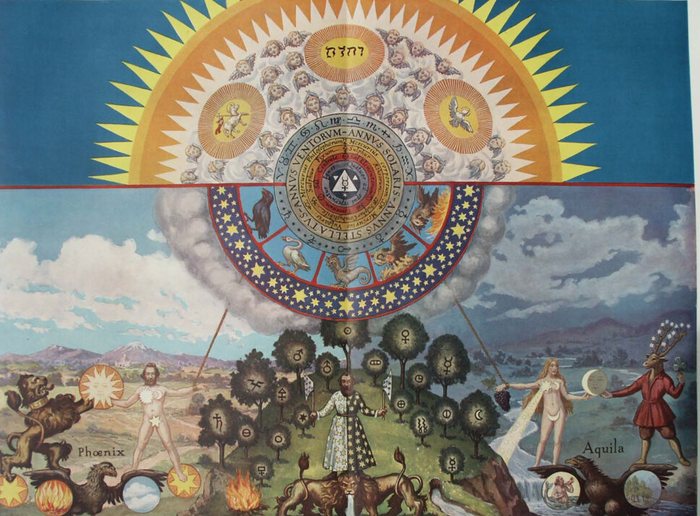
A diagram of everything, drawn so that a person can be found inside it. Note where the human figure stands in the scheme.
In plain words A second light, rayed and ringed, to the sun’s left and a little lower.
J. K., who wrote the 1920 elucidation, 1920 “To the Sun’s left is a luminous Star surrounded by a golden halo, which is also directing its rays towards the Queen, or young King.”
Symbolica Two lights in one sky, both aimed at the same person. The sheet gives the star a halo the sun does not have.
Also carrying the King and the Queen
35 works carry it. The 6 where it is the central motif are here. The symbol.
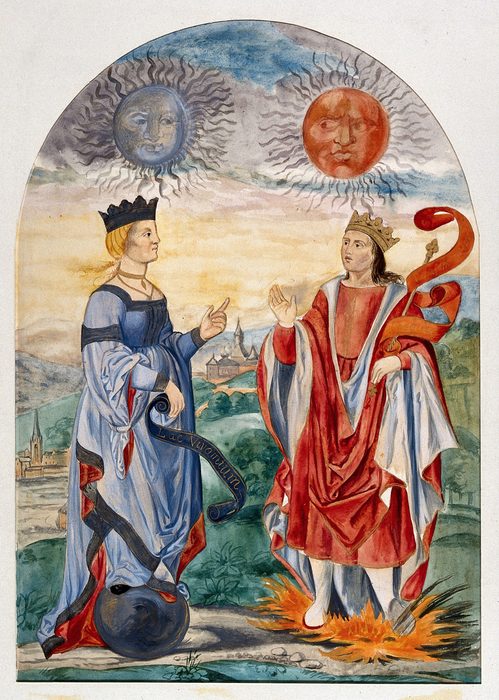
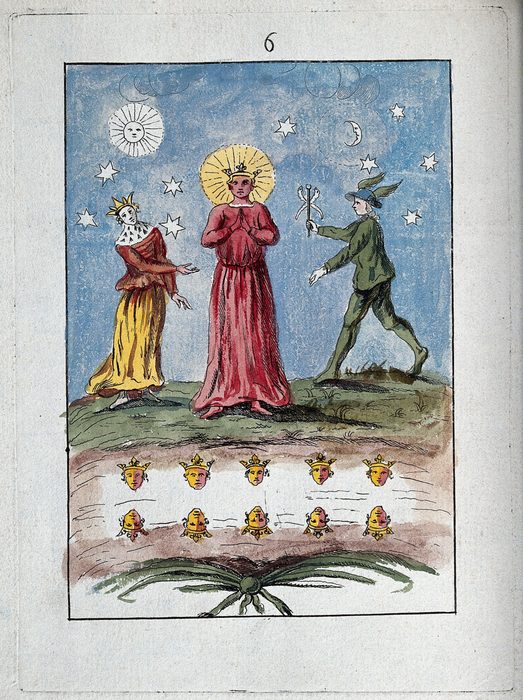
Where the detail is the subject
the Crown · the Sun and the Moon · the Heavens · the Water
Each of these is in the picture without being what it is about. Below, one work that is about each.
In the same series
After Splendor Solis, watercolours by Edith A. Ibbs, 1900 to 1909
Record
One symbol a week, decoded.
This picture is free at full size from its source, linked above. What an address gets is the Sunday letter: one picture, one symbol marked on it, what it meant and who said so, and the master files of the decoded plates as they are verified. Leave any time.
Free, one letter a week, unsubscribe in one click. How the address is used.
Scroll or pinch to zoom · drag to move · double-tap for 1:1 · 860 by 1400 pixel web copy; the source file is linked under Record