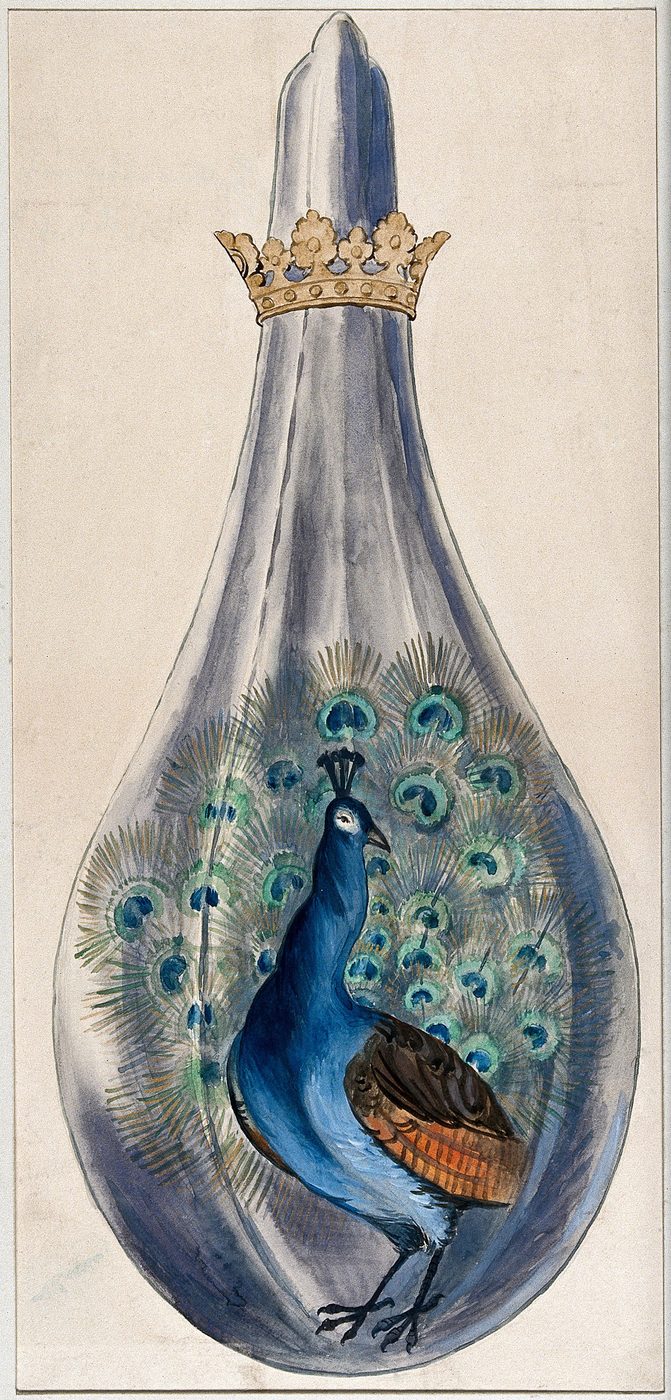
The Peacock in the Flask
The Vessel as the central motif, with the Bird and the Crown in a secondary part. From Splendor Solis.
Key · 3 motifs
Tap a motif on the picture, or a line below. Its note opens under the line, with the reading its author gave it.
- Primary motif
- Secondary motifs · 2
The picture
A peacock stands inside a sealed glass flask with its tail spread flat behind it in a fan of eyes; a tall gold crown with leaves between its points is clasped round the neck of the glass. By eye
The reading
The picture read whole, in the archive's words, from the sources quoted on the marks. Read on, and the picture follows: the motif under discussion keeps its colour.
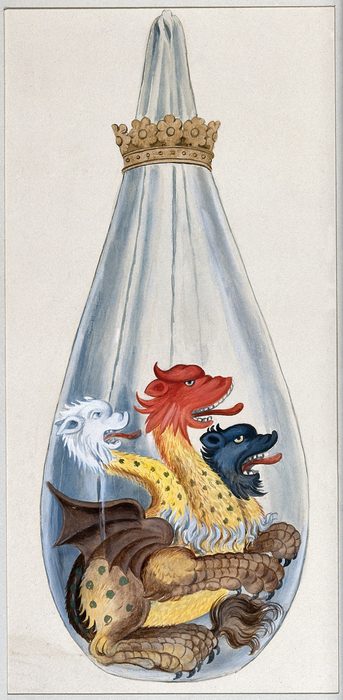
Set this sheet next to the three-headed flask and the pair explain each other. Same glass, same crown, same hand, same size. In the first one a dragon is arguing with itself in three colours. In this one a bird has its tail out and the argument is over.
The Fifth Treatise of the same book, in a chapter on the colours which appear in the preparation of the stone, is where the peacock comes from, though it never uses the word. Three colours matter, it says: “The principal colours are black, white and red; between these many others appear.” Many others appear. That is the sentence, and this is the picture of it. Every colour in the glass at once, and none of them the one you are working towards.
The chapter is careful about what those in-between colours are worth. A yellowish one comes after the white and before the first red and can be seen for some time, so one authority calls it perfect and another says it hardly stays on the matter long enough to be visible at all. They are arguing about a colour that flickers. The peacock is the archive's picture of a flicker.
Ibbs copied the glass and dropped the rest of the manuscript page, which had the bird looking down out of its flask at a party: a guitar, two viols, two women singing, and four people at a table with wine and grapes. Venus rides over the niche in a car drawn by doves. None of that survives on this sheet, and it changes the tone completely.
What she did keep is the crown, and she kept it different. This one is taller than the crown on the three-headed flask, with leaves standing up between its points. Two sheets, two crowns, and she did not paint the same one twice.
Look at the tail last. Ibbs spread it flat behind the bird and filled it with eyes, then turned the bird side on so that it looks down and out through the glass, at whatever is below.
Decoded: every motif is marked, and each mark carries the reading its author gave it, quoted from the text, or says that it is observed on the picture and not read. The reading above is the archive's own, made from those sources and no others.
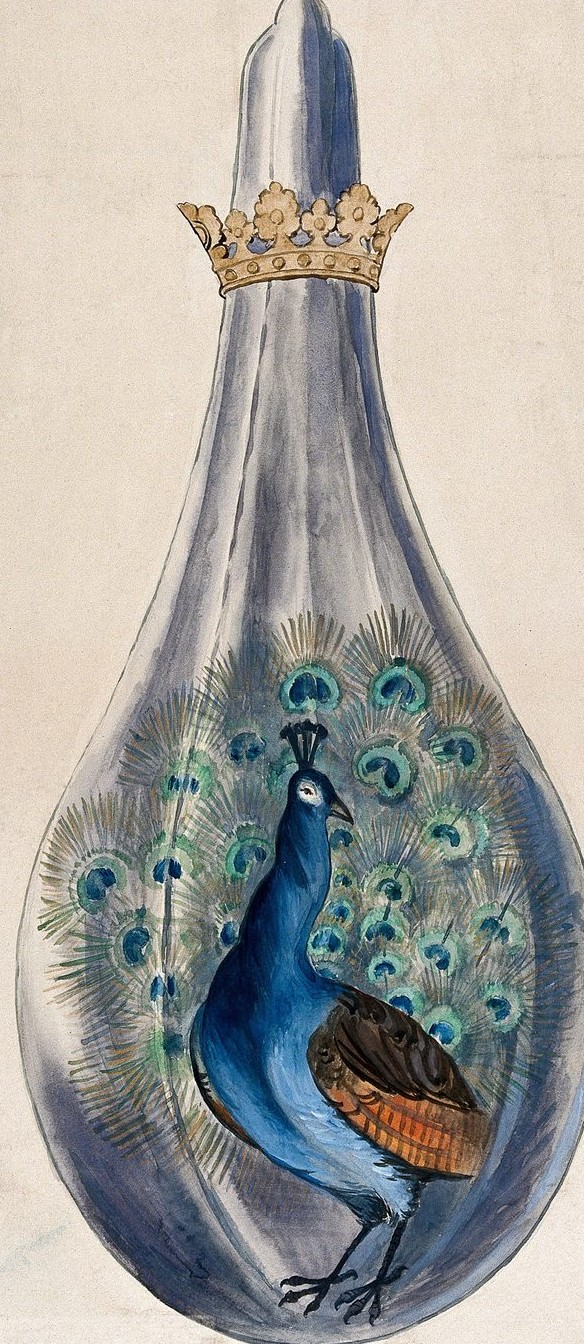
Never the subject. What is inside it is.
In plain words The same glass as the flask before it, painted by the same hand on the same size of sheet. Set the two beside each other and the sequence does its own work: three heads arguing in one, and then a bird with its tail out.
J. K., who wrote the 1920 elucidation, 1920 “A similar but more fanciful golden niche. The top part has a circular opening in it to allow the pointed top of the glass Cucurbit to pass through it.”
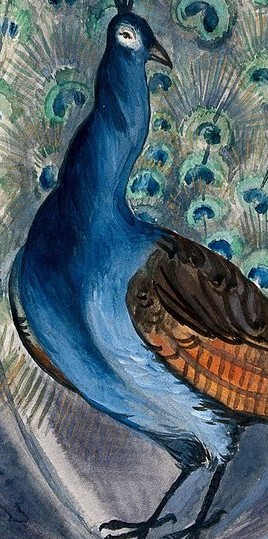
What rises and what comes back down. Note whether the bird is flying, caught, or paired with a second one.
In plain words A peacock is not a stage in the work, it is a symptom of one. The Fifth Treatise says the principal colours are three and that between them many others appear, and this bird is that sentence drawn: the moment the glass shows every colour at once and the worker knows the heat is right.
J. K., who wrote the 1920 elucidation, 1920 “Inside the Cucurbit is a beautifully painted peacock looking down upon a group of musicians below.”
Salomon Trismosin, 1920 “And although all colours appear so are there yet but three most noticeable amongst all. The principal colours are black, white and red; between these many others appear”
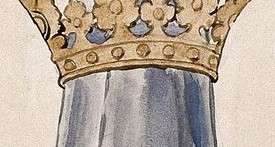
Completion, and in the Kabbalistic reading the first sephirah, the point at which the work is no longer yours.
In plain words The crown sits at the same height as on the three-headed flask and is cut differently, with leaves standing up between the points. Ibbs painted both and kept the difference, which is how you know she was copying and not remembering.
J. K., who wrote the 1920 elucidation, 1920 “From this point are suspended two golden chains, the other ends of the chains are attached to two pillars at the sides of the niche.”
Also carrying the Vessel
32 works carry it. The 6 where it is the central motif are here. The symbol.
Where the detail is the subject
Each of these is in the picture without being what it is about. Below, one work that is about each.
By the same hand
In the same series
After Splendor Solis, watercolours by Edith A. Ibbs, 1900 to 1909
Record
One symbol a week, decoded.
This picture is free at full size from its source, linked above. What an address gets is the Sunday letter: one picture, one symbol marked on it, what it meant and who said so, and the master files of the decoded plates as they are verified. Leave any time.
Free, one letter a week, unsubscribe in one click. How the address is used.
Scroll or pinch to zoom · drag to move · double-tap for 1:1 · 671 by 1400 pixel web copy; the source file is linked under Record