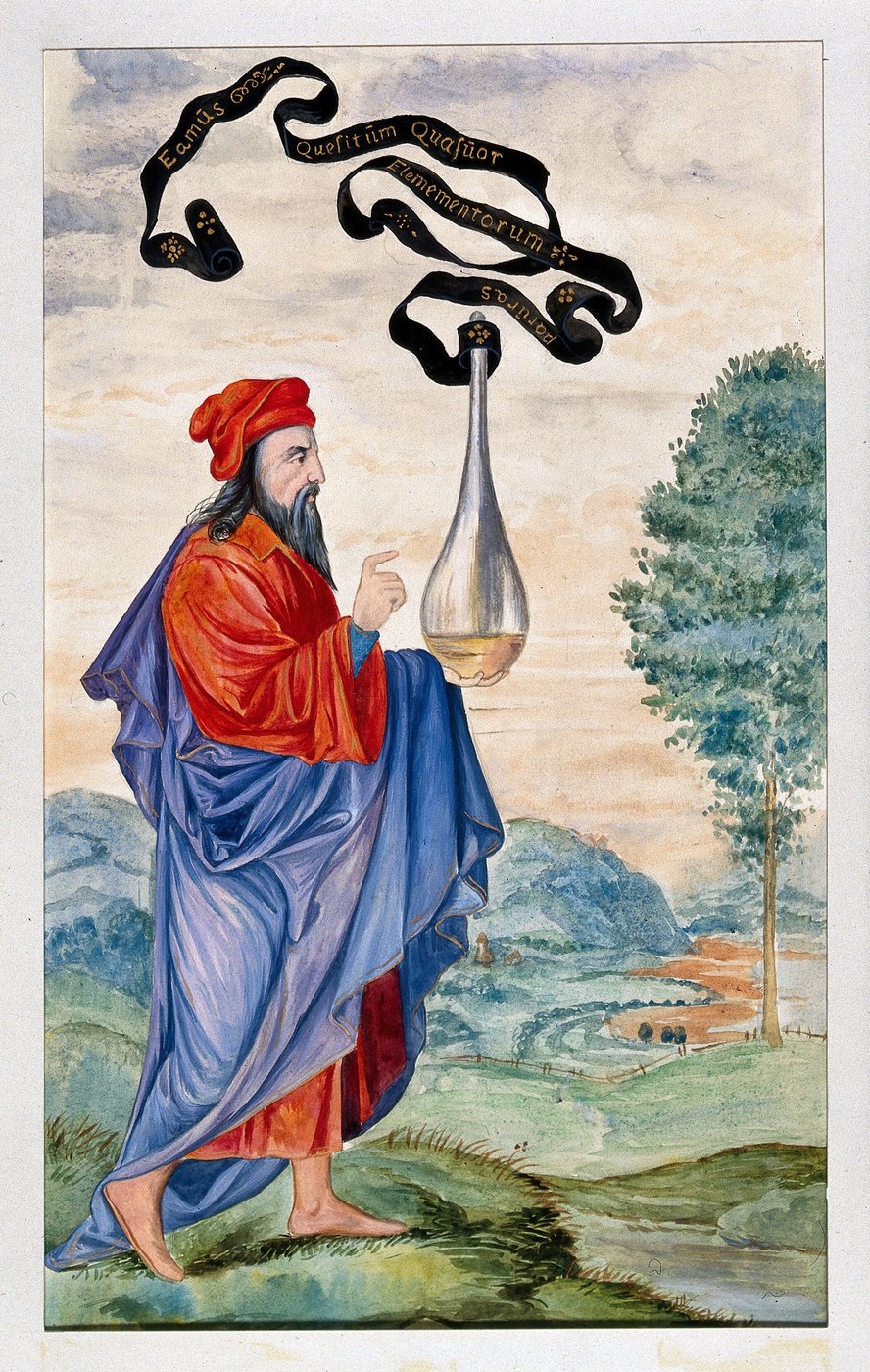
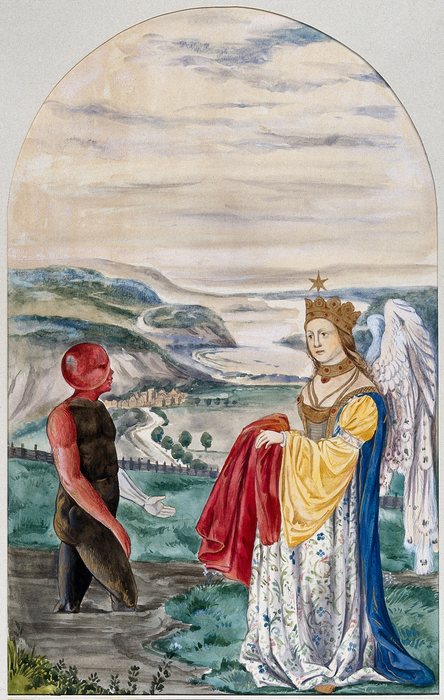
The adept with the flask of the four elements
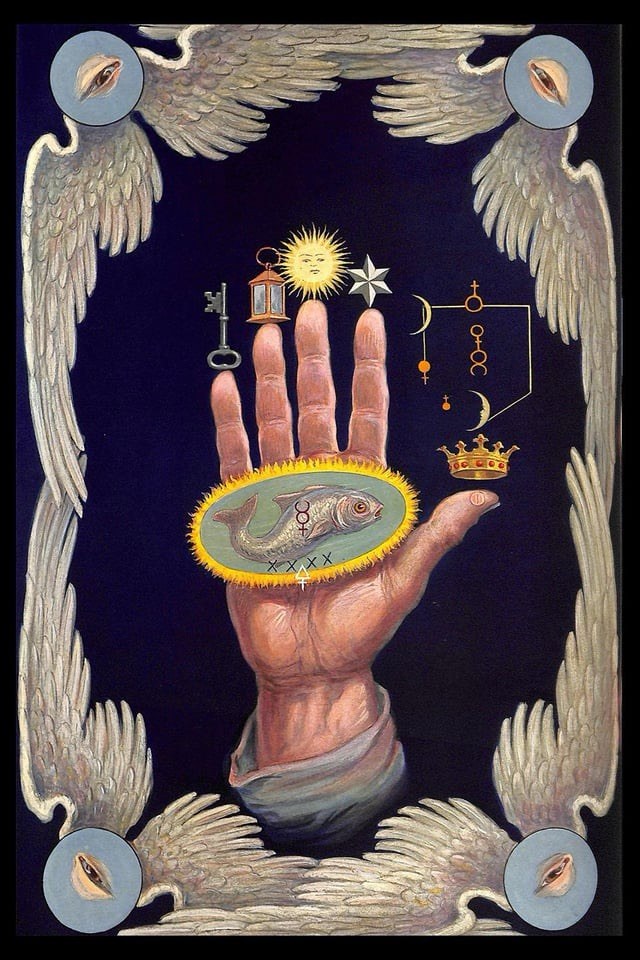
The Vessel as the central motif, with the Hand in a secondary part. From Splendor Solis.
What is happening
J. K., who wrote the 1920 elucidation, 1920 “A man clothed in red robe, with a red cap and a purple outer cloak. In his left hand he holds a long-necked flask, cucurbit, or glass retort, which is one-third filled with a yellowish transparent fluid, partly luminous, and to which he is pointing with his right finger thoughtfully, whilst walking upon the foreground of a beautiful lansdcape.”
Symbolica Let us go to seek the natures of the four elements. The words run along the ribbon on the sheet itself, gold on black, and the archive reads them there as well as in the book. J. K. prints lansdcape for landscape and the archive leaves the slip where he set it.
Key · 2 motifs
Tap a motif on the picture, or a line below. Its note opens under the line, with the reading its author gave it.
- Primary motif
- Secondary motifs · 1
The picture
A bearded man in a red robe and red cap with a purple cloak, carrying a long-necked flask a third full of yellow fluid, a black ribbon lettered in gold flowing from its neck, one finger raised towards the glass. By eye
The reading
The picture read whole, in the archive's words, from the sources quoted on the marks. Read on, and the picture follows: the motif under discussion keeps its colour.
Second of the twenty-two, and the only one of the nine that needs no commentary at all, because the picture carries its own sentence. A man in a red cap walks out of a landscape holding a flask, and a black ribbon streams from the neck of the glass with seven words on it in gold.
“Eamus Quesitum Quatuor Elementorum Naturas”. Let us go to seek the natures of the four elements. J. K. transcribed the ribbon in 1920 and Ibbs painted it again about 1907, and the two agree letter for letter. The whole programme of the book hangs on that line: not a claim to have found the thing, an announcement of setting out to look.
The right hand settles what kind of looking. “to which he is pointing with his right finger thoughtfully”. He walks through a wide green country with a river in it and points at none of it. The finger goes to the glass.
Decoded: every motif is marked, and each mark carries the reading its author gave it, quoted from the text, or says that it is observed on the picture and not read. The reading above is the archive's own, made from those sources and no others.
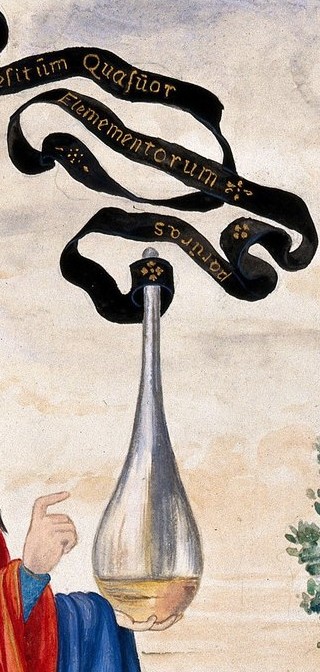
Never the subject. What is inside it is.
In plain words A glass flask a third full of a yellow fluid, held up at chest height. A black ribbon comes out of the neck and carries a line of gold capitals across the top of the sheet.
J. K., who wrote the 1920 elucidation, 1920 “From the neck of the cucurbit flows a black ribbon upon which is printed in gold letters : "Eamus Quesitum Quatuor Elementorum Naturas"”
Symbolica The flask announces the errand: let us go to seek the natures of the four elements. The man has not found anything yet. He has set out.

The hand as a sign in itself: what it holds, where it points, which fingers are raised. On the Hand of the Mysteries every finger carries a sign of its own.
In plain words He points at the fluid in the flask rather than at anything in the landscape.
J. K., who wrote the 1920 elucidation, 1920 “to which he is pointing with his right finger thoughtfully, whilst walking upon the foreground of a beautiful lansdcape”
Symbolica J. K. reads the gesture as thought. The man walks through open country and looks at the glass.
Also carrying the Vessel
32 works carry it. The 6 where it is the central motif are here. The symbol.
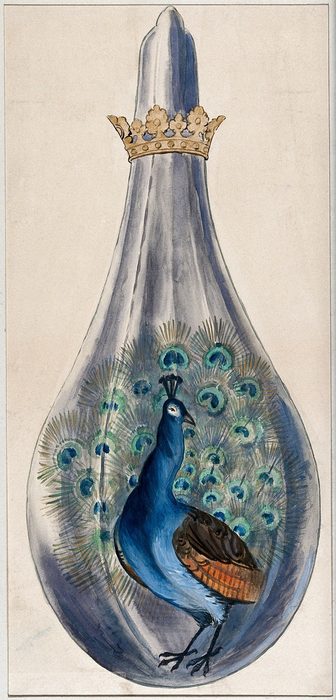
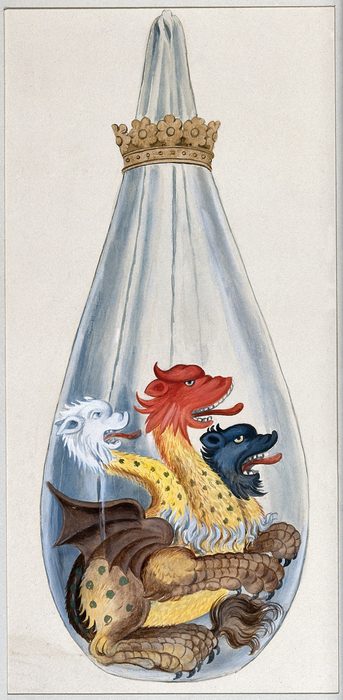
Where the detail is the subject
This is in the picture without being what it is about. Below, one work that is about it.
In the same series
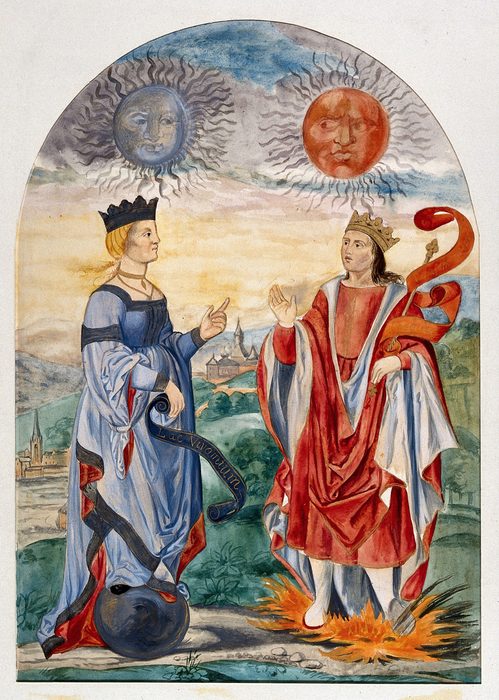
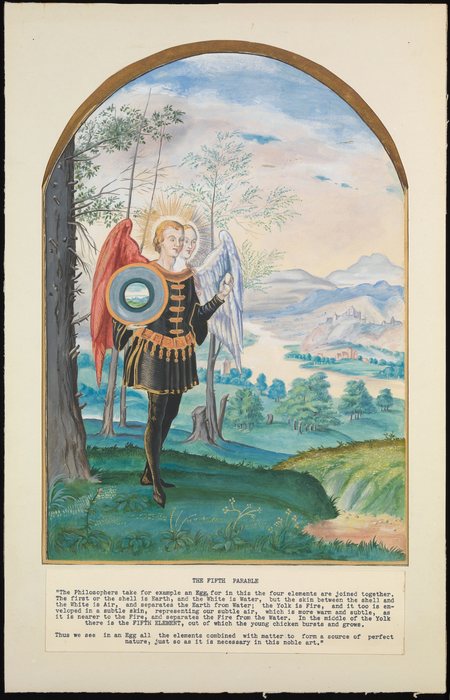
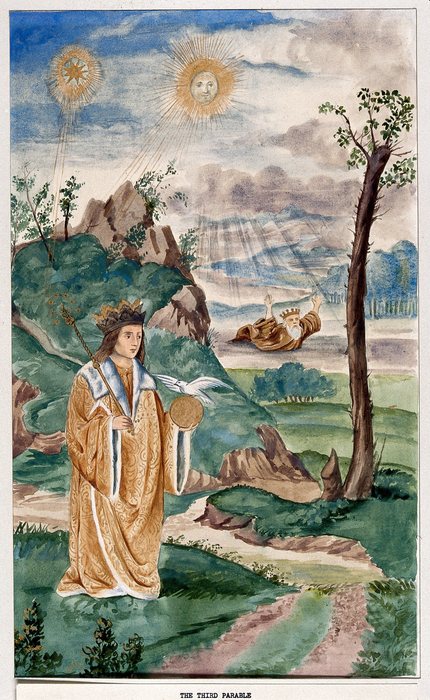
After Splendor Solis, watercolours by Edith A. Ibbs, 1900 to 1909
Record
One symbol a week, decoded.
This picture is free at full size from its source, linked above. What an address gets is the Sunday letter: one picture, one symbol marked on it, what it meant and who said so, and the master files of the decoded plates as they are verified. Leave any time.
Free, one letter a week, unsubscribe in one click. How the address is used.
Scroll or pinch to zoom · drag to move · double-tap for 1:1 · 888 by 1400 pixel web copy; the source file is linked under Record