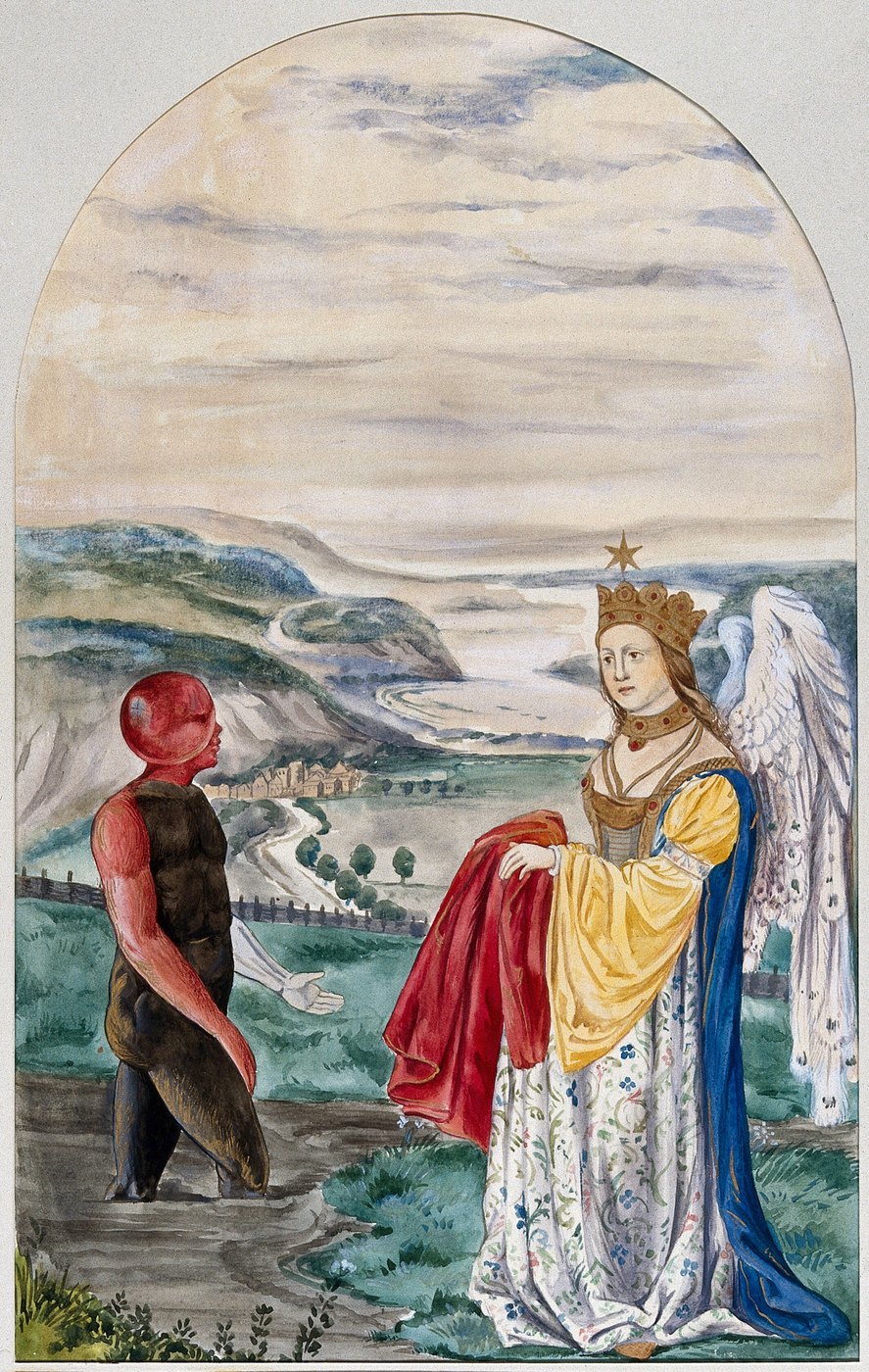
The winged queen holds out a robe to the black man
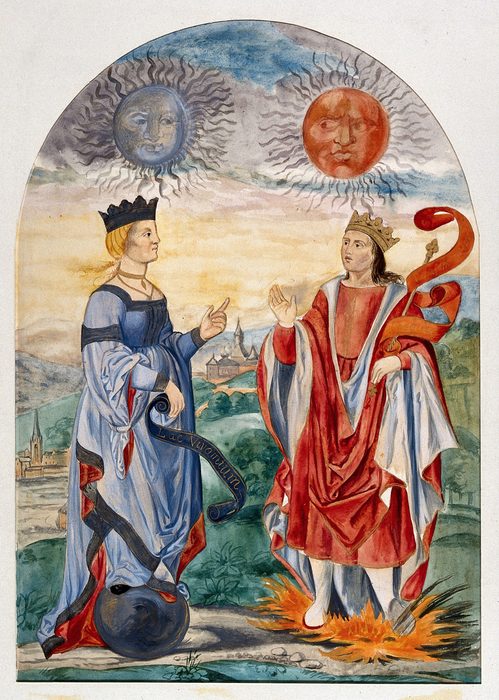
The King and the Queen as the central motif, with the Angel and the Wing, the Crown, and the Water in a secondary part. From Splendor Solis.
What is happening
J. K., who wrote the 1920 elucidation, 1920 “In her hand she holds a crimson robe edged with gold, which she is holding out to a naked black man who is standing to the knees in a black mud pool. His left arm is white and slightly soiled. His right arm, neck, and head is blood red.”
J. K., who wrote the 1920 elucidation, 1920 “He stands with right side towards us and on the profile is seen a circular transparent glass globe, just covering head all but profile, through this globe are to be seen on the organ of Self-esteem, the right cheek bone, and over the right eye, three luminous spots, in each of which is seen a small red cross.”
Symbolica J. K. describes and does not explain, which is his habit through all twenty-two. The treatise fifty pages ahead of him supplies the reading: putrefaction here means a wetting of what has dried out so it can grow again. The man stands in the wet, black to the knees and already red at the head, and the robe waiting for him is crimson.
Key · 4 motifs
Tap a motif on the picture, or a line below. Its note opens under the line, with the reading its author gave it.
- Primary motif
- Secondary motifs · 3
The picture
A crowned queen with angel wings in gold and blue holding out a crimson robe, a naked man standing knee deep in black mud with his head, neck and right arm blood red and a glass globe over his profile, a lake and a village behind them. By eye
The reading
The picture read whole, in the archive's words, from the sources quoted on the marks. Read on, and the picture follows: the motif under discussion keeps its colour.
Two people at the edge of a black pool, and nothing between them but a red coat. A crowned woman with white wings holds it out at arm’s length. A naked man stands in the wet to his knees and has not taken it.
“In her hand she holds a crimson robe edged with gold, which she is holding out to a naked black man who is standing to the knees in a black mud pool”. Look at what colour he already is. “His left arm is white and slightly soiled. His right arm, neck, and head is blood red”. Black at the feet, white on one arm, red at the head, and a red robe waiting. The three colours of the work stand on one body, in order, from the ground up.
J. K. names the pool and stops. The reading sits fifty pages back in the treatise. “The Philosophers do not mean this kind of Putrefaction. Their Putrefaction is a moistening of dry bodies, that they may be restored to their former state of Greening and Growing.” Not rot, then. A wetting of what has dried out, so it can start again.
“Depicts a Queen with angels’ wings” is the first thing J. K. writes about her, ahead of the crown and the brocade. [sym:crown] Above the crown the sheet carries a small star that his description never reaches.
The strangest detail on the plate goes unread by everybody. “on the profile is seen a circular transparent glass globe, just covering head all but profile, through this globe are to be seen on the organ of Self-esteem, the right cheek bone, and over the right eye, three luminous spots, in each of which is seen a small red cross”. J. K. reaches for phrenology, which was three hundred years too late to be what the painter meant, and the archive records the three crosses as seen and not explained.
Decoded: every motif is marked, and each mark carries the reading its author gave it, quoted from the text, or says that it is observed on the picture and not read. The reading above is the archive's own, made from those sources and no others.
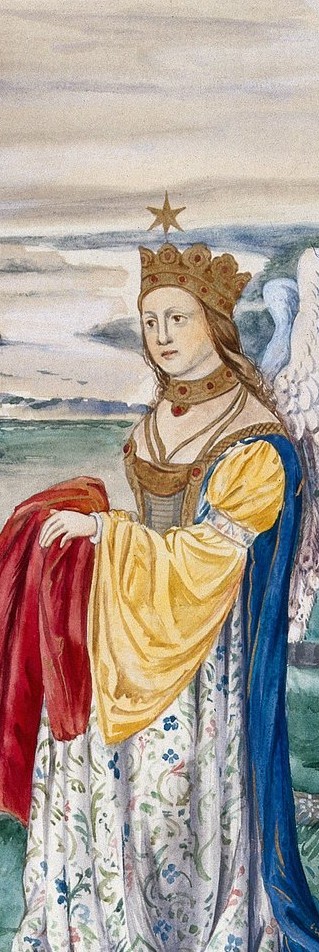
A rank rather than a person. Read the robe, the throne and what comes out of the mouth before you read the face.
In plain words A queen in gold, blue and white brocade, crowned, with a red robe over her arm which she is offering across the gap between them.
J. K., who wrote the 1920 elucidation, 1920 “In her hand she holds a crimson robe edged with gold, which she is holding out to a naked black man who is standing to the knees in a black mud pool.”
J. K., who wrote the 1920 elucidation, 1920 “The Queen seems to be encouraging and sympathysing with him.”
Symbolica She brings the colour he has not reached yet. J. K. reads her posture as encouragement and spells sympathysing his own way.
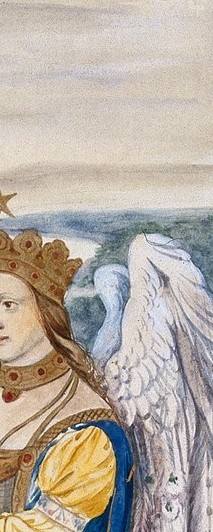
The mark of an errand rather than a nature. Note whether the wings are open, folded, or given to the figure by someone else.
In plain words Long white feathered wings, folded, rising above her shoulder on the outer side.
J. K., who wrote the 1920 elucidation, 1920 “Depicts a Queen with angels’ wings—and most gorgeously dressed.”
Symbolica The wings are the first thing J. K. records about her, before the crown or the dress.

Completion, and in the Kabbalistic reading the first sephirah, the point at which the work is no longer yours.
In plain words A crown of gold points, worn over loose hair, with a small star set above the head.
J. K., who wrote the 1920 elucidation, 1920 “She has a golden crown and neck ornaments, with golden chains, yellow sleeves and flowing.”
Symbolica J. K. runs out of sentence there and the word after flowing never comes. The star above the crown he does not mention at all; it is on the sheet and stays recorded as observed.
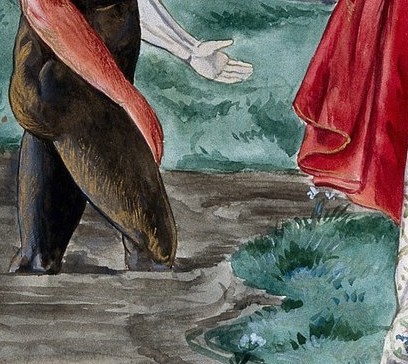
Where a thing is taken apart rather than destroyed. Note whether the figure is in the water, on it, or pouring it.
In plain words Dark wet ground at the bottom left, running up to the man’s knees, with a stream coming down from the landscape behind.
Salomon Trismosin, attributed, 1920 “The Philosophers do not mean this kind of Putrefaction. Their Putrefaction is a moistening of dry bodies, that they may be restored to their former state of Greening and Growing.”
Symbolica The treatise gives the mud its name. The philosophers’ putrefaction is a moistening of dry bodies so they can green and grow again, which is why the figure stands in it rather than lies in it.
Also carrying the King and the Queen
35 works carry it. The 6 where it is the central motif are here. The symbol.
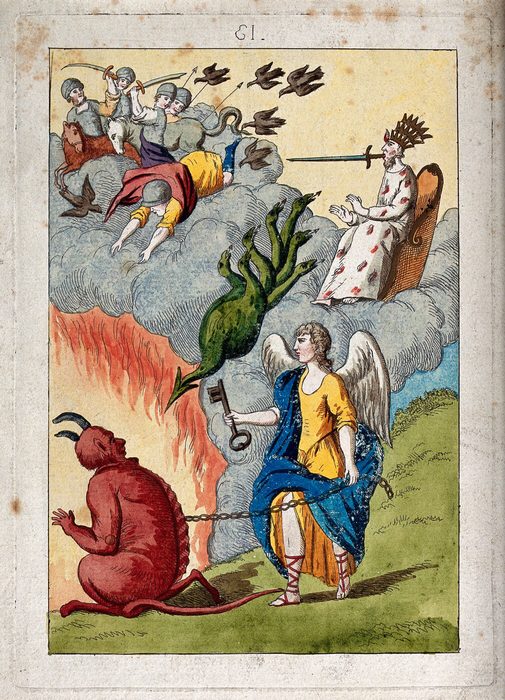
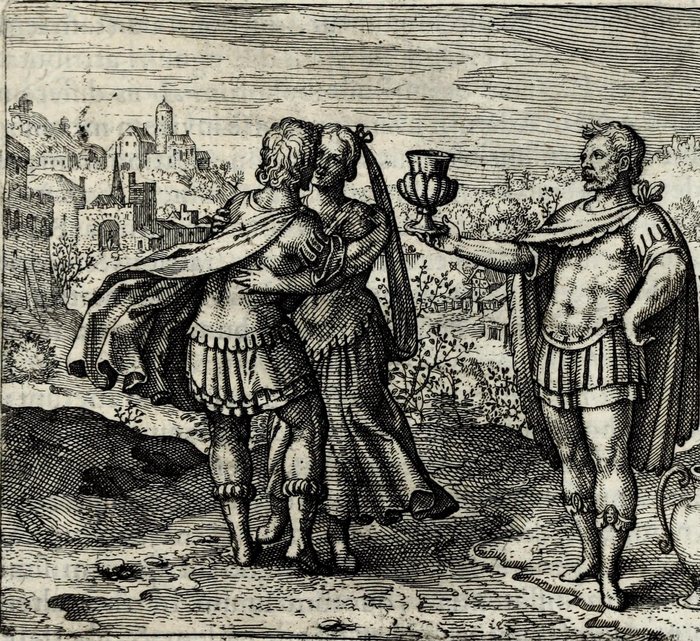
Where the detail is the subject
the Angel and the Wing · the Crown · the Water
Each of these is in the picture without being what it is about. Below, one work that is about each.
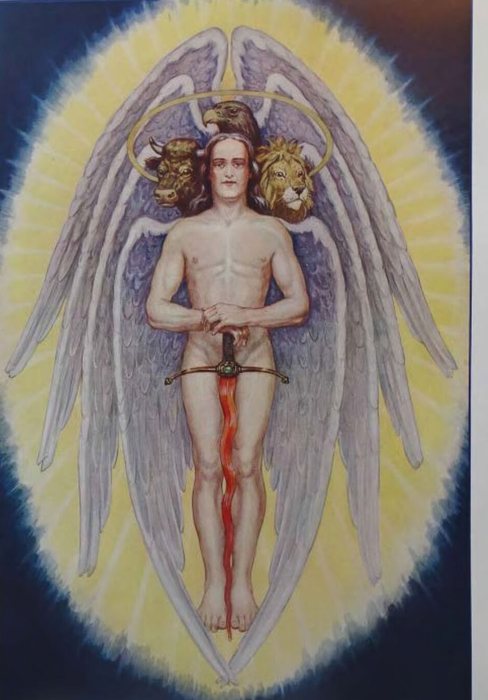
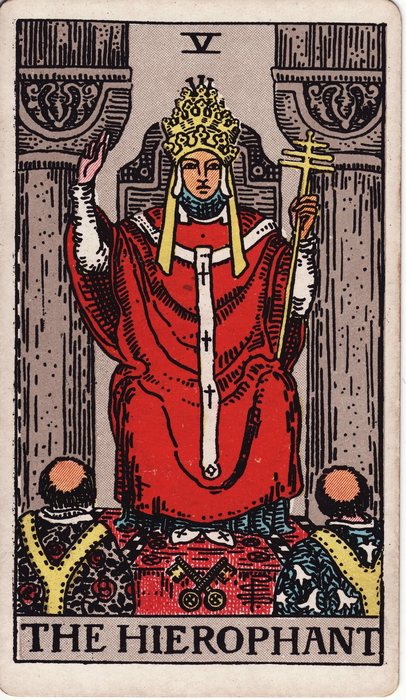
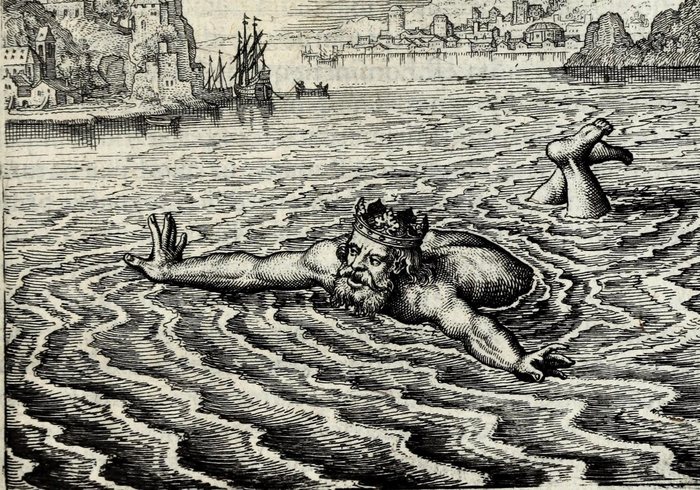
In the same series
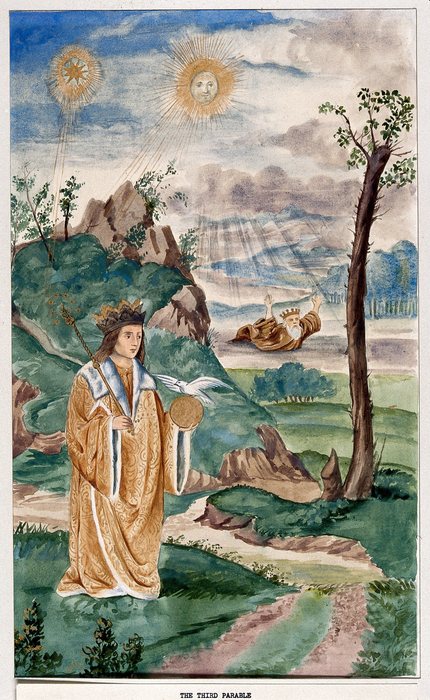
After Splendor Solis, watercolours by Edith A. Ibbs, 1900 to 1909
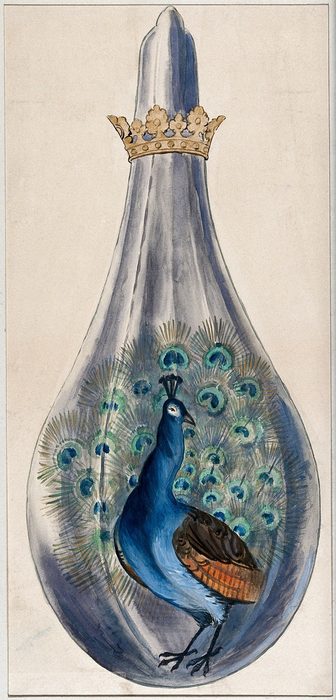
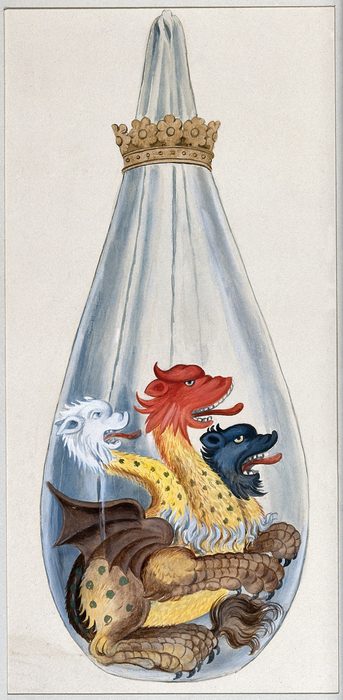
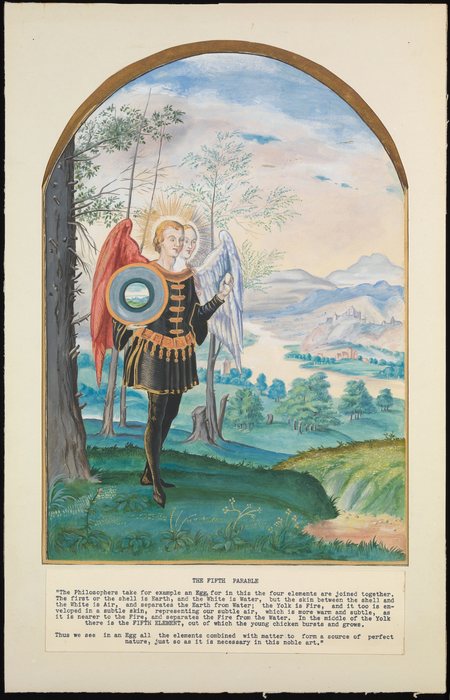
Record
One symbol a week, decoded.
This picture is free at full size from its source, linked above. What an address gets is the Sunday letter: one picture, one symbol marked on it, what it meant and who said so, and the master files of the decoded plates as they are verified. Leave any time.
Free, one letter a week, unsubscribe in one click. How the address is used.
Scroll or pinch to zoom · drag to move · double-tap for 1:1 · 887 by 1400 pixel web copy; the source file is linked under Record