The Hermetic Androgyne
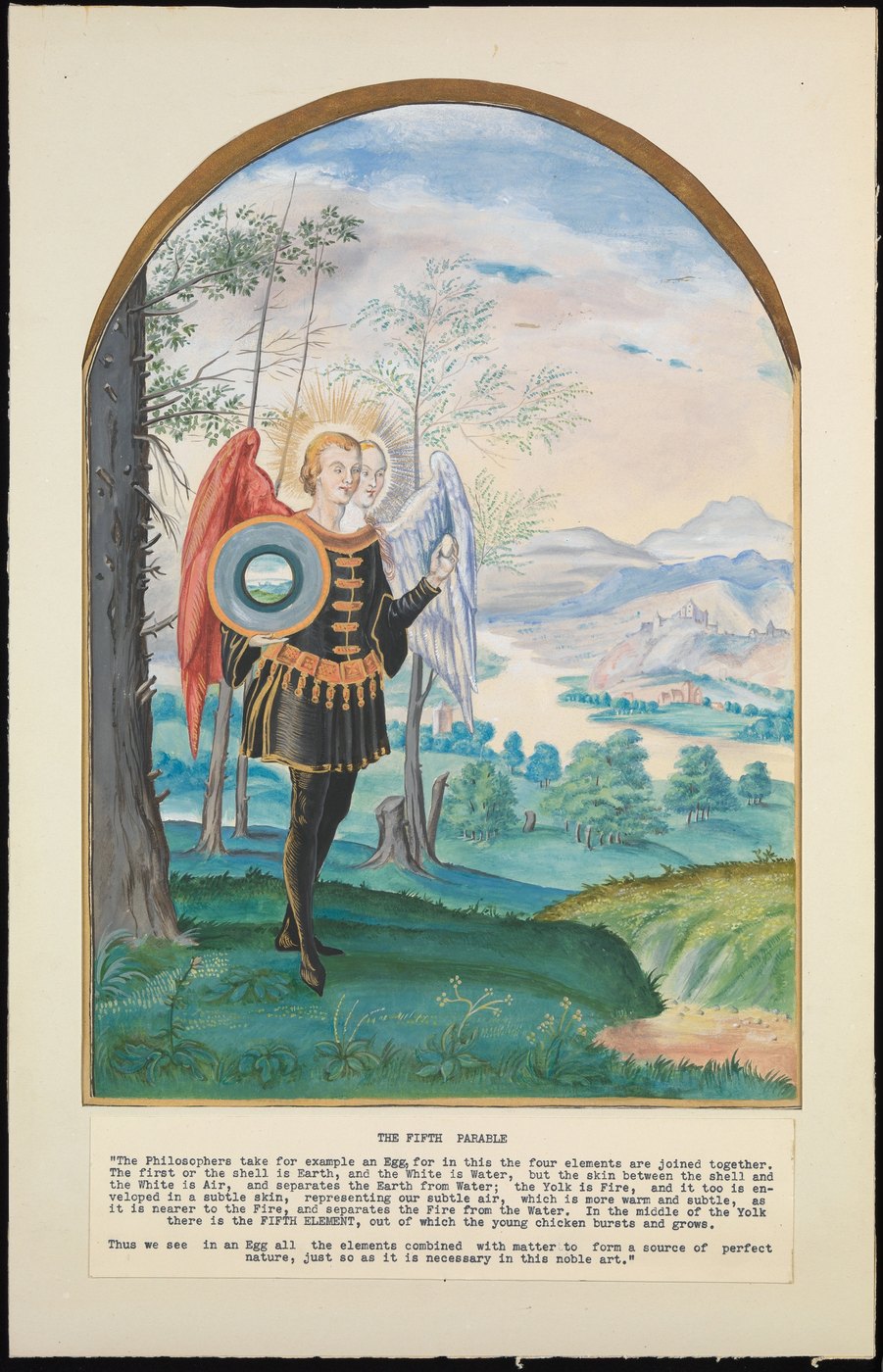
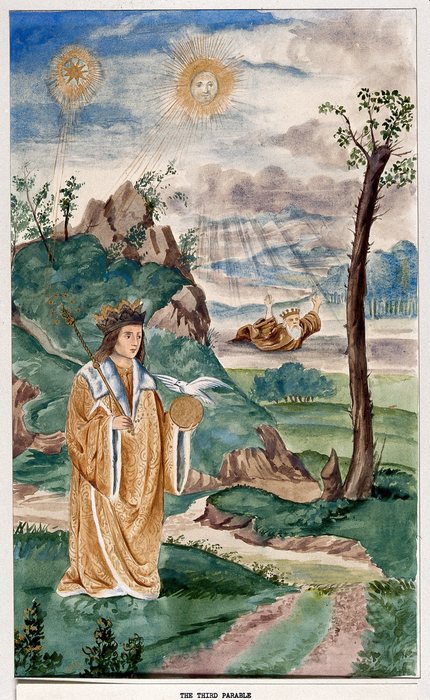
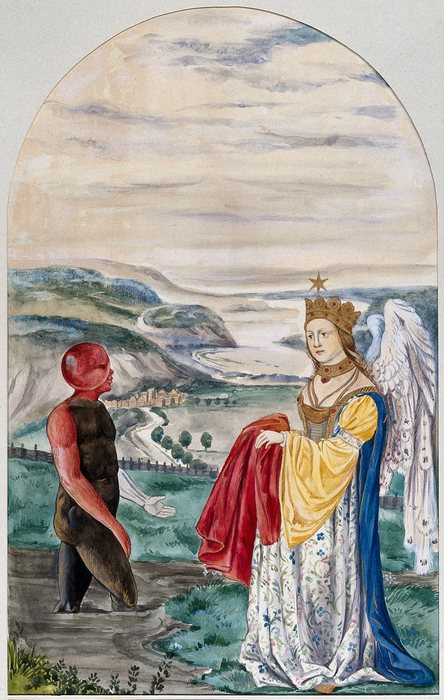
The King and the Queen as the central motif, with the Angel and the Wing, and the Tree in a secondary part. From Splendor Solis.
What is happening
Symbolica, 2026 A watercolour copy of an illumination of Splendor Solis, the sixteenth-century alchemical treatise attributed to Salomon Trismosin. The text typed on its mount is the fifth parable, which is the plate's own key, printed with the picture by whoever mounted it.
Key · 3 motifs
Tap a motif on the picture, or a line below. Its note opens under the line, with the reading its author gave it.
- Primary motif
- Secondary motifs · 1
The picture
One body with two heads, a young man's face forward and a haloed head behind at the shoulder; one red wing and one white; black and gold garments; a grey disc held up with a small landscape in it; a dead tree at the left and a river with castles beyond. By eye
The reading
The picture read whole, in the archive's words, from the sources quoted on the marks. Read on, and the picture follows: the motif under discussion keeps its colour.
A figure stands in a green landscape with a dead tree behind and a river running to castles in the distance. It has one body and two heads, both haloed, one looking forward and one over the shoulder. Its wings are different colours, one red and one white, and its coat is black worked with gold. In one hand it holds up a grey disc with a small landscape showing in it.
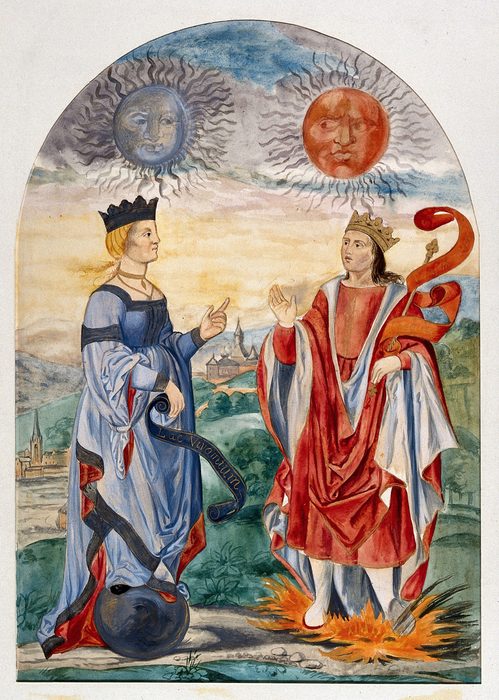
This is the figure alchemy calls the rebis, the two-thing: the king and the queen after the marriage, drawn as a single body that has kept both heads. In this archive the King and the Queen usually stand apart, on two spheres, under a sun and a moon. Here the picture has been run forward to the point where they are one, and the two heads are what is left of the two of them.
The colours are the argument. Red wing, white wing, black garments: the three states the work is said to pass through, worn simultaneously by one figure. The plate is not showing a stage of the work. It is showing the work finished, holding all its stages at once.
What makes this sheet worth having is that somebody typed its key onto the mount beneath it, and the key is not about the figure at all. It is the fifth parable, on the egg: shell for earth, white for water, the skin between them for air, the yolk for fire, and in the middle of the yolk a fifth element ‘out of which the young chicken bursts and grows’. The text and the picture are making one point in two languages. Four things held in one shell, with a fifth in the middle that is alive. Neither the text nor the picture explains the other, and the archive prints both and joins them no further than that.
Decoded: every motif is marked, and each mark carries the reading its author gave it, quoted from the text, or says that it is observed on the picture and not read. The reading above is the archive's own, made from those sources and no others.
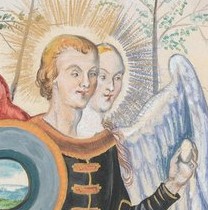
A rank rather than a person. Read the robe, the throne and what comes out of the mouth before you read the face.
In plain words Two heads grow from one neck. The forward face is a young man's, crowned with a halo of rays; the second is smaller, haloed too, and looks past him. This is the figure the alchemists call the rebis or the hermaphrodite: the king and the queen after they have been joined, drawn as one body that has not stopped being two. Nothing on the plate marks one head male and the other female, and the archive does not add that.
Symbolica, 2026 Read off the sheet. The mount's text is about the egg and the four elements and never mentions the figure, so what the two heads are for is not stated by the sheet's own key. Wellcome's catalogue calls the figure the Hermetic androgyne, which is quoted above as their wording, not as a reading.
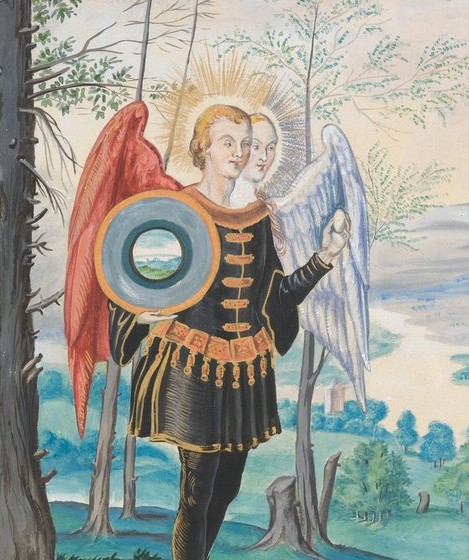
The mark of an errand rather than a nature. Note whether the wings are open, folded, or given to the figure by someone else.
In plain words The wings do not match. One is red and one is white, and the garments between them are black. Red, white and black are the three colours the work passes through, so the figure wears the whole sequence at once rather than standing at one point in it. The mount's text makes the same move with an egg: four elements held together in one thing, and a fifth in the middle of them.
Splendor Solis, 1920 “The Philosophers take for example an Egg, for in this the four elements are joined together. The first or the shell is Earth, and the White is Water, but the skin between the shell and the White is Air, and separates the Earth from Water; the Yolk is Fire, and it too is enveloped in a subtle skin, representing our subtle air, which is more warm and subtle, as it is nearer to the Fire, and separates the Fire from the Water. In the middle of the Yolk there is the FIFTH ELEMENT, out of which the young chicken bursts and grows. Thus we see in an Egg all the elements combined with matter to form a source of perfect nature, just so as it is necessary in this noble art.”
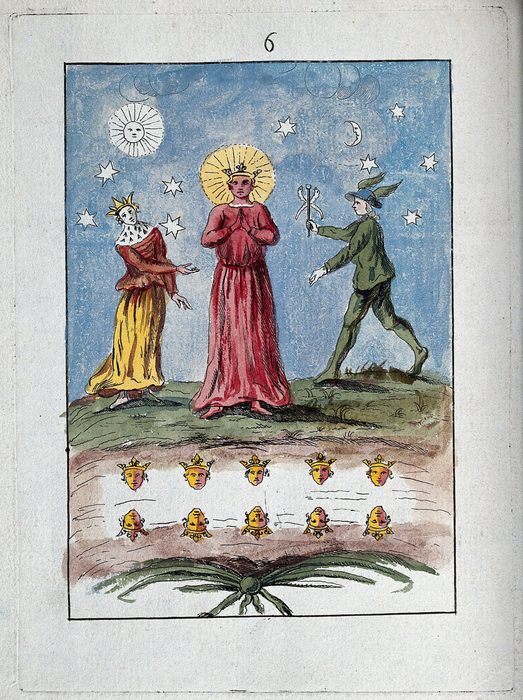
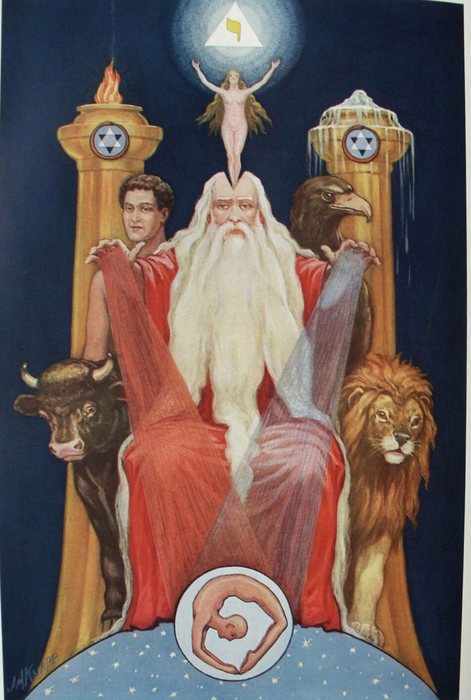
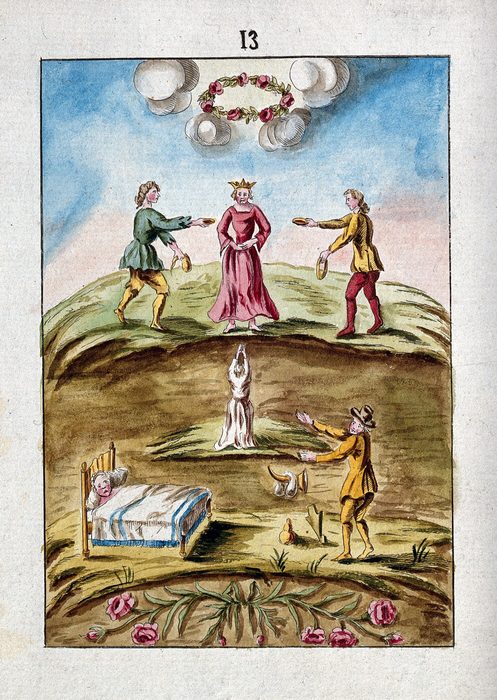
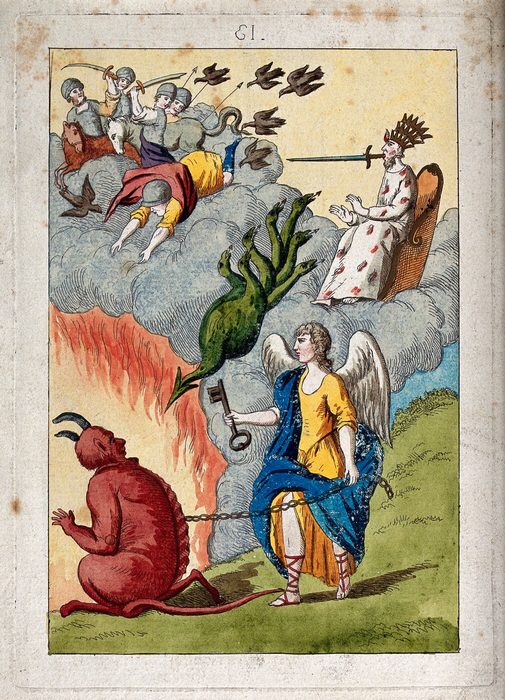
Also carrying the King and the Queen
35 works carry it. The 6 where it is the central motif are here. The symbol.
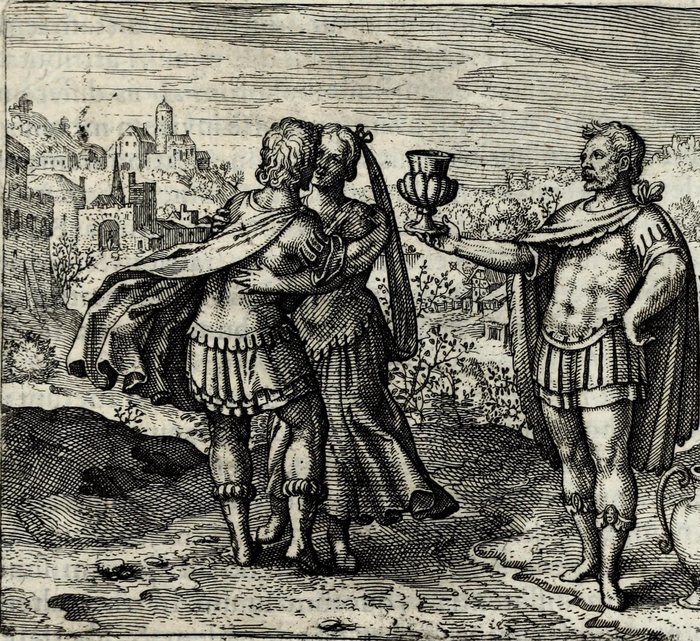
Where the detail is the subject
the Angel and the Wing · the Tree
Each of these is in the picture without being what it is about. Below, one work that is about each.
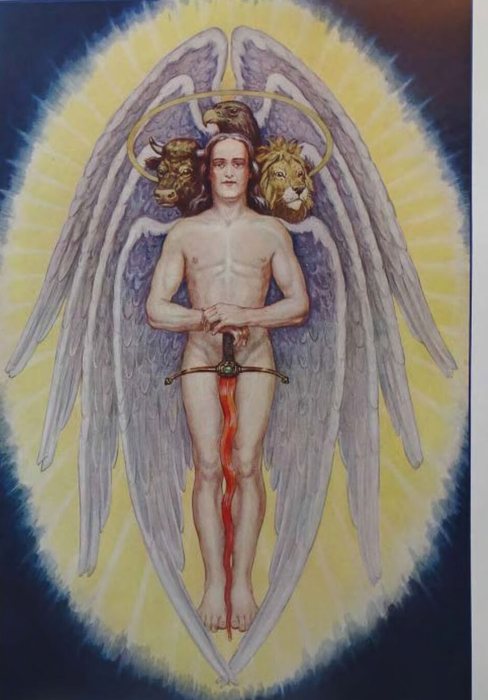
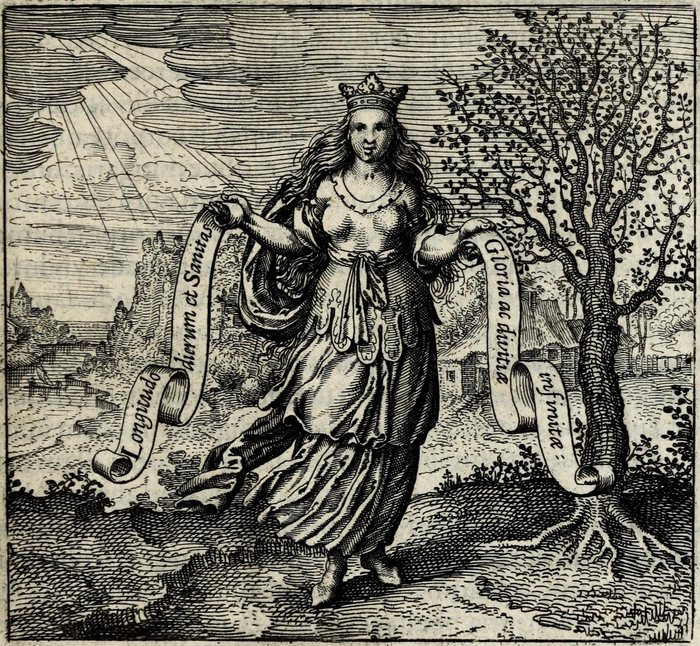
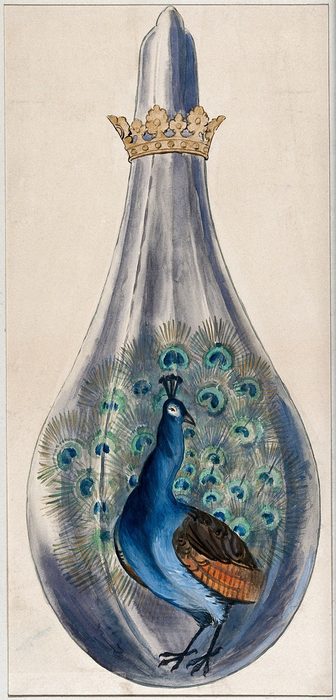
In the same series
After Splendor Solis, watercolours by Edith A. Ibbs, 1900 to 1909
Record
One symbol a week, decoded.
This picture is free at full size from its source, linked above. What an address gets is the Sunday letter: one picture, one symbol marked on it, what it meant and who said so, and the master files of the decoded plates as they are verified. Leave any time.
Free, one letter a week, unsubscribe in one click. How the address is used.
Scroll or pinch to zoom · drag to move · double-tap for 1:1 · 901 by 1400 pixel web copy; the source file is linked under Record