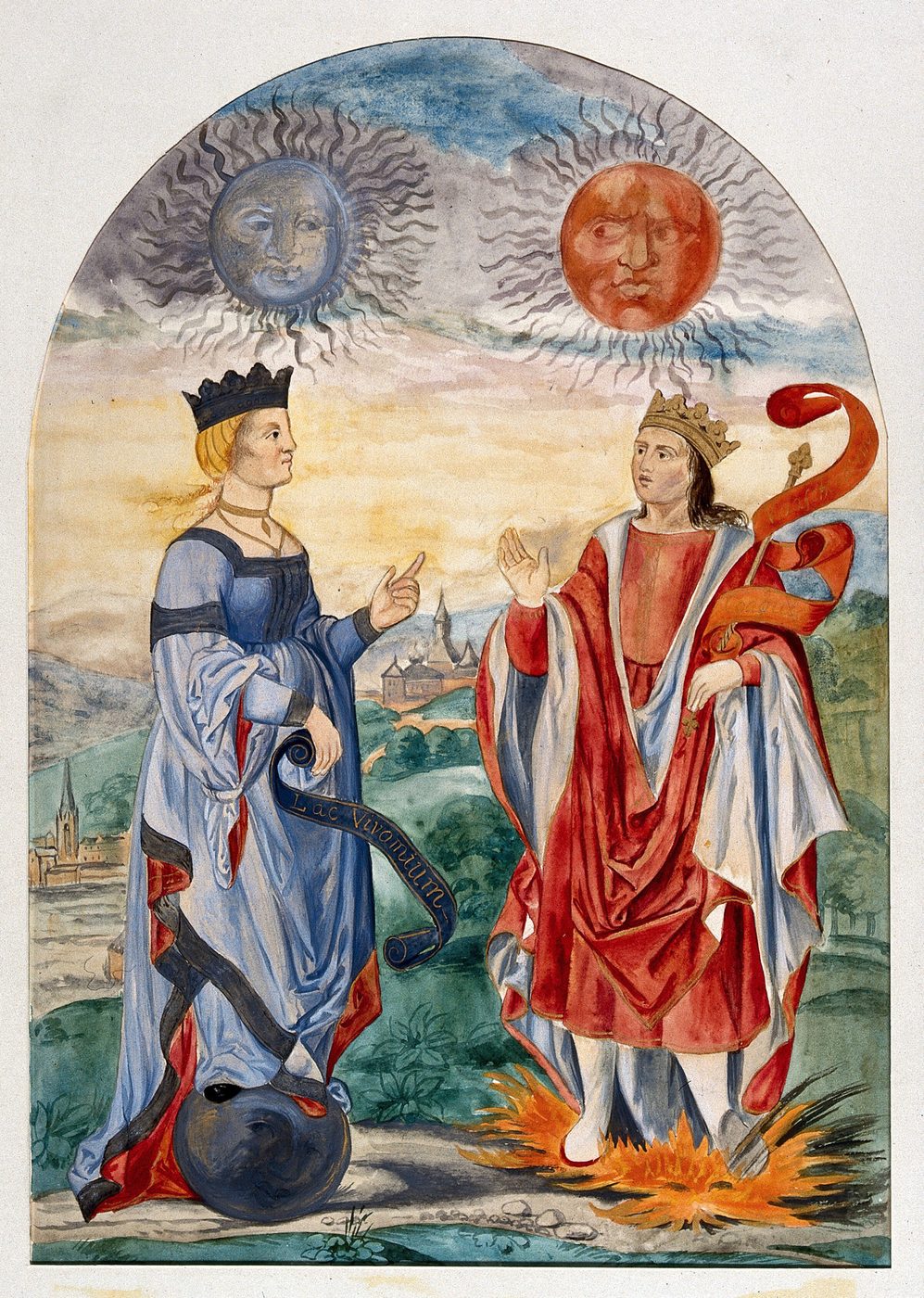
The Sun and the Moon over the King and the Queen
The King and the Queen as the central motif, with the Sun and the Moon, the Water, and Fire in a secondary part. From Splendor Solis.
Key · 4 motifs
Tap a motif on the picture, or a line below. Its note opens under the line, with the reading its author gave it.
- Primary motif
- Secondary motifs · 3
The picture
A crowned queen in blue and a crowned king in red stand talking in a valley; she is on a dark sphere holding a blue scroll lettered in gold, he stands in a burning fire holding a red scroll with a sceptre; two radiate faces hang in the sky above them, one silver and one red, turned towards each other. By eye
The reading
The picture read whole, in the archive's words, from the sources quoted on the marks. Read on, and the picture follows: the motif under discussion keeps its colour.
Two crowned people stand in a green valley, level with each other, talking. She wears blue and stands on a dark sphere. He wears red and stands in a fire. Each of them holds up a scroll with a word on it, and those two words put the picture in the book.
Hers survives. The gold lettering on the blue band reads “Lac Virginum”, the milk of virgins, one of the oldest names in the trade for a white water that dissolves without destroying. The 1920 English prints the singular, Lac virginis. The King carries a red scroll lettered in gold on two bands, and on this copy the gold has gone; the same edition reads it as “Coagula Masculinum”, which gives an order rather than a name. Set the male part solid.
So the two of them hold one instruction between them, in two halves. Dissolve and coagulate, the whole of the work in two words, handed to a man and a woman to say to each other. Neither does anything else. They do not marry, fight or die, which covers most of what a king and queen do in this material.
What they stand on says the same thing again without words. She stands on a dark full moon, cold, and his ground burns. The 1920 description notices the fire first and it repays noticing: two people at the same height, one of them burning, having a conversation.
Overhead the archive's own title went wrong. Two radiate faces hang in that sky, one silver and blue and one red, and Ibbs drew both the same way, with a face and a full ring of wavy rays. Neither carries a crescent. Wellcome's title calls the left one a moon; the 1920 English calls them both Suns and adds the detail that makes the picture, that they look at each other. Hers turns towards the King enquiringly and hopefully. His turns towards her sorrowfully.
Whether they hold two suns or a sun and a moon overhead, nobody doubts the moon under her feet, and she stands on it. The luminaries have swapped places with the people, and the people do the talking.
Decoded: every motif is marked, and each mark carries the reading its author gave it, quoted from the text, or says that it is observed on the picture and not read. The reading above is the archive's own, made from those sources and no others.
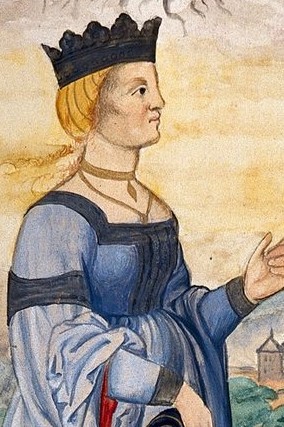
A rank rather than a person. Read the robe, the throne and what comes out of the mouth before you read the face.
In plain words They are not married here, or fighting, or dying. They are talking, and each is holding up a word. The 1920 English reads the Queen's scroll as Lac virginis and the King's as Coagula Masculinum, so between them they are naming a liquid and an instruction to set it solid.
J. K., who wrote the 1920 elucidation, 1920 “Represents on right side a King in red and gold robes, with golden crown on head and standing upon a blazing fire, holding a sceptre in his hand with a scroll upon which is: “Coagula Masculinum” in golden letters. He is talking to a Queen robed in blue with red lining to dress, holding a blue scroll with “Lac virginis” inscribed in gold letters.”
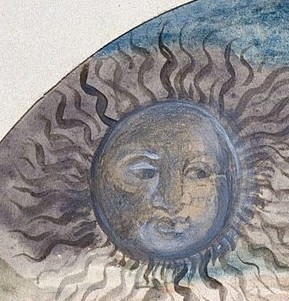
Gold, the perfected metal, and the illuminated intellect. The most overloaded symbol in the tradition.
In plain words Both discs in the sky are drawn the same way, as a face with wavy rays: the left one silver and blue, the right one red. The museum's title calls the left one a moon. The 1920 English calls them both Suns and notices something better, that their eyes are turned towards each other. The unarguable moon in this picture is the dark sphere the Queen is standing on.
J. K., who wrote the 1920 elucidation, 1920 “She stands upon a dark full Moon with both feet, over her head in the air is a faint silvery Sun, which has its eyes directed towards the King enquiringly and hopefully. Above his head is a golden red Sun which has its eyes directed towards her sorrowfully.”
Symbolica Wellcome Collection's own title for the sheet reads it the other way: a moon above a queen dressed in blue, and a sun above a king dressed in red. On the sheet both discs carry a face and a full ring of rays, and neither is a crescent.
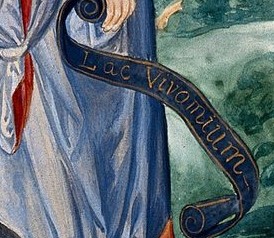
Where a thing is taken apart rather than destroyed. Note whether the figure is in the water, on it, or pouring it.
In plain words The Queen's word survives on the sheet and can be read off it: Lac Virginum, the milk of virgins. The 1920 English prints it as Lac virginis, the singular. Either way it is a name for a white water, and it is the only lettering on this copy that a reader can still make out.
The plate “Lac Virginum”
J. K., who wrote the 1920 elucidation, 1920 “holding a blue scroll with “Lac virginis” inscribed in gold letters.”
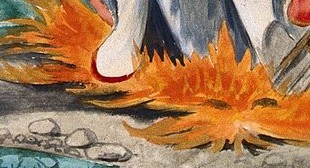
A count, a catastrophe, or the visible part of something that has no body. Note whether the flames are arranged in a number, breaking something, or standing where a figure would be.
In plain words She stands on a cold dark sphere and he stands in a fire, and the two of them are level with each other and talking across it. Nothing else in the picture explains why one of them is burning.
J. K., who wrote the 1920 elucidation, 1920 “standing upon a blazing fire”
Also carrying the King and the Queen
35 works carry it. The 6 where it is the central motif are here. The symbol.
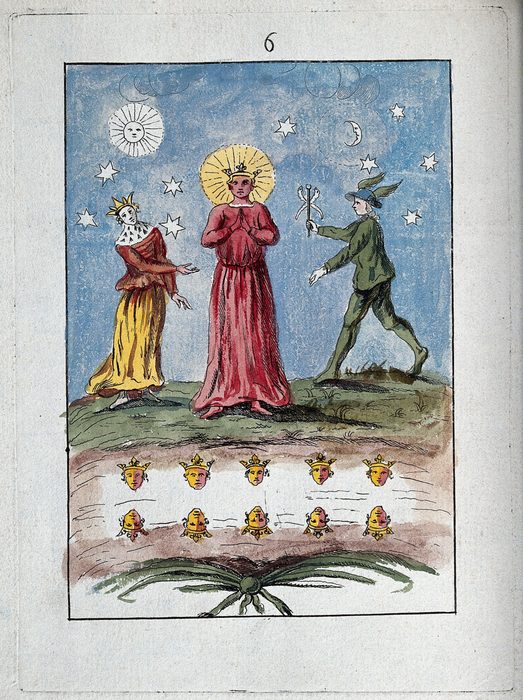
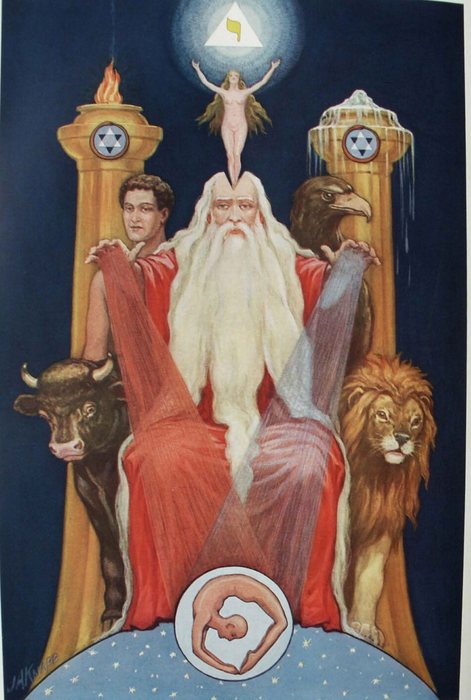
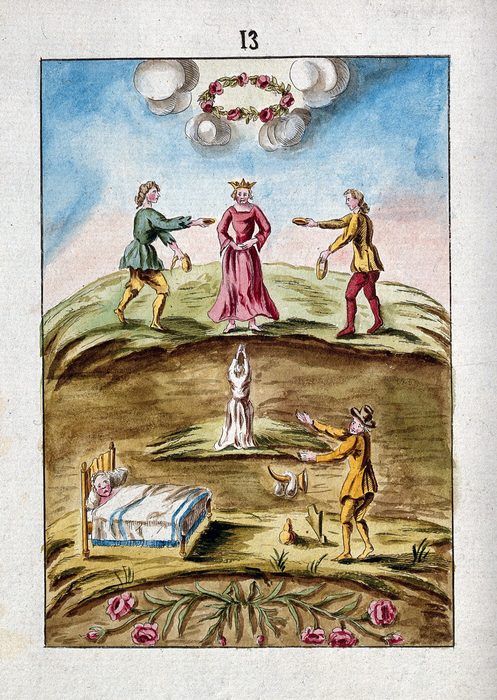
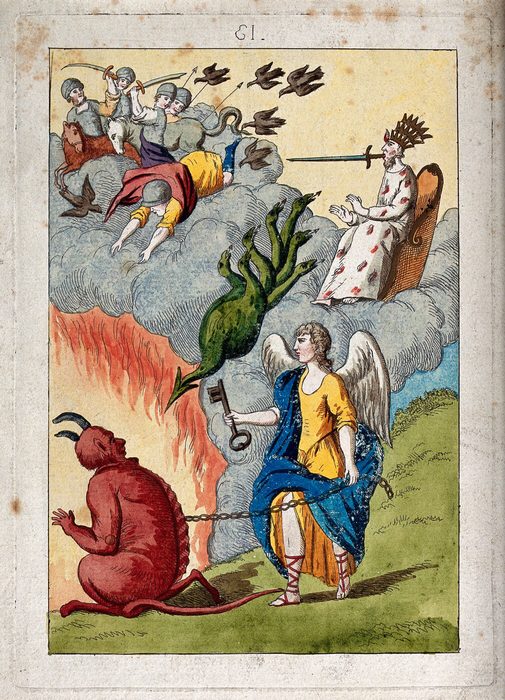
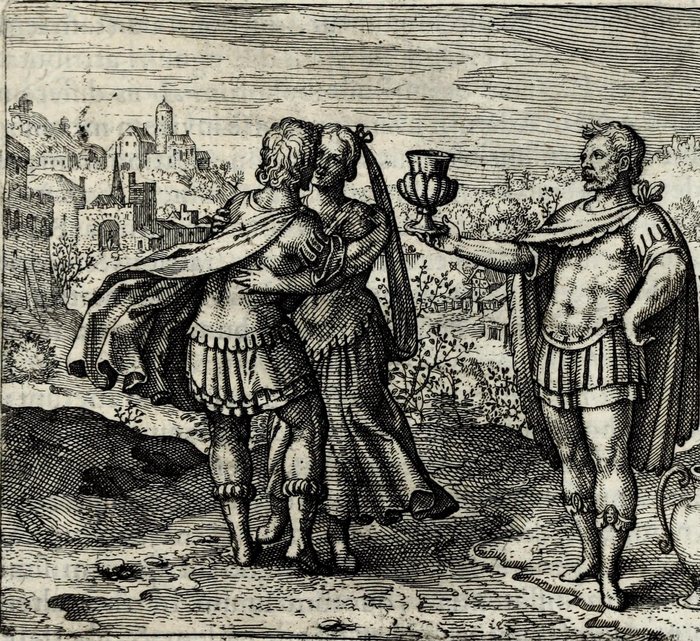
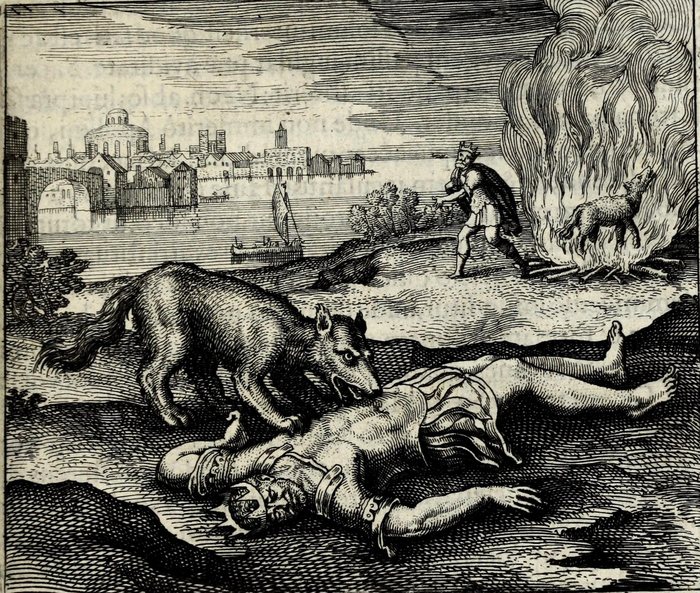
Where the detail is the subject
the Sun and the Moon · the Water · Fire
Each of these is in the picture without being what it is about. Below, one work that is about each.
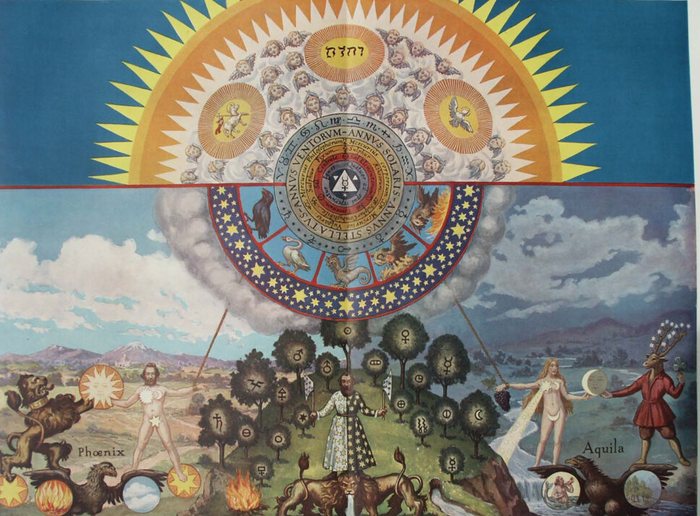
In the same series
After Splendor Solis, watercolours by Edith A. Ibbs, 1900 to 1909
Record
One symbol a week, decoded.
This picture is free at full size from its source, linked above. What an address gets is the Sunday letter: one picture, one symbol marked on it, what it meant and who said so, and the master files of the decoded plates as they are verified. Leave any time.
Free, one letter a week, unsubscribe in one click. How the address is used.
Scroll or pinch to zoom · drag to move · double-tap for 1:1 · 997 by 1400 pixel web copy; the source file is linked under Record