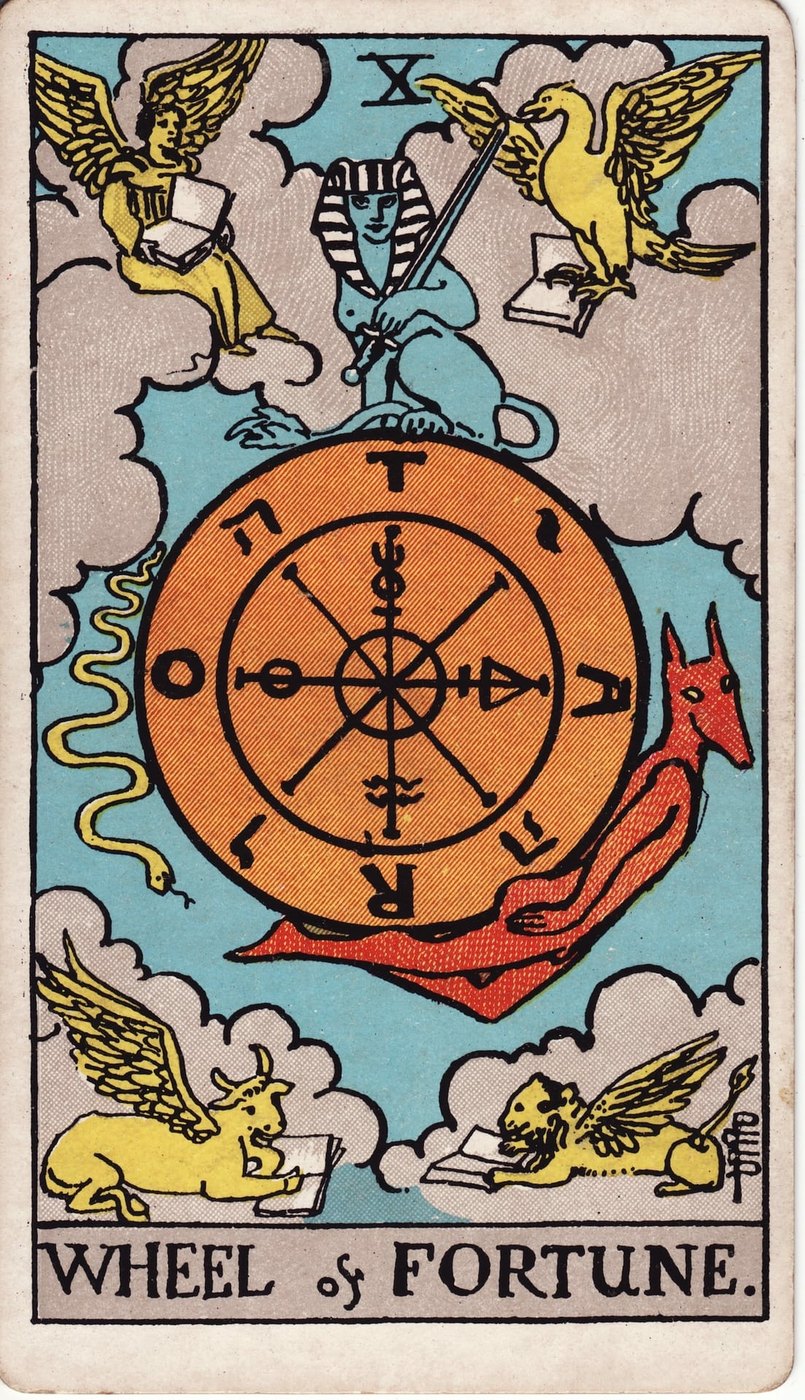
Wheel of Fortune (X)
The Heavens as the central motif, with the Angel and the Wing, the Serpent and the Dragon, and the Lion in a secondary part. From The 1909 tarot.
What is happening
Waite, 1911 “Sometimes the sphinx is represented couchant on a pedestal above, which defrauds the symbolism by stultifying the essential idea of stability amidst movement.”
Waite, 1911 “Behind the general notion expressed in the symbol there lies the denial of chance and the fatality which is implied therein.”
Key · 4 motifs
Tap a motif on the picture, or a line below. Its note opens under the line, with the reading its author gave it.
- Primary motif
- Secondary motifs · 3
The picture
A wheel lettered TARO and ROTA with alchemical signs, a sphinx with a sword seated on top, a serpent descending at the left and a jackal-headed figure rising at the right; the four living creatures with open books in the corners, on clouds; the Heavens as the central motif, the Angel, the Serpent and the Lion by eye. By eye
The reading
The picture read whole, in the archive's words, from the sources quoted on the marks. Read on, and the picture follows: the motif under discussion keeps its colour.
Waite says outright that he did not design this card. He took the arrangement from Eliphas Lévi, who had redrawn the old Wheel of Fortune with Egyptian figures on it, and he keeps the figures while refusing the Egyptology that came with them: it is legitimate to use such symbolism, he writes, ‘provided that no theory of origin is implied therein’. So the picture is a wheel hanging in the sky with a sphinx on top holding a sword, a serpent sliding down the left side, a jackal headed figure climbing the right, and four winged creatures on clouds in the corners, reading.
The rim is lettered, and the letters do two jobs at once. Read one way round they spell TARO, the deck; started a quarter turn along they spell ROTA, the Latin for wheel; and set between them are the four Hebrew letters of the divine name. Waite's gloss is that ‘the transliteration of Taro as Rota is inscribed on the wheel, counterchanged with the letters of the Divine Name, to shew that Providence is implied through all’. Inside the rim sit the alchemical signs for mercury, sulphur, water and salt. What the whole thing means he takes from Lévi again: the picture ‘stands for the perpetual motion of a fluidic universe and for the flux of human life. The Sphinx is the equilibrium therein’.
The snake going down the left has a name. Waite chose to draw Typhon in serpent form, the Egyptian Set as the Greeks called him, the destroyer, leaving the wheel as it turns. Coming up the other side is Hermanubis, the jackal headed guide of souls. Waite calls Lévi's grouping an invention made to prop up a hypothesis and then says that if the hypothesis is dropped the grouping is symbolically correct anyway. Down one side and up the other, destruction and return, on a single turning object.
The four in the corners are Ezekiel's, seen by the river of Babylon: a man, an eagle, a lion and a bull, each winged, each here holding an open book. Waite points out that they stop the card being purely Egyptian, since ‘the four Living Creatures of Ezekiel occupy the angles of the card’. They come back on the last card of the deck, where they watch a dancer. Here they read, because here they are the witnesses: the letters inside the wheel are the divine intention within, and the four creatures are the same intention shown from outside.
The lion at the lower right is one of the four, marked on its own because the lion has its own entry. It is Mark's lion and it is Leo, the fixed fire of the zodiac, one of the four corners the sky turns on.
Waite ends on a piece of drafting advice and a doctrine. Some designs lay the sphinx on a pedestal above the wheel, which he says ‘defrauds the symbolism by stultifying the essential idea of stability amidst movement’: the sphinx has to sit on the wheel itself, still while the thing turns under it. And behind the whole symbol, he writes, ‘there lies the denial of chance and the fatality which is implied therein’. A Wheel of Fortune that denies chance sounds like a contradiction until you notice whose name is on the rim. The wheel turns by law, four witnesses are watching it, and what looks like luck from inside the turning is Providence from outside.
Decoded: every motif is marked, and each mark carries the reading its author gave it, quoted from the text, or says that it is observed on the picture and not read. The reading above is the archive's own, made from those sources and no others.
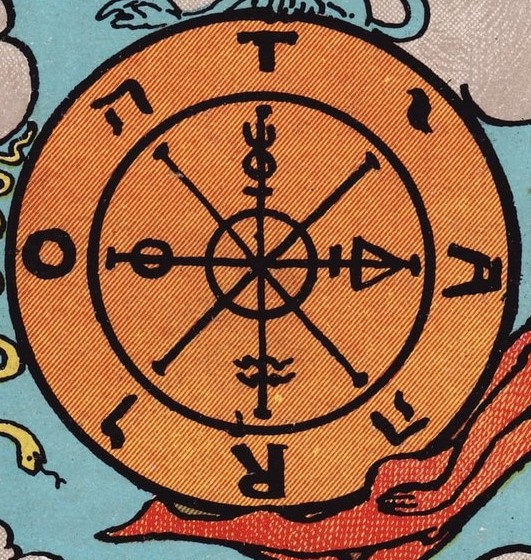
A diagram of everything, drawn so that a person can be found inside it. Note where the human figure stands in the scheme.
In plain words The wheel is the universe in motion and the ups and downs of a life, Waite says, following Lévi. The letters round its rim read TARO and ROTA, the name of the deck and the Latin for wheel, mixed with the four Hebrew letters of God's name, to say that Providence turns with it. The sphinx on top does not move: it is the still point in the turning.
Waite, 1911 “With the French occultist, and in the design itself, the symbolic picture stands for the perpetual motion of a fluidic universe and for the flux of human life. The Sphinx is the equilibrium therein.”
Waite, 1911 “The transliteration of Taro as Rota is inscribed on the wheel, counterchanged with the letters of the Divine Name--to shew that Providence is implied through all.”
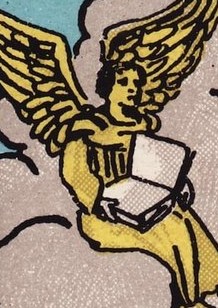
The mark of an errand rather than a nature. Note whether the wings are open, folded, or given to the figure by someone else.
In plain words The four winged creatures in the corners, each reading a book, are Ezekiel's living creatures, the man, the eagle, the lion and the bull, which the church gave to the four Evangelists. Waite says they show God's intention outside the wheel, as the letters of the Name show it inside.
Waite, 1911 “The symbolism is, of course, not exclusively Egyptian, as the four Living Creatures of Ezekiel occupy the angles of the card, and the wheel itself follows other indications of Lévi in respect of Ezekiel's vision, as illustrative of the particular Tarot Key.”
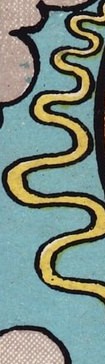
A single creature doing two opposite jobs. Note whether it is bound, killed, or eating itself.
In plain words The snake sliding down the left side of the wheel is Typhon, Waite says, the Egyptian power of destruction in his serpent form, taken from Lévi's version of the card. He goes down as the wheel turns.
Waite, 1911 “In this symbol I have again followed the reconstruction of Eliphas Lévi, who has furnished several variants. It is legitimate--as I have intimated--to use Egyptian symbolism when this serves our purpose, provided that no theory of origin is implied therein. I have, however, presented Typhon in his serpent form.”
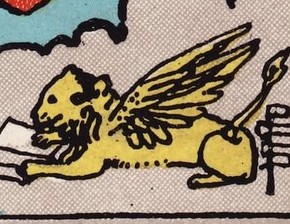
Usually not an animal but one face of a set of four. Count the other three before reading it alone.
In plain words The lion is one of the four creatures, at the lower right, winged and reading. It is the same lion that stands for the Evangelist Mark and for the fixed sign Leo.
Waite, 1911 “But this is the Divine intention within, and the similar intention without is exemplified by the four Living Creatures.”
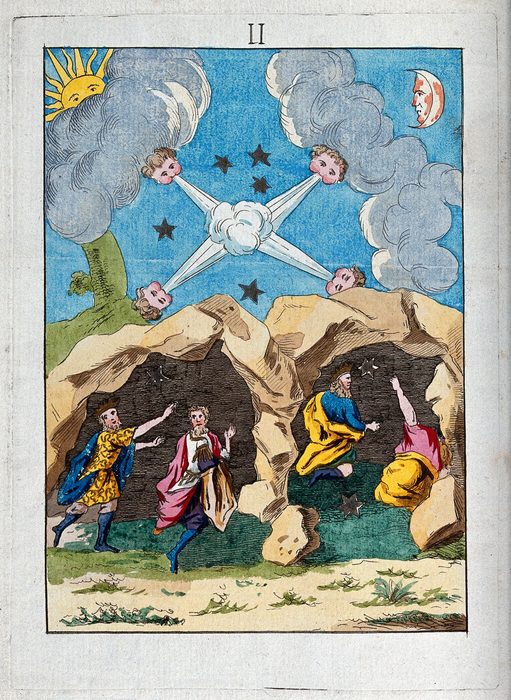
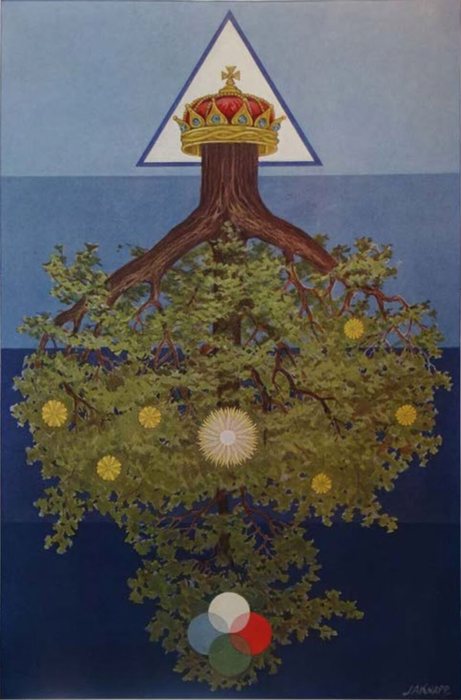
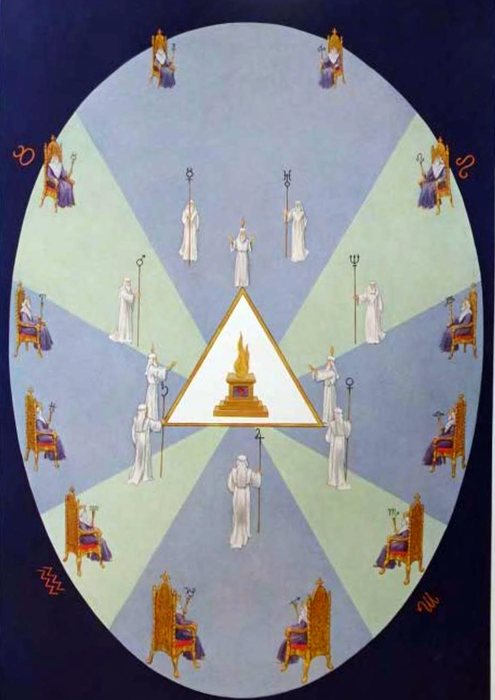
Also carrying the Heavens
61 works carry it. The 6 where it is the central motif are here. The symbol.
Where the detail is the subject
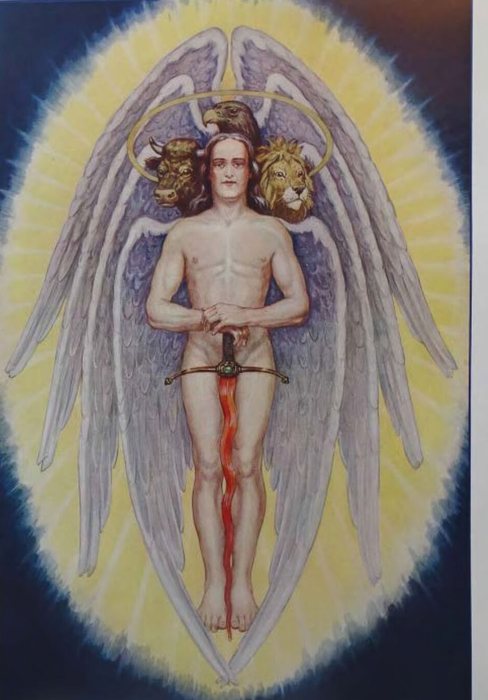
the Angel and the Wing · the Serpent and the Dragon · the Lion
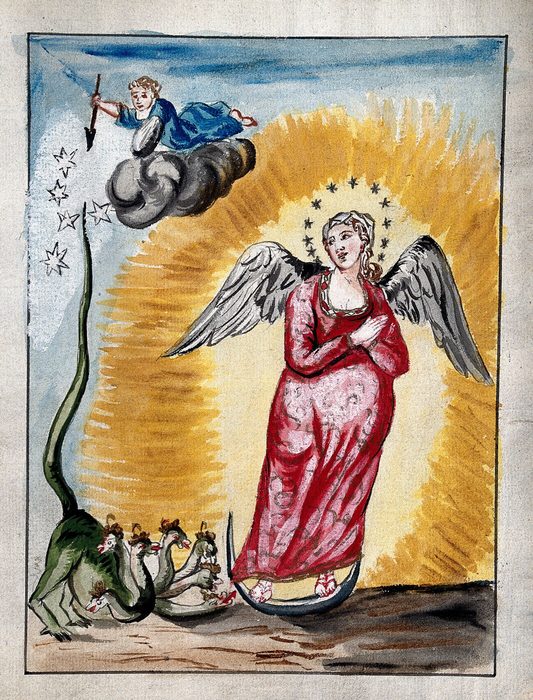
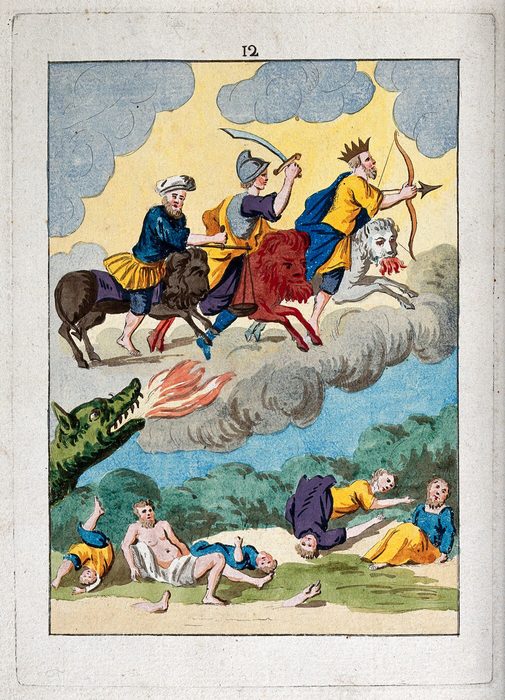
Each of these is in the picture without being what it is about. Below, one work that is about each.
In the same series
Record
One symbol a week, decoded.
This picture is free at full size from its source, linked above. What an address gets is the Sunday letter: one picture, one symbol marked on it, what it meant and who said so, and the master files of the decoded plates as they are verified. Leave any time.
Free, one letter a week, unsubscribe in one click. How the address is used.
Scroll or pinch to zoom · drag to move · double-tap for 1:1 · 805 by 1400 pixel web copy; the source file is linked under Record