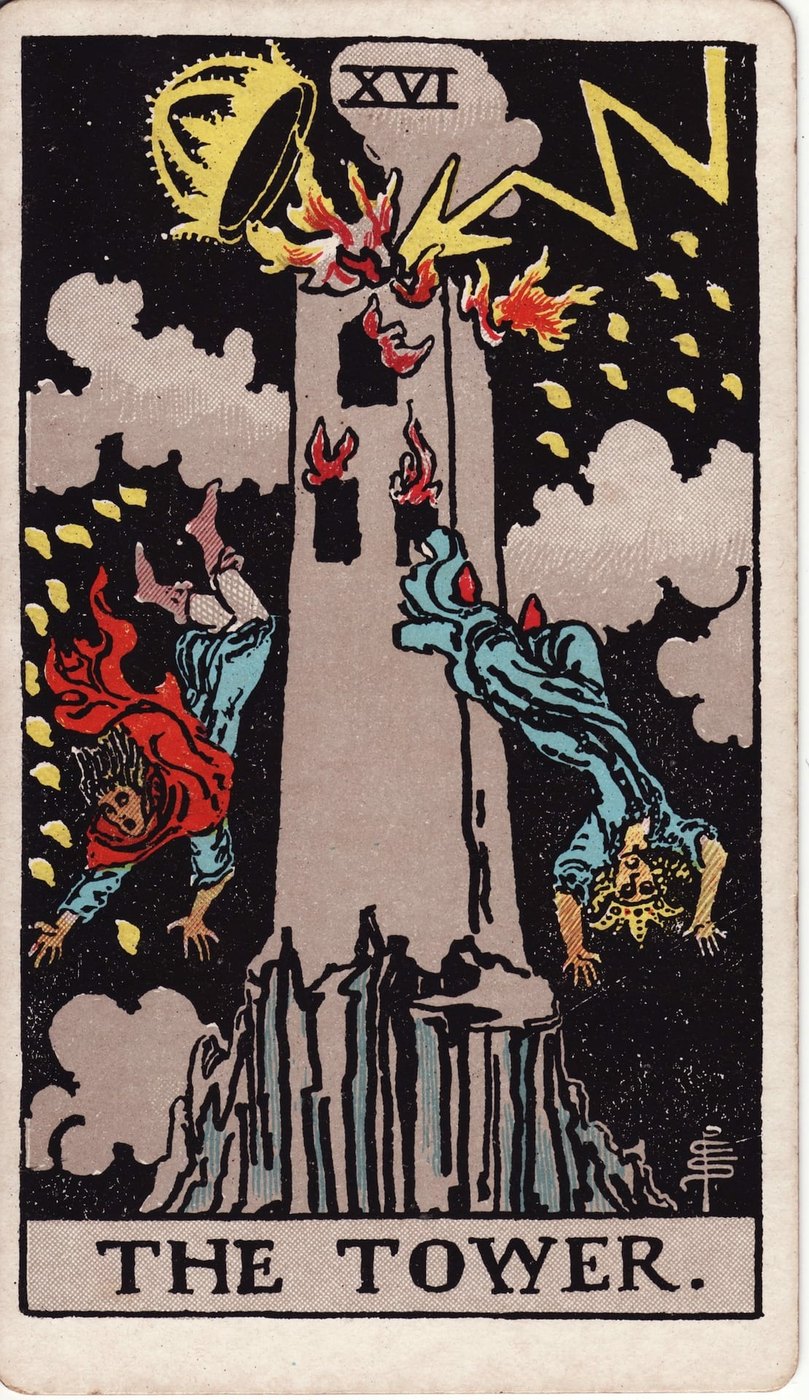
The Tower (XVI)
Fire as the central motif, with the Crown in a secondary part. From The 1909 tarot.
What is happening
Waite, 1911 “I agree rather with Grand Orient that it is the ruin of the House of Life, when evil has prevailed therein, and above all that it is the rending of a House of Doctrine. I understand that the reference is, however, to a House of Falsehood.”
Waite, 1911 “Its alternative titles are: Castle of Plutus, God's House and the Tower of Babel. In the last case, the figures falling therefrom are held to be Nimrod and his minister.”
Key · 2 motifs
Tap a motif on the picture, or a line below. Its note opens under the line, with the reading its author gave it.
- Primary motif
- Secondary motifs · 1
The picture
A tower on a crag struck by lightning, its crown knocked from the top, flames at the windows, two figures falling head first, drops of fire in a black sky; Fire as the central motif, the Crown by eye. By eye
The reading
The picture read whole, in the archive's words, from the sources quoted on the marks. Read on, and the picture follows: the motif under discussion keeps its colour.
This is the card Waite found hardest to write about, and he says so before he says anything else: the occult explanations attached to it are meagre and mostly disconcerting. Then he sorts through them. Papus called it the fall of Adam, which Waite rejects, though he prefers Papus's alternative, the materialization of the spiritual word. Christian called it the downfall of the mind trying to penetrate the mystery of God, rejected too. Waite sides with Grand Orient: this is the ruin of the House of Life when evil has got into it, and above all ‘the rending of a House of Doctrine’. His own last word is harder. The reference, he understands, is to ‘a House of Falsehood’.
The picture is a tower on a crag at night. Lightning comes down from the right and strikes the top, flame bursts from three windows, and two figures fall head first towards the rocks through a sky full of burning drops, twenty two of them shaped like the Hebrew letter yod, counted here and not by Waite. He offers one historical reading and seems mildly annoyed nobody got there first: ‘it is a little surprising that the device has not so far been allocated to the destruction of Solomon's Temple, when the lightning would symbolize the fire and sword with which that edifice was visited by the King of the Chaldees’. The older names for the card he lists as ‘Castle of Plutus, God's House and the Tower of Babel’, and in the Babel reading the two falling men are taken to be Nimrod and his minister.
Look at what the lightning has done first. It has knocked the crown clean off the tower, and the crown hangs in the air a little way clear of the top, the way a lid comes off a pot. It is gold, and it is drawn as a real crown rather than as battlements. Waite's text says nothing about it and nothing about the two people falling either, so both are marked here as seen and left unread, which is honest and also unnecessary. Nobody needs telling what it means when the crown comes off the top of the house. The illustrator has said in one stroke what Waite takes a paragraph to say about the House of Falsehood: what falls is what was set highest.
The card is tied to the one before it, and Waite is careful about how. The catastrophe reflects the Devil, but by analogy rather than by symbolism: the Devil is the fall into the material and animal state, the Tower is destruction on the intellectual side. Then he quotes the psalm, that except the Lord build the house, they labour in vain that build it. The tower went up in the wrong hands. The lightning is the correction.
Decoded: every motif is marked, and each mark carries the reading its author gave it, quoted from the text, or says that it is observed on the picture and not read. The reading above is the archive's own, made from those sources and no others.
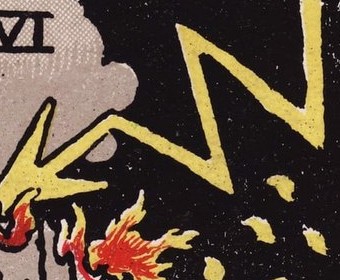
A count, a catastrophe, or the visible part of something that has no body. Note whether the flames are arranged in a number, breaking something, or standing where a figure would be.
In plain words Lightning strikes a tower on a rock, fire bursts from its windows, and two people fall head first through a night full of burning drops. Waite says it is idle to explain that the card shows ruin, because ruin is on its surface; the question is ruin of what, and he answers, of a house of falsehood.
Waite, 1911 “It is a little surprising that the device has not so far been allocated to the destruction of Solomon's Temple, when the lightning would symbolize the fire and sword with which that edifice was visited by the King of the Chaldees.”
Waite, 1911 “It is idle to indicate that it depicts ruin in all its aspects, because it bears this evidence on the surface.”
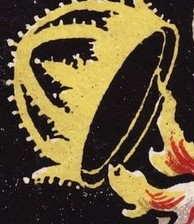
Completion, and in the Kabbalistic reading the first sephirah, the point at which the work is no longer yours.
In plain words The lightning has knocked the crown clean off the top of the tower, and it hangs in the air beside the flames. Waite's text does not mention it, nor the falling figures. Observed on the card and left unread: a reader will see what a crown blown off a tower means without help.
Symbolica The crown knocked from the top of the tower is on the card and not in Waite's text, which names neither it nor the falling figures. Marked as observed on the card, and left unread rather than guessed.
Also carrying Fire
44 works carry it. The 6 where it is the central motif are here. The symbol.
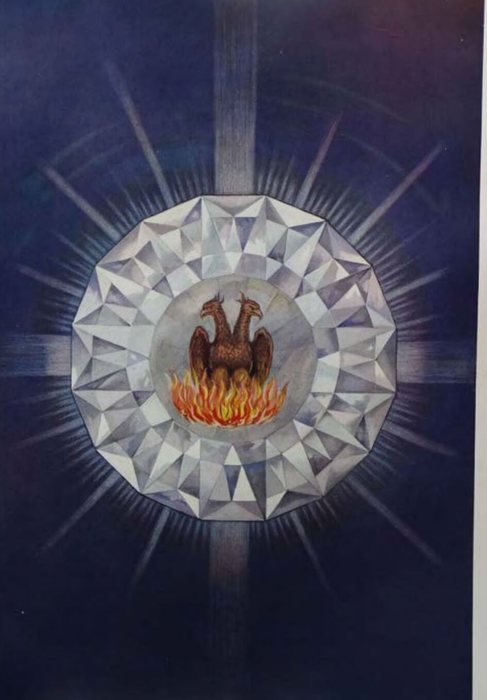
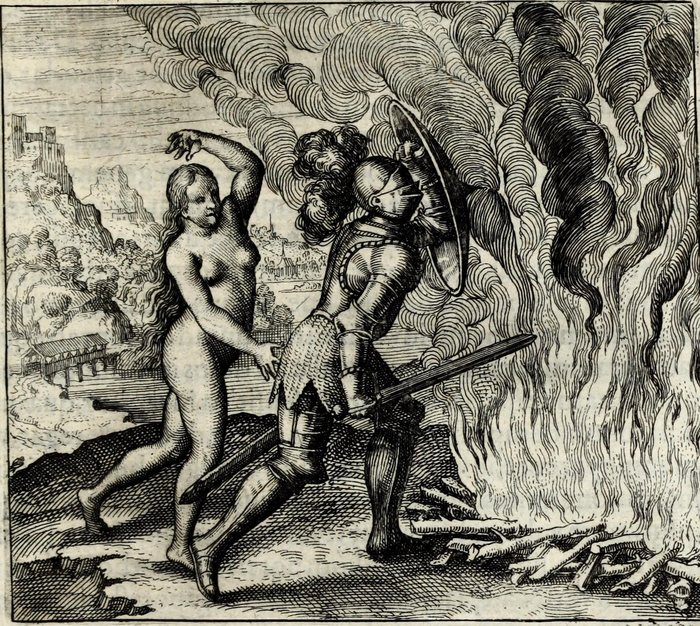
Where the detail is the subject
This is in the picture without being what it is about. Below, one work that is about it.
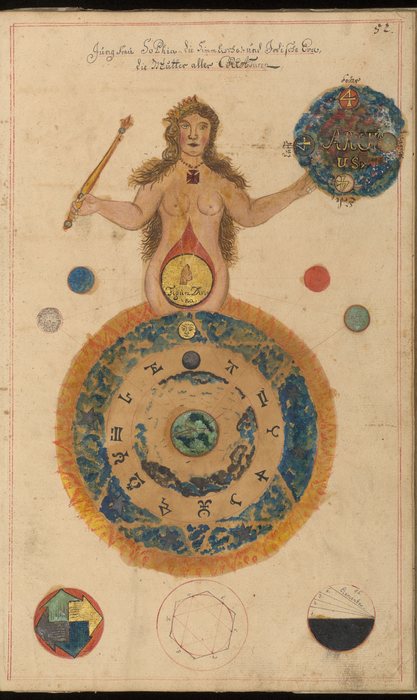
In the same series
Record
One symbol a week, decoded.
This picture is free at full size from its source, linked above. What an address gets is the Sunday letter: one picture, one symbol marked on it, what it meant and who said so, and the master files of the decoded plates as they are verified. Leave any time.
Free, one letter a week, unsubscribe in one click. How the address is used.
Scroll or pinch to zoom · drag to move · double-tap for 1:1 · 809 by 1400 pixel web copy; the source file is linked under Record