The Lantern
the lamp, lucerna
Light that is carried rather than received. The attribute of the Hermit, and of anyone who has to go into the dark on purpose.
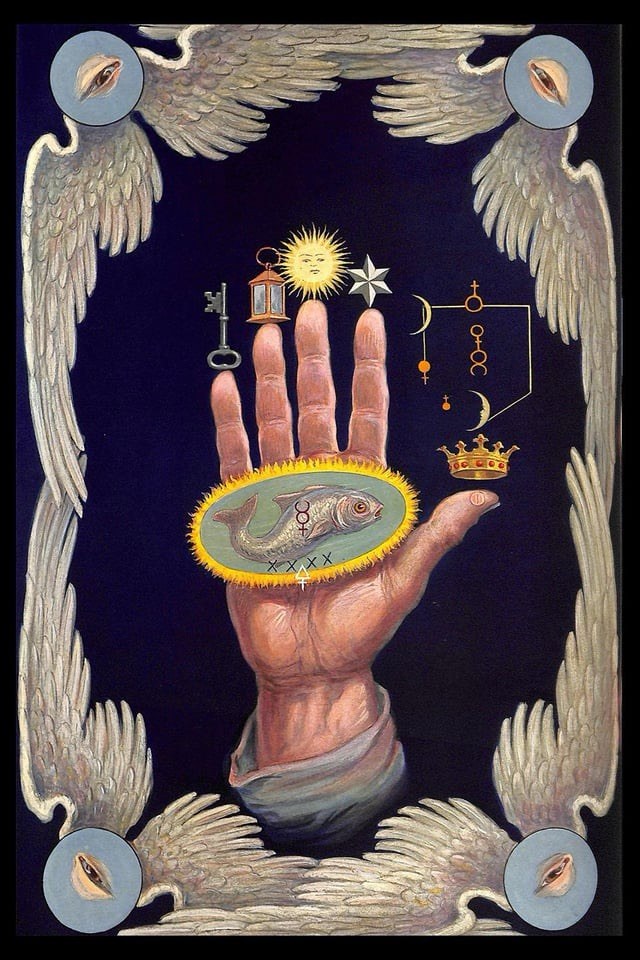
The lantern is on the ring finger, and both readings of the Hand of the Mysteries agree on one point about it before they part: this is light that had to be made.
Hall is explicit. The lantern is “human knowledge, for it is a spark of the Universal Fire captured in a man-made vessel”. Every word there is doing work. It is a spark and not the fire. It is captured and not given. And the vessel is man-made, which places human knowledge one careful step below whatever the fire is. On the thumb of the same hand Hall puts “Absolute Light, unknown and unrevealed”, so the plate is holding both at once: light nobody made, and light in a box.
The seventeenth-century Hand of the Philosophers has no interest in that distinction. On its ring finger the lantern is alum, without which no perfect work can be accomplished. Those are the archive's words for the text rather than its own. It is the same grammar the older hand uses for every finger: a substance, and a claim that the work fails without it.
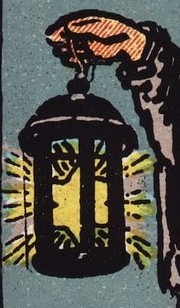
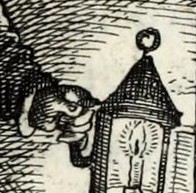
Two more lanterns have arrived since, and both agree with Hall against the older hand. Waite's Hermit of 1909 holds his up on a peak, and Waite says of it “It is a star which shines in the lantern”, and that his beacon intimates “where I am, you also may be”: a light carried so that someone else can follow it. Maier's forty-second emblem of 1618 gives an old man a lantern to follow Nature with, and the motto says what the lamp is, reading: “Lectio sit lampas tenebris dilucida”, let reading be a lamp bright in the dark, so that you may be careful of the heaps of things and of words.
Which leaves the lantern as the most modest sign on the plate and, read Hall's way, the most human one. The crown, the star and the sun are all light arriving from somewhere. The lantern is the only light in the picture that somebody had to carry.
Contested
This entry stands on two sources and one picture, and both sources are flagged in the record rather than settled. Hall's caption is a transcription not yet read against the printed 1928 page. The Hand of the Philosophers reaches us through Leone Muller's English of 1986, not yet read against a seventeenth-century printing, and the authorship of the Hollandus texts is disputed. What the archive holds of the older hand is a reading of it rather than a quotation from it, and the entry says so wherever it draws on it.
Hall's reading of the lantern as human knowledge subordinate to a universal fire is a theological claim and the archive holds no source that agrees or disagrees with it. It is quoted as his.
The Lantern has no group of its own in this archive and lives under the Hand; it stands on the Hand of the Mysteries, on Waite's Hermit and on Maier's forty-second emblem.
Sources
- Manly P. Hall, The Secret Teachings of All Ages, 1928: The plate caption to the Hand of the Mysteries. Transcribed, not yet read against the printed page.
- Hollandus, attributed, The Hand of the Philosophers, 17th c.: Through Leone Muller's English translation, RAMS, 1986. Not yet read against a seventeenth-century printing, and the authorship of the Hollandus texts is disputed. What the archive holds is a reading of the text rather than a quotation from it.
- Arthur Edward Waite, The Pictorial Key to the Tarot: Waite commissioned the 1909 designs and wrote the key to them, so his account is the closest thing the deck has to an author's statement.
- Michael Maier, Atalanta Fugiens, 1618: The mottoes and epigrams of the fifty emblems, Oppenheim 1618, read against the page images of the Getty Research Institute copy; the English is the archive's own and is marked as such on every record. Maier's discourses, in which he explains each emblem at length, are not yet transcribed.
On the same plate
Where it appears · 3
3 works in the archive carry the Lantern. First the 3 where it has been read, with the Lantern itself picked out.