The Key
clavis
Access to what is deliberately closed. In hermetic imagery the key is almost never a key to a door.
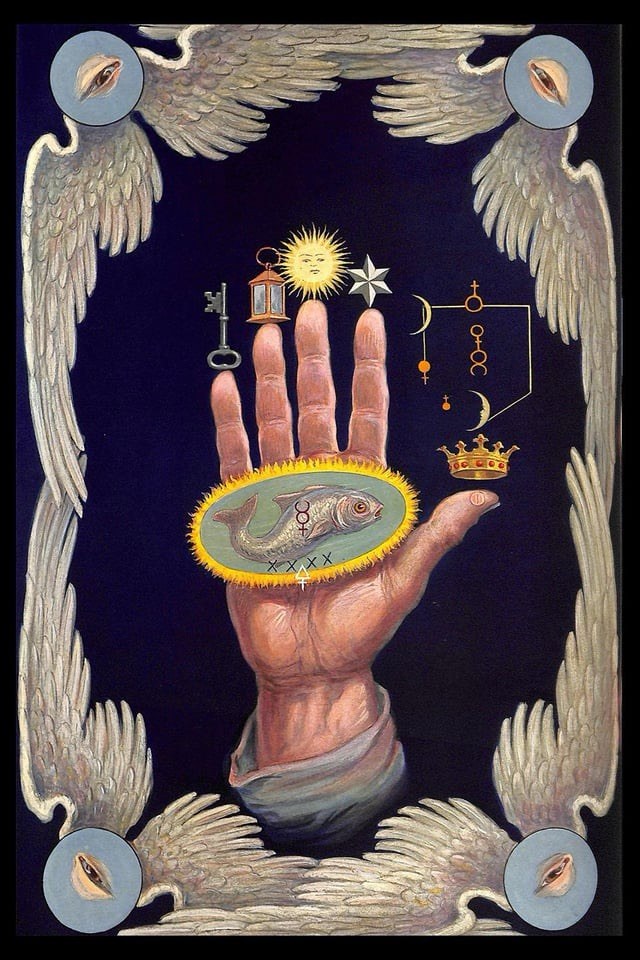
The key is on the little finger of the Hand of the Mysteries, and the two texts that read that hand disagree about what kind of thing it is while using the same word for it.
For Hall in 1928 the key is not an object in the picture but the subject of the whole book he put the picture in. It stands for “the Mysteries themselves, without whose aid man cannot unlock the numerous chambers of his own being”. Note where the locked door is. It is not a vault, a library or a heaven; it is the person looking at the plate, and the chambers are his.
The seventeenth-century Hand of the Philosophers puts a chemical on the same finger and then says something odd with it. On that hand the key is common salt, and salt, that text says, is the key in this Art. So the picture shows a key, the older reading names a substance, and then reaches for the word key again to explain why the substance matters. Those are the archive's words for the text and not the text's own.
That is worth pausing on, because it is the clearest case in this archive of the two hands not being two vocabularies for one idea. Hall's key opens a man. The older key is a reagent that happens to be described as opening the work. The pictures agree, the finger agrees, and the sentences underneath are doing different jobs.
Maier draws the key by its absence. His twenty-seventh emblem shows a man without feet walking toward the locked gate of a walled garden, and its motto puts the two together: whoever tries to enter the philosophers' rose garden without a key is like a man who wants to walk and has no feet. The key is not in the picture. The gate, the wall and the footless man are, and together they say what a key is for. The epigram adds that it is cheap: “Unica cui clavis res vilis habetur in orbe”, its one key is a thing held cheap in the world, which answers the question the two hands left open in its own way. Maier's key is neither a mystery nor a reagent but a thing anyone might have, and most do not think worth having.
Contested
This entry stands on two sources and one picture, and both sources are flagged in the record rather than settled. Hall's caption is a transcription not yet read against the printed 1928 page. The Hand of the Philosophers reaches us through Leone Muller's English of 1986, not yet read against a seventeenth-century printing, and the authorship of the Hollandus texts is disputed. What the archive holds of the older hand is a reading of it rather than a quotation from it, and the entry says so wherever it draws on it.
The Key has no group of its own in this archive and lives under the Hand; it stands on the Hand of the Mysteries and on Maier's locked gate, where the key itself is not drawn.
Whether the older hand's use of the word key is a figure of speech or a technical term is not settled by anything held here, and the entry deliberately leaves it open.
Sources
- Manly P. Hall, The Secret Teachings of All Ages, 1928: The plate caption to the Hand of the Mysteries. Transcribed, not yet read against the printed page.
- Hollandus, attributed, The Hand of the Philosophers, 17th c.: Through Leone Muller's English translation, RAMS, 1986. Not yet read against a seventeenth-century printing, and the authorship of the Hollandus texts is disputed. What the archive holds is a reading of the text rather than a quotation from it.
- Michael Maier, Atalanta Fugiens: The motto of Emblema XXVII, read off the 1618 page; the English is the archive's own translation and is marked as such on the record.
On the same plate
Where it appears · 2
2 works in the archive carry the Key. First the 2 where it has been read, with the Key itself picked out.