The Fish
piscis, the fish in the flame
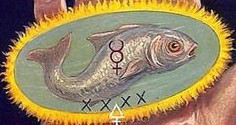
Living substance in a hostile element. In the flaming oval it is philosophical mercury, marked with Mercury's own glyph.
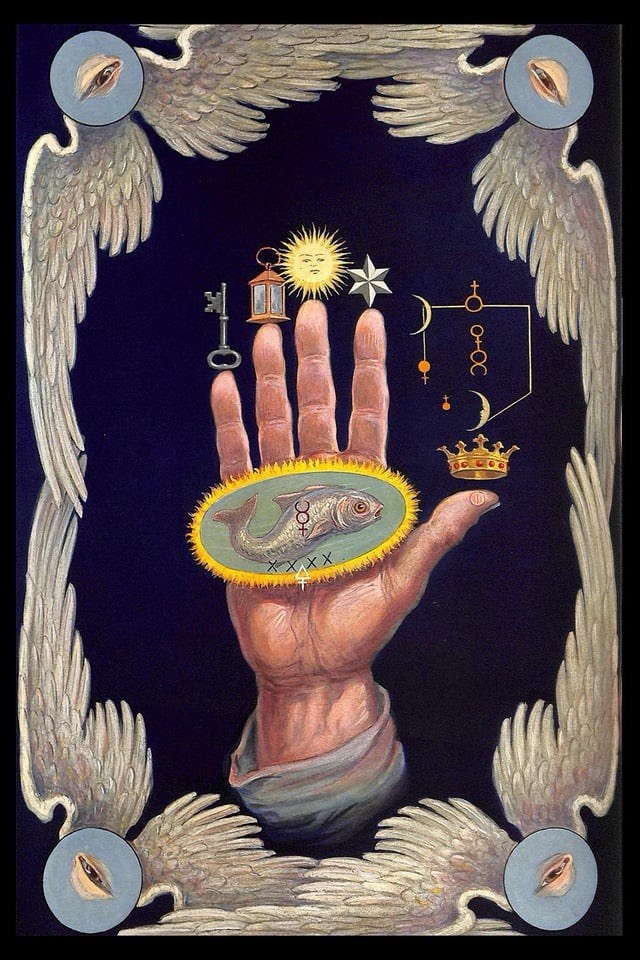
The fish is the exception. On every other finger of the Hand of the Mysteries the two readings pull apart, one naming a faculty of mind and the other a chemical. In the flaming oval on the palm they say the same thing.
Hall: “The fish is mercury and the flame-bounded sea in which it swims is sulphur”. The older Hand of the Philosophers agrees, and goes further: the fish is mercury, the beginning, middle and end of the work, and the fire it swims in is sulphur. Those are the archive's words for that text and not its own.
Two readings three centuries apart, on the one sign in the middle of the palm, and they match. That is either the strongest evidence in this archive that the 1928 plate is a faithful redrawing of the older hand rather than a reinvention of it, or it is the one place where the correspondence was too well known to vary. The archive holds nothing that decides which.
What both are describing is a living thing kept alive in what should kill it. Mercury in sulphur, a fish in fire. The glyph of Mercury is painted on its side, which is the plate telling you not to take the animal literally, and the oval it swims in is drawn as a ring of flame rather than as water.
It is also the only sign on the hand that is not on a finger. It sits in the palm, inside the grip, where a hand would hold something it did not intend to drop.
Contested
This entry stands on two sources and one picture, and both sources are flagged in the record rather than settled. Hall's caption is a transcription not yet read against the printed 1928 page. The Hand of the Philosophers reaches us through Leone Muller's English of 1986, not yet read against a seventeenth-century printing, and the authorship of the Hollandus texts is disputed. What the archive holds of the older hand is a reading of it rather than a quotation from it, and the entry says so wherever it draws on it.
That the two hands agree here and disagree elsewhere is an observation about the sources this archive holds, not a claim about the history of the image. Two texts are a small sample and the archive holds no third.
There is no group for the Fish and no second work carrying one. The reading that the fish sits in the palm rather than on a finger, and that the oval is drawn as flame rather than water, is the archive's own, made by looking at the plate.
Sources
- Manly P. Hall, The Secret Teachings of All Ages, 1928: The plate caption to the Hand of the Mysteries. Transcribed, not yet read against the printed page.
- Hollandus, attributed, The Hand of the Philosophers, 17th c.: Through Leone Muller's English translation, RAMS, 1986. Not yet read against a seventeenth-century printing, and the authorship of the Hollandus texts is disputed. What the archive holds is a reading of the text rather than a quotation from it.
On the same plate
Where it appears · 1
1 work in the archive carries the Fish. First the one where it has been read, with the Fish itself picked out.