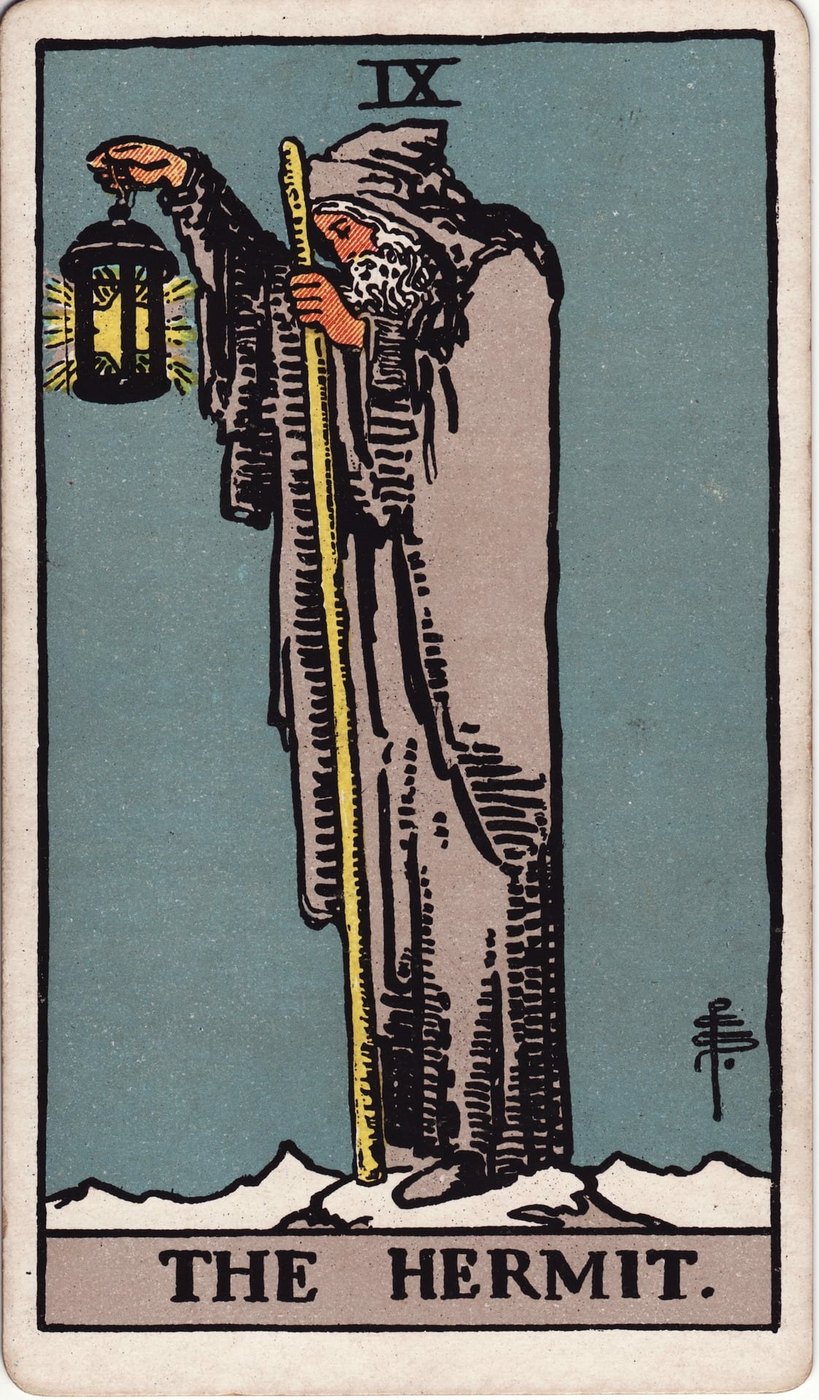
The Hermit (IX)
The Hermit as the central motif, filed under the Hand, with the Heavens in a secondary part. From The 1909 tarot.
Key · 2 motifs
Tap a motif on the picture, or a line below. Its note opens under the line, with the reading its author gave it.
- Primary motif
- Secondary motifs · 1
The picture
An old man in a grey hooded cloak on a snowy peak, holding up a lantern with a six-pointed star shining in it, a staff in his other hand, a grey-blue sky behind; the Hermit as the central motif. By eye
The reading
The picture read whole, in the archive's words, from the sources quoted on the marks. Read on, and the picture follows: the motif under discussion keeps its colour.
Everything in Waite's reading turns on the height of the lamp. On the older cards the bearer half hides it inside his cloak. Here he holds it up, and Waite notes that ‘the variation from the conventional models in this card is only that’. One change, and the card means close to the opposite of what it used to.
A raised lamp makes him a signal rather than a searcher. ‘The Hermit is not, as Court de Gebelin explained, a wise man in search of truth and justice’, Waite writes; ‘this is a card of attainment ... rather than a card of quest’. He has climbed, he has arrived, and he holds his beacon out over the edge for whoever still climbs below. Waite even gives the lantern a line to speak: ‘where I am, you also may be’.
A six pointed star burns inside the glass. Waite calls it a star, leaves it there, and spends his energy instead on what the light does not mean. Not the Light of Occult Science. Not occult isolation, ‘the protection of personal magnetism against admixture’, which he calls one of the frivolous renderings we owe to Lévi. The lamp shows rather than hoards.
Waite ends on concealment, and writes the best sentence on the card. The unknown philosopher of the Martinists never hid on purpose, he says; the phrase meant, like the card itself, ‘the truth that the Divine Mysteries secure their own protection from those who are unprepared’. Nobody has locked anything. The lamp stands up in plain sight on a snowfield, and only the climb gets a reader to it.
Readings quoted
Waite, 1911 “Therefore the Hermit is not, as Court de Gebelin explained, a wise man in search of truth and justice; nor is he, as a later explanation proposes, an especial example of experience.”
Waite, 1911 “It is further a card which is understood quite incorrectly when it is connected with the idea of occult isolation, as the protection of personal magnetism against admixture. This is one of the frivolous renderings which we owe to Eliphas Lévi.”
Waite, 1911 “It did not refer to the intended concealment of the Instituted Mysteries, much less of their substitutes, but--like the card itself--to the truth that the Divine Mysteries secure their own protection from those who are unprepared.”
Waite, 1911 “He is said to be in search of that Truth which is located far off in the sequence, and of justice which has preceded him on the way. But this is a card of attainment, as we shall see later, rather than a card of quest.”
Decoded: every motif is marked, and each mark carries the reading its author gave it, quoted from the text, or says that it is observed on the picture and not read. The reading above is the archive's own, made from those sources and no others.
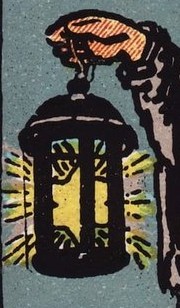
Light that is carried rather than received. The attribute of the Hermit, and of anyone who has to go into the dark on purpose.
In plain words He holds the lantern out and up, not hidden in his cloak as in older cards, and that small change is Waite’s whole point. This is not a man searching in the dark; he has arrived, he is standing on a peak, and he is holding the light out for whoever is coming behind. Waite gives the lantern a sentence to say: ‘where I am, you also may be’.
Waite, 1911 “The variation from the conventional models in this card is only that the lamp is not enveloped partially in the mantle of its bearer, who blends the idea of the Ancient of Days with the Light of the World. It is a star which shines in the lantern.”
Waite, 1911 “I have said that this is a card of attainment, and to extend this conception the figure is seen holding up his beacon on an eminence.”
Waite, 1911 “His beacon intimates that "where I am, you also may be."”
Guidance from something that does not move. Count the points before reading it: five, six and eight are all here, and no source treats them as one sign.
In plain words The light in the lantern is drawn as a six-pointed star, not a flame. Waite says only that it is a star. The older reading, that the lantern holds the light of occult science, he sets beside fortune-telling and dismisses.
Waite, 1911 “It is a star which shines in the lantern.”
Waite, 1911 “It is said also that his lantern contains the Light of Occult Science and that his staff is a Magic Wand. These interpretations are comparable in every respect to the divinatory and fortune-telling meanings with which I shall have to deal in their turn.”
Also carrying the Hand
24 works carry it. The 4 where it is the central motif are here. The symbol.
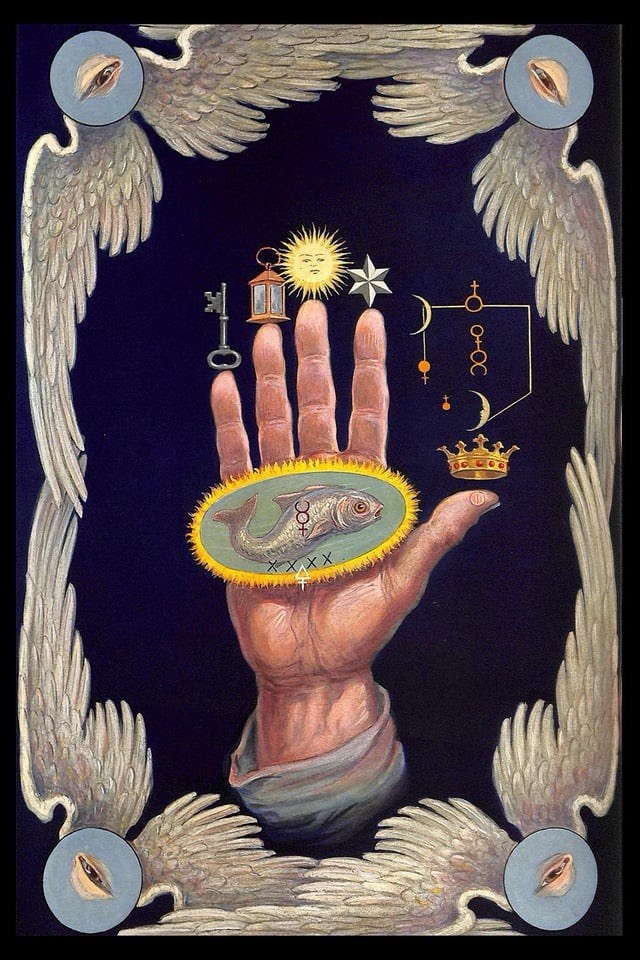
Where the detail is the subject
This is in the picture without being what it is about. Below, one work that is about it.
In the same series
Record
One symbol a week, decoded.
This picture is free at full size from its source, linked above. What an address gets is the Sunday letter: one picture, one symbol marked on it, what it meant and who said so, and the master files of the decoded plates as they are verified. Leave any time.
Free, one letter a week, unsubscribe in one click. How the address is used.
Scroll or pinch to zoom · drag to move · double-tap for 1:1 · 819 by 1400 pixel web copy; the source file is linked under Record