The Mosaic Pavement and the Blazing Star
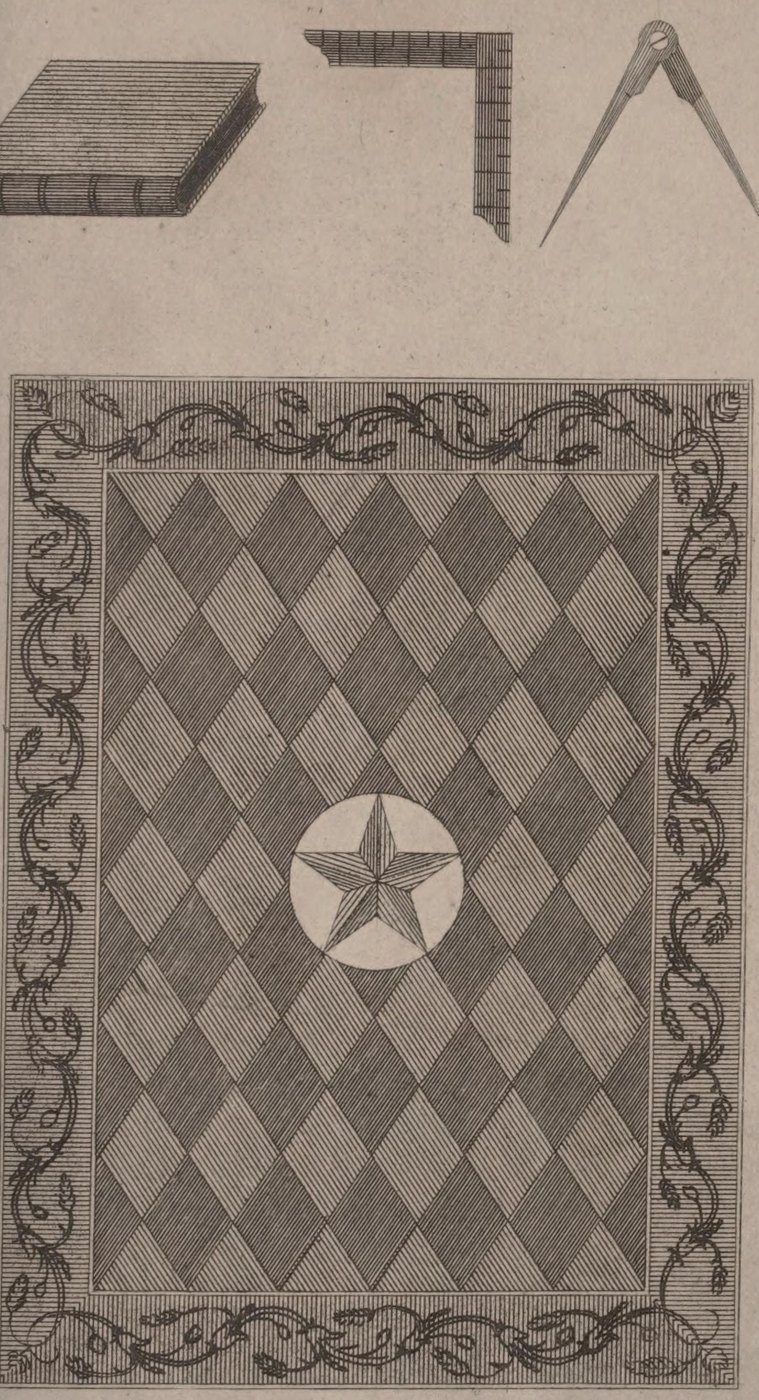
The Heavens as the central motif. From Masonic Chart.
What is happening
Jeremy L. Cross, 1826 “Every well-governed Lodge is furnished with the Holy Bible, the Square, and the Compasses.”
Jeremy L. Cross, 1826 “The Holy Bible is dedicated to God; the Square, to the Master; and the Compasses, to the Craft.”
Jeremy L. Cross, 1826 “The Bible is dedicated to God, because it is the inestimable gift of God to man; *** the square to the master, because it is the proper masonic emblem of his office; and the compasses to the craft, because, by a due attention to their use, they are taught to circumscribe their desires, and keep their passions within due bounds.”
Jeremy L. Cross, 1826 “The Ornaments of a Lodge, are the Mosaic pavement, the indented tessel, and the blazing star.”
Key · 1 motif
Tap a motif on the picture, or a line below. Its note opens under the line, with the reading its author gave it.
- Primary motif
The picture
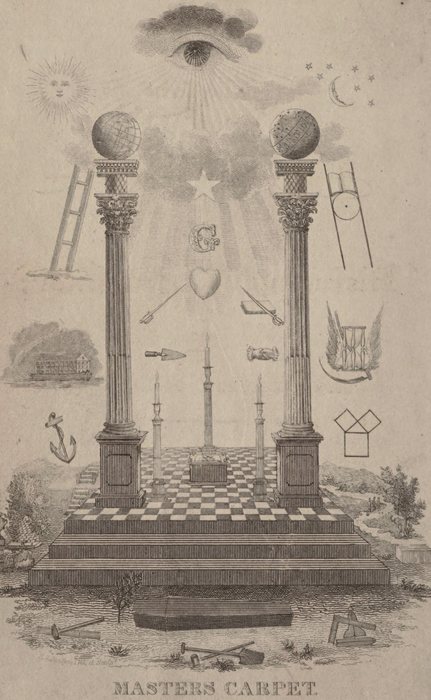
A chequered pavement bordered with a tessellated band, a five-pointed star blazing in a disc at its centre, and the book, the square and the compasses above it. By eye
The reading
The picture read whole, in the archive's words, from the sources quoted on the marks. Read on, and the picture follows: the motif under discussion keeps its colour.
Plate 8 of Cross's chart draws the three ornaments of a lodge and, above them, its three pieces of furniture, and the monitor explains both sets on one page. ‘The Ornaments of a Lodge, are the Mosaic pavement, the indented tessel, and the blazing star.’ The pavement ‘is a representation of the ground floor of King Solomon's temple’, the border ‘that beautiful tesselated border, or skirting, which surrounded it’, and then, in the next sentence, the moral: ‘The Mosaic pavement is emblematical of human life, chequered with good and evil; the beautiful border which surrounds it, those manifold blessings and comforts which surround us’.
The star at the centre is five-pointed and drawn in a disc of white, and the lecture gives it two meanings, one historical and one moral. It ‘is commemorative of the Star which appeared, to guide the wise men of the East to the place of our Saviour's nativity’, and it stands for ‘Divine Providence, which is hieroglyphically represented by the blazing star in the centre’. Cross calls it a star and never a pentagram, and the archive files it with the stars.
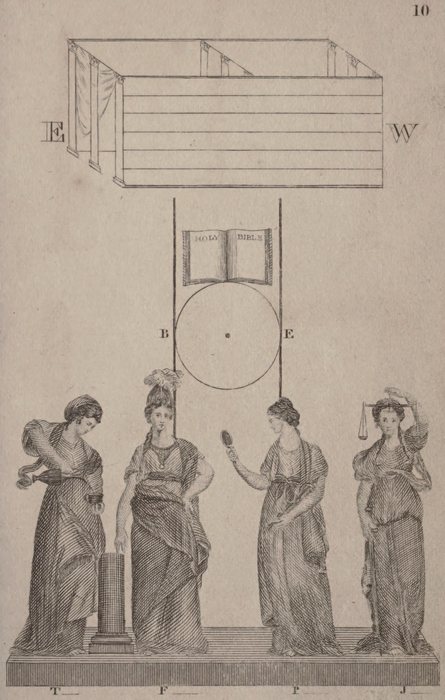
Above the pavement sit the Bible, the square and the compasses. ‘Every well-governed Lodge is furnished with the Holy Bible, the Square, and the Compasses. The Holy Bible is dedicated to God; the Square, to the Master; and the Compasses, to the Craft.’ The reasons follow: the Bible ‘because it is the inestimable gift of God to man’, the square ‘because it is the proper masonic emblem of his office’, and the compasses ‘because, by a due attention to their use, they are taught to circumscribe their desires, and keep their passions within due bounds’. Three tools, three ranks, and a floor to stand them on.
The plate is a lodge reduced to its emblems, and the lecture is a walk across it. The word Cross keeps reaching for is emblematical: nothing here is a picture of a thing, everything is a picture of a lesson.
Decoded: every motif is marked, and each mark carries the reading its author gave it, quoted from the text, or says that it is observed on the picture and not read. The reading above is the archive's own, made from those sources and no others.
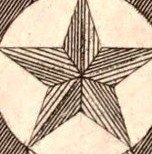
Guidance from something that does not move. Count the points before reading it: five, six and eight are all here, and no source treats them as one sign.
In plain words A five-pointed star blazes in a white disc at the centre of the floor. Cross gives it two meanings in two sentences: it remembers the star that led the wise men to the birth of Christ, and it stands for Divine Providence, the care that surrounds a life the way the border surrounds the floor. He calls it a star, never a pentagram.
Jeremy L. Cross, 1826 “The Mosaic pavement is a representation of the ground floor of King Solomon's temple; the indented tessel, that beautiful tesselated border, or skirting, which surrounded it; and the blazing star in the centre, is commemorative of the Star which appeared, to guide the wise men of the East to the place of our Saviour's nativity.”
Jeremy L. Cross, 1826 “The Mosaic pavement is emblematical of human life, chequered with good and evil; the beautiful border which surrounds it, those manifold blessings and comforts which surround us, and which we hope to enjoy by a faithful reliance on Divine Providence, which is hieroglyphically represented by the blazing star in the centre.”
Also carrying the Heavens
61 works carry it. The 6 where it is the central motif are here. The symbol.

In the same series
Record
One symbol a week, decoded.
This picture is free at full size from its source, linked above. What an address gets is the Sunday letter: one picture, one symbol marked on it, what it meant and who said so, and the master files of the decoded plates as they are verified. Leave any time.
Free, one letter a week, unsubscribe in one click. How the address is used.
Scroll or pinch to zoom · drag to move · double-tap for 1:1 · 759 by 1400 pixel web copy; the source file is linked under Record