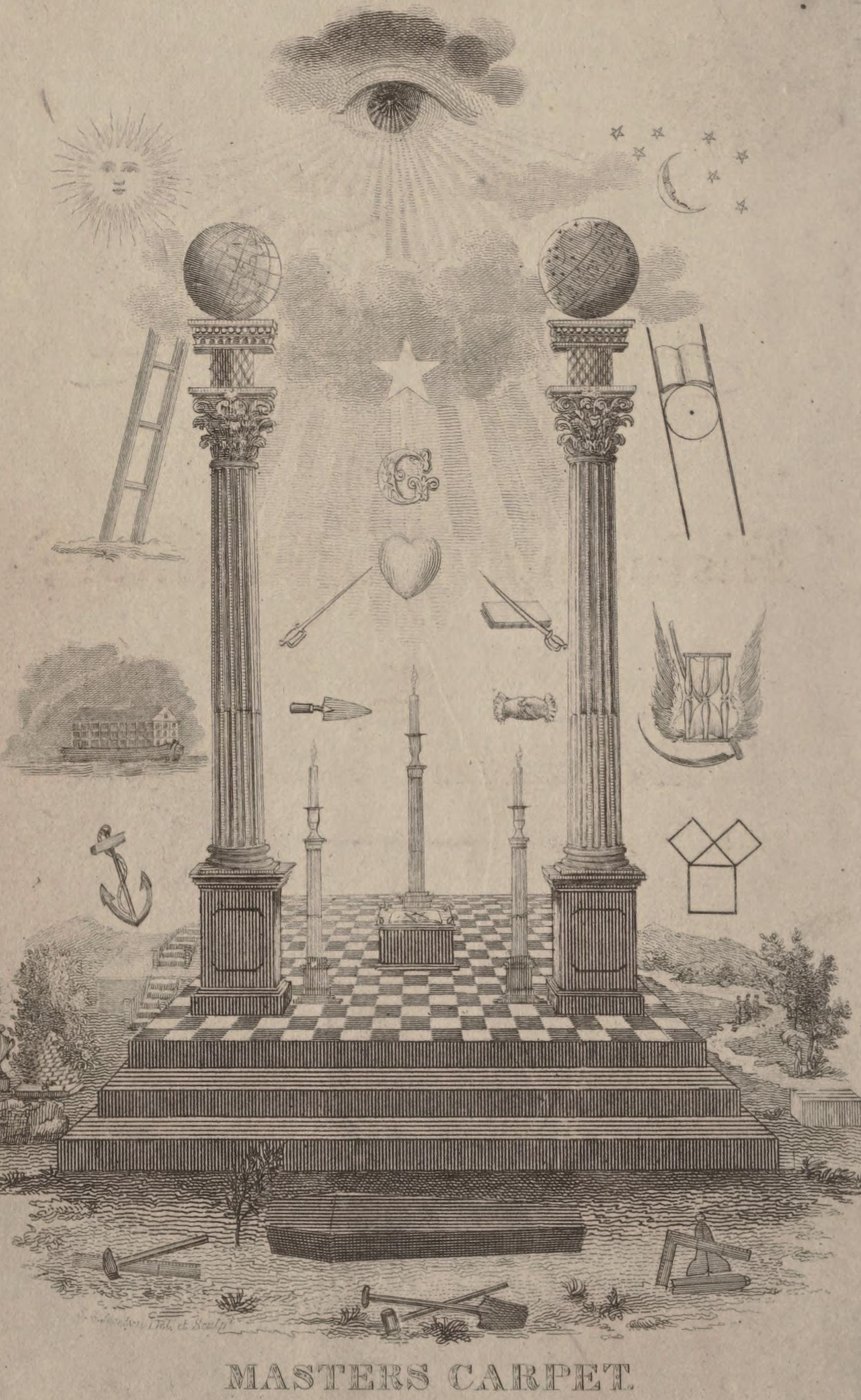
Master's Carpet
The Eye as the central motif, with the Sun and the Moon, the Heavens, the Divine, the Pillar, Death and the Skull, and the Vessel in a secondary part. From Masonic Chart.
What is happening
Jeremy L. Cross, 1826 “Masters Carpet.”
Symbolica, 2026 Plate the frontispiece to the degrees of the chart, in the Master Mason degree. The monitor prints no lecture headed Master's Carpet, but it names the carpet once, in the passage on the three steps, and it lectures nearly every emblem drawn here in its own place: the pavement and the blazing star on page 16, the globes on page 24, the trowel on page 36, and the emblems of the third section on pages 38 to 41. The plate is read here against those lectures. Where the monitor is silent, as it is for the letter G, the record says so.
Key · 7 motifs
Tap a motif on the picture, or a line below. Its note opens under the line, with the reading its author gave it.
- Primary motif
- Secondary motifs · 6
The picture
The all-seeing eye in a cloud over two Corinthian pillars carrying globes, the sun at the left and a crescent moon with seven stars at the right, a blazing star and the letter G between the capitals, a chequered pavement on three steps, and the emblems of the third section standing in the air round them: the pot of incense, the trowel, the sword and the naked heart, the ark and the anchor, the winged hour-glass and scythe, the forty-seventh problem, and a coffin with a maul and a spade at the foot. By eye
The reading
The picture read whole, in the archive's words, from the sources quoted on the marks. Read on, and the picture follows: the motif under discussion keeps its colour.
Cross's own sentence tells you what the object is. The three steps, he writes, are ‘usually delineated upon the master's carpet’, so the carpet is a surface the emblems are drawn on: the floor cloth of a lodge room, laid down for the degree and taken up after it. This plate is a picture of one, spread on a stepped platform in open country with its emblems standing on it and hanging in the air above it. The monitor prints no lecture headed Master's Carpet, and it does not need one. Nearly every object here is lectured somewhere else in the same volume, which makes this the plate that gathers the whole book into a single picture.
Start where Cross names it. ‘The Three Steps, usually delineated upon the master's carpet, are emblematical of the three principal stages of human life, viz. youth, manhood, and age.’ The three broad steps that carry the pavement are that sentence built in stone, and Cross climbs the degrees up them in order: in youth, as an entered apprentice, a man gathers useful knowledge; in manhood, as a fellow craft, he applies it; in age, as a master mason, he enjoys ‘the happy reflections consequent on a well-spent life, and die in the hope of a glorious immortality’. The coffin on the grass at the foot of the steps, with a setting maul and a spade dropped beside it, is where the climb ends, and the monitor ends its emblem lecture in the same place: ‘Thus we close the explanation of the emblems upon the solemn thought of death, which, without revelation, is dark and gloomy.’
Above all of it, in a cloud, is the eye. The Master Mason lecture gives it a sentence the length of the sky: ‘although our thoughts, words and actions, may be hidden from the eyes of men, yet that All-seeing Eye, whom the Sun, Moon, and Stars obey, and under whose watchful care even Comets perform their stupendous revolutions, pervades the inmost recesses of the human Heart, and will reward us according to our merits.’ On its own plate the eye is drawn over a naked heart and nothing else. Here it is drawn over an entire lodge, and its rays fall on every emblem in the picture.
The sun and the moon are set at the same height as the cloud, one at each corner, and the lecture gives them a single word of work: they obey. The seven stars round the crescent are the engraver's count, not the monitor's, which says only Stars. Whatever else these two are in this archive, on this plate they have been demoted to attendants.
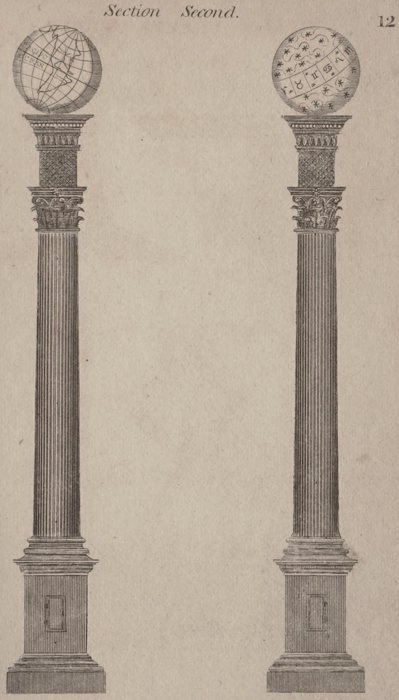
The pillars carry the composition. Two fluted columns with Corinthian capitals stand at the back of the floor, the map of the earth on one and the face of the heavens on the other, and everything the carpet has to show is arranged between them. They are the pair set up in the porch of Solomon's temple, and Cross's Fellow Craft degree lectures the globes on their capitals as bodies with the countries, seas and planetary revolutions drawn on their surfaces. The pillars are the only things here at architectural scale, which is why the plate reads as a room rather than a page of emblems.
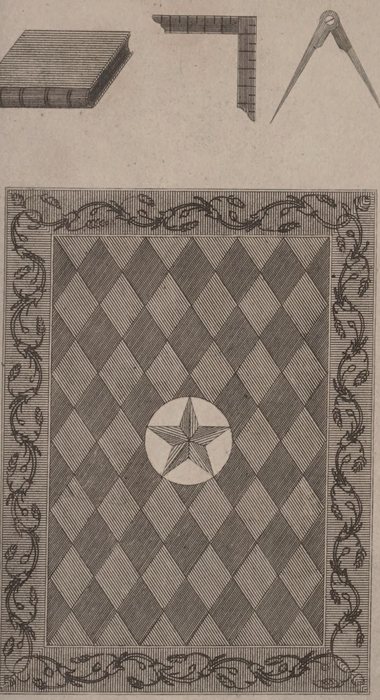
The floor is the chequered pavement of the Entered Apprentice lecture, ‘emblematical of human life, chequered with good and evil’, inside the bordered edge that stands for the comforts surrounding a life. The blazing star belongs at its centre, and the lecture says so twice, but the engraver has lifted it off the floor and hung it in the air between the capitals. That one liberty is what organises the plate: star, letter, heart, the chest at the centre of the floor and the coffin all fall on a single vertical line under the eye.
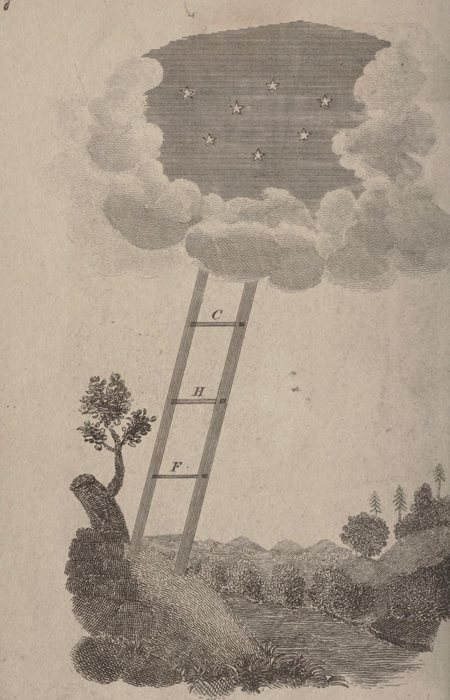
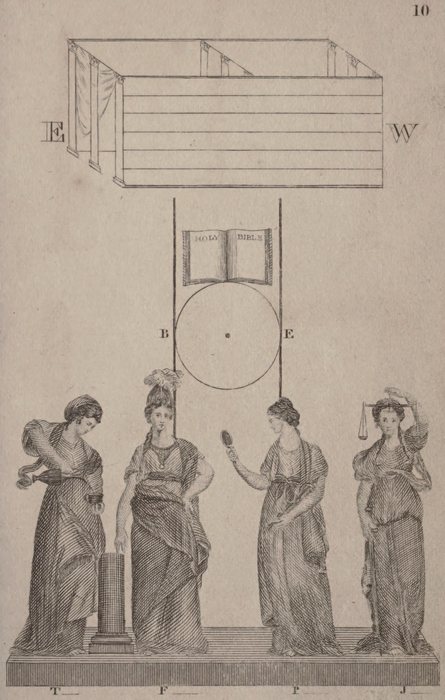
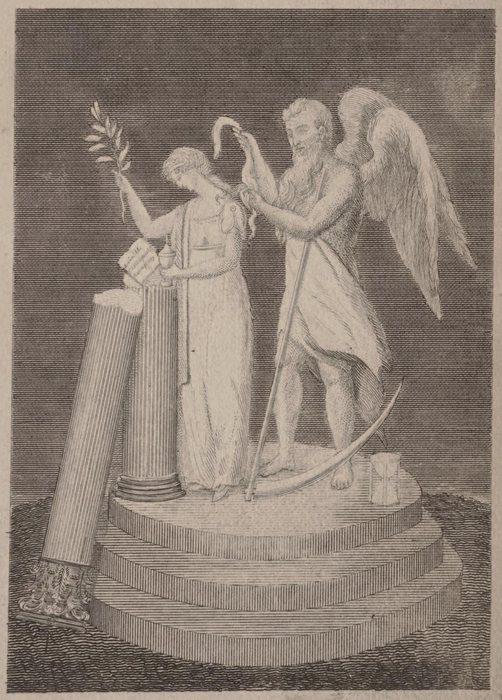
Around the middle of the plate the emblems of the third section stand in the air like objects on a shelf: the pot of incense, which the lecture calls a pure heart glowing with gratitude; a trowel, which the working tools lecture on page 36 turns from an instrument for cement into an instrument for ‘spreading the cement of BROTHERLY LOVE and affection’; the sword pointing at the naked heart; the book of constitutions with the Tyler's sword laid across it; the winged hour-glass and the scythe; the three squares of the forty-seventh problem; the ark afloat and the anchor beside it; and at the top corners a ladder on a mound and a circle with a point in it between two parallel lines, with the scriptures resting on top. Almost every one of them has a plate of its own elsewhere in the chart, with the monitor’s paragraph beside it. The ladder is the exception: it has a plate, and Cross prints no lecture for it either.
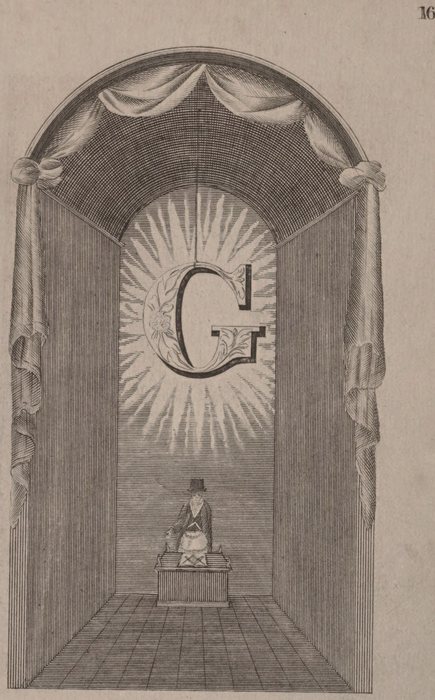
One thing on the plate is not explained anywhere. The letter G hangs in its own glory in the middle of the picture, between the capitals, under the star and over the heart, and Cross never says what it is. The Master Mason degree runs from page 35 to page 41 of his monitor without touching it, and the letter's own plate later in the chart is silent too. Cross was publishing pictures for a spoken teaching, and he printed as much of the teaching as he was willing to print. The carpet shows you the whole lodge and withholds the middle of it.
Decoded: every motif is marked, and each mark carries the reading its author gave it, quoted from the text, or says that it is observed on the picture and not read. The reading above is the archive's own, made from those sources and no others.
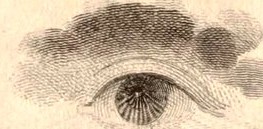
Attention from outside the frame. Note it is almost always placed at a boundary rather than at the centre.
In plain words An eye looks out of a cloud at the top of the plate and its rays reach down past the star and the letter to the floor. Cross's lecture for the Master Mason gives it its name and its work: it is the eye the sun, moon and stars obey, and it reads a heart whatever a man keeps from other men. It is the highest thing drawn here, and everything else on the carpet stands inside its light.
Jeremy L. Cross, 1826 “The Sword, pointing to a Naked Heart, demonstrates that justice will sooner or later overtake us; and although our thoughts, words and actions, may be hidden from the eyes of men, yet that All-seeing Eye, whom the Sun, Moon, and Stars obey, and under whose watchful care even Comets perform their stupendous revolutions, pervades the inmost recesses of the human Heart, and will reward us according to our merits.”
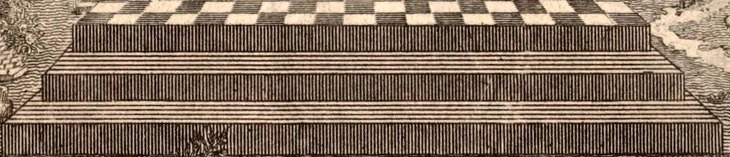
An office, not an ending. Note what Death is holding and who is being made to look at it.
In plain words Three steps carry the chequered floor, and below them, on the grass, lies a coffin with a setting maul and a spade thrown down beside it. This is the passage that names the plate. Cross's monitor calls the three steps youth, manhood and age, and runs the three degrees up them: an apprentice gathers knowledge, a fellow craft puts it to use, a master mason looks back on a well-spent life. The coffin is where the steps arrive, and the monitor closes its whole emblem lecture there.
Jeremy L. Cross, 1826 “Usually delineated upon the master's carpet, are emblematical of the three principal stages of human life, viz. youth, manhood, and age. In youth, as entered apprentices, we ought industriously to occupy our minds in the attainment of useful knowledge: in manhood, as fellow crafts, we should apply our knowledge to the discharge of our respective duties to God, our neighbors, and ourselves; that so, in age, as master masons, we may enjoy the happy reflections consequent on a well-spent life, and die in the hope of a glorious immortality.”
Jeremy L. Cross, 1826 “Thus we close the explanation of the emblems upon the solemn thought of death, which, without revelation, is dark and gloomy; but the Christian is suddenly revived by the ever green and ever living sprig of Faith in the merits of the Lion of the tribe of Judah.”
Gold, the perfected metal, and the illuminated intellect. The most overloaded symbol in the tradition.
In plain words The sun has a human face and a ring of rays; the moon is a thin crescent with seven stars scattered round it. The lecture for the eye gives them their whole part in one clause: they obey. They are set at the same height as the cloud, so the three read as one row across the top of the plate, and the two lights are the smaller things in it.
Jeremy L. Cross, 1826 “whom the Sun, Moon, and Stars obey”

Two columns, and the thing that matters is between them. Note what stands there, and whether the pillars are told apart.
In plain words Two columns stand at the back of the pavement, each carrying a globe: the map of the earth on the left, the face of the heavens on the right. The pillars are the pair set up in the porch of Solomon's temple and named in the book that lies open on the lodge altar. The globes are lectured in Cross's Fellow Craft degree as artificial bodies with the earth and the sky drawn on them. On this plate the pair are the frame, and everything else is arranged between them.
3 Kings 7:21 “And he set up the two pillars in the porch of the temple: and when he had set up the pillar on the right hand, he called the name thereof Jachin: in like manner he set up the second pillar, and called the name thereof Booz.”
Jeremy L. Cross, 1826 “The Globes are two artificial and spherical bodies; on the convex surface of which are represented, the countries, seas, and various parts of the earth, the face of the heavens, the planetary revolutions, and other particulars.”

A diagram of everything, drawn so that a person can be found inside it. Note where the human figure stands in the scheme.
In plain words A five-pointed star blazes in the air between the two capitals, and the floor beneath is laid in black and white squares inside a border. Cross's Entered Apprentice lecture reads them as one ornament: the floor is the ground floor of Solomon's temple and it is human life chequered with good and evil, the border is the comforts that surround a life, and the star at the centre is Providence. Here the engraver has lifted the star off the floor and hung it in the air, directly under the eye and directly over the letter.
Jeremy L. Cross, 1826 “The Mosaic pavement is a representation of the ground floor of King Solomon's temple; the indented tessel, that beautiful tesselated border, or skirting, which surrounded it; and the blazing star in the centre, is commemorative of the Star which appeared, to guide the wise men of the East to the place of our Saviour's nativity.”
Jeremy L. Cross, 1826 “The Mosaic pavement is emblematical of human life, chequered with good and evil; the beautiful border which surrounds it, those manifold blessings and comforts which surround us, and which we hope to enjoy by a faithful reliance on Divine Providence, which is hieroglyphically represented by the blazing star in the centre.”

Never the subject. What is inside it is.
In plain words A small two-handled urn stands in the air among the tools, with smoke at its mouth. The monitor makes it a heart rather than a vessel: the pot is a pure heart, the offering the Deity accepts, and the heat it holds is what gratitude should feel like. It is the one object on the carpet whose lecture is about the inside of a person.
Jeremy L. Cross, 1826 “The Pot of Incense is an emblem of a pure heart, which is always an acceptable sacrifice to the Deity; and, as this glows with fervent heat, so should our hearts continually glow with gratitude to the great beneficent Author of our existence, for the manifold blessings and comforts we enjoy.”

God shown, or pointed at. Look for what stands where a face would be: a name in a cloud, a circle above the top of a diagram, a ring of verses, a sign over a head.
In plain words The letter stands alone in the middle of the plate, in its own light, with the blazing star above it and a naked heart below. Cross prints no lecture for it. The Master Mason degree runs from page 35 to page 41 in his monitor and never explains the letter, and it has a plate to itself later in the chart which the monitor also leaves unexplained. The archive does not supply the sentence he withheld.
Symbolica, 2026 Read against the page images of the monitor, pages 35 to 41. The letter G is drawn on this plate and on a plate of its own, and neither is lectured. What the letter stood for belonged to the spoken part of the degree, and Cross published the picture without it.
Also carrying the Eye
8 works carry it. The 3 where it is the central motif are here. The symbol.
Where the detail is the subject
the Sun and the Moon · the Heavens · the Divine · the Pillar · Death and the Skull · the Vessel
Each of these is in the picture without being what it is about. Below, one work that is about each.
In the same series
Record
One symbol a week, decoded.
This picture is free at full size from its source, linked above. What an address gets is the Sunday letter: one picture, one symbol marked on it, what it meant and who said so, and the master files of the decoded plates as they are verified. Leave any time.
Free, one letter a week, unsubscribe in one click. How the address is used.
Scroll or pinch to zoom · drag to move · double-tap for 1:1 · 861 by 1400 pixel web copy; the source file is linked under Record