The Opening of the Third Eye
The Eye as the central motif, with the Pentagram in a secondary part. From The Secret Teachings.
Key · 2 motifs
Tap a motif on the picture, or a line below. Its note opens under the line, with the reading its author gave it.
- Primary motif
- Secondary motifs · 1
The picture
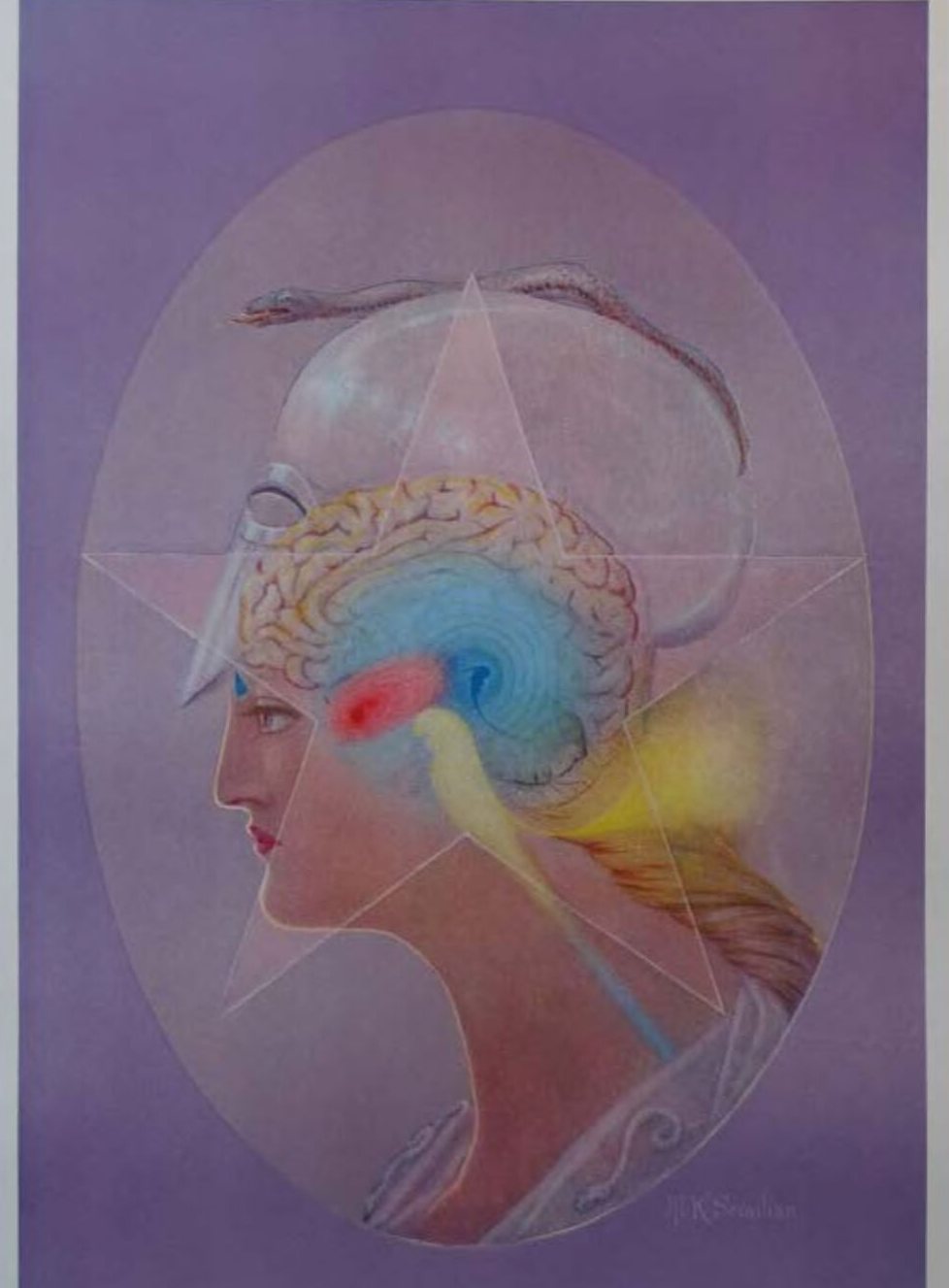
The head of a woman in profile in a winged helmet, the skull shown as if transparent, the brain and the glands in blue, red and yellow, a beam of light passing to the brow; a five-pointed star drawn over the head and a serpent above it, all within a pale oval on violet; the Eye as the central motif by Hall's title, the Heavens by eye. By eye
The reading
The picture read whole, in the archive's words, from the sources quoted on the marks. Read on, and the picture follows: the motif under discussion keeps its colour.
Serailian painted the head of Minerva in profile, in her winged helmet, with the skull made transparent so that the brain shows through it in blue and red and yellow, and a beam of light passing forward from the centre of the brain to the brow. Hall's caption says what is meant to be happening: the painting shows, in part, the activities of the pineal gland and the pituitary body at the time of the phenomenon commonly termed the opening of the Third Eye. The goddess of wisdom is the subject because the eye is wisdom's organ.
The eye that opens is not on the face. It is the small gland in the middle of the brain, and Hall's chapter on the Hiramic legend of Freemasonry explains why he calls it an eye: in the human brain there is a tiny gland called the pineal body, which is the sacred eye of the ancients, and corresponds to the third eye of the Cyclops; as its name signifies, the pineal gland is the sacred pine cone in man. The name is Latin, pinea, a pine cone, given for the gland's shape, and Hall builds on it the whole chain that runs through this archive: the pine cone on the crown of the dead in Egyptian papyri, the pine cone on the staff of Bacchus, the pine cone in the skull. The beam on the plate is the moment the cone opens.
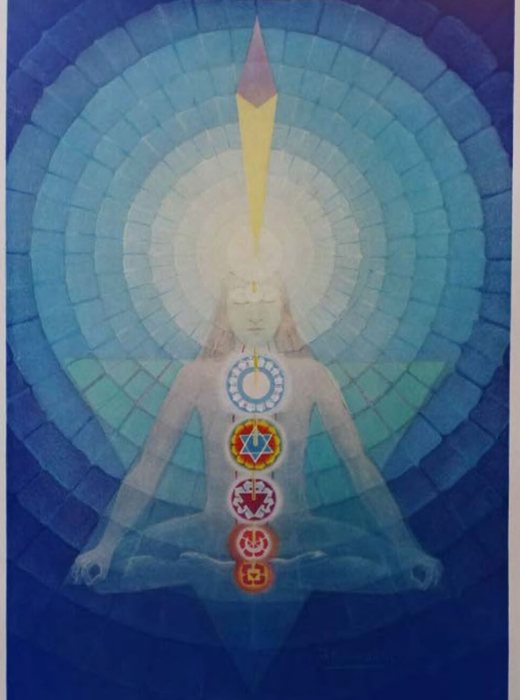
The pituitary is the second gland Hall names, and the plate shows two coloured bodies at the base of the brain with the light passing between them and out to the forehead. In the same chapter he makes the pituitary Isis and the pineal Ra, and the raising of the spirit fire through the spine to the skull the true meaning of the Masonic legend. None of that is on the plate; the plate shows glands and light. The archive gives Hall's reading as his, and notes that the anatomy is real and the function he assigns it is not medicine.
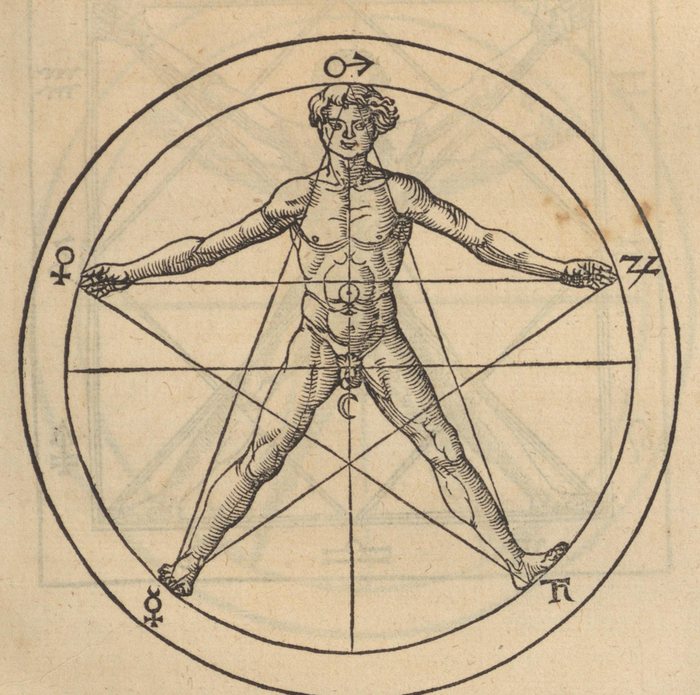
Over the whole head a five-pointed star is drawn in thin lines, its top point at the crown of the helmet, and above the star a serpent lifts its head. Hall's caption says nothing about either. They are recorded as seen. A reader of the rest of Hall's book will connect the star to the human figure Agrippa fitted into a pentagram, and the serpent to the spirit fire he describes rising up the spine, and may be right; the archive does not make the connection for the caption.
The plate has had a long afterlife on the internet, where the pineal gland and the third eye are a fixed pair. It is worth knowing where the pair comes from. It comes from here, from Hall in 1928 and from the theosophical writers before him, drawing a line from an old sacred emblem to a gland named after it. The picture is the argument's illustration, and it is a beautiful one, but it is an illustration of a claim, and the claim is Hall's.
Decoded: every motif is marked, and each mark carries the reading its author gave it, quoted from the text, or says that it is observed on the picture and not read. The reading above is the archive's own, made from those sources and no others.
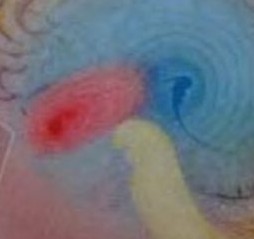
An eye that is not on the face. One painter put it in the middle of a skull, and the man who commissioned him named the gland.
In plain words Hall calls the pineal gland, the small body in the middle of the brain, the sacred eye of the ancients and the third eye of the Cyclops, and the plate shows it lit up: a beam of light passes from the glands to the brow. In today's terms, the picture illustrates a claim that a physical gland is the organ of a spiritual sense.
Hall, 1928 “This painting of the head of Minerva shows, in part, the activities of the pineal gland and the pituitary body at the time of the phenomenon commonly termed the opening of the Third Eye.”
Hall, 1928 “In the human brain there is a tiny gland called the pineal body, which is the sacred eye of the ancients, and corresponds to the third eye of the Cyclops.”
Hall, 1928 “As its name signifies, the pineal gland is the sacred pine cone in man - the eye single, which cannot be opened until CHiram (the Spirit Fire) is raised through the sacred seals which are called the Seven Churches in Asia.”
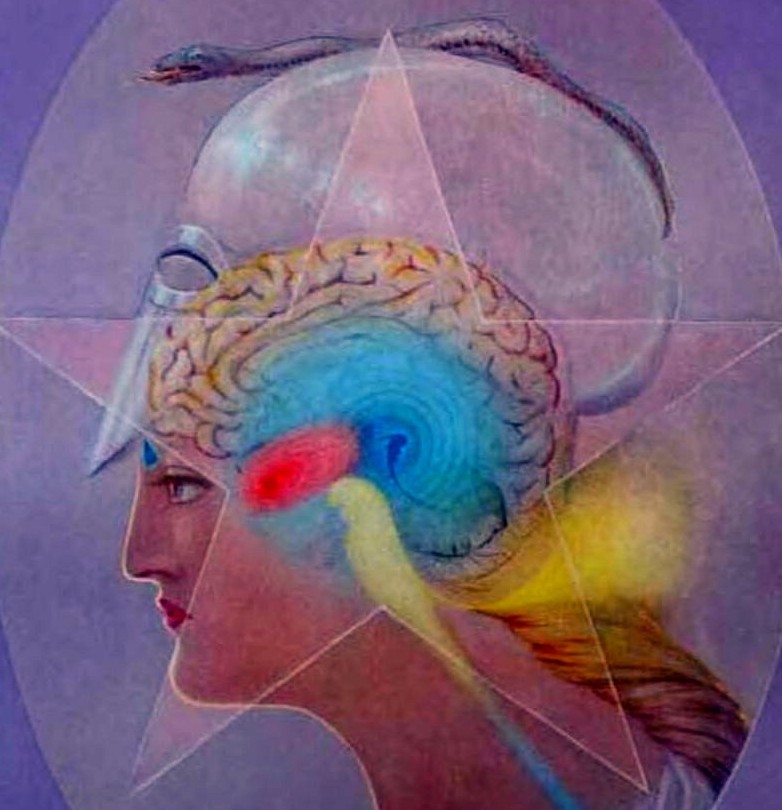
A five-pointed star drawn in one line. Count which way it points before reading it: one point up and two down is one sign, two up and one down is another.
In plain words A five-pointed star is drawn over the whole head, and a serpent rises above it. Hall's caption reads the glands and does not mention either. They are recorded as seen.
Symbolica The star drawn over the head, and the serpent above it, are on the plate; Hall's caption reads the glands and does not name either. Observed on the plate, and left unread rather than guessed.
Also carrying the Eye
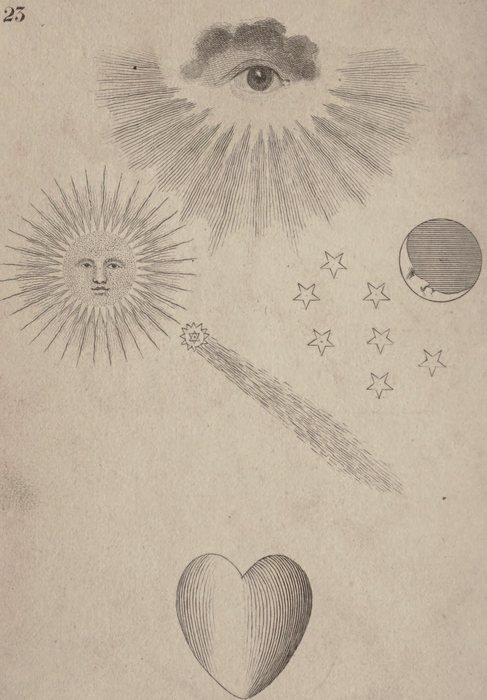
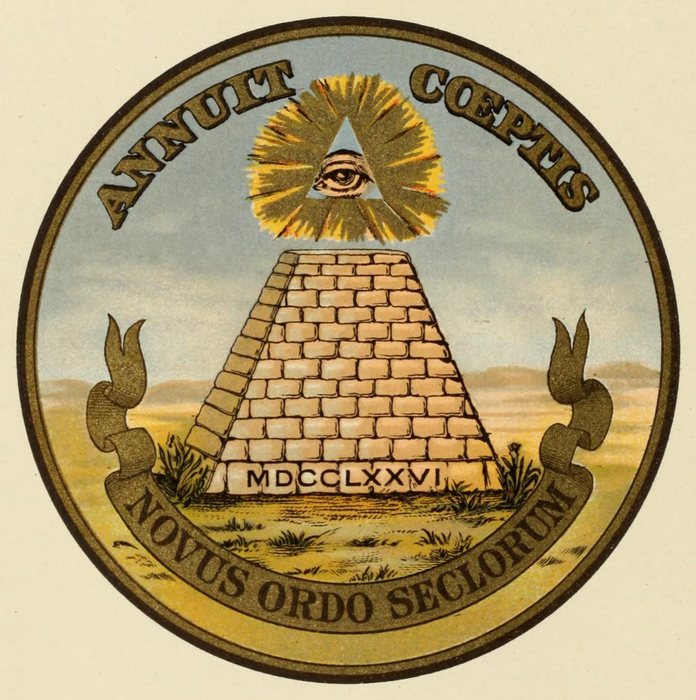
8 works carry it. The 3 where it is the central motif are here. The symbol.
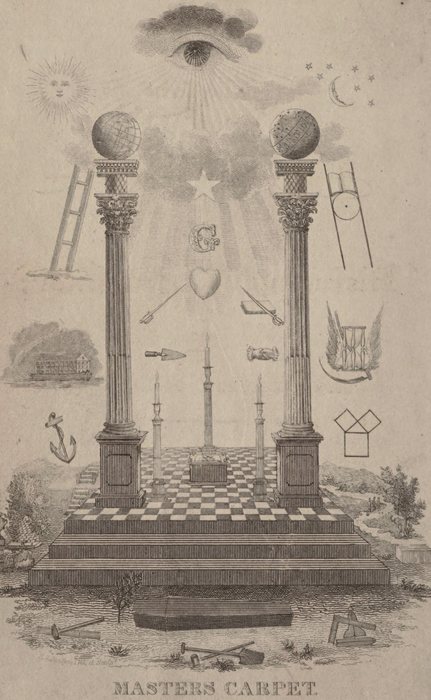
Where the detail is the subject
This is in the picture without being what it is about. Below, one work that is about it.
By the same hand
In the same series
Record
One symbol a week, decoded.
This picture is free at full size from its source, linked above. What an address gets is the Sunday letter: one picture, one symbol marked on it, what it meant and who said so, and the master files of the decoded plates as they are verified. Leave any time.
Free, one letter a week, unsubscribe in one click. How the address is used.
Scroll or pinch to zoom · drag to move · double-tap for 1:1 · 978 by 1327 pixel web copy; the source file is linked under Record