The upside down pentagram got its meaning in 1856, from one man, in one paragraph
Ask what a five pointed star means and the answer comes back the same from every direction: one point up for good, two points up for evil. That rule has an author, a city and a date. Éliphas Lévi published it in Paris in 1856, and the three pentagrams this archive holds from before him carry no explanation at all.
Start with a naked man standing inside a circle, printed in 1533.
Heinrich Cornelius Agrippa put him in the second of his three books of occult philosophy, a phrase that in his century meant the study of causes nobody could see rather than anything sinister. The chapter concerns the proportions of the human body. Agrippa spreads the man's arms and legs until his fingertips and his heels touch the circle, then counts what those five points of contact do to it.
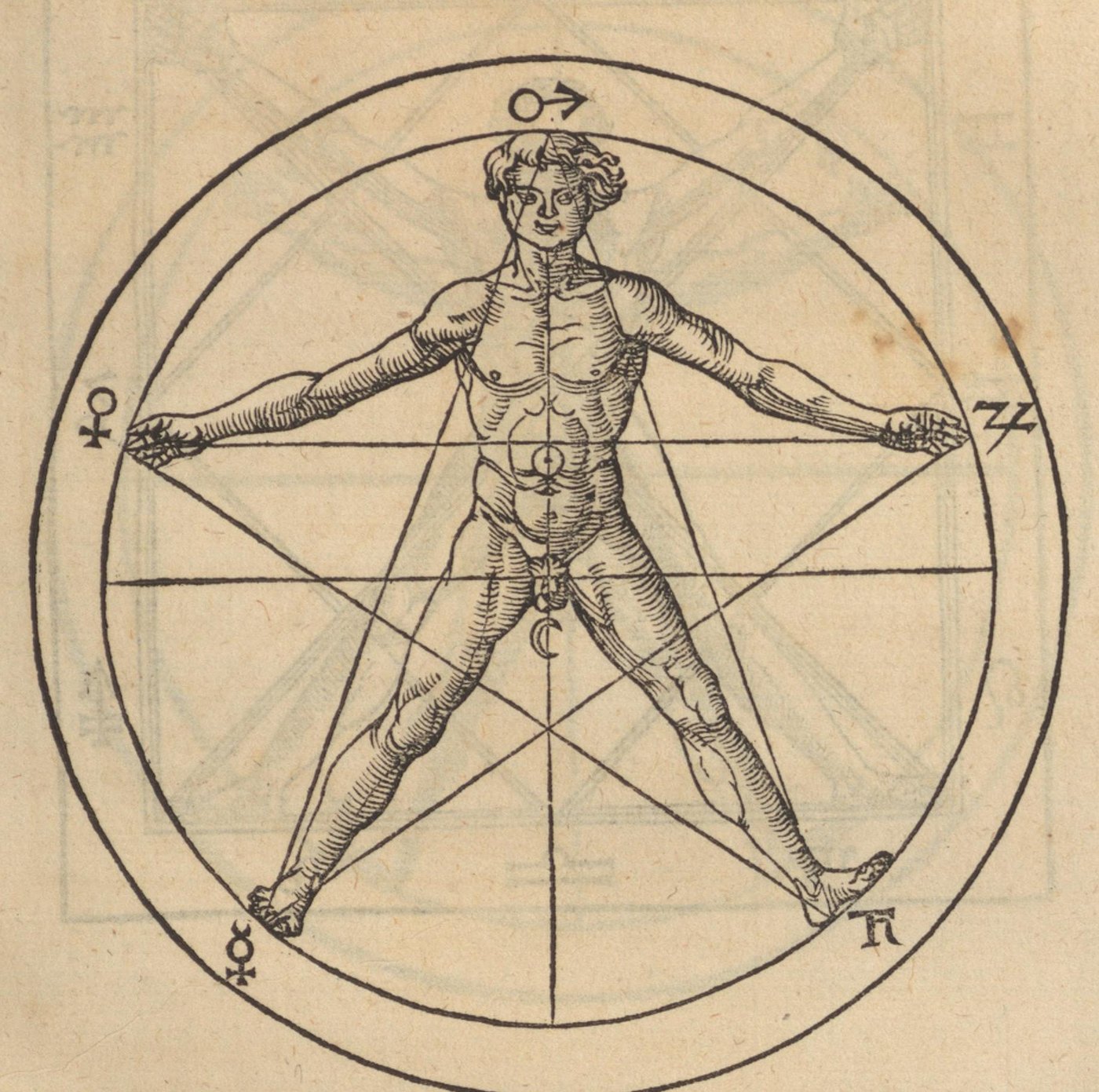
they divide that circle which was drawn from the center of the lower belly, into five equal parts, and do constitute a perfect Pentagon
Heinrich Cornelius Agrippa, 1533, in J. F.'s English of 1651, Book II, chapter 27
Geometry, and nothing more. Agrippa measures a body and finds a five sided figure inside a circle. He never tells his reader what the five points signify, and the chapter closes without a word about good or evil, up or down.
Sixty years later a German physician built an engraving around a room and left a five pointed star lying on a table in it.
Heinrich Khunrath devised the plate, Hans Vredeman de Vries drew it and Paullus van der Doort cut the copper. On the left a man kneels in his oratory, the room kept for prayer, and two books lie open on the table in front of him. One of them carries no words at all. A five pointed star inside a circle sits on its left page and a triangle inside a circle on its right. Khunrath drew the figures rather than lettering them, and nothing on the sheet names what the five points stand for.
In 1826 a compiler of masonic charts cut a five pointed star into the lid of a coffin.
Jeremy L. Cross published the plate and Amos Doolittle engraved it. Cross's monitor prints a single sentence to close the whole set of emblems, on death and on the evergreen sprig at the coffin's head, and prints nothing whatever on the maul, the spade or the coffin. That part of the lecture went by mouth and never reached paper. Either way the star on the lid goes unnamed, and the record page here says so rather than guessing.
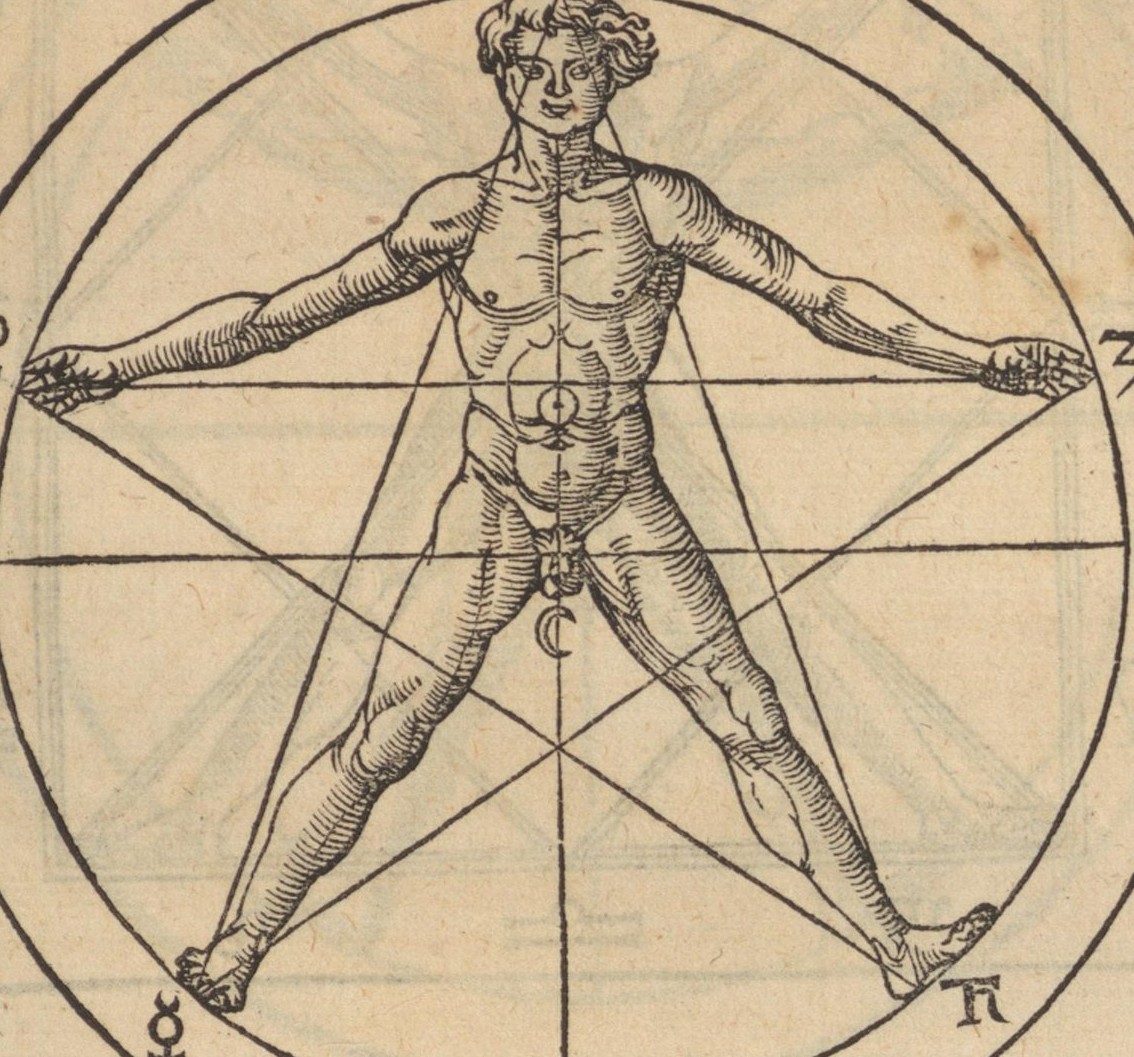 Agrippa, 1533
 Khunrath, 1595
 Cross, 1826
A proportion diagram, a figure drawn in a book with no text, and an emblem on a coffin. Three countries, three centuries, and not one sentence anywhere about what the shape means.
Then Paris, and 1856.
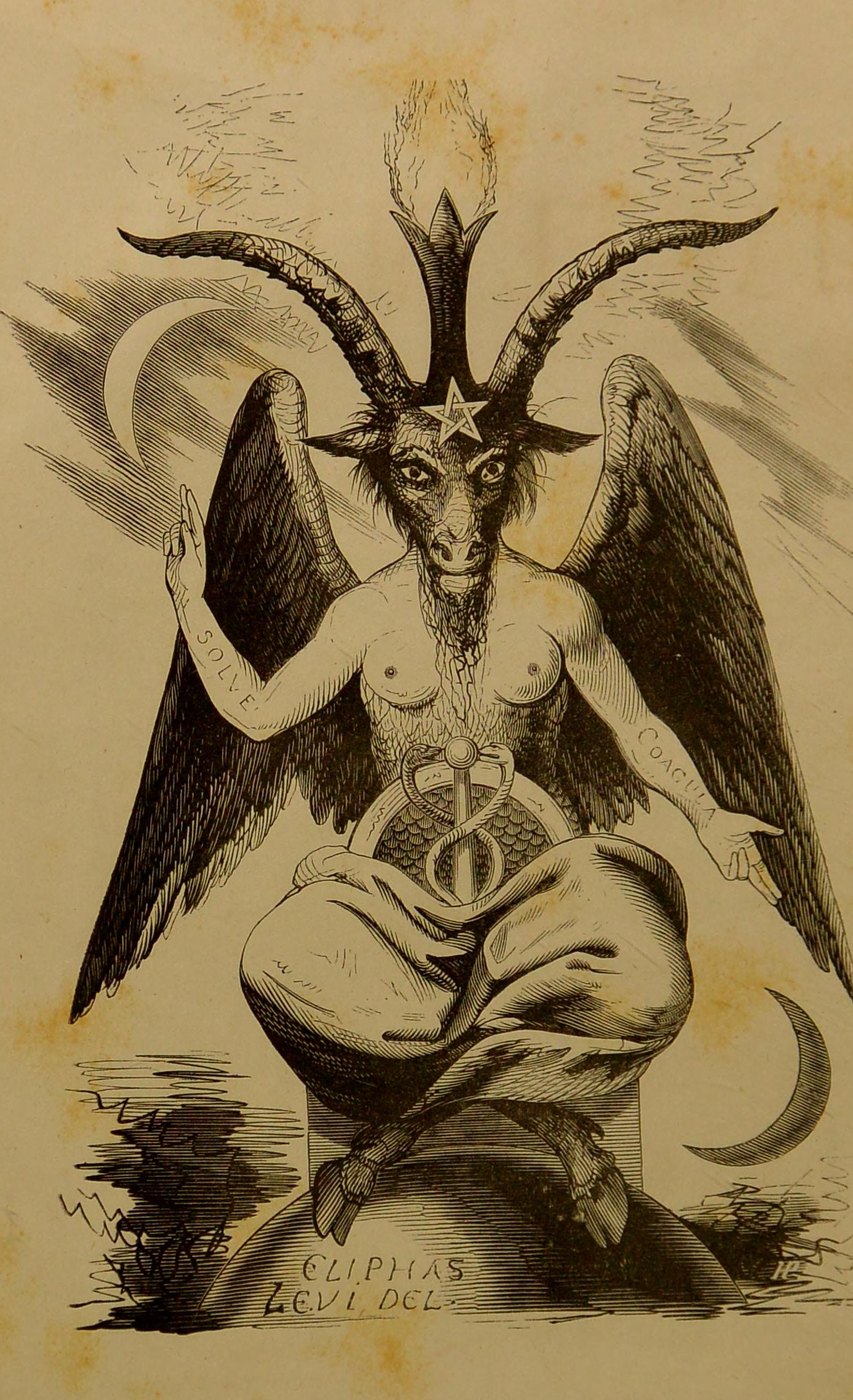
Éliphas Lévi published Dogme et Rituel de la Haute Magie in two volumes and set a goat headed figure of his own devising in front of them. In the fifth chapter of the second volume he does what nobody before him had done with this shape. He writes a rule for it.
The pentagram with two points in the ascendant represents Satan as the goat of the Sabbath; when one point is in the ascendant, it is the sign of the Saviour.
Éliphas Lévi, 1856, in A. E. Waite's English of 1896, the Ritual, chapter V
One sentence. Everything anyone has ever told you about which way up a star should point comes out of it.
Lévi needed one more move to get there, and he made it at Agrippa's expense. Agrippa had fitted a body to a star: the circle comes first, the man stretches until he meets it. Lévi reverses the order.
The pentagram is the figure of the human body, having the four limbs, and a single point representing the head. A human figure, head downwards, naturally represents a demon; that is, intellectual subversion, disorder, or madness.
Éliphas Lévi, in A. E. Waite's English of 1896, the Ritual, chapter V
Once the star stands for a body, a star turned over stands for a body turned over, and a body turned over earns the reading Lévi gives it. The whole argument rests on that reversal. Agrippa's own sentence, which measures a man and stops, will not supply it.
And notice what Lévi did with his own goat. The star on its forehead sits with one point up, the direction he calls the sign of the Saviour, and he says as much in his chapter on the sabbath. Anyone who posts that figure as a picture of the devil posts a figure wearing the friendlier of its author's two signs.
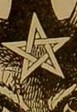 Lévi, 1856, one point up
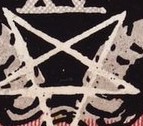 Colman Smith, 1909, turned over
The card turned it over.
Pamela Colman Smith drew the Devil for the deck of 1909, and she drew it from Lévi: the horns, the wings, the raised hand, the torch held downward. On the forehead she put the star the other way up. A. E. Waite, who wrote the little book that goes with the cards, records the change in one line and moves on.
A reversed pentagram is on the forehead.
A. E. Waite, 1911, The Pictorial Key to the Tarot, Part II
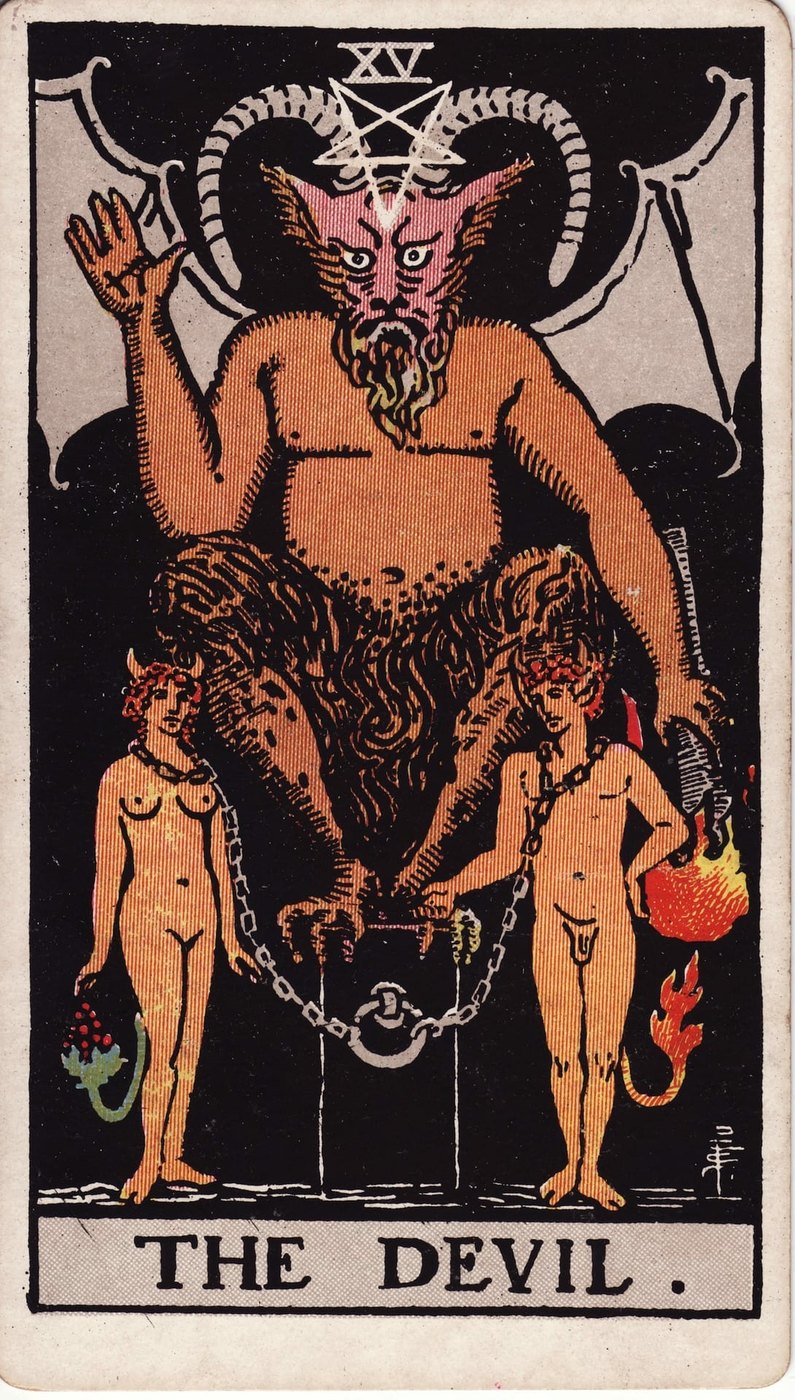
That deck sold, and kept selling, and the inverted star on a horned head rode out with it into a century of book covers, record sleeves and film posters. A rule written for readers of a French book of magic became a thing people now take to be old.
One last picture, from 1928, showing how little had settled even then. Mihran K. Serailian painted a plate for Manly P. Hall with a five pointed star drawn right across a man's head and a serpent rising above it. Hall's caption walks down the glands of the body and mentions neither the star nor the snake. This archive records both as seen and leaves them unread.
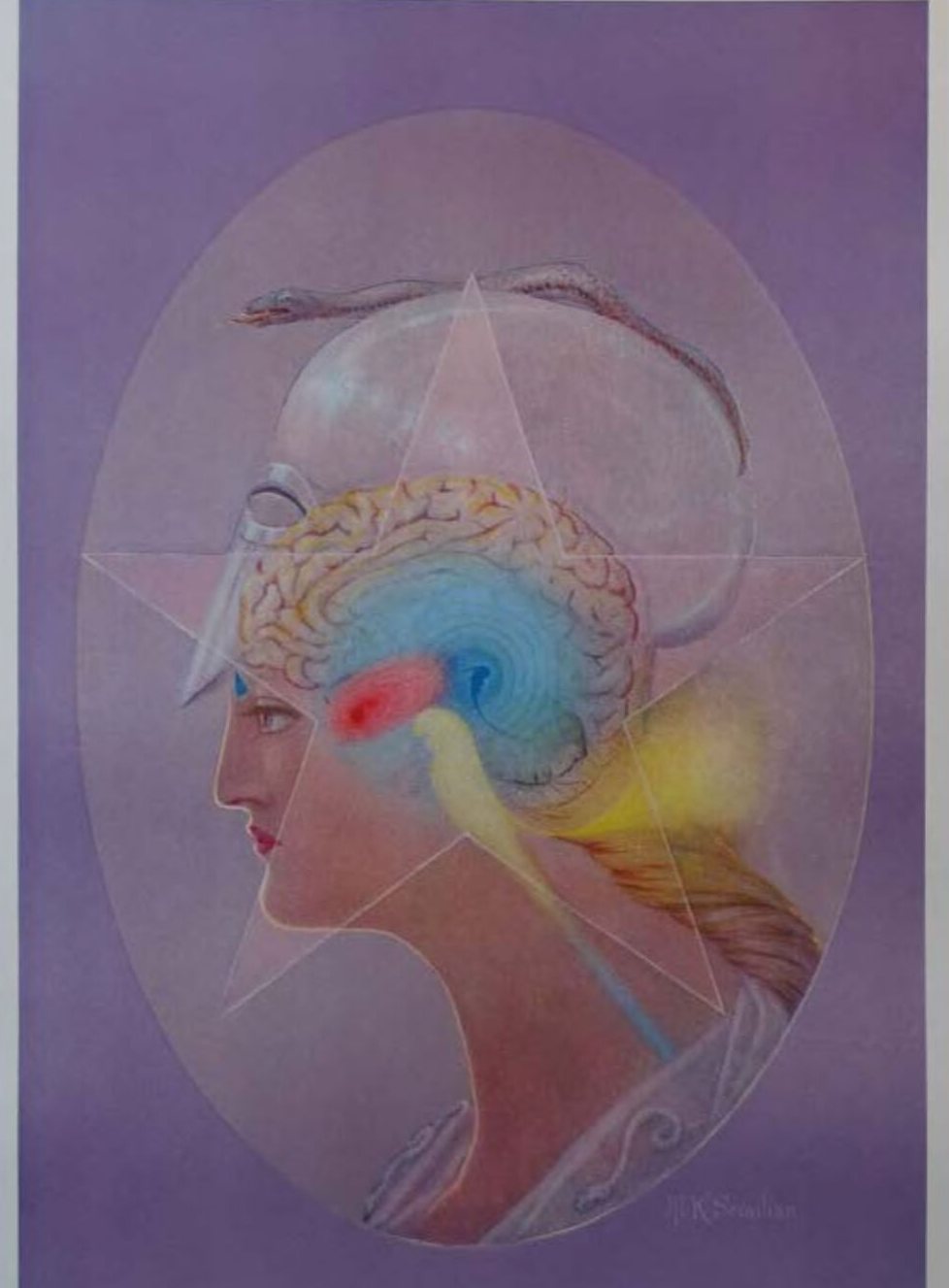
So the rule holds, in the sense that people follow it. It also carries a date, a city and a signature. Lévi wrote it in 1856, for a book of his own, under a figure he had drawn himself, and he gave that figure the friendlier of his two directions. Every argument since about points up and points down runs back through one paragraph by one man, and the three centuries of pentagrams standing behind him keep their silence.