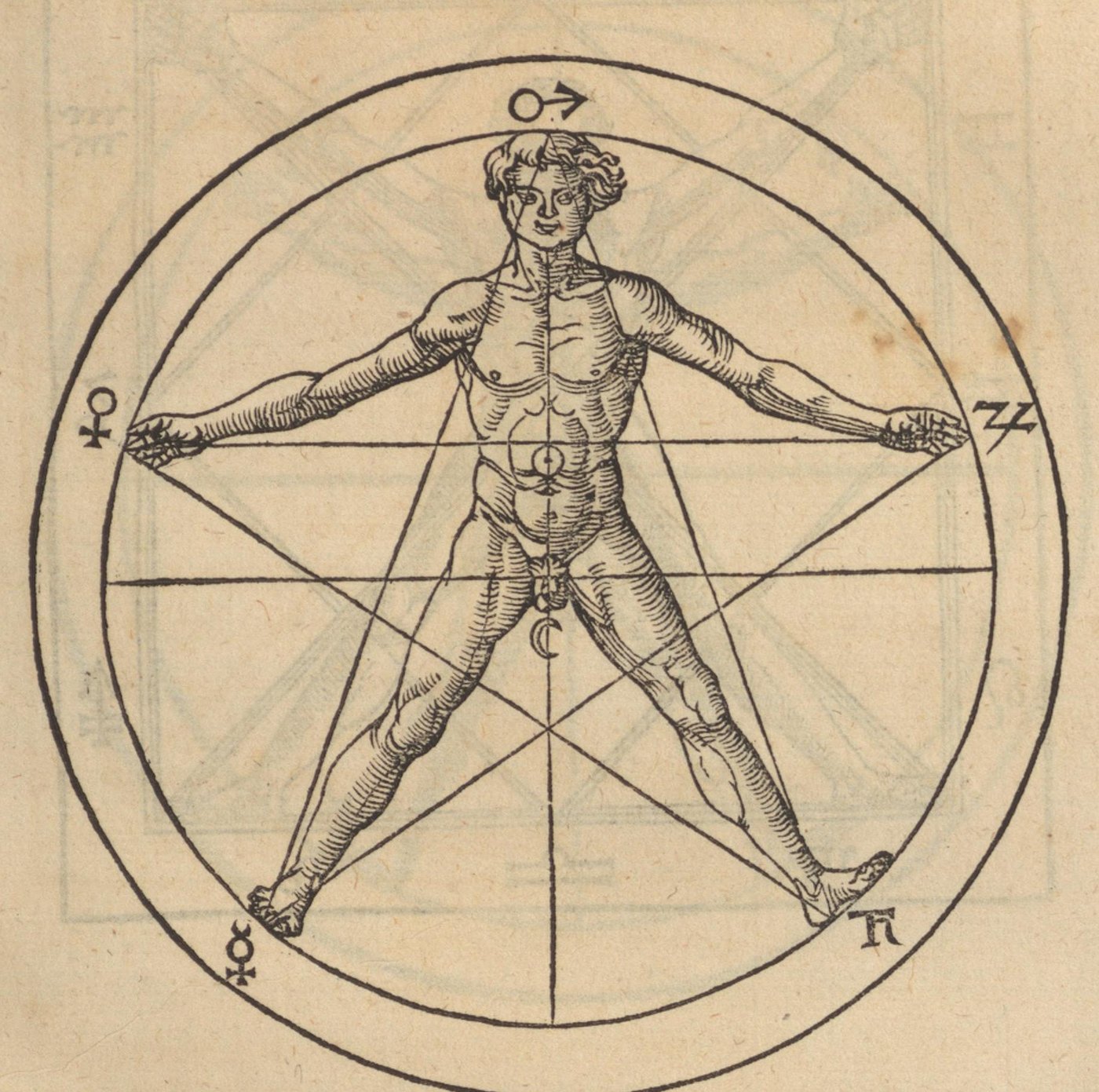
The Man in the Pentagram
The man in the pentagram as the central motif, filed under the Pentagram, with the Heavens, the Sun and the Moon, and the Hand in a secondary part. From De occulta philosophia.
What is happening
Agrippa, in J.F.'s translation, 1651 “From hence all the Ancients in time past did number by their fingers, and shewed all numbers by them; and they seem to prove that from the very joynts of mans body all numbers, measures, proportions, and Harmonies were invented; Hence according to this measure of the body, they framed, and contrived their temples, pallaces, houses, Theaters; also their ships, engins, and every kind of Artifice, and every part and member of their edifices, and buildings, as columnes, chapiters of pillars, bases, buttresses, feet of pillars, and all of this kind.”
Key · 4 motifs
Tap a motif on the picture, or a line below. Its note opens under the line, with the reading its author gave it.
- Primary motif
- Secondary motifs · 3
The picture
A naked man with arms outstretched and legs apart inside two concentric circles, the lines of a pentagram drawn through his head, hands and feet, a planet's sign at each point, the sun's sign on his breast and the moon's at his loins; the man in the pentagram as the central motif. By eye
The reading
The picture read whole, in the archive's words, from the sources quoted on the marks. Read on, and the picture follows: the motif under discussion keeps its colour.
Agrippa's chapter on the proportions of the body is where this picture comes from, and the picture is a proof, not an emblem. ‘Seeing man is the most beautiful and perfectest work of God, and his Image, and also the lesser world’, he begins, in the English of 1651, man ‘doth contain and maintain in himself all numbers, measures, weights, motions, Elements’. The ancients, he says, counted on their fingers and built their temples to the body's measure; God taught Noah to build the ark to it; ‘he made the whole fabrick of the world proportionable to mans body; from hence it is called the great world, mans body the lesse’.
Then the construction. Draw a circle from the crown of the head, centred on the lower belly; let the arms fall until the fingertips touch it; spread the feet on it as far apart as the fingers are from the top of the head. ‘Then they divide that circle which was drawn from the center of the lower belly, into five equal parts, and do constitute a perfect Pentagon’, and the heels, referred to the navel, ‘make a triangle of equal sides’. The pentagram in this picture is that division. It is drawn through a man because a man, standing so, is one.
The star inside a circle is the star inside the world. Agrippa's whole argument in the chapter is that the two are made to one measure, and the woodcut says it by fitting the body to the ring exactly, fingertips and toes and crown on the line. The circle, then, is not decoration; it is ‘the great world’, and the man is the little one that fits it.
What the sentence does not say, the cutter adds. Mars sits over the head, Venus at one hand and Jupiter at the other, Mercury and Saturn at the feet, the sun on the breast and the moon at the loins. Agrippa gives no such table here; he says only that ‘there is no member in man which hath not correspondence with some sign, Star, intelligence, divine name’. The planets on the points are the picture's way of making that sentence particular, and later readers took the picture as the sentence. Three centuries on, Lévi wrote that ‘the pentagram is the figure of the human body, having the four limbs, and a single point representing the head’, and the sentence fits this cut exactly.
Decoded: every motif is marked, and each mark carries the reading its author gave it, quoted from the text, or says that it is observed on the picture and not read. The reading above is the archive's own, made from those sources and no others.
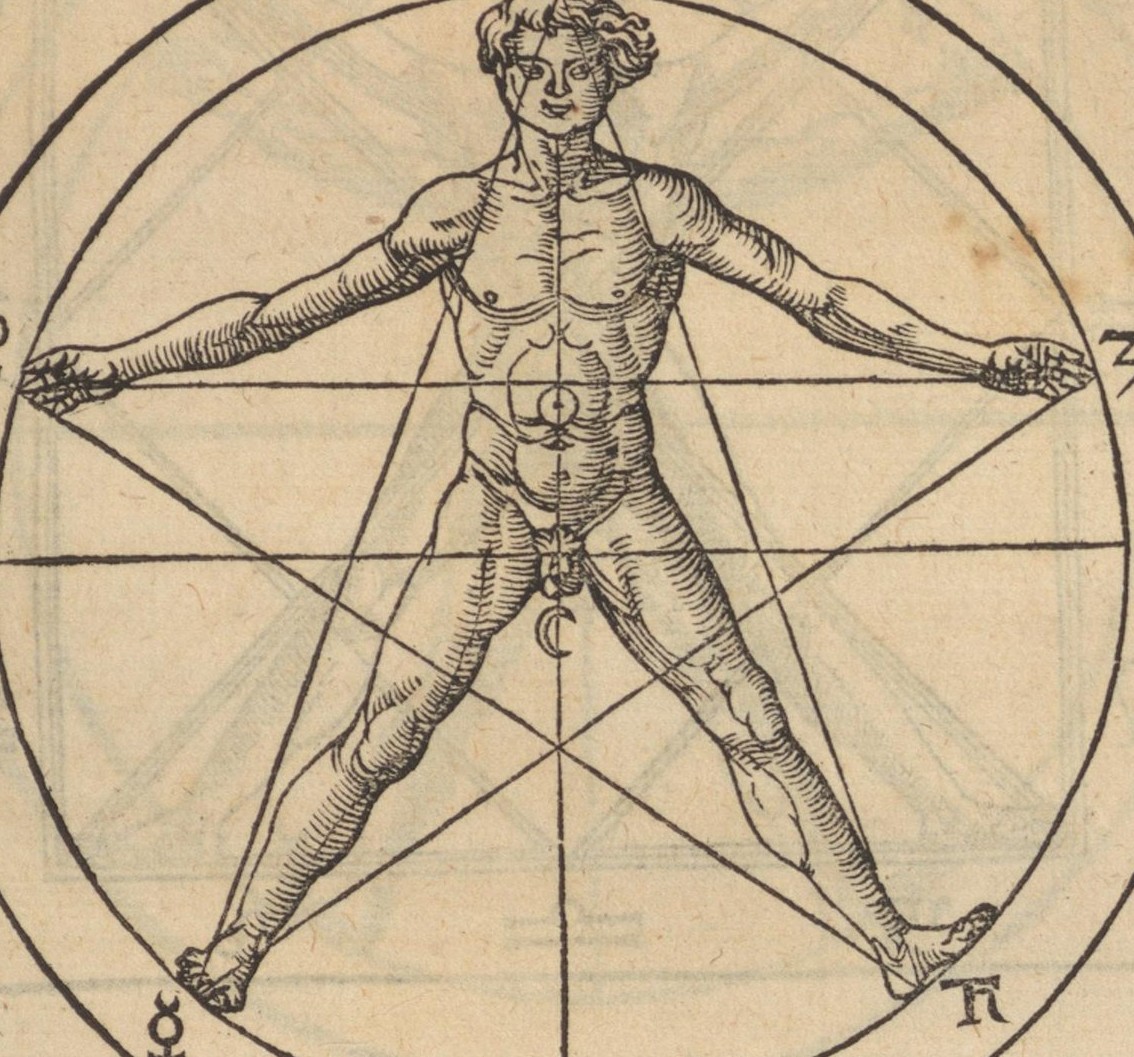
A five-pointed star drawn in one line. Count which way it points before reading it: one point up and two down is one sign, two up and one down is another.
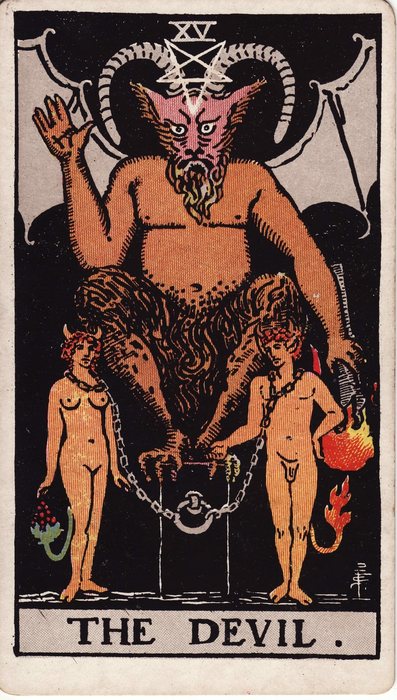
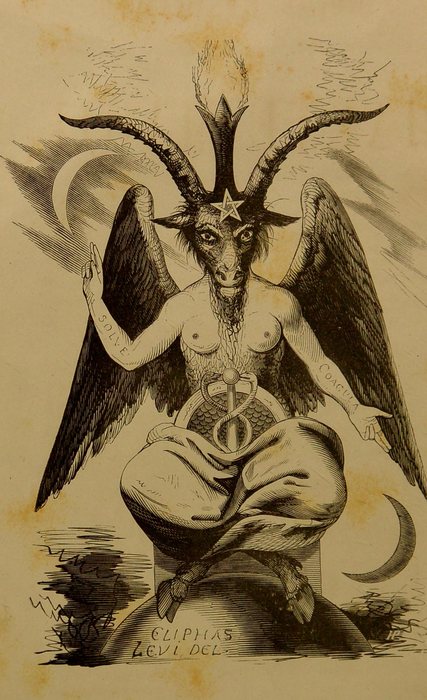
In plain words Agrippa fits a man to a five-pointed star: head, two hands and two feet at the points, the navel at the centre. His chapter is about proportion and says nothing about what the star means. Three centuries later Éliphas Lévi looked at the same arrangement and read it the other way round, taking the star to be the figure of the body rather than the body to be fitted to the star, which is what lets him say that the same star turned over is a demon.
Heinrich Cornelius Agrippa, 1533 “Quod si super eodem centro circulus fabricetur per summum caput, demissi brachii quousque extremi digiti circuli illius circumferentiam contingant, passisque pedes in eadem circumferentia, quantum extrema manuum a summo vertice distant, tunc circulum illum super imi pectinis centro ductum, in quinque aequas partes dividunt, perfectumque pentagonum constituunt, ipsique pedum extremi tali ad umbilicum relati, triangulum faciunt aequilaterum.”
Agrippa, in J.F.'s translation, 1651 “But if on the same center a circle be made by the crown of the head; the arms being let fall so far till the end of the fingers touch the circumference of that circle, and the feet spread abroad in the same circumference, as much as the fingers ends are distant from the top of the head; Then they divide that circle which was drawn from the center of the lower belly, into five equal parts, and do constitute a perfect Pentagon and the Heels of the feet, having reference to the navile, make a triangle of equal sides.”
Lévi, in Waite's translation, 1896 “The pentagram is the figure of the human body, having the four limbs, and a single point representing the head. A human figure, head downwards, naturally represents a demon; that is, intellectual subversion, disorder, or madness.”
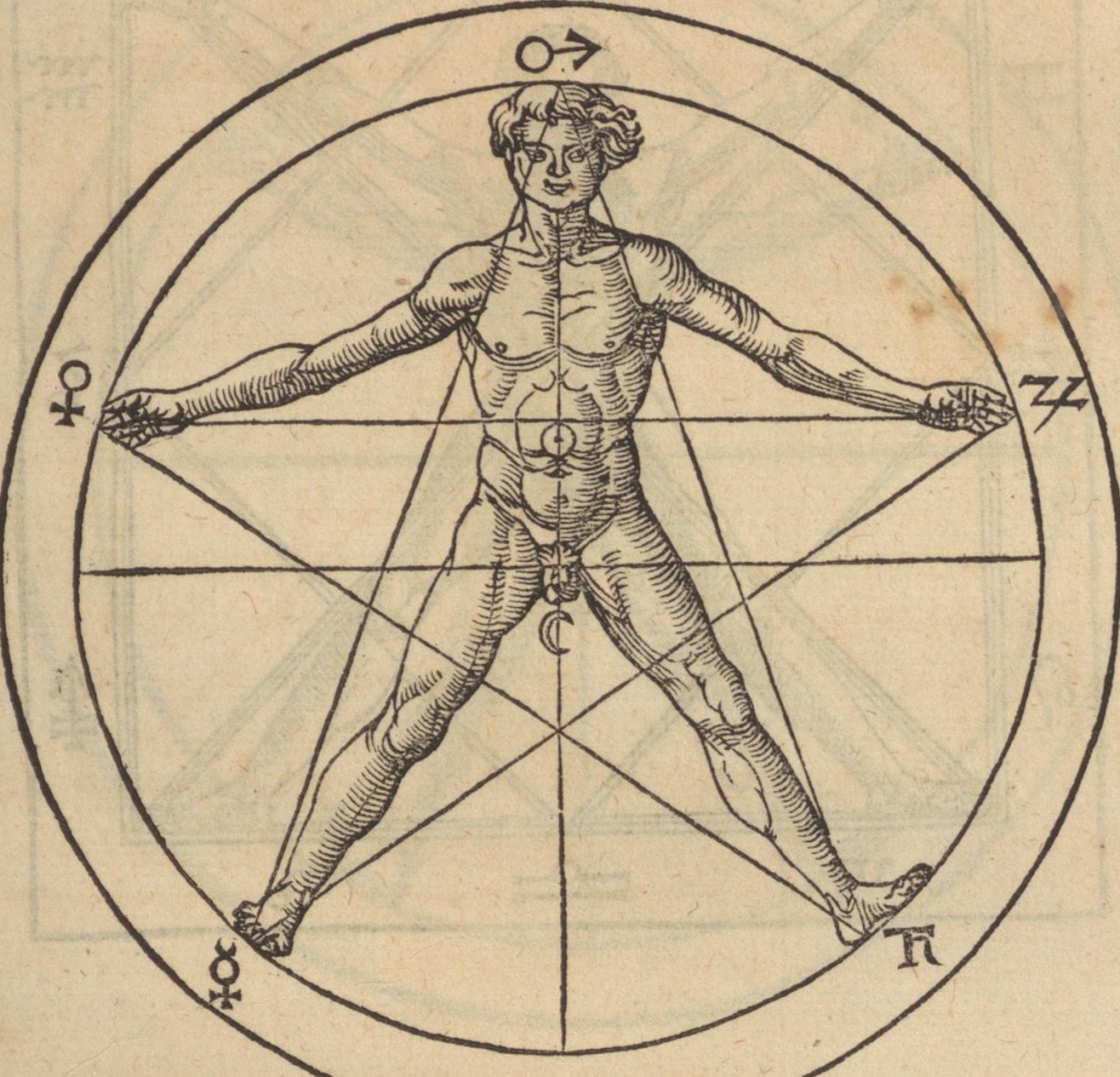
A diagram of everything, drawn so that a person can be found inside it. Note where the human figure stands in the scheme.
In plain words The circle is drawn round him with its centre at the groin, as the text directs, and the rings hold the whole figure, fingertips and toes and crown on the line. Agrippa's argument is that the world was made to the measure of a human body, the great world and the little one, which is why a man fits a circle so exactly. The circle is filed under the Heavens because it is the great world he is measured against.
Agrippa, in J.F.'s translation, 1651 “Moreover God himself taught Noah to build the Arke according to the measure of mans body, and he made the whole fabrick of the world proportionable to mans body; from hence it is called the great world, mans body the lesse.”
Agrippa, in J.F.'s translation, 1651 “Seeing man is the most beautiful and perfectest work of God, and his Image, and also the lesser world; therefore he by a more perfect composition, and sweet Harmony, and more sublime dignity doth contain and maintain in himself all numbers, measures, weights, motions, Elements, and all other things which are of his composition.”
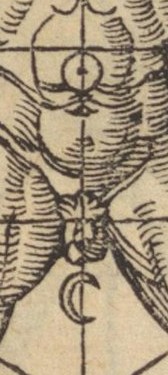
Gold, the perfected metal, and the illuminated intellect. The most overloaded symbol in the tradition.
In plain words A small circle with a dot, the sign of the sun, sits on his breast, and a crescent, the moon, at his loins. The chapter does not say why; it says only that every part of the body answers to some star. The cutter put the answers on the picture.
Agrippa, in J.F.'s translation, 1651 “The measures of all the members are proportionate, and consonant both to the parts of the world and measures of the Archetype, and so agreeing, that there is no member in man which hath not correspondence with some sign, Star, intelligence, divine name, sometimes in God himself the Archetype.”
Symbolica The two signs are cut into the block and are not named in Agrippa's chapter, which gives the proportions and not the planets. Marked as observed on the cut, and read by their shapes only.
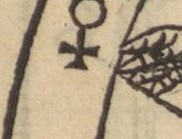
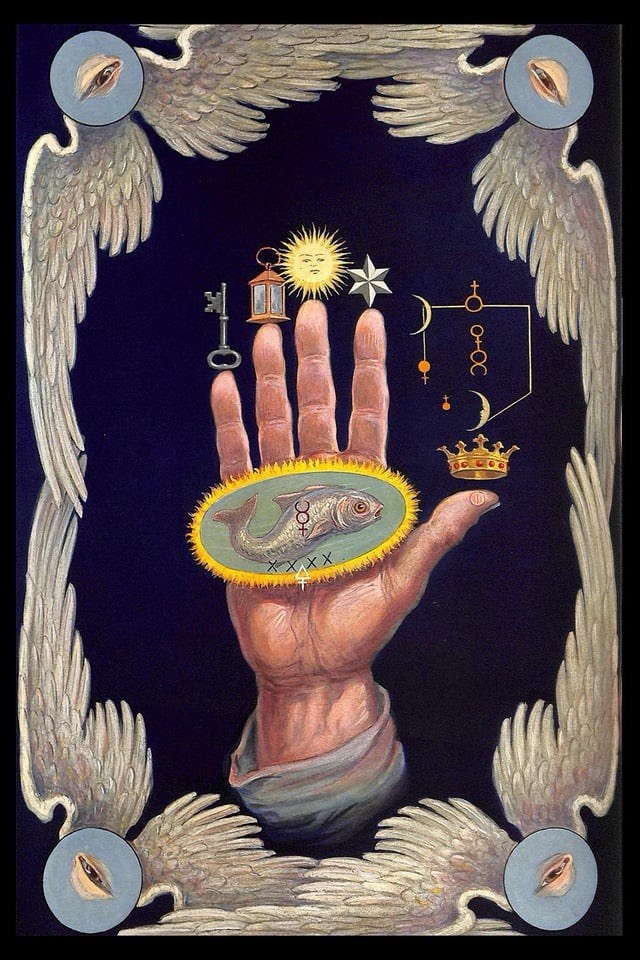
The hand as a sign in itself: what it holds, where it points, which fingers are raised. On the Hand of the Mysteries every finger carries a sign of its own.
In plain words Each hand reaches a point of the star, and each point carries a planet's sign: Venus at one hand, Jupiter at the other, Mars over the head, Mercury and Saturn at the feet. Agrippa's text does not assign them; it says only that no part of a man is without its star. The woodcut gives the assignments the text withholds.
Agrippa, in J.F.'s translation, 1651 “The measures of all the members are proportionate, and consonant both to the parts of the world and measures of the Archetype, and so agreeing, that there is no member in man which hath not correspondence with some sign, Star, intelligence, divine name, sometimes in God himself the Archetype.”
Symbolica The signs at the fingertips, and those at the head and feet, are on the cut and not in the sentence; they are read here by their shapes.
Also carrying the Pentagram
5 works. The symbol.
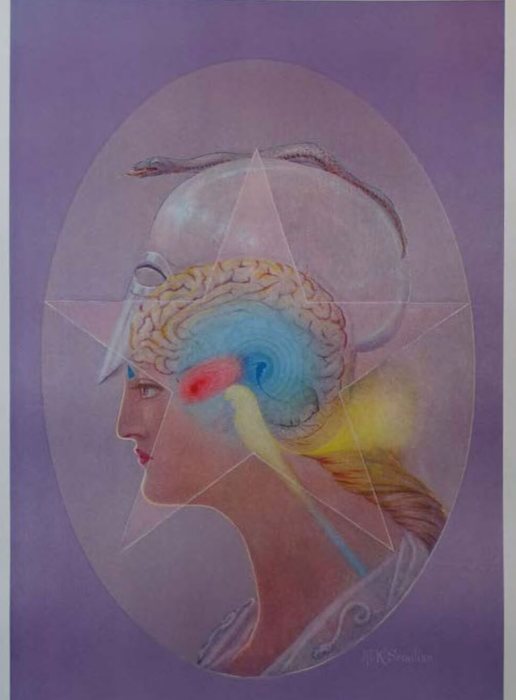
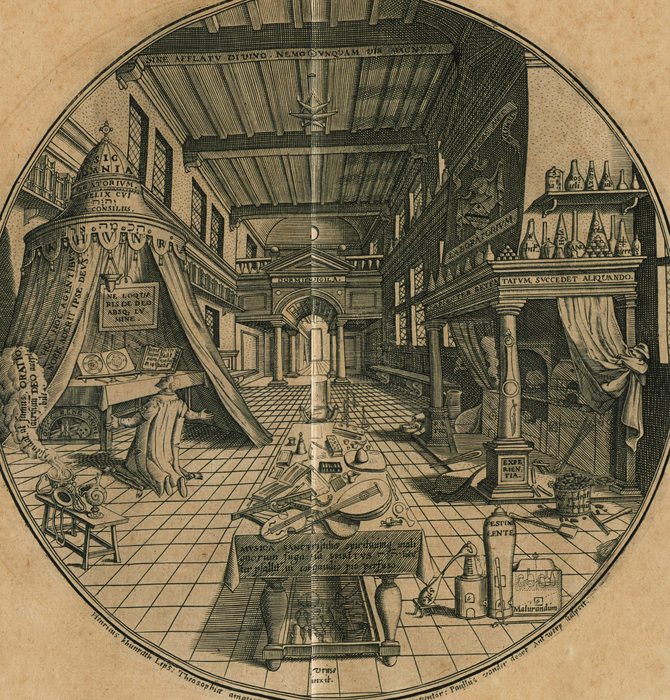
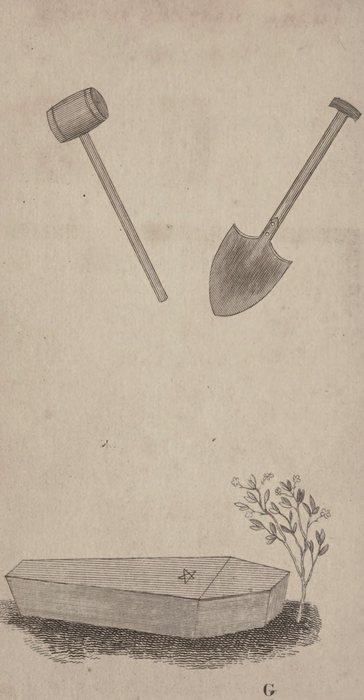
Where the detail is the subject
the Heavens · the Sun and the Moon · the Hand
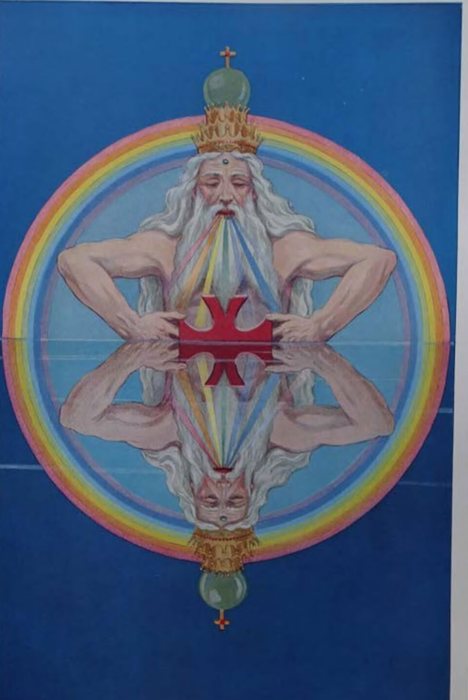
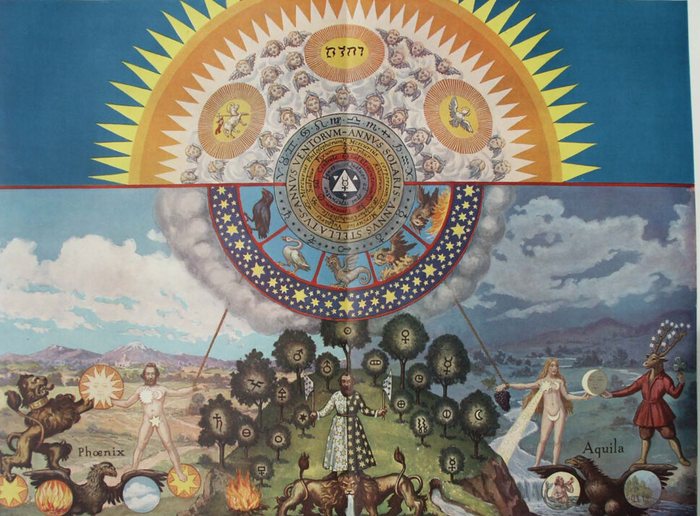
Each of these is in the picture without being what it is about. Below, one work that is about each.
In the same series
Record
One symbol a week, decoded.
This picture is free at full size from its source, linked above. What an address gets is the Sunday letter: one picture, one symbol marked on it, what it meant and who said so, and the master files of the decoded plates as they are verified. Leave any time.
Free, one letter a week, unsubscribe in one click. How the address is used.
Scroll or pinch to zoom · drag to move · double-tap for 1:1 · 1400 by 1391 pixel web copy; the source file is linked under Record