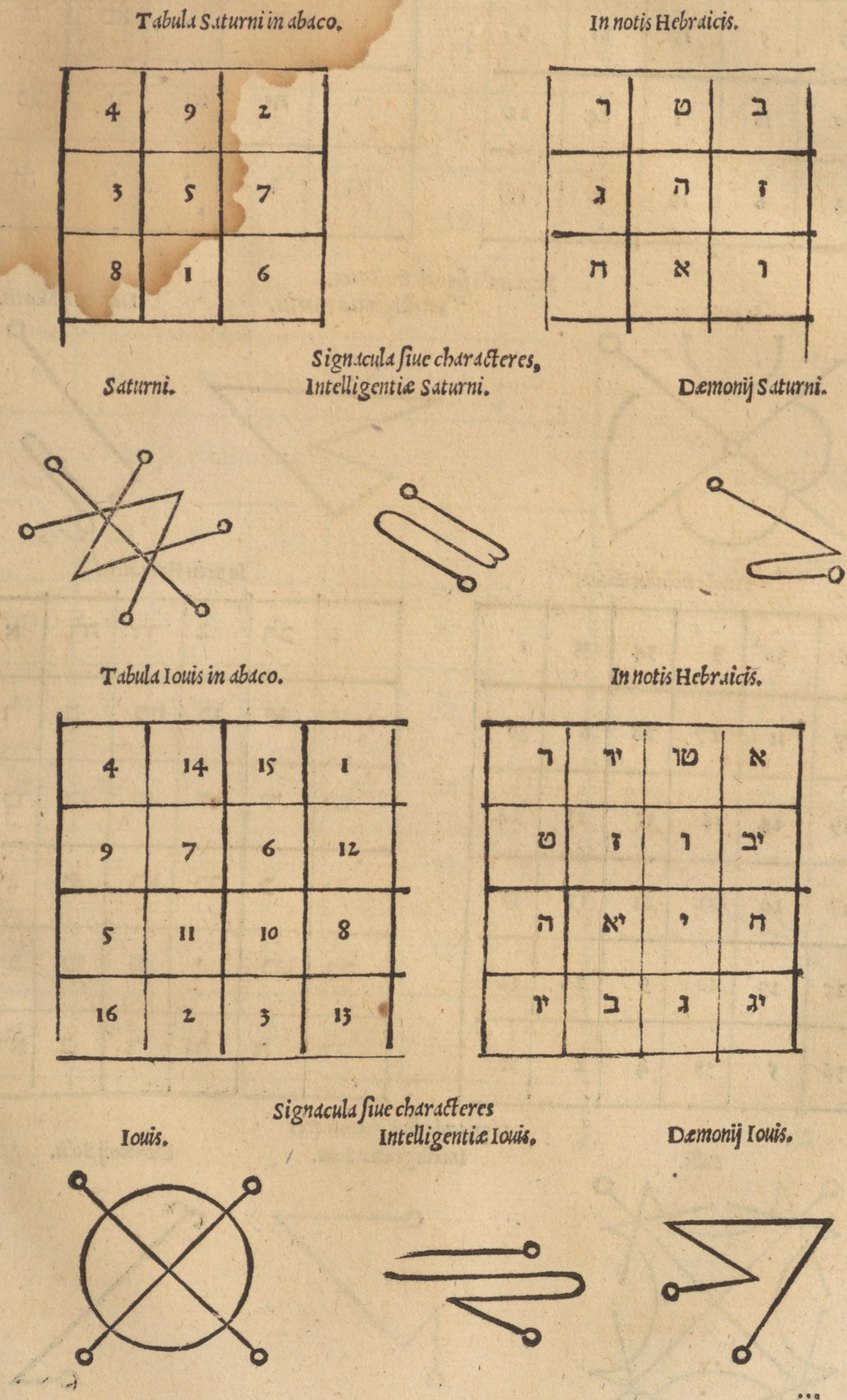
The Tables of Saturn and Jupiter
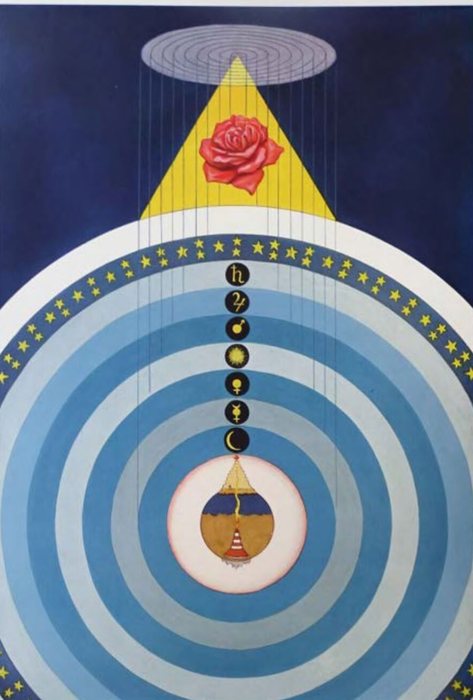
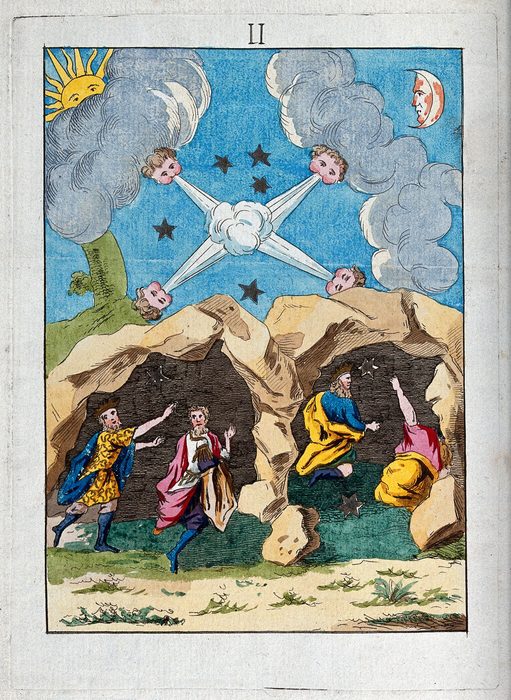
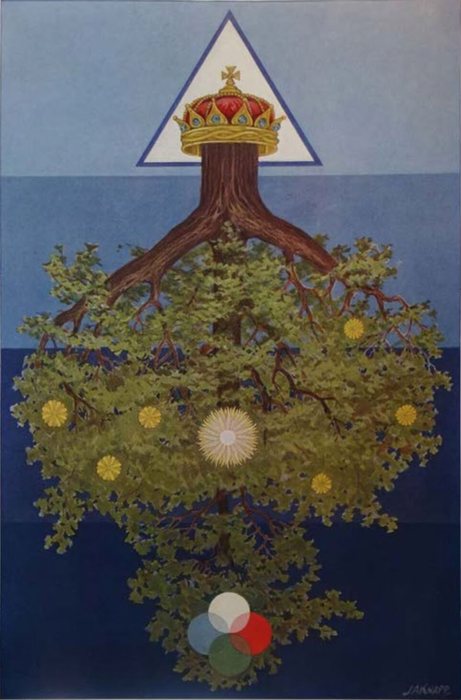
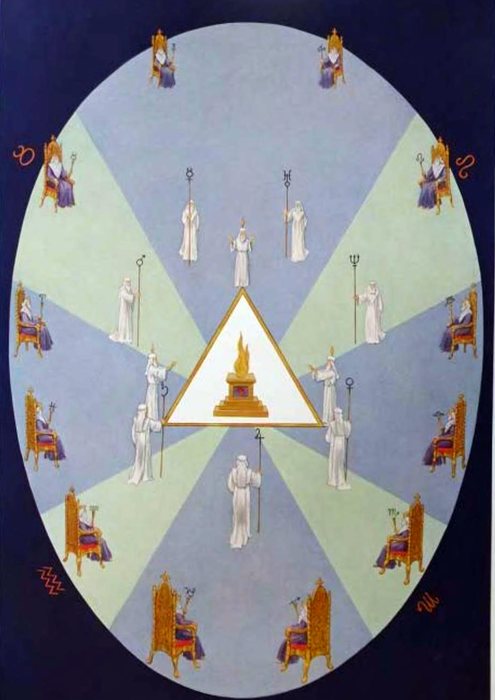
The Heavens as the central motif, with the Triangle and the Pyramid in a secondary part. From De occulta philosophia.
Key · 2 motifs
Tap a motif on the picture, or a line below. Its note opens under the line, with the reading its author gave it.
- Primary motif
- Secondary motifs · 1
The picture
Two squares of numbers, three by three and four by four, each printed twice, once in arabic figures and once in Hebrew letters, with six line characters under them captioned for the planet, its intelligence and its daemon. By eye
The reading
The picture read whole, in the archive's words, from the sources quoted on the marks. Read on, and the picture follows: the motif under discussion keeps its colour.
Agrippa prints seven squares of numbers in this chapter, one for each planet, and a reader can check the first two of them in about ten seconds. That is unusual in a book of this kind, and it is why they are here.
Saturn gets the smallest. Nine numbers in a three by three, and Agrippa states the property outright: every line each way and both diameters make fifteen, and the whole sum is forty five. Beside it the same square again in Hebrew, because in Hebrew the letters are the numbers. Then he says what it is for, and the answer turns on how the planet stands when the plate is cut. Cut on lead while Saturn is fortunate, it helps a birth, makes a man safe and powerful, and gets his petitions granted by princes. Cut while Saturn is unfortunate, it hinders building and planting, throws men down from their honours, breeds quarrels and scatters armies.
Jupiter gets the four by four: sixteen numbers, thirty four along every line and both diameters, a hundred and thirty six in all. Agrippa's paragraph promises gain and riches, favour and love, peace and concord among men, and says the square dissolves enchantments if it is cut in coral. What the paragraph never mentions is Saturn.
That matters, because these sixteen numbers have a second and much more famous home. Dürer hung them on the wall behind Melancholy in 1514, nineteen years before this book was printed. Reverse the order of Agrippa's rows, exchange the two middle columns, and Dürer's square comes out exactly, still making thirty four every way, with fifteen and fourteen in the bottom middle so that the square gives the year. The reading everybody knows says Dürer put Jupiter's table there as a charm against Saturn's melancholy. That reading is a twentieth century one. What the sixteenth century page in front of you actually promises is gain, love and peace, and it says nothing about Saturn at all.
Decoded: every motif is marked, and each mark carries the reading its author gave it, quoted from the text, or says that it is observed on the picture and not read. The reading above is the archive's own, made from those sources and no others.
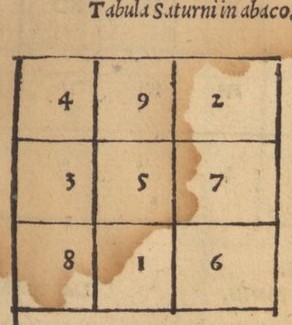
The outermost planet of the old order, the metal lead, the black first stage of the work, and an old man with a sickle. One sign does all four jobs, and the books move between them without explaining themselves.
In plain words Nine numbers, and Agrippa states the property instead of hinting at it: every line each way and both diameters make fifteen, and the whole sum is forty five. The second square is the same one in Hebrew, because in Hebrew the letters are the numbers. Then he says what it is for, and the answer depends entirely on how Saturn stands when it is cut.
Heinrich Cornelius Agrippa, 1533 “Harum prima Saturno adsignata, ex quadrato ternario constat, continens numeros particulares nouem, & in qualibet linea tres quaquauersum, & per utrunque diametrum constituentes quindecim: tota autem numerorum summa, quadraginta quinque.”
Symbolica Agrippa's Latin, put into English here: The first of them, assigned to Saturn, is made of a square of three, holding nine particular numbers, three in every line each way, and by both diameters making fifteen; and the whole sum of the numbers, forty five.
Heinrich Cornelius Agrippa, 1533 “Dicunt hanc tabulam fortunato Saturno in lamina plumbea sculptam, adiuuare partum, reddere hominem tutum & potentem, atque praestare successus petitionum apud principes & potestates: si uero infortunato Saturno fiat, impedire aedificia & plantationes & consimilia hominum, deiicere ab honoribus & dignitatibus, gignere rixas & discordias, & dispergere exercitus.”
Symbolica Agrippa's Latin, put into English here: They say that this table, cut on a plate of lead while Saturn is fortunate, helps a birth, makes a man safe and powerful, and gets his petitions granted by princes and powers; but if it is made while Saturn is unfortunate, it hinders buildings and plantings and the like, casts men down from honours and dignities, breeds quarrels and discords, and scatters armies.
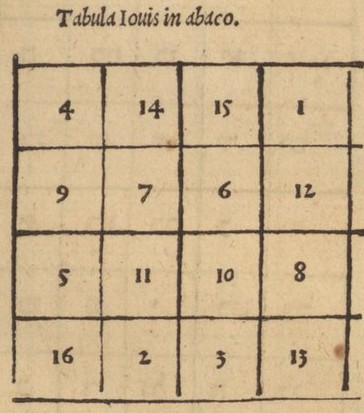
A figure a maker expects the reader to construct. In this material geometry is an instruction rather than an ornament, and the makers say so on the page.
In plain words Sixteen numbers, thirty four along every line and both diameters, a hundred and thirty six in all. This is the square Dürer hung on the wall behind Melancholy in 1514, nineteen years before this printing: reverse the order of Agrippa's rows, exchange the two middle columns, and Dürer's square comes out exactly, still making thirty four every way, with fifteen and fourteen in the bottom middle to give the year. What Agrippa's paragraph promises for it is gain, love and peace. Saturn is not in that paragraph at all.
Heinrich Cornelius Agrippa, 1533 “Secunda dicitur tabula Iouis, quae constat quaternario in se ducto, continens numeros, particulas sexdecim, & in quauis linea atque diametro quatuor, constituentes triginta quatuor: omnium autem summa centum triginta sex.”
Symbolica Agrippa's Latin, put into English here: The second is called the table of Jupiter, which is made of four multiplied into itself, holding sixteen numbers, four in every line and diameter, making thirty four; and the sum of them all, a hundred and thirty six.
Heinrich Cornelius Agrippa, 1533 “Ferunt illam si Ioue potente dominateque argenteae laminae fuerit impressa, conferre lucrum & diuitias, gratiam & amorem, pacem & concordiam hominum, & placare inimicos, confirmare honores & dignitates & consilia: & dissoluere maleficia, si in corallio insculpta fuerit.”
Symbolica Agrippa's Latin, put into English here: They say that if it is struck on a silver plate with Jupiter powerful and ruling, it confers gain and riches, favour and love, peace and concord among men, appeases enemies, and confirms honours and dignities and counsels; and that it dissolves enchantments, if it is cut in coral.
Symbolica Agrippa's paragraph on the table of Jupiter, on page CXLVI, gives it these uses and does not mention Saturn. The nearest he comes to setting the two planets against one another is a sentence in the first book, on page XXIX: Saturnine things conduce to sadness and melancholy, Jovial things to gladness and dignity.
Also carrying the Heavens
54 works carry it. The 6 where it is the central motif are here. The symbol.

Where the detail is the subject
This is in the picture without being what it is about. Below, one work that is about it.
In the same series
Record
One symbol a week, decoded.
This picture is free at full size from its source, linked above. What an address gets is the Sunday letter: one picture, one symbol marked on it, what it meant and who said so, and the master files of the decoded plates as they are verified. Leave any time.
Free, one letter a week, unsubscribe in one click. How the address is used.
Scroll or pinch to zoom · drag to move · double-tap for 1:1 · 847 by 1400 pixel web copy; the source file is linked under Record