Heinrich Cornelius Agrippa
of Nettesheim, 1486 to 1535, soldier, physician and scholar, whose De occulta philosophia gathered the magic of his age into one system with figures to match.
Readings given
13 passages on 3 pictures in the archive.
-
De occulta philosophia libri tres, Book I, chapter 60, page LXXVIII of the Cologne printing
“maxime autem si iuuetur influxu aliquo coelesti, praecipue Saturni, qui cum ipse frigidus sit atque siccus, qualis est humor melancholicus, illum quotidie influit, auget atque conseruat.”
“Praeterea cum sit ipse arcanae contemplationis autor, ab omni publico negotio alienus, ac planetarum altissimus, animam ipsam cum ab externis officiis ad intima semper reuocat, tum ab inferioribus ascendere facit, trahendo ad altissima, scientiasque ac futurorum praesagia largitur.”
De occulta philosophia libri tres, Book II, chapter 22, page CXLVI of the Cologne printing
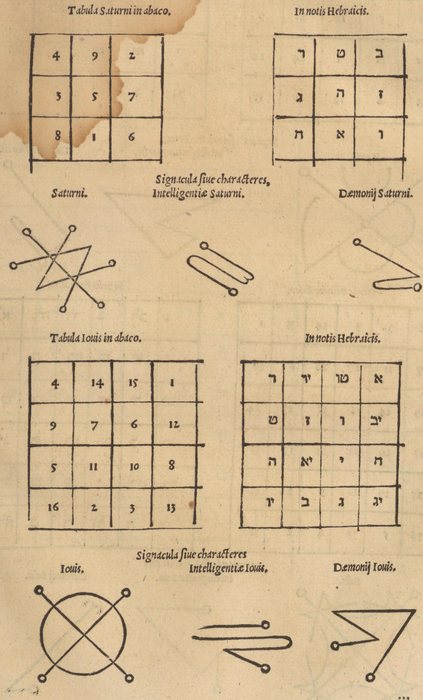
“Secunda dicitur tabula Iouis, quae constat quaternario in se ducto, continens numeros, particulas sexdecim, & in quauis linea atque diametro quatuor, constituentes triginta quatuor: omnium autem summa centum triginta sex.”
-
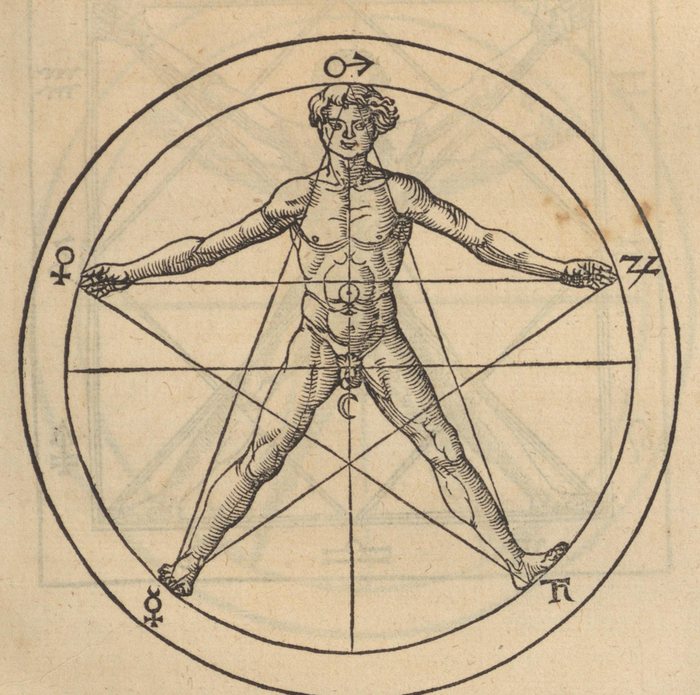
De occulta philosophia libri tres, Book II, chapter 27, De humani corporis proportione, mensura et harmonia; page CLXIII of the Cologne printing
“Quod si super eodem centro circulus fabricetur per summum caput, demissi brachii quousque extremi digiti circuli illius circumferentiam contingant, passisque pedes in eadem circumferentia, quantum extrema manuum a summo vertice distant, tunc circulum illum super imi pectinis centro ductum, in quinque aequas partes dividunt, perfectumque pentagonum constituunt, ipsique pedum extremi tali ad umbilicum relati, triangulum faciunt aequilaterum.”
Three Books of Occult Philosophy, Book II, chapter 27, Of the proportion, measure, and harmony of man's body
“But if on the same center a circle be made by the crown of the head; the arms being let fall so far till the end of the fingers touch the circumference of that circle, and the feet spread abroad in the same circumference, as much as the fingers ends are distant from the top of the head; Then they divide that circle which was drawn from the center of the lower belly, into five equal parts, and do constitute a perfect Pentagon and the Heels of the feet, having reference to the navile, make a triangle of equal sides.”
“Moreover God himself taught Noah to build the Arke according to the measure of mans body, and he made the whole fabrick of the world proportionable to mans body; from hence it is called the great world, mans body the lesse.”
“Seeing man is the most beautiful and perfectest work of God, and his Image, and also the lesser world; therefore he by a more perfect composition, and sweet Harmony, and more sublime dignity doth contain and maintain in himself all numbers, measures, weights, motions, Elements, and all other things which are of his composition.”
“The measures of all the members are proportionate, and consonant both to the parts of the world and measures of the Archetype, and so agreeing, that there is no member in man which hath not correspondence with some sign, Star, intelligence, divine name, sometimes in God himself the Archetype.”
“From hence all the Ancients in time past did number by their fingers, and shewed all numbers by them; and they seem to prove that from the very joynts of mans body all numbers, measures, proportions, and Harmonies were invented; Hence according to this measure of the body, they framed, and contrived their temples, pallaces, houses, Theaters; also their ships, engins, and every kind of Artifice, and every part and member of their edifices, and buildings, as columnes, chapiters of pillars, bases, buttresses, feet of pillars, and all of this kind.”
-
The Tables of Saturn and Jupiter
De occulta philosophia libri tres, Book II, chapter 22, page CXLVI of the Cologne printing
“Harum prima Saturno adsignata, ex quadrato ternario constat, continens numeros particulares nouem, & in qualibet linea tres quaquauersum, & per utrunque diametrum constituentes quindecim: tota autem numerorum summa, quadraginta quinque.”
“Dicunt hanc tabulam fortunato Saturno in lamina plumbea sculptam, adiuuare partum, reddere hominem tutum & potentem, atque praestare successus petitionum apud principes & potestates: si uero infortunato Saturno fiat, impedire aedificia & plantationes & consimilia hominum, deiicere ab honoribus & dignitatibus, gignere rixas & discordias, & dispergere exercitus.”
“Secunda dicitur tabula Iouis, quae constat quaternario in se ducto, continens numeros, particulas sexdecim, & in quauis linea atque diametro quatuor, constituentes triginta quatuor: omnium autem summa centum triginta sex.”
“Ferunt illam si Ioue potente dominateque argenteae laminae fuerit impressa, conferre lucrum & diuitias, gratiam & amorem, pacem & concordiam hominum, & placare inimicos, confirmare honores & dignitates & consilia: & dissoluere maleficia, si in corallio insculpta fuerit.”