Geometry
sacred geometry, Metatron's cube, the Flower of Life, the tetractys
A figure a maker expects the reader to construct. In this material geometry is an instruction rather than an ornament, and the makers say so on the page.
Geometry in this archive is never ornament. In every case below the maker says on the page that the figure is an instruction, and expects the reader to construct it.
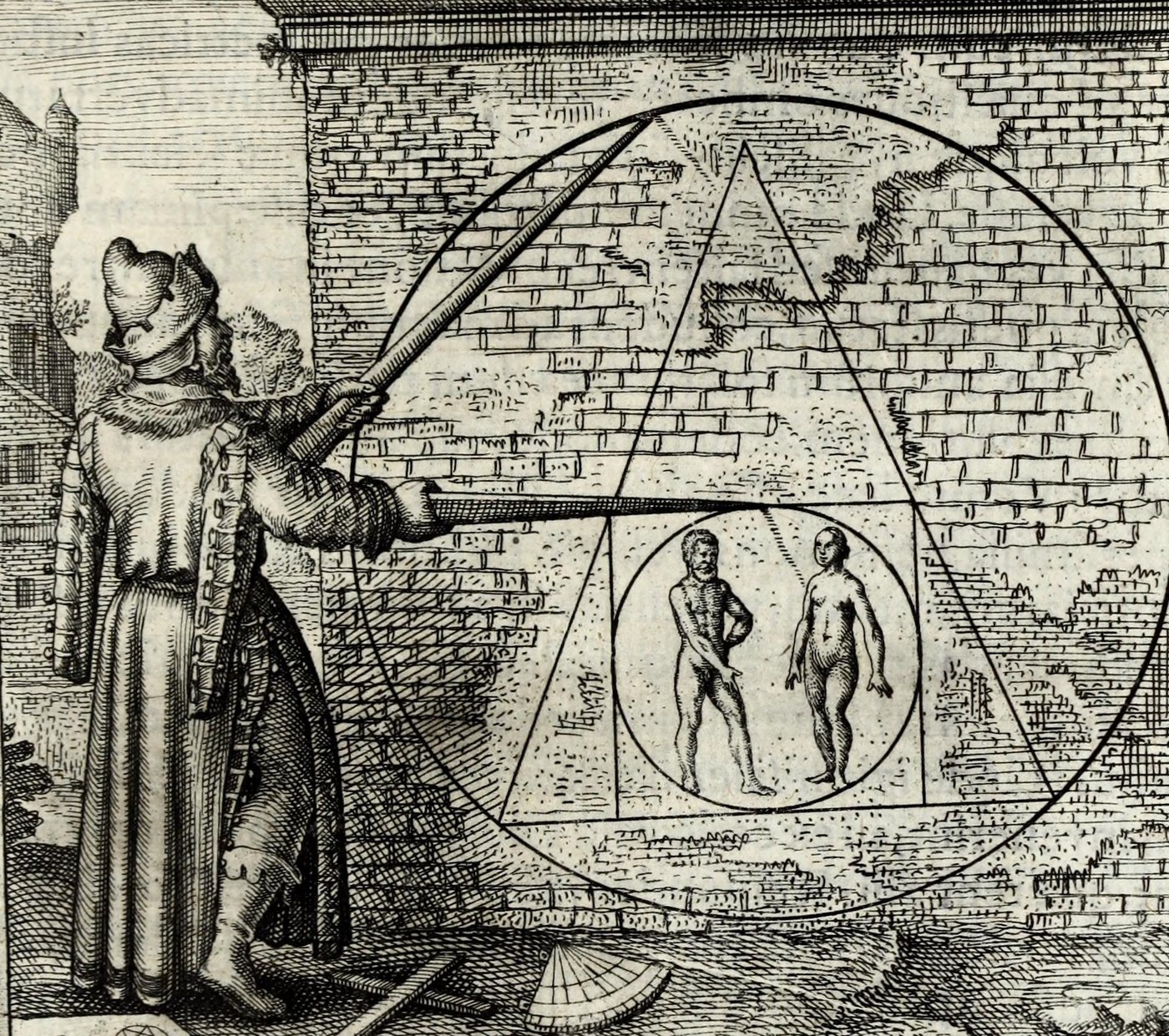
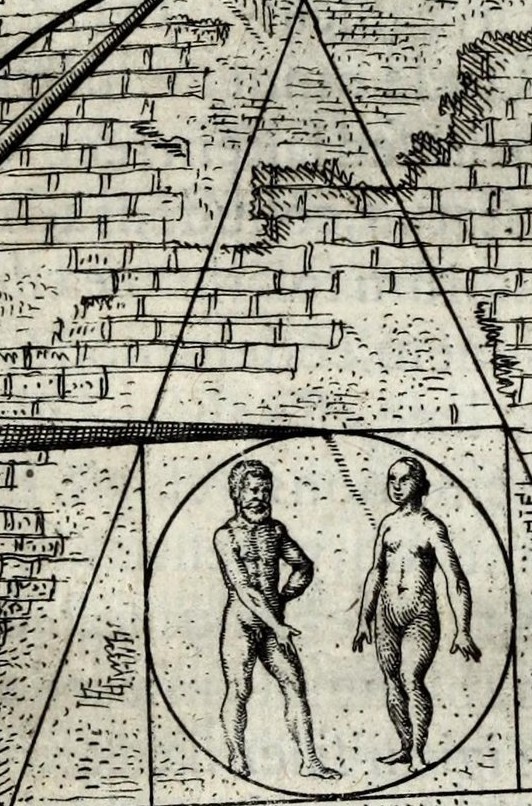
Maier is the plainest. The twenty-first emblem of the Atalanta Fugiens of 1618 shows a philosopher setting compasses to a figure of a circle, a square and a triangle, and the motto printed over it is a recipe: “Fac ex mare & fœmina circulum, inde quadrangulum, hinc triangulum, fac circulum & habebis lap. Philosophorum.” Make a circle of the man and the woman, then a square, then a triangle, then a circle again, and you will have the Philosophers' Stone. In case a reader takes that for a turn of phrase, the epigram ends by telling him where to go and learn: “Si res tanta tuae non mox venit obvia menti, / Dogma Geometra si capis, omne scies.” If so great a thing does not come to your mind at once, take hold of the geometer's teaching and you will know it all. Both translations are the archive's own.
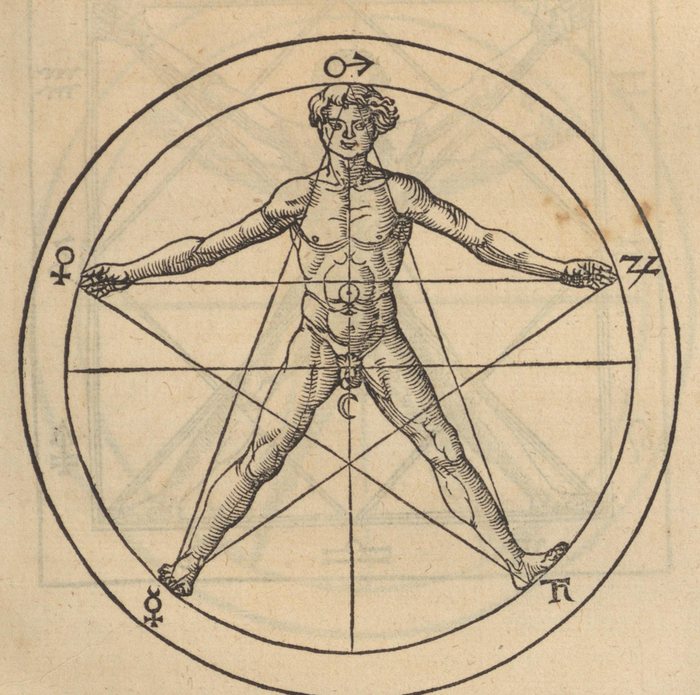
Agrippa, in 1533, states the doctrine the rest of it runs on. His man stands in a circle and a square with a pentagram drawn through him, and the chapter beside the figure says why the measurements matter: “Moreover God himself taught Noah to build the Arke according to the measure of mans body, and he made the whole fabrick of the world proportionable to mans body; from hence it is called the great world, mans body the lesse.” The proportions are not chosen for beauty. They are held to be the same proportions twice, once in a body and once in a world, which is what makes a diagram of a man an argument about everything.
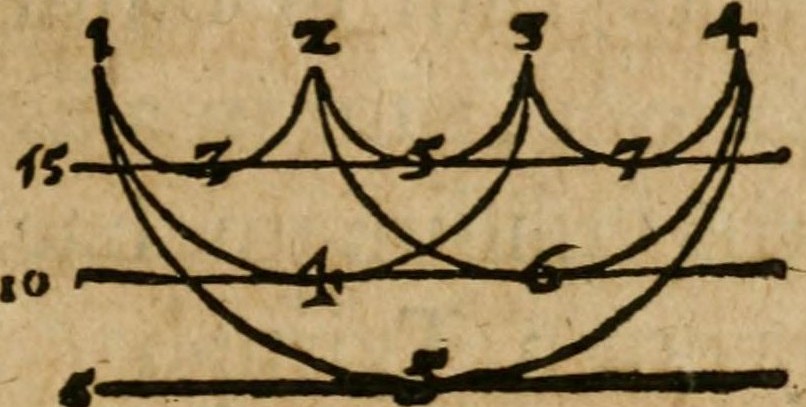
Dee, in 1564, does arithmetic on his own glyph and prints the sums. One figure is lettered “Quaternarii Pythagorici.” and another carries the working beside it: “Omnis possibilis Metathesis, 24. Summa Pythagorica, 10. Omnimoda partium additio, dat 30.” A reader who wants to check him can check him, which is the whole difference between a diagram and a decoration.
Fludd, in 1617, draws the cosmos as a single string and tunes it. His monochord runs from earth to the outermost heaven and he gives the interval as a measurable ratio, a fourfold proportion between the earth and the convex surface of the spiritual world, doubled through the octave. On his title page geometry is not a mystery at all but one of the arts in a list with the others: “Arithmeticam. Musicam. Geometriam. Perspectivam.”
Two later makers keep the same habit. Cross's monitor of 1826 puts a Euclidean proof on a plate and names its author: “The Forty-Seventh Problem of Euclid. This was an invention of our ancient friend and brother, the great Pythagoras. It teaches masons to be general lovers of the arts and sciences.” Hall, in 1928, has Knapp paint the tetractys and explains what is being counted: “Pythagoras taught that 10, or the unit of the decimal system, was the most perfect of all numbers, and he symbolized the number ten by the lesser tetractys, an arrangement of ten dots in the form of an upright triangle.”
One picture in the archive argues the other way, and it is the most famous geometric print there is. In Dürer's Melencolia I of 1514 the instruments of geometry and building lie about the seated figure unused, a four by four square of numbers hangs on the wall behind her, and she is not measuring anything. Everywhere else in this material geometry is the operation that gets you somewhere. There it is the thing a mind can hold and still not be able to act.
Four centuries and six makers, and the claim is the same one each time: the figure is a calculation, the reader is expected to do it, and the answer is not aesthetic.
Contested
Almost everything published under the phrase sacred geometry belongs to the last hundred years, and the archive holds none of it, because none of it has a maker who expected a reader to decode it. The phrase itself is modern. So is the Flower of Life as a named system, and so is Metatron's Cube, which was popularised through Drunvalo Melchizedek's books in the nineteen nineties. Metatron is genuinely old, in 3 Enoch and the Merkabah literature, but no historical source gives him a cube, and no artefact in any collection carries that name from before the twentieth century.
That is not an argument that the modern figures are worthless. It is the reason they are not here. Every picture on this site is a photographed object with a holding library and a rights line; a diagram drawn by us to illustrate a modern name would be neither, and the archive would have nothing to attribute it to. If a printed source older than the name turns up carrying the same figure, it belongs here and the entry will say so.
Sources
- Michael Maier, Atalanta Fugiens, 1618: Emblema XXI, the motto and the epigram, read against the Getty copy of the 1618 Oppenheim printing.
- Heinrich Cornelius Agrippa, De occulta philosophia libri tres, 1533: Book II, chapter 27, on the proportion and measure of the human body, quoted in J.F.'s English of 1651.
- John Dee, Monas Hieroglyphica, 1564: The Quaternarii Pythagorici figure and its arithmetic, read against the Getty copy of the 1591 Frankfurt printing.
- Robert Fludd, Utriusque cosmi historia, 1617: Book III, De musica mundana, on the proportion between the earth and the spiritual world, and the list of arts on the title page.
- Jeremy L. Cross, The True Masonic Chart, or Hieroglyphic Monitor, 1826: The Master Mason lecture on the forty-seventh problem of Euclid, read against the Library of Congress copy.
- Manly P. Hall, The Secret Teachings of All Ages, 1928: The Zodiac and Its Signs, on the tetractys. Transcribed, not yet read against the printed 1928 page.
On the same plate
Where it appears · 10
10 works in the archive carry Geometry. First the 10 where it has been read, with Geometry itself picked out.
Fac ex mare & fœmina circulum, inde quadrangulum, hinc triangulum, fac circulum & habebis lap. Philosophorum
The Man in the Pentagram
Quaternarii Pythagorici
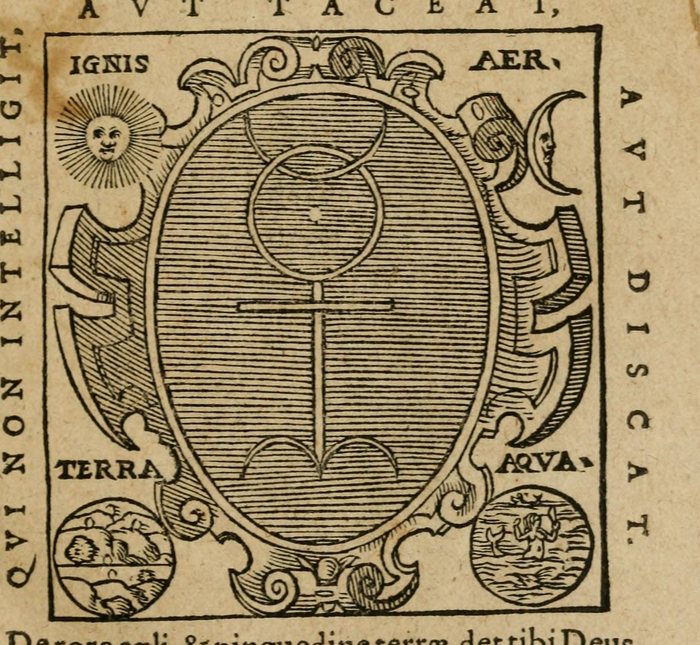
Monas Hieroglyphica, the hieroglyphic monad on the title
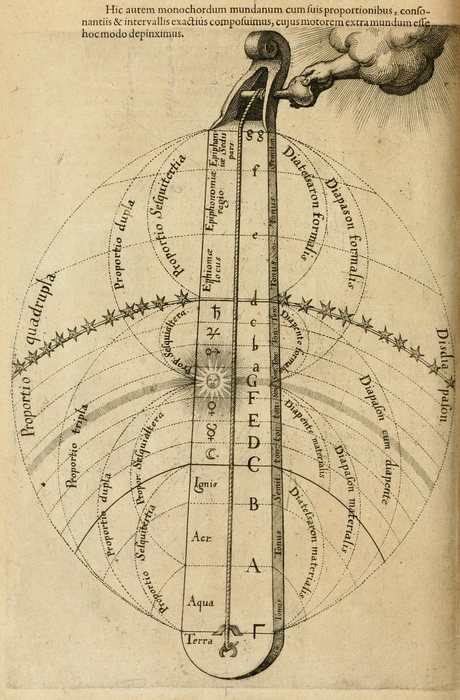
Monochordum Mundanum, the Divine Monochord
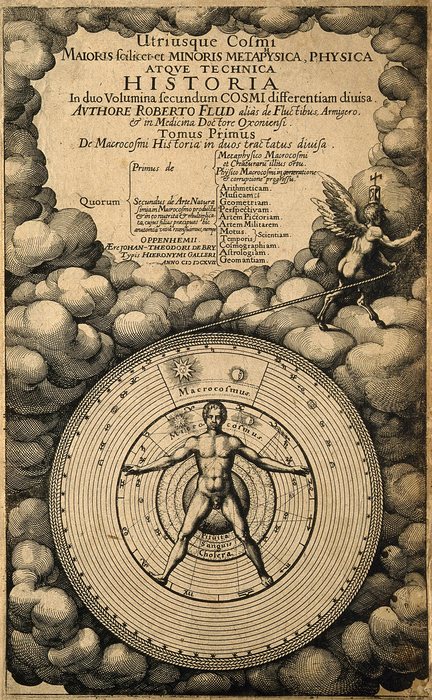
Man the Microcosm, the title page of Utriusque Cosmi Historia
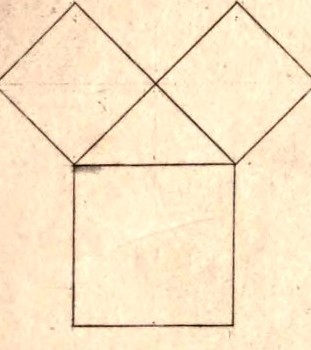
The Anchor and the Ark, the Forty-seventh Problem, the Hourglass and the Scythe
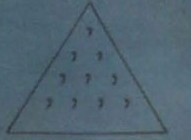
Pythagoras of Crotona
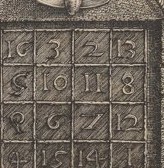
Melencolia I
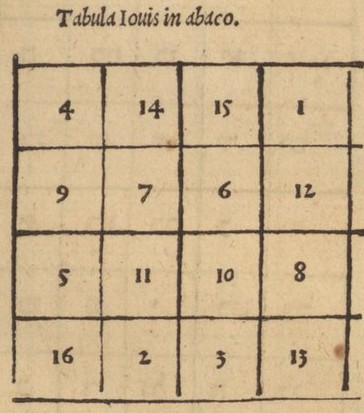
The Tables of Saturn and Jupiter