Quaternarii Pythagorici
The Triangle and the Pyramid as the central motif. From Monas Hieroglyphica.
What is happening
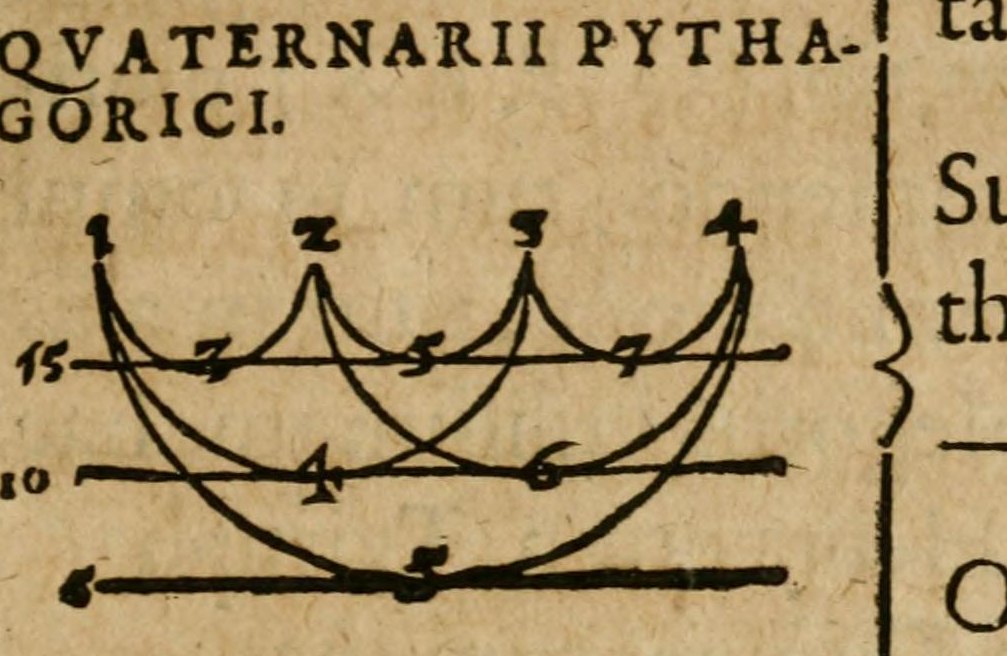
Symbolica, 2026 Dee's Latin, put into English here: Of the Pythagorean Quaternary. Every possible transposition, 24; the Pythagorean sum, 10; the addition of the parts in every way gives 30. The figure is the tetractys of one, two, three and four, whose sum is ten, drawn as arcs rather than as the usual triangle of points, and Dee makes it the arithmetic of his glyph.
Key · 1 motif
Tap a motif on the picture, or a line below. Its note opens under the line, with the reading its author gave it.
- Primary motif
The picture
The numbers one to four set in a row and joined by arcs beneath, their sums written along the arcs, the figure of the Pythagorean fourfold. By eye
The reading
The picture read whole, in the archive's words, from the sources quoted on the marks. Read on, and the picture follows: the motif under discussion keeps its colour.
‘Quaternarii Pythagorici’: of the Pythagorean quaternary. The tetractys, the triangle of ten points the Pythagoreans swore by, one, two, three and four in rows, is here drawn as a line of four numbers with arcs beneath.
Dee unfolds the triangle into a calculation. The four numbers stand in a row; under them arcs join the neighbours, and their sums are written on the arcs, three, five and seven on the first tier, four and six on the second, five on the third, with fifteen, ten and five set at the left where each tier is added. The note beside it gives the totals that matter to him: ‘Omnis possibilis Metathesis, 24. Summa Pythagorica, 10. Omnimoda partium additio, dat 30’, every possible transposition, twenty four; the Pythagorean sum, ten; the addition of the parts in every way gives thirty. The triangle is still there, in the ten, and Khunrath will build the same four rows out of the letters of the Name.
The figure sits in the text of the Monas and is kept at the size of the page.
Decoded: every motif is marked, and each mark carries the reading its author gave it, quoted from the text, or says that it is observed on the picture and not read. The reading above is the archive's own, made from those sources and no others.
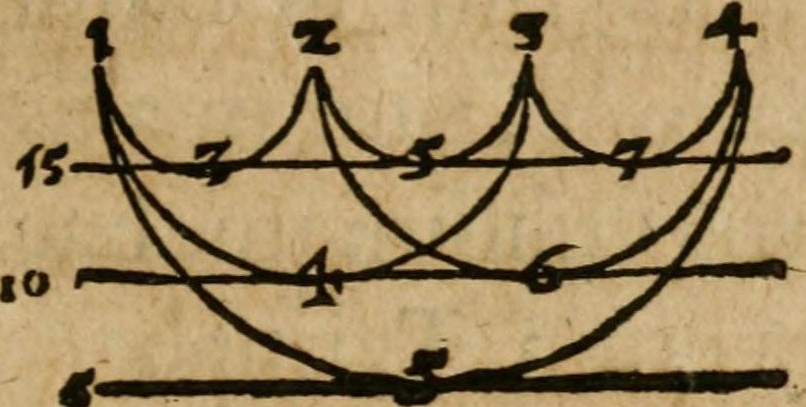
A number made visible. Count the points and then find what else in the picture comes in threes.
In plain words The tetractys is the Pythagoreans' triangle of ten points, one, two, three and four in rows. Dee draws it flat: the four numbers in a line, and arcs under them joining the pairs, whose sums are written on the arcs, three, five and seven, then four and six, then five at the bottom, with fifteen, ten and five totted at the left. The triangle has been unfolded into a sum, and the sum is the arithmetic of the glyph.
John Dee, 1564 “Quaternarii Pythagorici.”
John Dee, 1564 “Omnis possibilis Metathesis, 24. Summa Pythagorica, 10. Omnimoda partium additio, dat 30.”
Symbolica Dee's Latin, put into English here: of the Pythagorean Quaternary; every possible transposition, 24; the Pythagorean sum, 10; the addition of the parts in every way gives 30.
Also carrying the Triangle and the Pyramid
25 works carry it. The 5 where it is the central motif are here. The symbol.
In the same series
Record
One symbol a week, decoded.
This picture is free at full size from its source, linked above. What an address gets is the Sunday letter: one picture, one symbol marked on it, what it meant and who said so, and the master files of the decoded plates as they are verified. Leave any time.
Free, one letter a week, unsubscribe in one click. How the address is used.
Scroll or pinch to zoom · drag to move · double-tap for 1:1 · 1007 by 656 pixel web copy; the source file is linked under Record