Theorem XIV: the anatomy of the monad, the planets drawn out of it
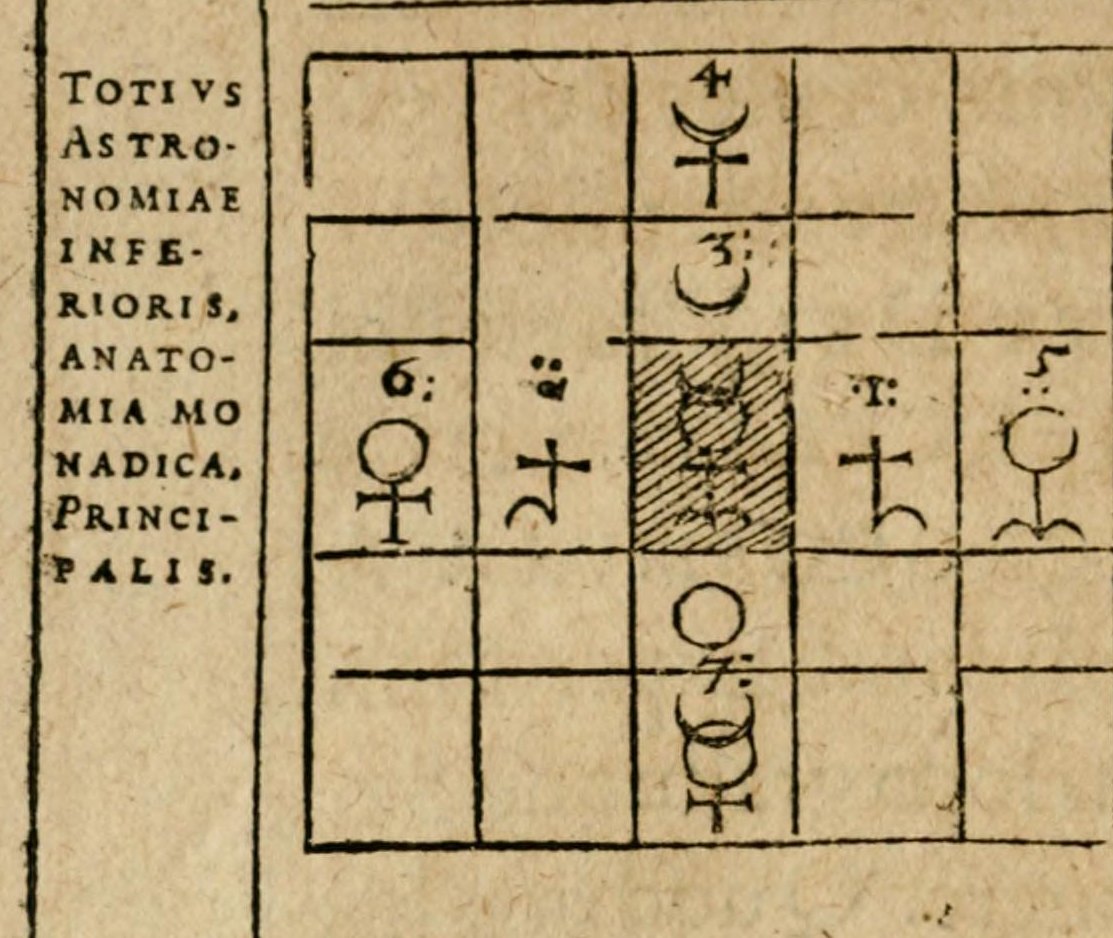
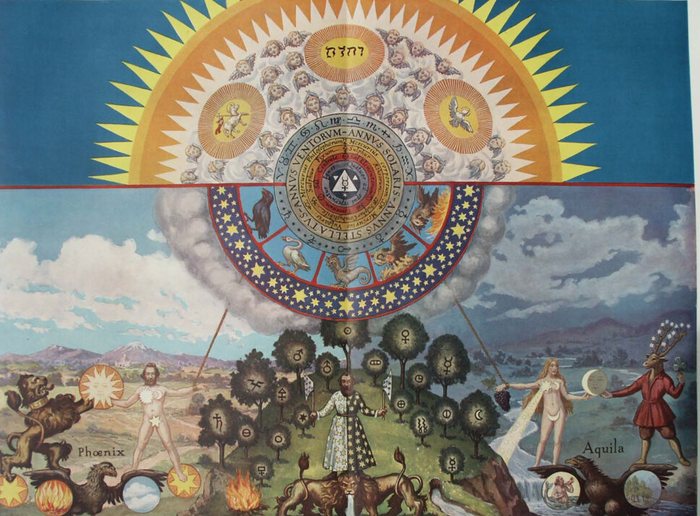
The Heavens as the central motif, with the Sun and the Moon in a secondary part. From Monas Hieroglyphica.
What is happening
Symbolica, 2026 Dee's Latin, put into English here: The principal Monadic anatomy of the whole of inferior astronomy. And: That this whole Mastery hangs from the Sun and the Moon is now clearly confirmed. Of this, thrice-greatest Hermes long ago warned us, asserting that its Father is the Sun and its Mother the Moon, and we know it is nursed in Lemnian earth. Inferior astronomy is Dee's name for alchemy, and the grid shows every planet's sign as a piece of the one glyph.
Key · 2 motifs
Tap a motif on the picture, or a line below. Its note opens under the line, with the reading its author gave it.
- Primary motif
- Secondary motifs · 1
The picture
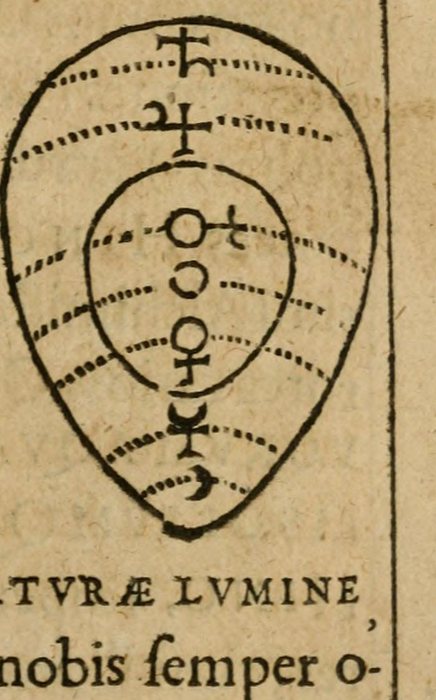
A cross-shaped grid of the signs of the planets, numbered, each shown as a part of the monad, with the monad itself hatched in the middle square, the moon above it and the sun below, and a label down the side calling it the principal anatomy of all inferior astronomy. By eye
The reading
The picture read whole, in the archive's words, from the sources quoted on the marks. Read on, and the picture follows: the motif under discussion keeps its colour.
‘Totius astronomiae inferioris anatomia Monadica principalis’: the principal monadic anatomy of the whole of inferior astronomy. The label runs down the margin beside a grid, and inferior astronomy is Dee's name for alchemy, the astronomy done below, in the furnace.
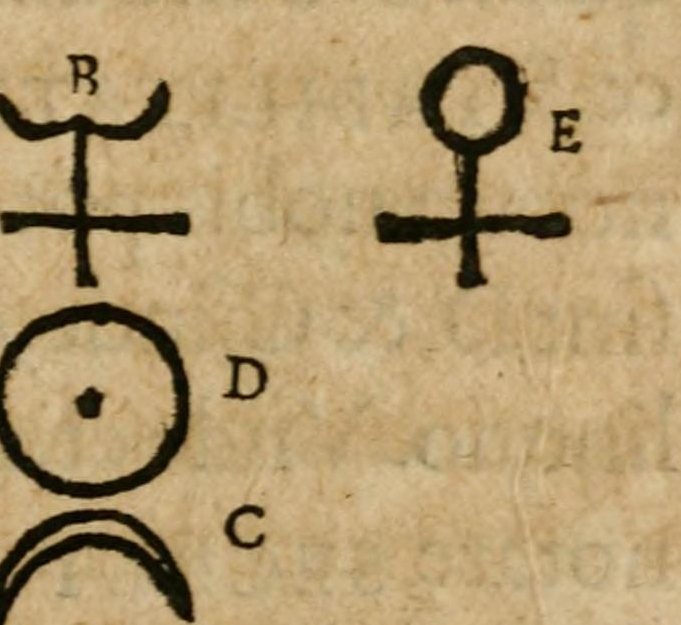
The grid is a cross of squares, and in the squares are the signs of the seven planets, numbered. Each is drawn as a combination of the pieces the glyph is made of, the crescent, the circle, the cross, the two half-circles of Aries, so that the reader can see Venus as a circle set on the cross, Mercury as a crescent on a circle on the cross, and so on through the seven. In the middle square, hatched, is the monad itself, the whole of which the others are parts. It is a table of elements two and a half centuries early: seven signs, one alphabet, and the claim that the sky's planets and the alchemist's metals are the same seven words.
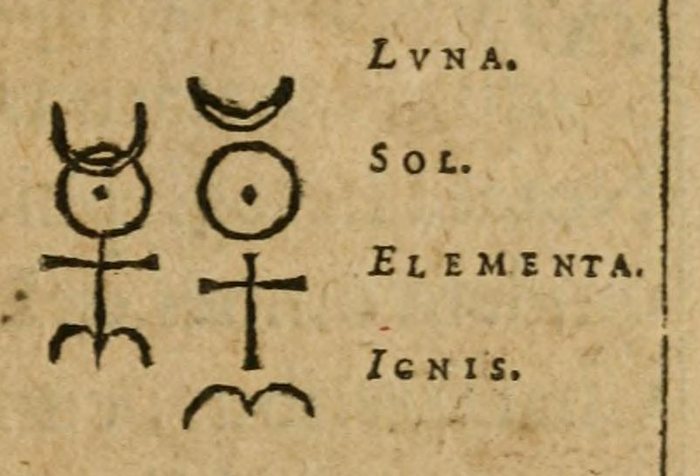
On the upright of the cross the moon's crescent stands directly above the monad and the sun's bare circle directly below it. The fourteenth theorem, which follows the figure, says why they hold the axis: ‘Ex Sole et Luna, totum hoc pendere Magisterium iam clare confirmatum est. Huius, etiam Termaximus ille Hermes, nos olim admonuit: eius Patrem Solem esse, asserens: Lunam autem, Matrem: nutriri vero scimus in Terra Lemnia’, that this whole mastery hangs from the Sun and the Moon is now clearly confirmed; of this thrice-greatest Hermes long ago warned us, asserting that its father is the Sun and its mother the Moon, and we know it is nursed in Lemnian earth. Hermes's sentence is the Emerald Tablet's, and Khunrath carved the same line on his rock.
The woodcut is small and kept at the size of the scan, and the archive marks the parts of it the theorems name.
Decoded: every motif is marked, and each mark carries the reading its author gave it, quoted from the text, or says that it is observed on the picture and not read. The reading above is the archive's own, made from those sources and no others.
A diagram of everything, drawn so that a person can be found inside it. Note where the human figure stands in the scheme.
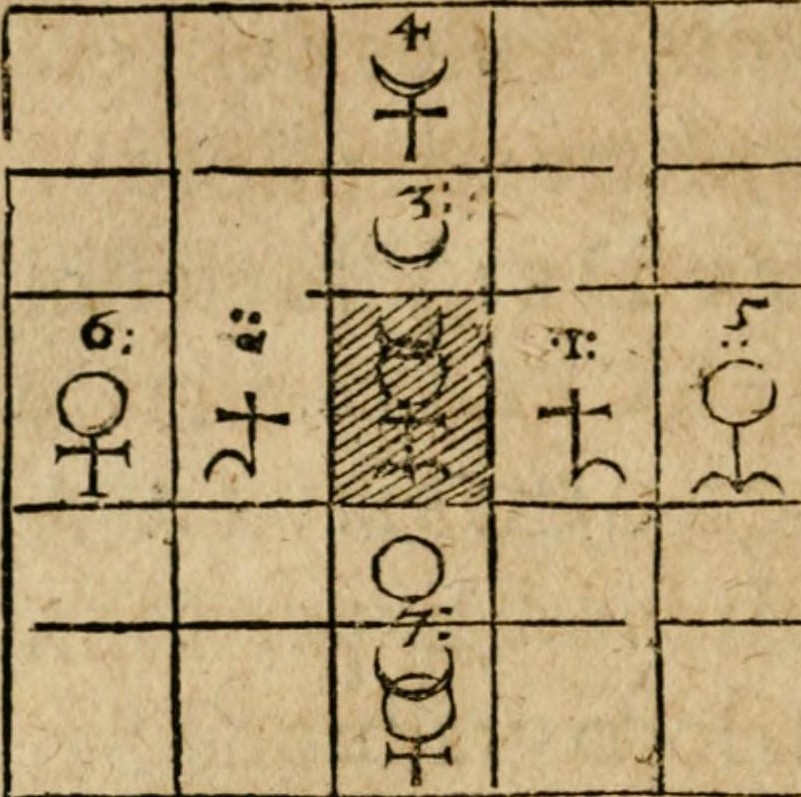
In plain words Seven planets in a cross-shaped grid, numbered, each sign drawn out of the parts of the glyph: the crescent, the circle, the cross and the half-circles of Aries, in different combinations. The monad sits in the middle square, hatched, with the moon above it and the sun below. Dee's label calls the figure the principal anatomy of the whole of inferior astronomy, and inferior astronomy is his name for alchemy: the planets and the metals are spelled from one sign.
John Dee, 1564 “Totius astronomiae inferioris anatomia Monadica principalis.”
Symbolica Dee's Latin, put into English here: the principal Monadic anatomy of the whole of inferior astronomy.

Gold, the perfected metal, and the illuminated intellect. The most overloaded symbol in the tradition.
In plain words On the upright of the cross the moon's crescent stands directly above the hatched monad and the sun's bare circle directly below it, the two parents of the work in Dee's own words: this whole mastery hangs from the Sun and the Moon, its father the Sun and its mother the Moon, as Hermes said.
John Dee, 1564 “Ex Sole et Luna, totum hoc pendere Magisterium iam clare confirmatum est. Huius, etiam Termaximus ille Hermes, nos olim admonuit: eius Patrem Solem esse, asserens: Lunam autem, Matrem: nutriri vero scimus in Terra Lemnia.”
Symbolica Dee's Latin, put into English here: That this whole Mastery hangs from the Sun and the Moon is now clearly confirmed. Of this, thrice-greatest Hermes long ago warned us, asserting that its Father is the Sun and its Mother the Moon, and we know it is nursed in Lemnian earth.
Also carrying the Heavens
61 works carry it. The 6 where it is the central motif are here. The symbol.
Where the detail is the subject
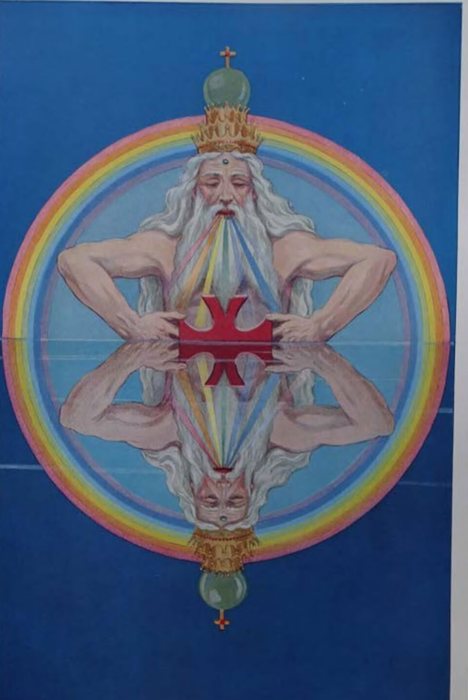
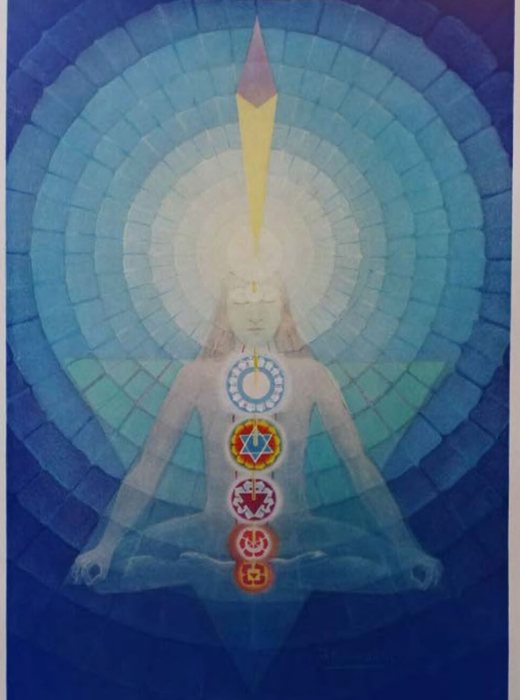
This is in the picture without being what it is about. Below, one work that is about it.
In the same series
Record
One symbol a week, decoded.
This picture is free at full size from its source, linked above. What an address gets is the Sunday letter: one picture, one symbol marked on it, what it meant and who said so, and the master files of the decoded plates as they are verified. Leave any time.
Free, one letter a week, unsubscribe in one click. How the address is used.
Scroll or pinch to zoom · drag to move · double-tap for 1:1 · 1113 by 938 pixel web copy; the source file is linked under Record