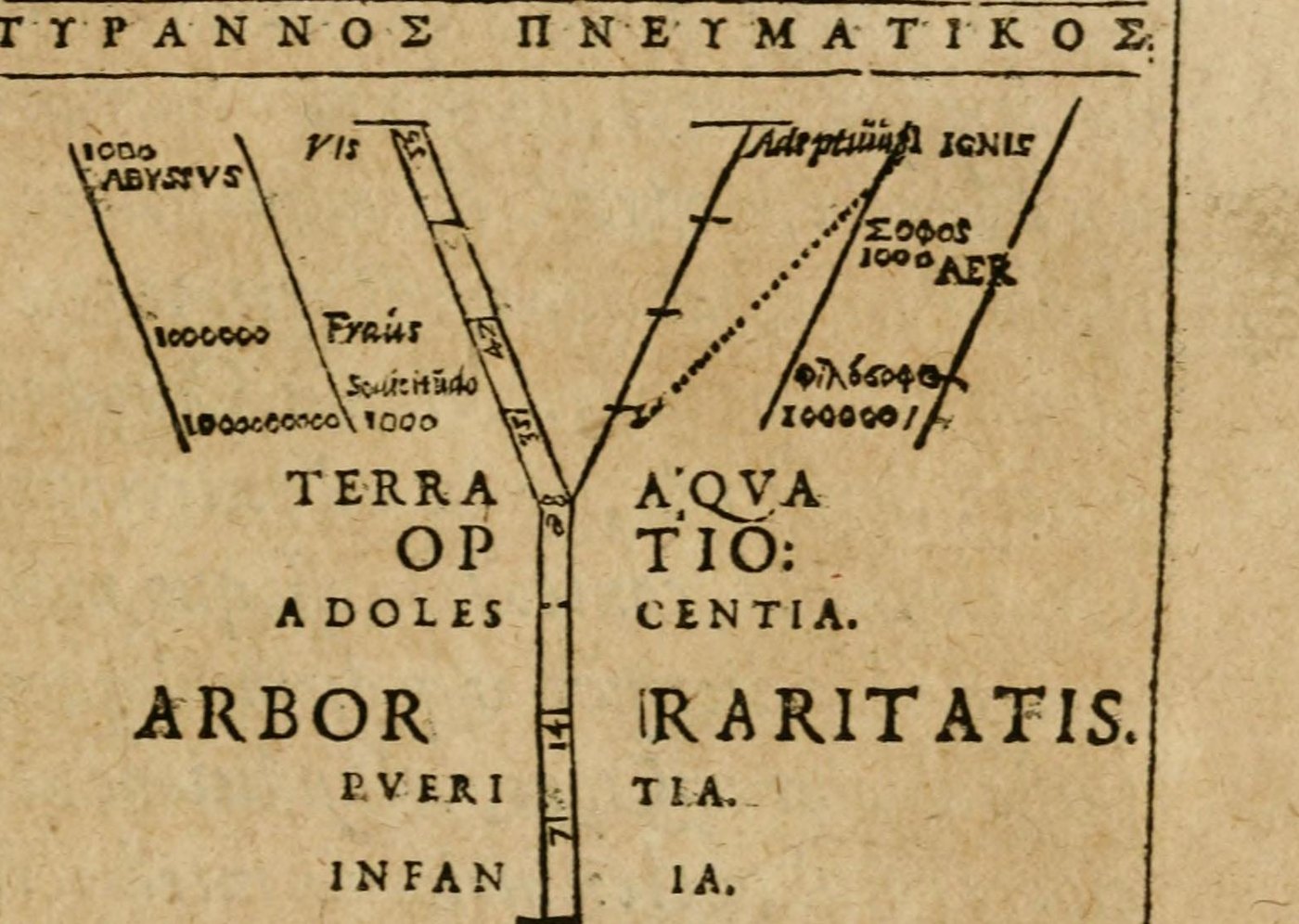
Arbor Raritatis
The Tree as the central motif. From Monas Hieroglyphica.
What is happening
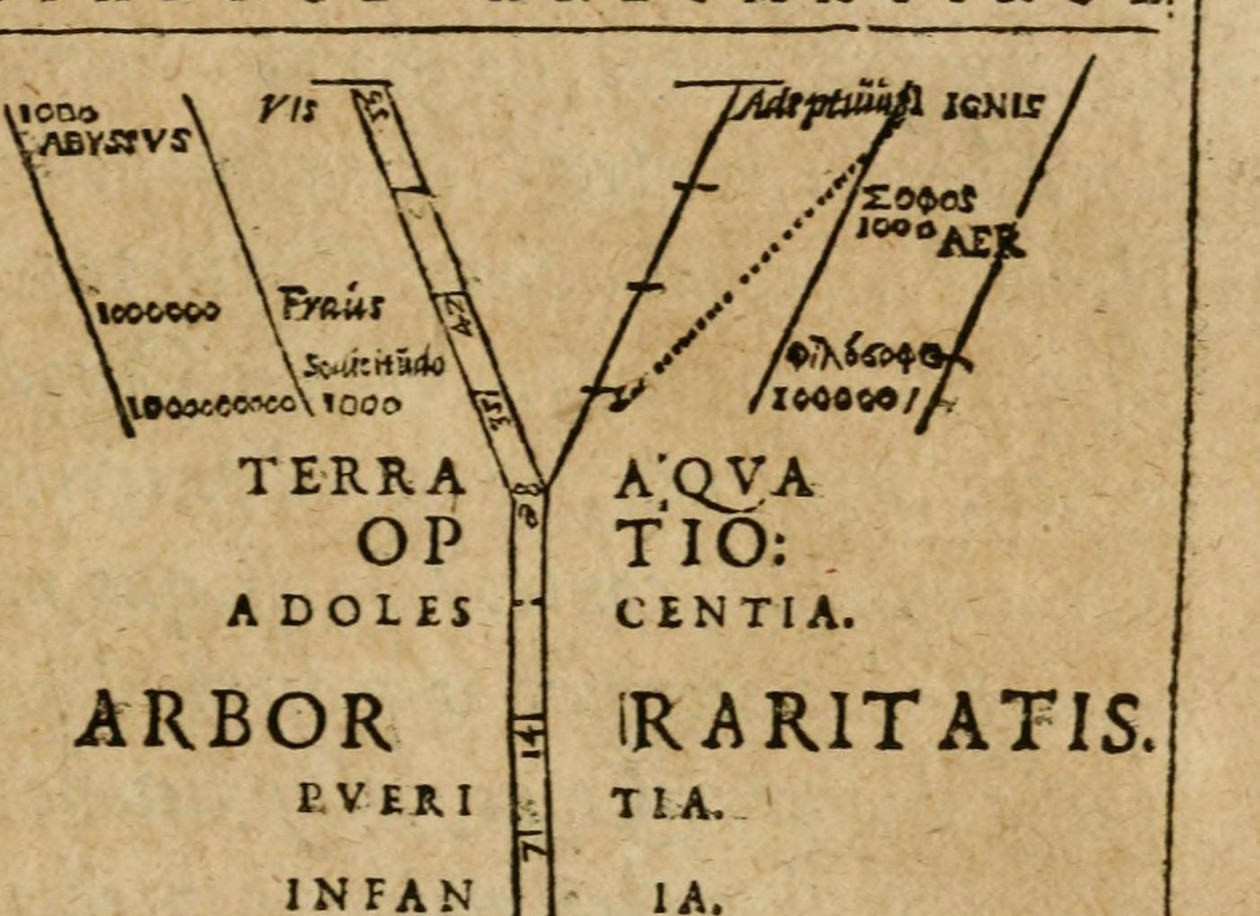
Symbolica, 2026 Dee's Latin, put into English here: The Tree of Rarity, and above it, Mysteries, described in this way from our Cosmopolitical Theories. The trunk is lettered Infantia, Pueritia, Adolescentia and Optio, the ages of a life up to the age of choice, where it forks into Terra and Aqua, earth and water, with the Greek words for the spiritual tyrant at the top. The figure is in the letter to the Emperor, before the theorems begin. Read again at the size of the archive's image: the trunk is lettered Infancy, Boyhood, Adolescence, Choice; at the fork Earth and Water; up the earth branch Abyss, Fraud, Care, Force, with numbers in the thousands and millions beside them; up the water branch the Philosopher, the Wise Man, the Adept, with Air and Fire beside the last two and the numbers thinning as they climb; and along the top, in Greek, the spiritual tyrant.
Key · 1 motif
Tap a motif on the picture, or a line below. Its note opens under the line, with the reading its author gave it.
- Primary motif
The picture
A tree drawn as a forked line and lettered, its trunk the ages of a life from infancy to choice, its two branches earth and water, the numbers of the rare set along them. By eye
The reading
The picture read whole, in the archive's words, from the sources quoted on the marks. Read on, and the picture follows: the motif under discussion keeps its colour.
‘Arbor Raritatis’, the tree of rarity. It stands in Dee's letter to the Emperor Maximilian before the theorems begin, headed ‘Mysteria: ex nostris hoc modo descripta Cosmopoliticis Theoriis’, mysteries described in this way from our cosmopolitical theories, and it is a tree only in the sense that it forks.
The trunk is a life, lettered from the root up ‘Infantia. Pueritia. Adolescentia. Optio.’: infancy, boyhood, adolescence, and then choice, at the fork. The two branches are the choice. ‘Terra. Aqua.’ stand at their roots, earth to the left and water to the right. Up the branch of earth climb ‘Abyssus. Fraus. Sollicitudo. Vis.’, abyss, fraud, care and force, with numbers beside them that run to a thousand million: this is where almost everyone goes. Up the branch of water climb ‘Philosophos. Sophos. Adeptivus.’, the philosopher, the wise man, the adept, in Greek and Latin, with air and then fire lettered beside the last two and the numbers dwindling as they rise. Along the top of the whole figure runs the Greek ‘Tyrannos pneumatikos’, the spiritual tyrant, over both branches.
The tree is rare because its good side is nearly bare. Dee counts the adepts in single figures and the deceived in millions, and draws the count as a plant, which is the one form that makes the two branches equal in length whatever their numbers. It is the only figure in the Monas that is about people rather than the sign, and it is placed before the sign is explained, as a warning about who will read the rest.
Decoded: every motif is marked, and each mark carries the reading its author gave it, quoted from the text, or says that it is observed on the picture and not read. The reading above is the archive's own, made from those sources and no others.
A body drawn as growth. Note which way it grows and what is at the root rather than at the top.
In plain words A tree drawn as a diagram: a straight trunk that is a life, infancy at the root and choice at the fork, and two branches that are what the choice is between. Up the branch of earth go abyss, fraud, care and force, with numbers in the millions; up the branch of water go the philosopher, the wise man and the adept, with the numbers shrinking to a few. Dee calls it the tree of rarity because the good branch is the empty one.
John Dee, 1564 “Arbor Raritatis.”
John Dee, 1564 “Mysteria: ex nostris hoc modo descripta Cosmopoliticis Theoriis.”
John Dee, 1564 “Infantia. Pueritia. Adolescentia. Optio.”
John Dee, 1564 “Terra. Aqua.”
John Dee, 1564 “Abyssus. Fraus. Sollicitudo. Vis.”
John Dee, 1564 “Philosophos. Sophos. Adeptivus.”
John Dee, 1564 “Tyrannos pneumatikos.”
Symbolica Dee's Latin and Greek, put into English here: the Tree of Rarity; mysteries described in this way from our cosmopolitical theories; infancy, boyhood, adolescence, choice; earth, water; abyss, fraud, care, force; the philosopher, the wise man, the adept; the spiritual tyrant.
Also carrying the Tree
23 works carry it. The 6 where it is the central motif are here. The symbol.
In the same series
Record
One symbol a week, decoded.
This picture is free at full size from its source, linked above. What an address gets is the Sunday letter: one picture, one symbol marked on it, what it meant and who said so, and the master files of the decoded plates as they are verified. Leave any time.
Free, one letter a week, unsubscribe in one click. How the address is used.
Scroll or pinch to zoom · drag to move · double-tap for 1:1 · 1400 by 996 pixel web copy; the source file is linked under Record