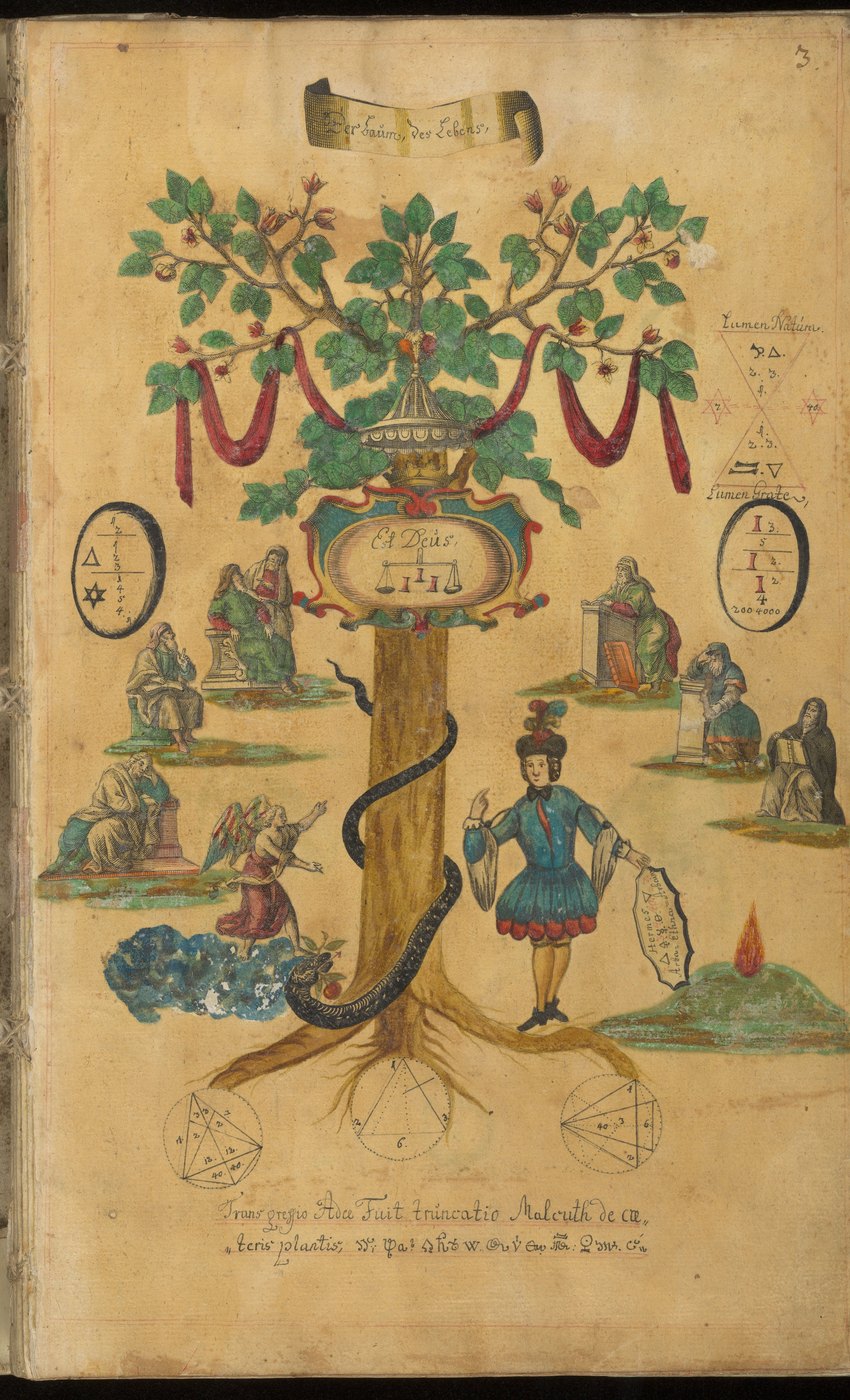
Der Baum des Lebens, the Tree of Life
The tree of life as the central motif, filed under the Tree, with the Serpent and the Dragon, the Angel and the Wing, Fire, and the Triangle and the Pyramid in a secondary part. From Gemma Sapientiae et Prudentiae, c. 1735.
What is happening
Symbolica, 2026 The manuscript's German, put into English here: The tree of life.
Symbolica, 2026 The manuscript's Latin, put into English here: Adam's transgression was the cutting of Malkuth from the other plants.
Wellcome Collection, 2026 “The MS. contains a remarkable mixture of transcendental alchemy, Cabbalistic speculations, and religious controversies. It ends with a chapter on Biblical prophecies and the Apocalypse.”
Key · 5 motifs
Tap a motif on the picture, or a line below. Its note opens under the line, with the reading its author gave it.
- Primary motif
- Secondary motifs · 4
The picture
A hand-coloured page: a flowering tree under a banner Der Baum des Lebens, a crowned vessel in its branches and red ribbons hanging from them, a cartouche Est Deus with scales on the trunk, a serpent coiled down the trunk with a fruit in its mouth, an angel on a cloud at the left and a gentleman in blue holding a paper headed Hermes at the right with a fire on a hill behind him, six sages seated round with books, two triangles lettered Lumen Naturae and Lumen Gratiae in the margin, and a Latin line at the foot on Adam's transgression; the tree of life as the central motif. By eye
The reading
The picture read whole, in the archive's words, from the sources quoted on the marks. Read on, and the picture follows: the motif under discussion keeps its colour.
The first figure in the manuscript is the tree of life, and the writer surrounds it with a company. Six sages in robes sit on the grass with their books, an angel stands on a cloud at the left, a gentleman in the blue coat of the 1730s stands at the right holding up a paper headed Hermes, and a fire burns on the hill behind him. The tree flowers, red ribbons hang from its branches, a crowned vessel stands among the leaves, and a cartouche on the trunk says Est Deus, God is, over a pair of scales. It is a picture of the tree being read, by everyone who ever read it.
The tree is Eden's, and it is also the Cabalists'. The Latin line at the foot of the page, in a careful hand, says: Transgressio Adae fuit truncatio Malcuth de caeteris plantis, Adam's transgression was the cutting of Malkuth from the other plants. Malkuth is the tenth and lowest sephira, the Kingdom, our world; the plants are the sephiroth as a garden; and the sentence is the doctrine Kircher had explained in Latin in 1653, that Adam's sin lopped the lower part of the tree and left it to wither. A German Protestant of the 1730s knew that teaching well enough to letter it under a picture, and then to add a line in a cipher alphabet that the archive has not read.
The serpent is where Genesis puts it, wound round the trunk, head down at the roots with a red fruit in its mouth. On the next page, the tree of knowledge, the same writer moves it into a dark triangle at the bottom. Here, on the tree of life, it is the thing that did the cutting, and it is drawn at the exact point where the Latin says the cut was made.
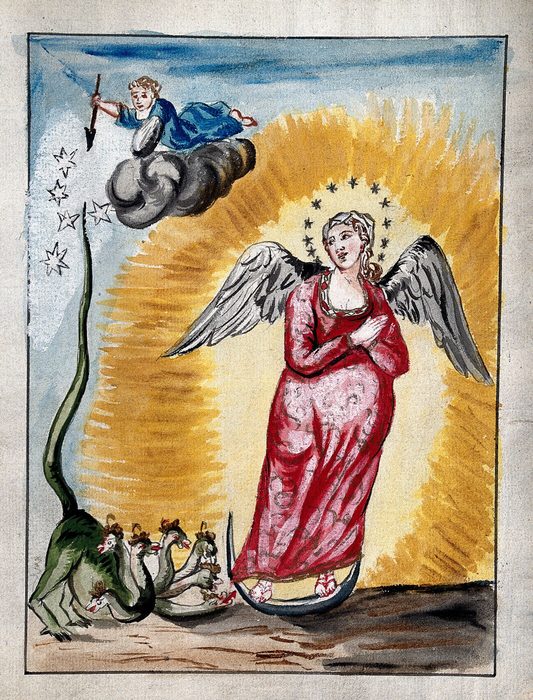
The angel at the left raises both arms across the trunk towards the serpent; it stands on a blue cloud, the only figure not on the ground. Angel, serpent, alchemist, philosophers: the page assembles every kind of reader the tree has had. The sages sit in the postures of Old Testament prophets in a Baroque Bible, with open books.
The fire on the hill belongs to the gentleman with the Hermes paper. He is the alchemist, dressed as a man of the writer's own day, and the fire is his furnace. In the margin above him the writer drew two triangles point to point and lettered them Lumen Naturae and Lumen Gratiae, the light of nature and the light of grace. The fire is what the light of nature looks like when a man works by it.
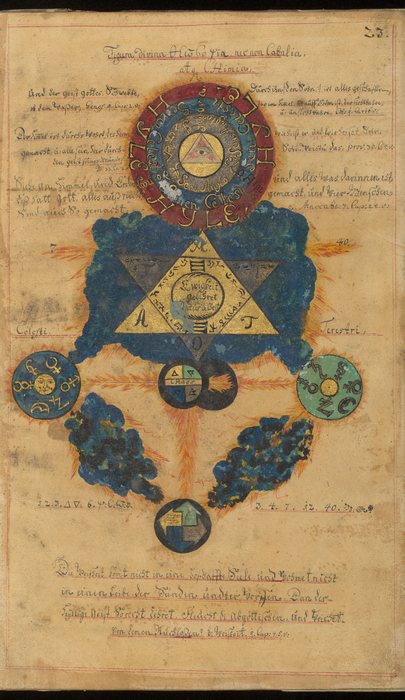
Those two lights are the key to the whole manuscript. The light of nature is what the alchemist and the physician read in the world; the light of grace is what the believer reads in Scripture. The Rosicrucian writers held that they were one light from one source, and the writer draws the two triangles touching at their points, with numbers and the signs of the elements written in them. At the left, in an oval, a triangle and a six-pointed star with the numbers one to four: the same claim in arithmetic.
Decoded: every motif is marked, and each mark carries the reading its author gave it, quoted from the text, or says that it is observed on the picture and not read. The reading above is the archive's own, made from those sources and no others.
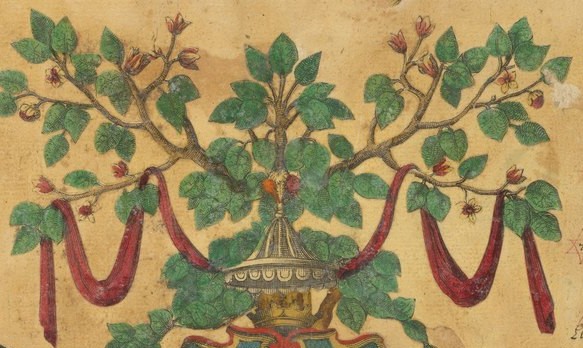
A body drawn as growth. Note which way it grows and what is at the root rather than at the top.
In plain words The banner names it the tree of life. A vessel with a crown stands in the branches, red ribbons hang from them, and on the trunk a cartouche says Est Deus, God is, over a pair of scales. Under everything, in Latin, the writer states the doctrine the two tree pages share: Adam's sin cut Malkuth, the lowest of the ten sephiroth, off from the rest of the tree.
The manuscript, c. 1735 “Der Baum des Lebens.”
Symbolica, 2026 The manuscript's German, put into English here: The tree of life.
The manuscript, c. 1735 “Est Deus.”
Symbolica, 2026 The manuscript's Latin, put into English here: God is.
The manuscript, c. 1735 “Transgressio Adae fuit truncatio Malcuth de caeteris plantis.”
Symbolica, 2026 The manuscript's Latin, put into English here: Adam's transgression was the cutting of Malkuth from the other plants.
Athanasius Kircher, 1653 “Quandocunque itaque ramus ex hac mystica arbore rescinditur, influxus in proximè inferiorem negari dicitur, plantaque truncari; si septem inferiores truncentur, quod in peccato Adae factum est, tum tota arbor maledicto subiecta, omni influxu vegetatiuo priuata contabescere dicitur.”
Symbolica, 2026 Kircher's Latin, put into English here: Whenever a branch is cut from this mystical tree, the influx is said to be denied to the one next below it, and the plant to be lopped; if the seven lower ones are lopped, which is what happened in the sin of Adam, then the whole tree, put under a curse and deprived of every quickening influx, is said to wither.
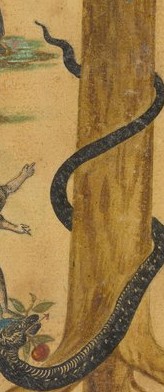
A single creature doing two opposite jobs. Note whether it is bound, killed, or eating itself.
In plain words The serpent winds round the trunk of the tree of life and holds a red fruit in its mouth at the bottom. This is the serpent of Eden where Genesis puts it, on the tree; the facing page files it elsewhere. The Latin line at the foot says what it did: it cut the kingdom off from the tree.
The manuscript, c. 1735 “Transgressio Adae fuit truncatio Malcuth de caeteris plantis.”
Symbolica, 2026 The manuscript's Latin, put into English here: Adam's transgression was the cutting of Malkuth from the other plants.
The manuscript, c. 1735 “Der Baum des Lebens.”
Symbolica, 2026 The manuscript's German, put into English here: The tree of life.
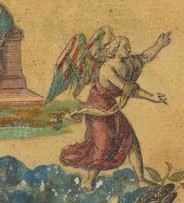
The mark of an errand rather than a nature. Note whether the wings are open, folded, or given to the figure by someone else.
In plain words An angel stands on a cloud at the left with arms raised, facing the serpent across the trunk. On the right a gentleman in the blue coat and breeches of the 1730s holds up a paper headed Hermes and a fire burns on a hill behind him. Angel, serpent, alchemist: the cast of the page, standing round the tree like the sages seated behind them.
The manuscript, c. 1735 “Est Deus.”
Symbolica, 2026 The manuscript's Latin, put into English here: God is.
The manuscript, c. 1735 “Der Baum des Lebens.”
Symbolica, 2026 The manuscript's German, put into English here: The tree of life.
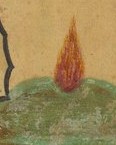
A count, a catastrophe, or the visible part of something that has no body. Note whether the flames are arranged in a number, breaking something, or standing where a figure would be.
In plain words A fire burns on the hill at the right, behind the gentleman with the paper headed Hermes. It is the alchemist's fire, and it sits under the diagrams of the light of nature. The tree of life is being read here by the furnace as well as by the Bible.
The manuscript, c. 1735 “Lumen Naturae. Lumen Gratiae.”
Symbolica, 2026 The manuscript's Latin, put into English here: The light of nature. The light of grace.
The manuscript, c. 1735 “Der Baum des Lebens.”
Symbolica, 2026 The manuscript's German, put into English here: The tree of life.
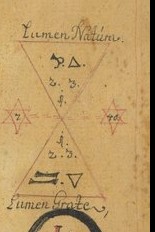
A number made visible. Count the points and then find what else in the picture comes in threes.
In plain words Two lights, the writer says at the right of the tree: the light of nature and the light of grace, drawn as two triangles set point to point, one for the world the alchemist reads and one for the Scripture the believer reads. The Rosicrucian claim was that they are one light, and the page draws them touching.
The manuscript, c. 1735 “Lumen Naturae. Lumen Gratiae.”
Symbolica, 2026 The manuscript's Latin, put into English here: The light of nature. The light of grace.
The manuscript, c. 1735 “Est Deus.”
Symbolica, 2026 The manuscript's Latin, put into English here: God is.
Also carrying the Tree
23 works carry it. The 6 where it is the central motif are here. The symbol.
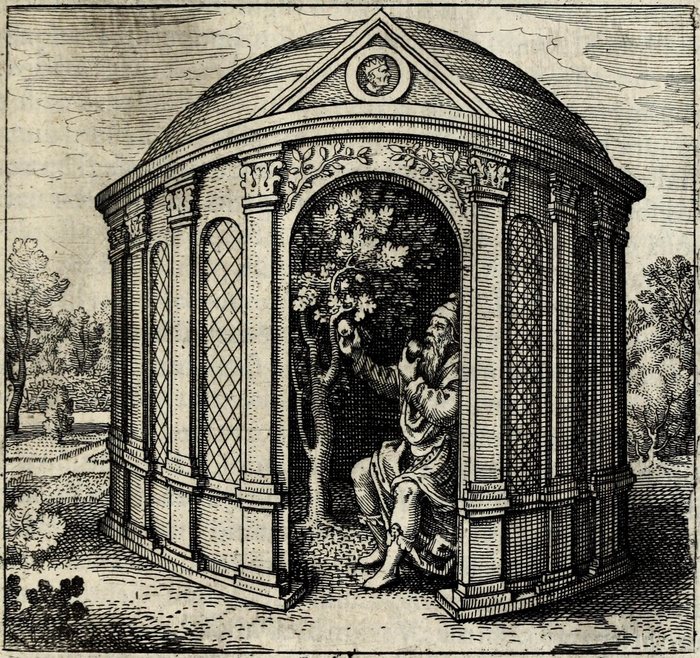
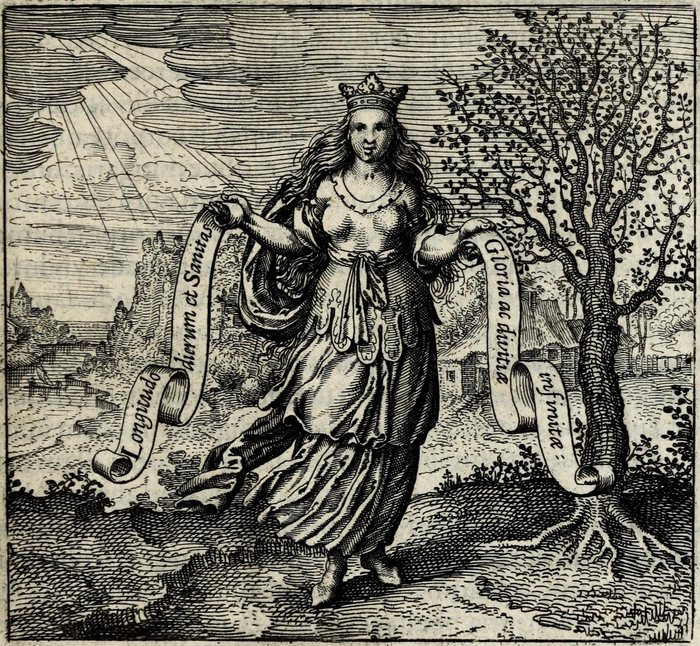
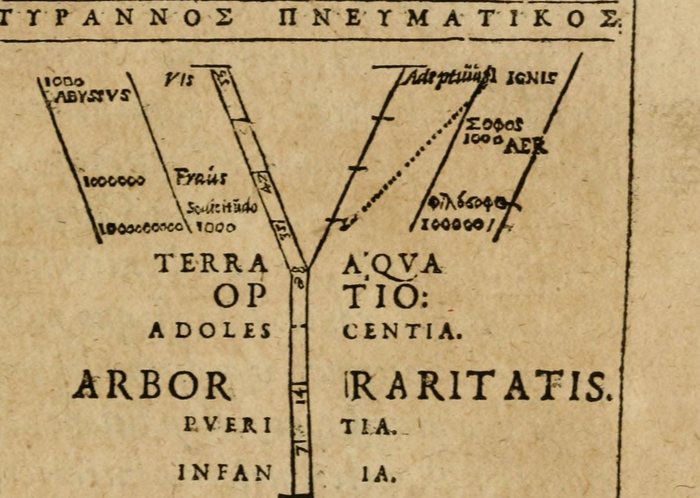
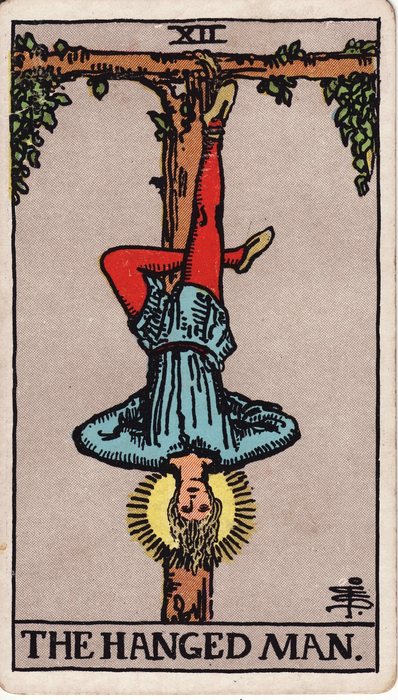
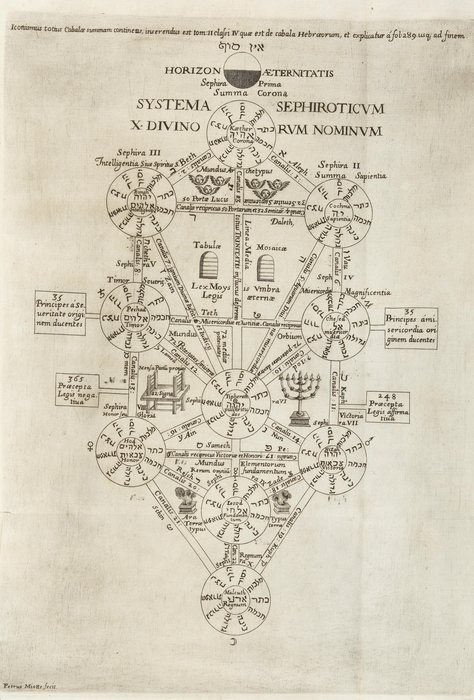
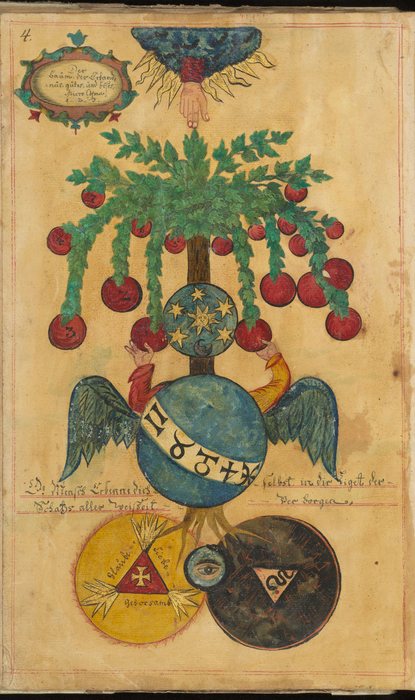
Where the detail is the subject
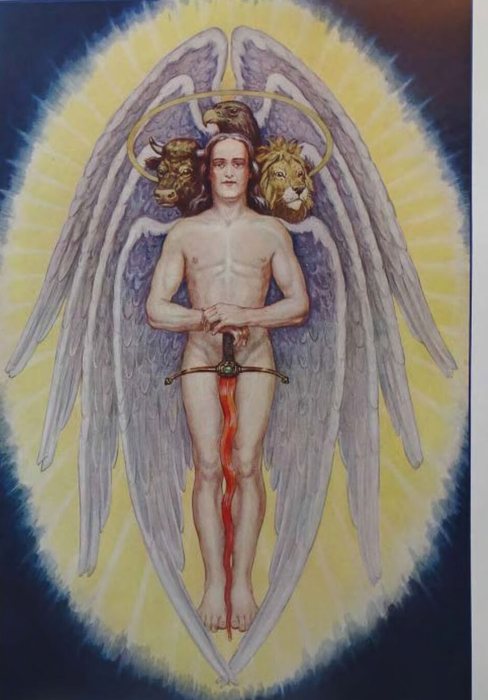
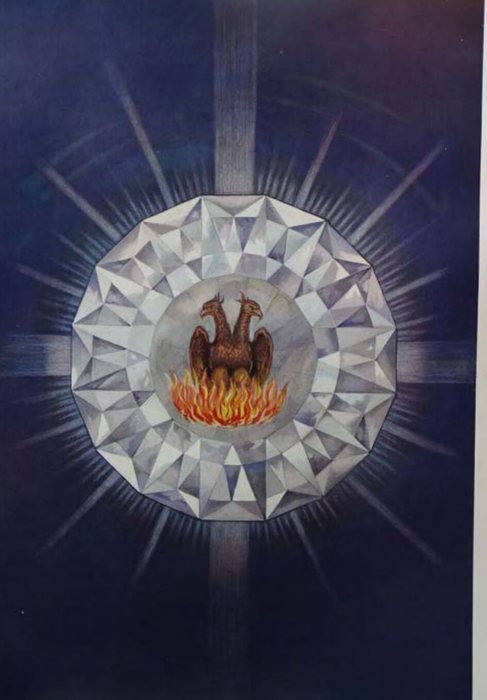
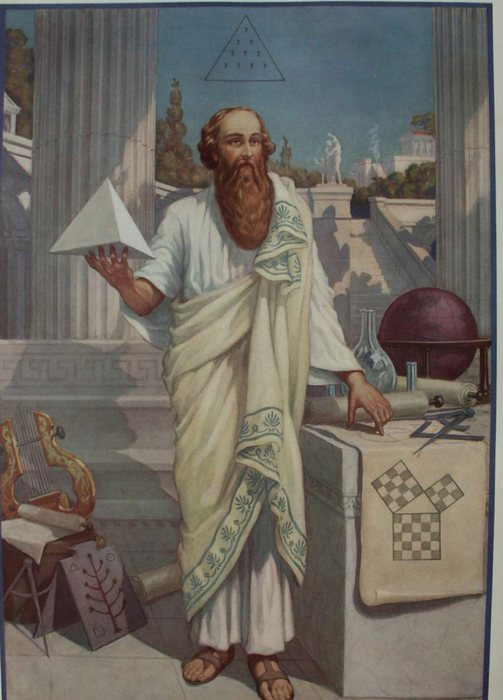
the Serpent and the Dragon · the Angel and the Wing · Fire · the Triangle and the Pyramid
Each of these is in the picture without being what it is about. Below, one work that is about each.
In the same series
Record
One symbol a week, decoded.
This picture is free at full size from its source, linked above. What an address gets is the Sunday letter: one picture, one symbol marked on it, what it meant and who said so, and the master files of the decoded plates as they are verified. Leave any time.
Free, one letter a week, unsubscribe in one click. How the address is used.
Scroll or pinch to zoom · drag to move · double-tap for 1:1 · 850 by 1400 pixel web copy; the source file is linked under Record