Christus 3. 6., the Star and the Book of Numbers
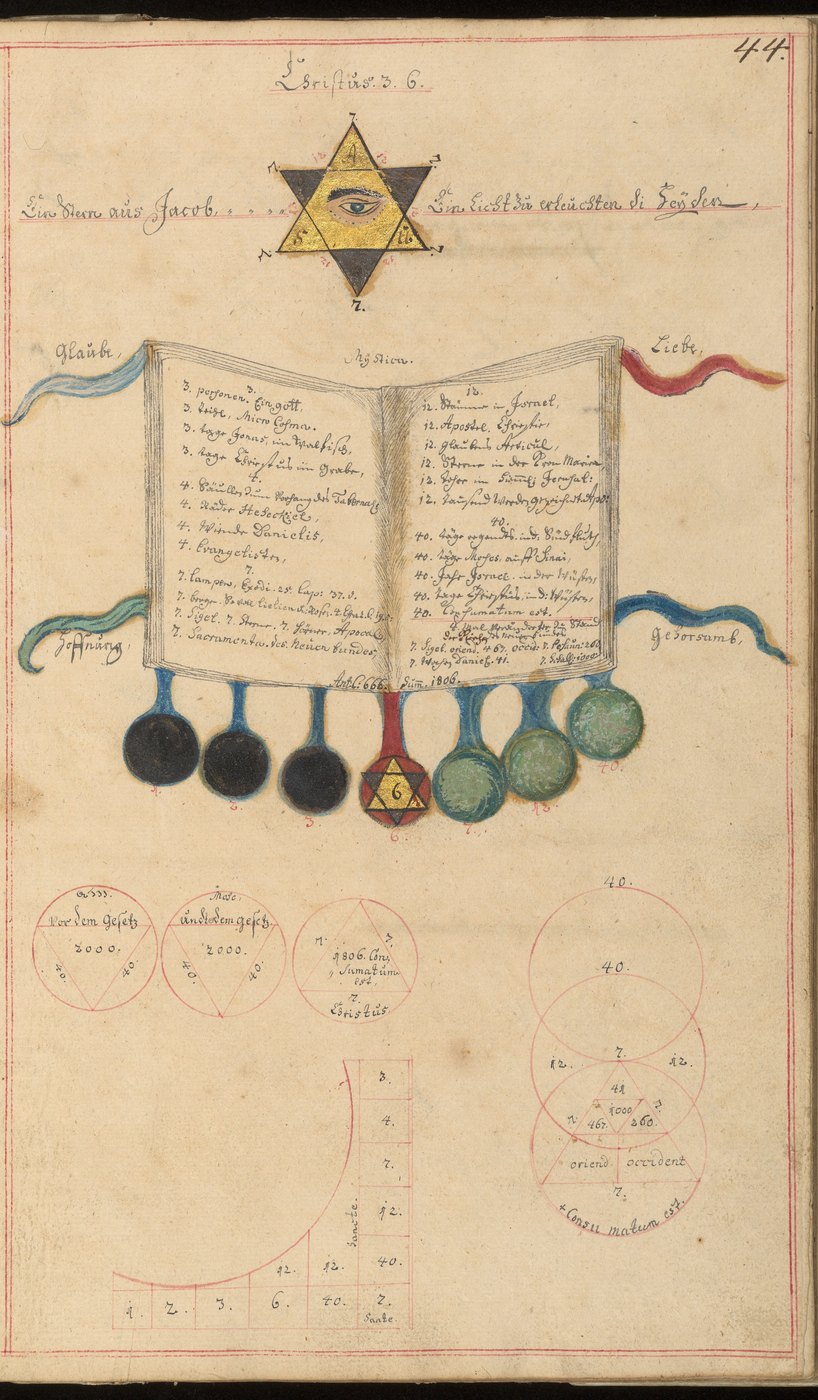
The star with the eye as the central motif, filed under the Triangle and the Pyramid, with the Eye in a secondary part. From Gemma Sapientiae et Prudentiae, c. 1735.
What is happening
The manuscript, c. 1735 “3 Personen, ein Gott. 3 Theile Microcosma. 3 Tage Jonas im Walfisch. 3 Tage Christus im Grabe. 4 Säulen zum Vorhang des Tabernacels. 4 Räder Hesechiel. 4 Winde Danielis. 4 Evangelisten. 7 Lampen, Exodi 25. Cap. 37. v. 7 Berge voll Lilien und Rosen, 4. Esra. 7 Sigel, 7 Sterne, 7 Hörner, Apocal. 7 Sacramenta des Neuen Bundes.”
Symbolica, 2026 The manuscript's German, put into English here: 3 persons, one God. 3 parts of the microcosm. 3 days Jonah in the whale. 3 days Christ in the grave. 4 pillars for the veil of the tabernacle. 4 wheels of Ezekiel. 4 winds of Daniel. 4 Evangelists. 7 lamps, Exodus 25, verse 37. 7 mountains full of lilies and roses, 4 Esdras. 7 seals, 7 stars, 7 horns, Apocalypse. 7 sacraments of the New Covenant.
The manuscript, c. 1735 “12 Stämme in Israel. 12 Apostel Christi. 12 Glaubens Articul. 12 Sterne in der Cron Mariae. 12 Thore im himmlischen Jerusalem. 12 tausend werden gezeichnet, Apoc. 40 Tage regnets in der Sündfluth. 40 Tage Moses auff Sinai. 40 Jahr Israel in der Wüsten. 40 Tage Christus in der Wüsten. 40. Consummatum est.”
Symbolica, 2026 The manuscript's German, put into English here: 12 tribes in Israel. 12 apostles of Christ. 12 articles of faith. 12 stars in the crown of Mary. 12 gates in the heavenly Jerusalem. 12 thousand are sealed, Apocalypse. 40 days it rains in the Flood. 40 days Moses on Sinai. 40 years Israel in the wilderness. 40 days Christ in the wilderness. 40. It is finished.
Wellcome Collection, 2026 “The MS. contains a remarkable mixture of transcendental alchemy, Cabbalistic speculations, and religious controversies. It ends with a chapter on Biblical prophecies and the Apocalypse.”
Key · 2 motifs
Tap a motif on the picture, or a line below. Its note opens under the line, with the reading its author gave it.
- Primary motif
- Secondary motifs · 1
The picture
A hand-coloured page: a six-pointed star of gold and black with an eye at its centre, a 7 at each point, under the heading Christus 3. 6. and between the words Ein Stern aus Jacob and Ein Licht zu erleuchten die Heyden; below it an open book lettered Mystica listing the threes, fours, sevens, twelves and forties of Scripture, with ribbons lettered Glaube, Liebe, Hoffnung, Gehorsamb at its corners and seven medallions hanging from it, three black, one red with a star and a 6, three green; below, circles in red ink counting the ages of the world; the star with the eye as the central motif. By eye
The reading
The picture read whole, in the archive's words, from the sources quoted on the marks. Read on, and the picture follows: the motif under discussion keeps its colour.
This page is a key, and it says so: the open book at its centre is lettered Mystica. Above it a six-pointed star of gold and black with an eye at its heart, under the heading Christus 3. 6., and either side of it the two prophecies of a light in the sky, Balaam's star out of Jacob and Simeon's light to lighten the Gentiles. The star is Christ, the eye is Christ seeing, and the numbers are how the writer proposes to read the Bible.
At the centre sits the same eye the writer painted in the triangle on his page of the Godhead, and here it is set in a star instead. That change is the point. The triangle was God in himself; the star, made of two triangles, is God joined to the world, and its name on this page is Christ.
The writer counts his star. A 7 stands at each of the six points and 12 runs along the edges, and the heading gives Christ the numbers 3 and 6: three for the Trinity, six for the points of the star that two triangles make. Then the book opens and the counting begins in earnest. Three persons, one God; three days Jonah in the whale, three days Christ in the grave. Four pillars of the tabernacle, four wheels of Ezekiel, four winds of Daniel, four Evangelists. Seven lamps, seven mountains of roses and lilies from the fourth book of Esdras, seven seals, seven stars, seven horns from the Apocalypse, seven sacraments. Twelve tribes, twelve apostles, twelve articles of faith, twelve stars in Mary's crown, twelve gates of the heavenly Jerusalem. Forty days of rain, forty days of Moses on Sinai, forty years in the wilderness, forty days of Christ in the wilderness. Consummatum est.
Four ribbons hang from the book, lettered faith, love, hope and obedience, and under it hang seven medallions on stalks, three black, one red with a star and a 6, three green. Below them, in red ink, the writer draws circles and sums: two thousand years before the law, two thousand under the law, and a figure of 1806 that he writes twice and labels with the last words of Christ. The Wellcome's catalogue notes that the manuscript ends with a chapter on the prophecies and the Apocalypse; this is where the arithmetic of that chapter is drawn. A reader in 1735 was being told, with a star and a ledger, that the world had a shape in time as well as in space, and that the numbers of Scripture were its measurements. The archive files the page without endorsing the sum.
Decoded: every motif is marked, and each mark carries the reading its author gave it, quoted from the text, or says that it is observed on the picture and not read. The reading above is the archive's own, made from those sources and no others.
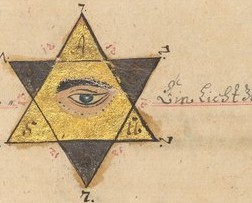
Guidance from something that does not move. Count the points before reading it: five, six and eight are all here, and no source treats them as one sign.
In plain words The star is two triangles, gold pointing up and black pointing down, and the writer has counted it: a 7 at each of the six points, 12 along the edges. Christ is 3 and 6, the heading says, three for the Trinity and six for the star's points. The whole page below is a book of such numbers.
The manuscript, c. 1735 “Christus. 3. 6.”
The manuscript, c. 1735 “Ein Stern aus Jacob. Ein Licht zu erleuchten die Heyden.”
Symbolica, 2026 The manuscript's German, put into English here: A star out of Jacob. A light to lighten the Gentiles.
The manuscript, c. 1735 “Glaube. Liebe. Hoffnung. Gehorsamb.”
Symbolica, 2026 The manuscript's German, put into English here: Faith. Love. Hope. Obedience.
Attention from outside the frame. Note it is almost always placed at a boundary rather than at the centre.
In plain words An eye looks out of the middle of the star, and the heading over it says whose: Christus, with the numbers 3 and 6. Either side the writer wrote the two prophecies of a light in the sky, a star out of Jacob, a light to lighten the Gentiles. The eye in the star is Christ as the light that sees.
The manuscript, c. 1735 “Christus. 3. 6.”
The manuscript, c. 1735 “Ein Stern aus Jacob. Ein Licht zu erleuchten die Heyden.”
Symbolica, 2026 The manuscript's German, put into English here: A star out of Jacob. A light to lighten the Gentiles. The first is Balaam's prophecy in Numbers 24, the second Simeon's in Luke 2.
Also carrying the Triangle and the Pyramid
25 works carry it. The 5 where it is the central motif are here. The symbol.
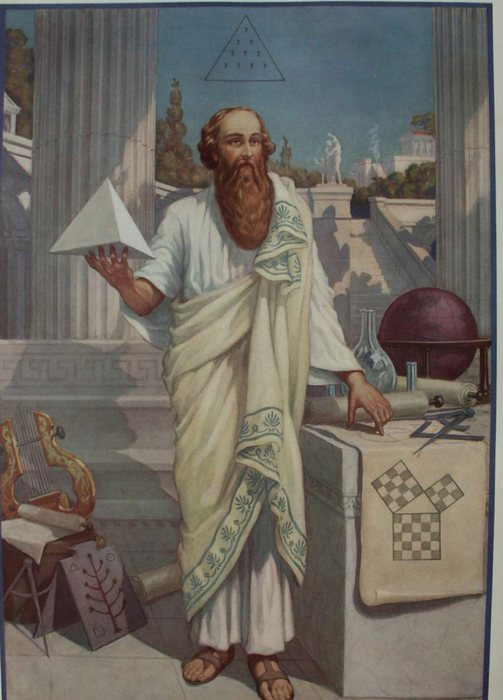
Where the detail is the subject
This is in the picture without being what it is about. Below, one work that is about it.
In the same series
Record
One symbol a week, decoded.
This picture is free at full size from its source, linked above. What an address gets is the Sunday letter: one picture, one symbol marked on it, what it meant and who said so, and the master files of the decoded plates as they are verified. Leave any time.
Free, one letter a week, unsubscribe in one click. How the address is used.
Scroll or pinch to zoom · drag to move · double-tap for 1:1 · 818 by 1400 pixel web copy; the source file is linked under Record