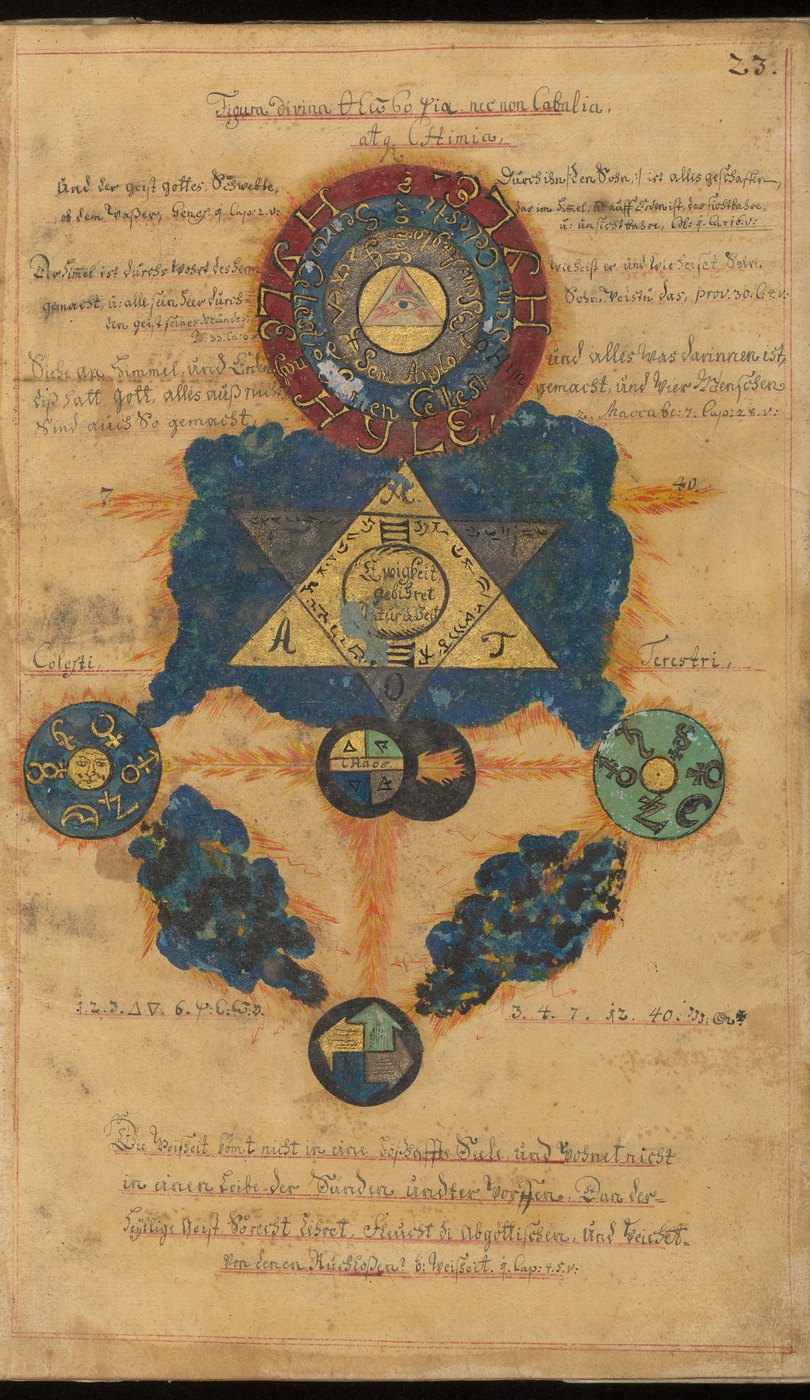
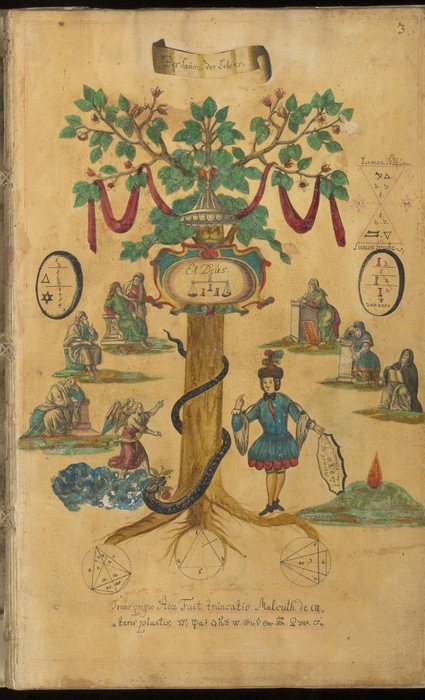
Figura Divina: Theosophia, Cabalia, Chimia
The divine figure as the central motif, filed under the Divine, with the Eye, the Triangle and the Pyramid, the Heavens, and Fire in a secondary part. From Gemma Sapientiae et Prudentiae, c. 1735.
What is happening
Symbolica, 2026 The manuscript's Latin, put into English here: The divine figure: theosophy, and cabala too, and chemistry.
Wellcome Collection, 2026 “p. 23. Divina Theosophia = Geh. Fig., fol. 32.”
Wellcome Collection, 2026 “Four of the illustrations have considerable likenesses to those in the 'Geheime Figuren der Rosenkreuzer', originally published at Altona in 1785-1788.”
Wellcome Collection, 2026 “The MS. contains a remarkable mixture of transcendental alchemy, Cabbalistic speculations, and religious controversies. It ends with a chapter on Biblical prophecies and the Apocalypse.”
Key · 5 motifs
Tap a motif on the picture, or a line below. Its note opens under the line, with the reading its author gave it.
- Primary motif
- Secondary motifs · 4
The picture
A hand-coloured page: at the top a ring of red and blue with gold letters, an eye in a triangle on a gold disc at its centre and six Bible verses in German written round it; below it a six-pointed star of gold and black on a blue cloud edged with fire, lettered Ewigkeit gebihret Natur und Zeit; two circles of the planets' signs either side of a quartered circle lettered Chaos; a verse from the Book of Wisdom along the foot; the divine figure as the central motif. By eye
The reading
The picture read whole, in the archive's words, from the sources quoted on the marks. Read on, and the picture follows: the motif under discussion keeps its colour.
The writer of this manuscript gave the page a title in three languages: Figura divina, the divine figure, and then in Greek letters Theosophia, and then nec non Cabalia, atque Chimia, cabala too, and chemistry. That is the whole programme of the Rosicrucian manuscripts of the early eighteenth century in one line. God, the Jewish doctrine of emanations and the work of the furnace are to be read as a single figure, and this is the figure. Fifty years later the same design, redrawn, was engraved for the Geheime Figuren der Rosenkreuzer at Altona; the Wellcome's catalogue matches this page to folio 32 of that book.
At the top is God, and the writer will not draw him. There is a ring, red outside and blue within, lettered in gold, and round it six verses copied out in German with their references, the way a preacher notes his texts. The Spirit of God moved upon the water. The heaven is made by the word of the Lord. Through him, the Son, everything visible and invisible was made. Three verses for three persons, and the ring holds all three. Along its lower edge the gold letters spell HYLE, matter, in Greek: the Godhead drawn as a wheel resting on the stuff it made.
In the middle of the ring is the one image the writer allowed: an eye in a triangle on a disc of gold. It is the eye of God, and the triangle is the Trinity, the same device that appears on churches and on the American dollar. Beside it stands the riddle from Proverbs, what is his name, and what is his son's name? The picture's answer is geometry.
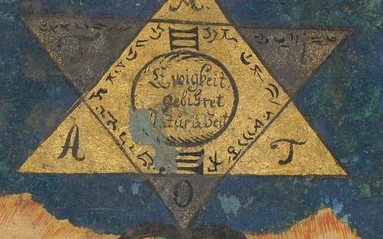
Below the ring, on a blue cloud edged with fire, hangs a six-pointed star, a gold triangle pointing up over a dark one pointing down, with a medallion at the crossing: Ewigkeit gebihret Natur und Zeit, eternity begets nature and time. That sentence is the hinge of the page. Above it everything is eternal; below it nature and time begin, and the world splits into the heavenly, coelesti, on the left and the earthly, terrestri, on the right.
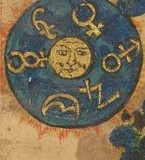
The two halves are drawn as two circles of the planets' signs. In the blue circle the signs are gold round a sun with a face: the planets as they are in heaven. In the green circle the same seven signs are black round a disc of gold leaf: the planets as they are in the earth, which is to say the seven metals. Nothing in alchemy was more basic than this doubling, and the writer states it with two circles and no words.
Between them is Chaos, named in ink, a circle quartered into the four elements with a second, dark circle behind it and fire tearing out of the dark. Further down four arrows in four colours chase one another round a ring, the elements in motion, and then the writer's last text, from the Book of Wisdom: Wisdom does not enter a malicious soul. The page has moved from God to matter to a warning. The figure is not to be read by everyone, it says, and the reader who has followed it this far has been told why.
Decoded: every motif is marked, and each mark carries the reading its author gave it, quoted from the text, or says that it is observed on the picture and not read. The reading above is the archive's own, made from those sources and no others.
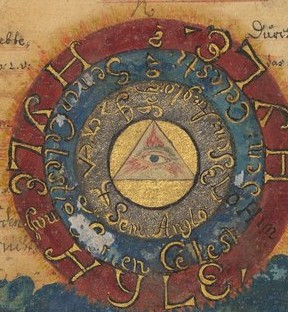
God shown, or pointed at. Look for what stands where a face would be: a name in a cloud, a circle above the top of a diagram, a ring of verses, a sign over a head.
In plain words The ring is the Godhead, and the writer has copied six verses round it to say so: the Spirit that moved on the waters, the Word that made the heavens, the Son through whom everything visible and invisible was made. The gold letters along the bottom of the ring spell HYLE, the Greek word for matter. The whole ring stands on a cloud of it.
The manuscript, c. 1735 “Figura divina ΘΕΩΣΟΦΙΑ, nec non Cabalia, atque Chimia.”
Symbolica, 2026 The manuscript's Latin, put into English here: The divine figure: theosophy, and cabala too, and chemistry.
The manuscript, c. 1735 “Und der Geist Gottes schwebte ob dem Wasser. Genes. 1. Cap. 2. v.”
Symbolica, 2026 The manuscript's German, put into English here: And the Spirit of God moved upon the water. Genesis 1, verse 2.
The manuscript, c. 1735 “Durch ihn, den Sohn, ist alles geschaffen, das im Himel und auff Erden ist, das sichtbahre und unsichtbahre. Col. 1. Ca. 16. v.”
Symbolica, 2026 The manuscript's German, put into English here: Through him, the Son, everything is created that is in heaven and on earth, the visible and the invisible. Colossians 1, verse 16.
The manuscript, c. 1735 “Der Himel ist durchs Wort des Herrn gemacht, und alle sein Heer durch den Geist seines Mundes. Ps. 33. Ca. 6. v.”
Symbolica, 2026 The manuscript's German, put into English here: The heaven is made by the word of the Lord, and all its host by the breath of his mouth. Psalm 33, verse 6.

Attention from outside the frame. Note it is almost always placed at a boundary rather than at the centre.
In plain words An eye inside a triangle inside a gold disc: God, three in one, looking out of the picture. The verse the writer set beside it is the riddle from Proverbs, what is his name, and what is his son's name? The figure answers with a triangle.
The manuscript, c. 1735 “Wie heist er, und wie heiset sein Sohn, weistu das? Prov. 30. C. 4. v.”
Symbolica, 2026 The manuscript's German, put into English here: What is his name, and what is his son's name, if thou knowest? Proverbs 30, verse 4.
The manuscript, c. 1735 “Siehe an Himmel und Erden und alles was darinnen ist; diß hatt Gott alles auß nichts gemacht, und wier Menschen sind auch so gemacht. 2. Maccab. 7. Cap. 28. v.”
Symbolica, 2026 The manuscript's German, put into English here: Look upon heaven and earth and all that is in them; God made all this out of nothing, and we men are made the same way. 2 Maccabees 7, verse 28.
A number made visible. Count the points and then find what else in the picture comes in threes.
In plain words Two triangles make the star: a gold one pointing up, a dark one pointing down. The medallion where they cross says what the picture is about in three words: eternity begets nature and time. Above the star is God, below it are the world's two halves, the heavenly on the left and the earthly on the right.
The manuscript, c. 1735 “Ewigkeit gebihret Natur und Zeit.”
Symbolica, 2026 The manuscript's German, put into English here: Eternity begets Nature and Time.
The manuscript, c. 1735 “Coelesti. Terrestri.”
Symbolica, 2026 The manuscript's Latin, put into English here: Of the heavenly. Of the earthly.
A diagram of everything, drawn so that a person can be found inside it. Note where the human figure stands in the scheme.
In plain words Two circles hang either side of the chaos: a blue one with the sun's face and the seven planets' signs in gold, the heavenly; a green one with a disc of gold and the same seven signs in black, the earthly, where the planets are metals. The same signs serve twice because the writer believed the same powers work above and below.
The manuscript, c. 1735 “Coelesti. Terrestri.”
Symbolica, 2026 The manuscript's Latin, put into English here: Of the heavenly. Of the earthly.
Symbolica, 2026 The seven signs are the planets' and the metals' at once: Saturn and lead, Jupiter and tin, Mars and iron, the sun and gold, Venus and copper, Mercury and quicksilver, the moon and silver. The blue circle puts the sun's face at its centre, the green one a disc of gold leaf.
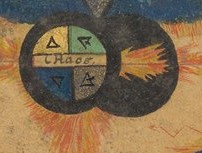
A count, a catastrophe, or the visible part of something that has no body. Note whether the flames are arranged in a number, breaking something, or standing where a figure would be.
In plain words Under the star sits Chaos, a circle cut into four with the triangles of the four elements in it, and a dark circle behind it with fire bursting out. Further down, four arrows in four colours chase each other round a ring: the elements in motion. Creation, in this picture, is fire coming out of the dark and the four elements sorting themselves out of it.
The manuscript, c. 1735 “Chaos.”
The manuscript, c. 1735 “Die Weisheit kömt nicht in eine boßhaffte Seele, und wohnet nicht in einen Leibe der Sünden unterworffen. Dan der heyllige Geist, so recht lehret, fleucht di Abgöttischen, und weichet von denen Ruchlosen. Weisheit 1. Cap. 4. 5. v.”
Symbolica, 2026 The manuscript's German, put into English here: Wisdom does not enter a malicious soul, nor dwell in a body subject to sins. For the Holy Spirit, which teaches rightly, flees the idolatrous and departs from the wicked. Wisdom 1, verses 4 and 5.
Also carrying the Divine
39 works carry it. The 6 where it is the central motif are here. The symbol.
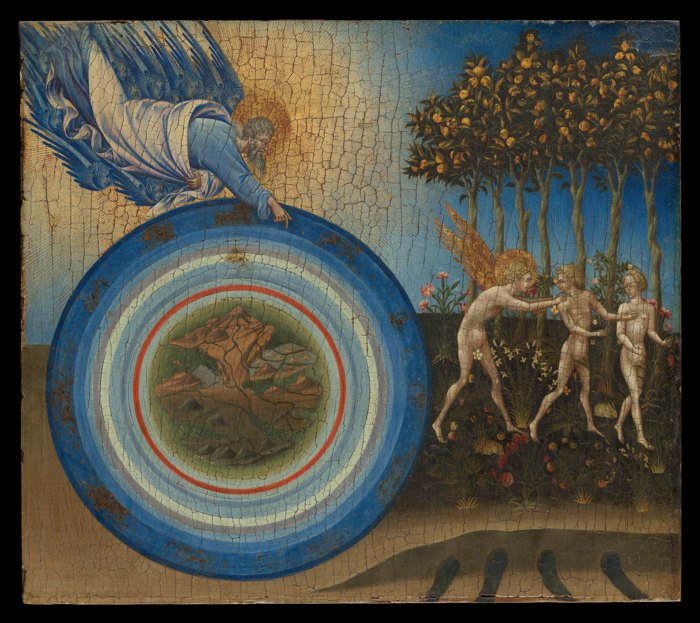
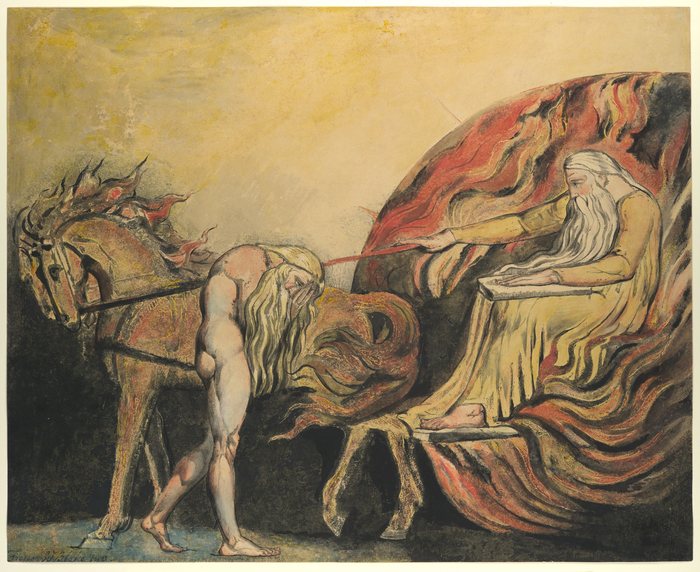
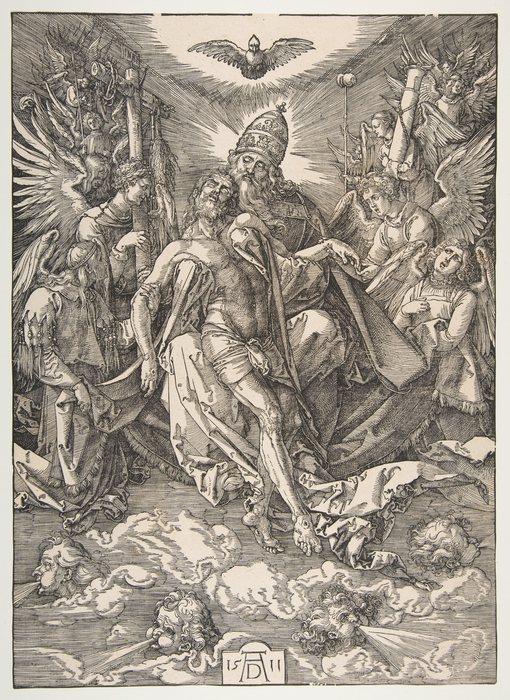
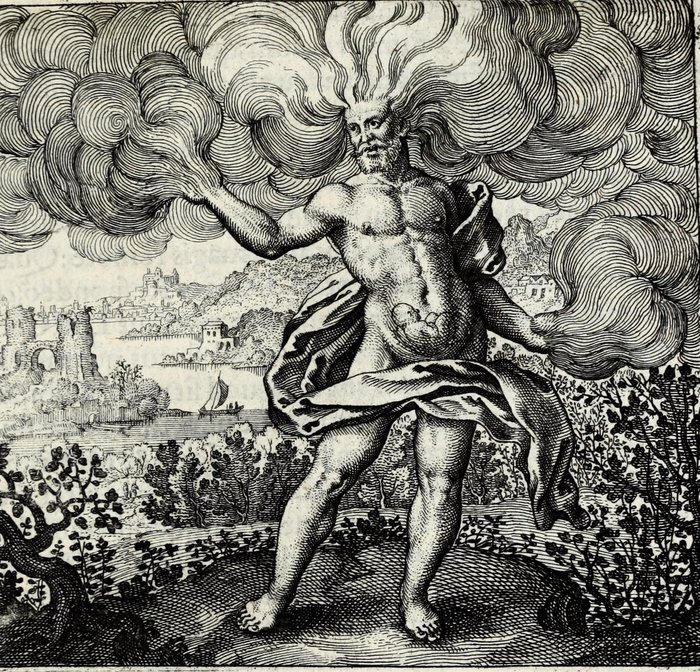
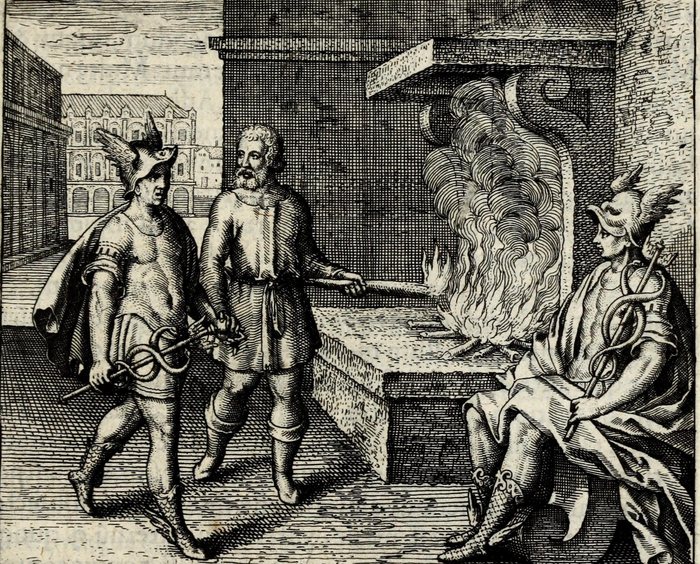
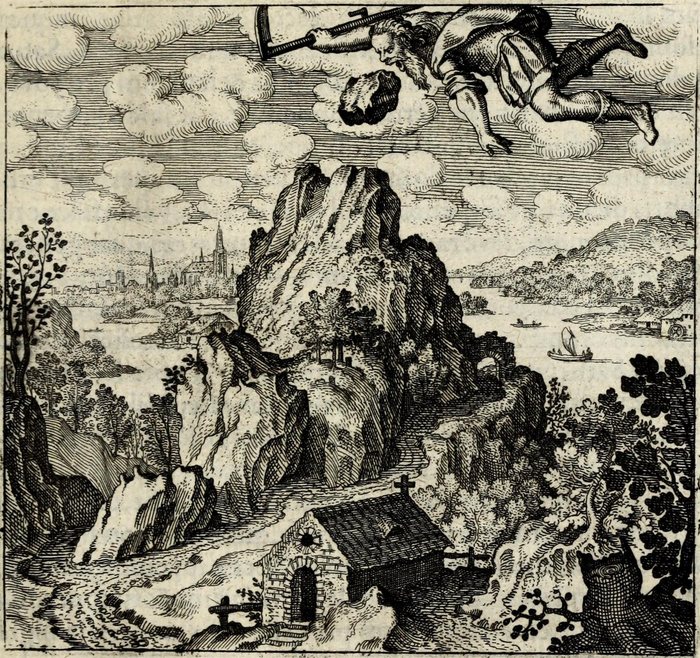
Where the detail is the subject
the Eye · the Triangle and the Pyramid · the Heavens · Fire
Each of these is in the picture without being what it is about. Below, one work that is about each.
In the same series
Record
One symbol a week, decoded.
This picture is free at full size from its source, linked above. What an address gets is the Sunday letter: one picture, one symbol marked on it, what it meant and who said so, and the master files of the decoded plates as they are verified. Leave any time.
Free, one letter a week, unsubscribe in one click. How the address is used.
Scroll or pinch to zoom · drag to move · double-tap for 1:1 · 810 by 1400 pixel web copy; the source file is linked under Record