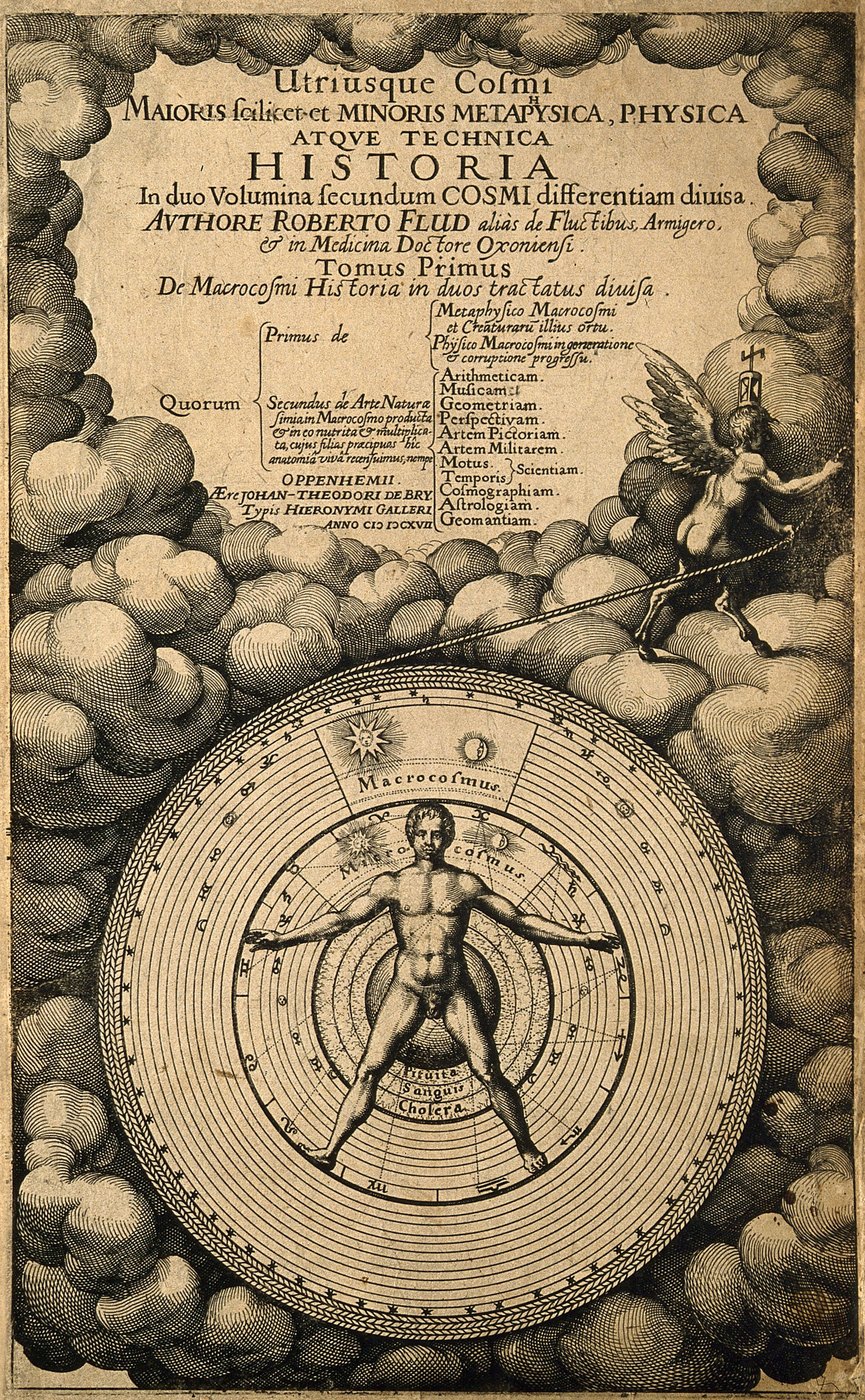
Man the Microcosm, the title page of Utriusque Cosmi Historia
Man the microcosm as the central motif, filed under the Heavens, with the Angel and the Wing, and the Sun and the Moon in a secondary part. From Fludd's history of the two worlds.
What is happening
J. B. Craven, 1902 “At the first glance, the engraved title-page will show the enquiring reader that no ordinary work is before him. A mass of clouds surround the whole page. Below the title is a diagram of macrocosm and the microcosm.”
The plate, 1617 “Secundus de Arte Naturae simia in Macrocosmo producta & in eo nutrita & multiplicata, cujus filias praecipuas hic anatomiâ vivâ recensuimus”
Symbolica, 2026 Fludd's Latin, put into English here: The second, on Art, the ape of Nature, brought forth in the macrocosm and nourished and multiplied in it, whose principal daughters we have here reviewed in a living anatomy.
Robert Fludd, quoted by Craven, 1631 “I sent them beyond the seas, because our home-borne Printers demanded of me five hundred pounds to print the first volume, and to find the cuts in copper; but, beyond the seas, it was printed at no cost of mine, and that as I would wish. And I had 16 copies sent me over, with 40 pounds in gold, as an unexpected gratuitie for it.”
Key · 3 motifs
Tap a motif on the picture, or a line below. Its note opens under the line, with the reading its author gave it.
- Primary motif
- Secondary motifs · 2
The picture
A title page framed in clouds: the title and contents of the book lettered in the sky, below them a great wheel lettered Macrocosmus with the planets on its rim, and inside it a second wheel lettered Microcosmus with the zodiac, in which a naked young man stands with arms and legs spread to touch the rim, three humours named at his feet; a winged figure with goat's legs and an hourglass on his head walks on the clouds and hauls the rope bound round the wheel; man the microcosm as the central motif. By eye
The reading
The picture read whole, in the archive's words, from the sources quoted on the marks. Read on, and the picture follows: the motif under discussion keeps its colour.
This is the door to Fludd's history of the two worlds, and it states the whole book in one picture. The title, in the clouds, promises a metaphysical, physical and technical history of both worlds, the greater and the lesser, and lists the contents: the origin of the great world and its creatures, then the arts, arithmetic, music, geometry, perspective, painting, war, the science of motion and of time, cosmography, astrology, geomancy. Below it the two worlds are drawn, one inside the other.
The outer wheel is lettered Macrocosmus, the great world, and carries the signs of the planets on its rim. The inner wheel is Microcosmus, the little world, and carries the signs of the zodiac; inside it stands a naked young man with his arms and legs spread so that his hands and feet touch the rim. Rings are drawn through his body, and at his feet three of the four humours are named, pituita, phlegm; sanguis, blood; cholera, bile. Craven, describing the page in 1902, took the centre for the earthly globe. The claim of the picture is exact. Man is not in the universe like a stone in a field. He is built to the same plan, ring for ring, and can be read the same way.
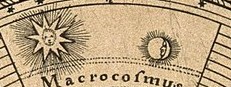
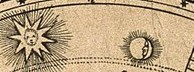
A sun and a crescent moon are set over the word Macrocosmus, and a smaller pair flank the man's head in the inner wheel. The same two lights govern both worlds. Fludd's book will argue that the sun is the god of nature, created, and the heart of the world; here it is simply placed twice, once for each world.
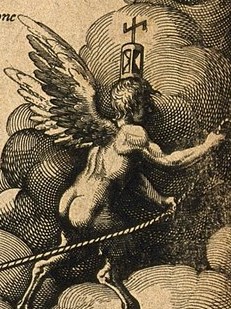
The wheel is bound by a four-fold cord, and the cord is hauled by a winged figure walking on the clouds at the right. He has the legs of a goat, and he balances an hourglass on his head with a small cross above it. Craven names him: Time, who, walking upon the clouds, draws the rope with both hands. Both worlds turn because time pulls them. The book's own table of contents, engraved beside his wings, promises a science of motion and of time, and the picture gives it a body.
Fludd sent the manuscript to Oppenheim because, he later wrote, London printers wanted five hundred pounds to print the first volume and cut the plates. Johann Theodor de Bry printed it at his own cost, sent him sixteen copies and forty pounds in gold, and put his name at the foot of this page: aere Johan-Theodori de Bry, at de Bry's charge. The engraving is unsigned. It opens a book that means to be read the way this page is read, from the letters in the clouds down to the man at the centre.
Decoded: every motif is marked, and each mark carries the reading its author gave it, quoted from the text, or says that it is observed on the picture and not read. The reading above is the archive's own, made from those sources and no others.
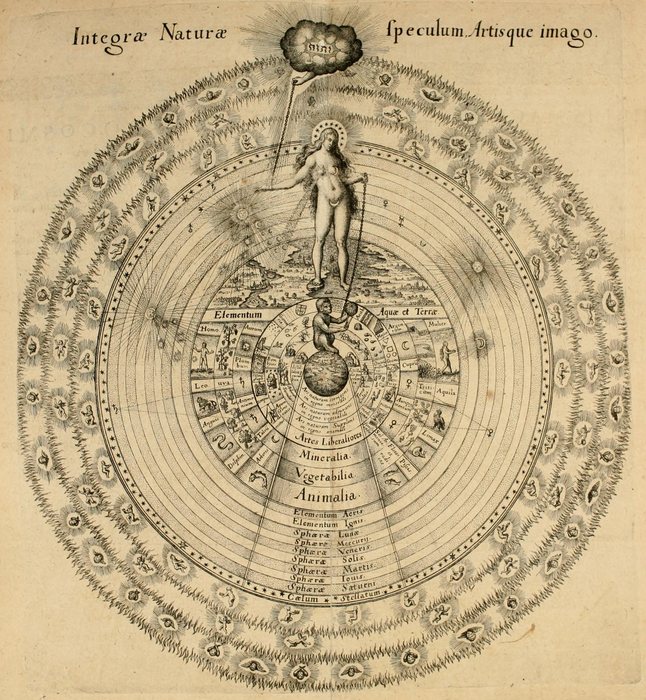
A diagram of everything, drawn so that a person can be found inside it. Note where the human figure stands in the scheme.
In plain words Two worlds, one inside the other. The outer wheel is the great world with the planets and the signs; the inner is the little world, a man, and his body is drawn to touch its rim at every point. Whatever is in the one is in the other.
The plate, 1617 “Macrocosmus. Microcosmus.”
The plate, 1617 “Utriusque Cosmi Maioris scilicet et Minoris Metaphysica, Physica atque Technica Historia, in duo Volumina secundum Cosmi differentiam diuisa. Authore Roberto Flud aliàs de Fluctibus, Armigero, & in Medicina Doctore Oxoniensi.”
Symbolica, 2026 Fludd's Latin, put into English here: The metaphysical, physical and technical history of both worlds, that is, of the greater and the lesser, divided into two volumes according to the difference of the worlds. By Robert Flud, otherwise de Fluctibus, esquire, and doctor of medicine of Oxford.
J. B. Craven, 1902 “Surrounding the border are the signs of the Zodiac, and towards the centre certain circles, 'Pituita Sanguis Cholera.' The centre itself represents the earthly globe.”
The mark of an errand rather than a nature. Note whether the wings are open, folded, or given to the figure by someone else.
In plain words The winged figure with the hourglass on his head is Time, and he has the legs of a goat. He walks on the clouds and hauls the rope that turns the whole wheel of the worlds. Fludd's book promised a science of motion and of time, and here time is the motor.
J. B. Craven, 1902 “A four-fold cord surrounds the circle, which is being drawn by Time, represented as a winged being with hoofs, who, walking upon the clouds, draws the rope with both hands.”
The plate, 1617 “Arithmeticam. Musicam. Geometriam. Perspectivam. Artem Pictoriam. Artem Militarem. Motus. Temporis. Scientiam. Cosmographiam. Astrologiam. Geomantiam.”
Symbolica, 2026 Fludd's Latin, put into English here: Arithmetic, music, geometry, perspective, the art of painting, the art of war, the science of motion and of time, cosmography, astrology, geomancy: the arts the second tractate treats as the daughters of Nature's ape.
Gold, the perfected metal, and the illuminated intellect. The most overloaded symbol in the tradition.
In plain words A sun and a moon stand over the great world, and a smaller sun and moon stand at the man's shoulders in the little one. The same two lights rule both.
J. B. Craven, 1902 “Looking at the circle below, we find the outer part, with the sun and moon, &c., enclosing the inner”
Robert Fludd, 1617 “Concludimus igitur Solem naturae DEUM, sed creatum, virtute harmoniae spiritualis, per Diapason formale cum intervallis suis proportionaliter ordinatum, accipere omnem formalem & lucidam virtutem à DEO omnium maximo, supernaturali creatore increato.”
Symbolica, 2026 Fludd's Latin, put into English here: We conclude, then, that the Sun, the god of nature but a created one, ordered proportionally through the formal octave with its intervals by the power of spiritual harmony, receives all its formal and luminous power from God, greatest of all, the supernatural and uncreated creator.
Also carrying the Heavens
61 works carry it. The 6 where it is the central motif are here. The symbol.
Where the detail is the subject
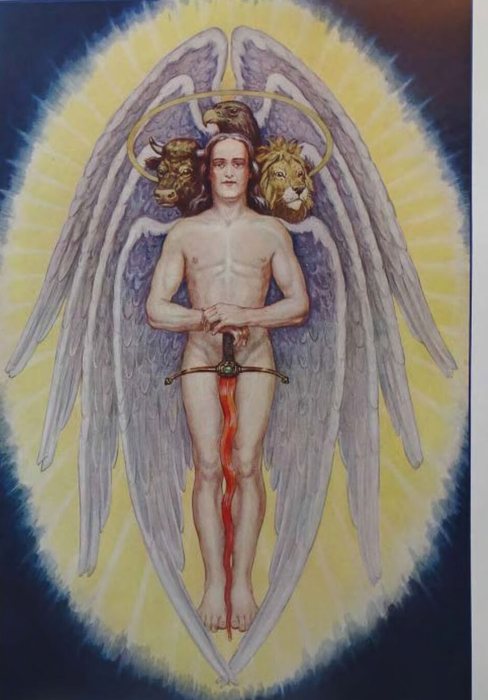
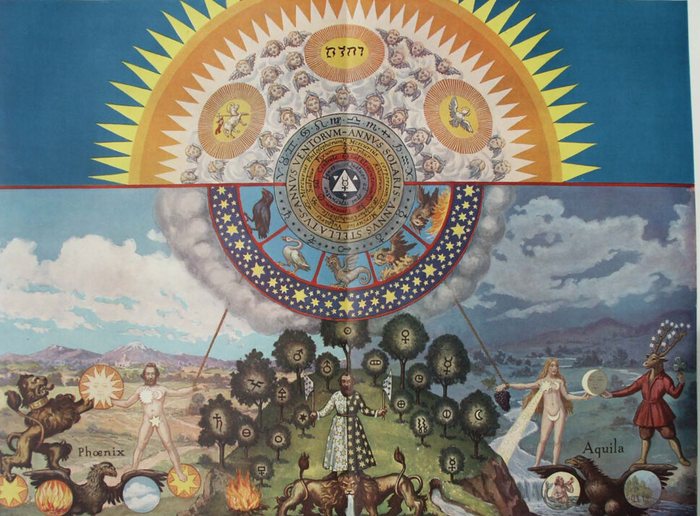
the Angel and the Wing · the Sun and the Moon
Each of these is in the picture without being what it is about. Below, one work that is about each.
In the same series
Record
One symbol a week, decoded.
This picture is free at full size from its source, linked above. What an address gets is the Sunday letter: one picture, one symbol marked on it, what it meant and who said so, and the master files of the decoded plates as they are verified. Leave any time.
Free, one letter a week, unsubscribe in one click. How the address is used.
Scroll or pinch to zoom · drag to move · double-tap for 1:1 · 865 by 1400 pixel web copy; the source file is linked under Record