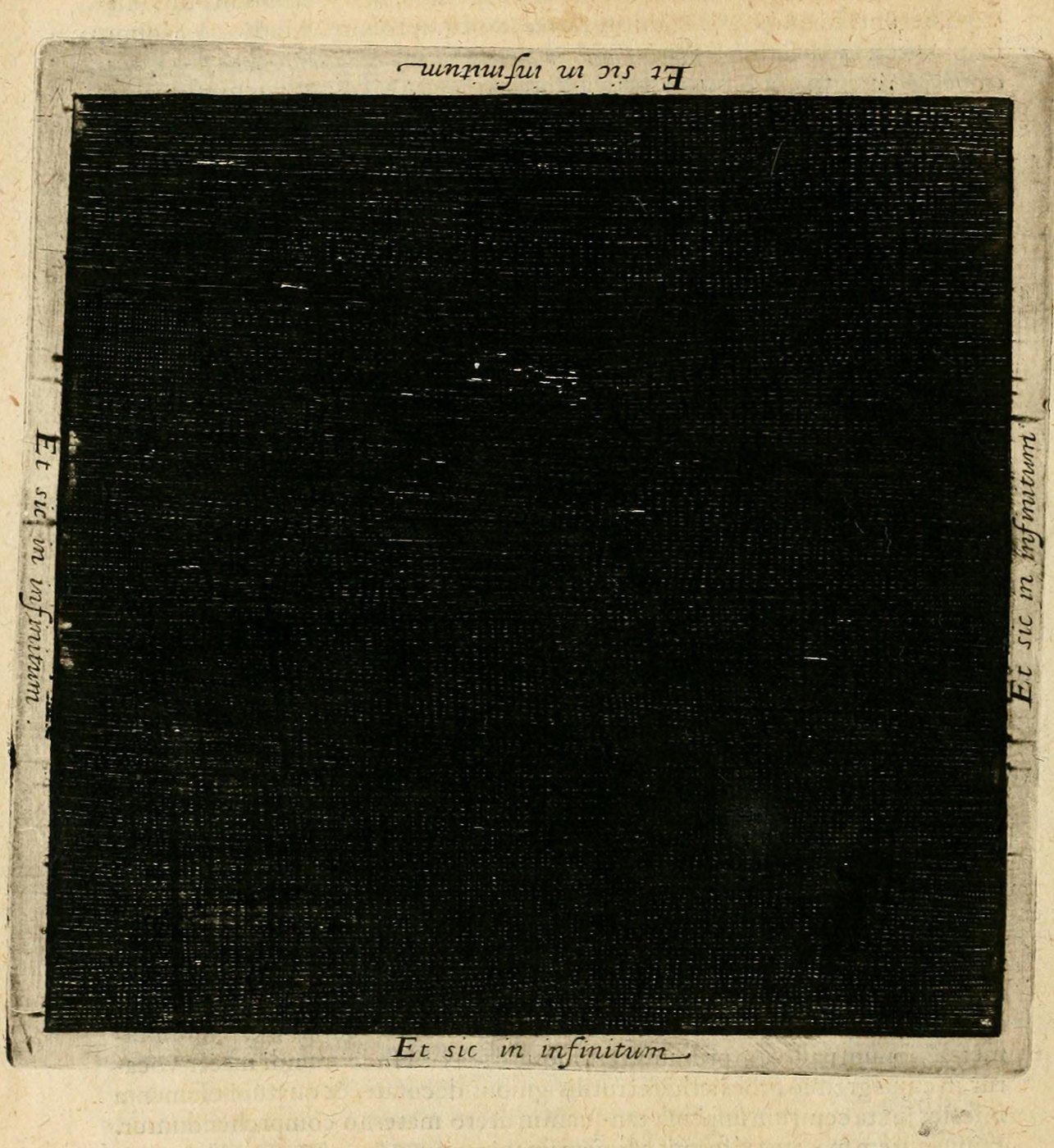
Et sic in infinitum
The first matter as the central motif, filed under the Heavens. From Fludd's history of the two worlds.
What is happening
Robert Fludd, 1617 “Hujus autem materiae informis effigiem imaginariam, Mercurii Trismegisti & veridici Moysis descriptionem imitando, sub forma fumi nigerrimi, seu vaporis, seu umbrae horrendae, seu abyssi tenebrosae, seu denique massae cujusdam rudis, indigestae & imperceptibilis hoc in loco depinximus.”
Symbolica, 2026 Fludd's Latin, put into English here: And in this place we have painted an imaginary likeness of this formless matter, following the description of Mercurius Trismegistus and of truthful Moses, in the form of the blackest smoke, or of a vapour, or of a dreadful shadow, or of a dark abyss, or lastly of a certain rough, undigested and imperceptible mass.
Robert Fludd, 1617 “Concludimus igitur ex omnibus tum veterum, tum recentiorum Philosophorum scriptis, materiam hanc primam esse Ens primordiale, infinitum, informe, in potentia tam ad aliquid, quàm ad nihil; nullius quantitatis seu dimensionis, cùm nec parvum, nec magnum dici possit; nullius qualitatis, cùm nec sit subtile, nec spissum, nec perceptibile; nullius proprietatis, nec inclinationis, non movens, nec quiescens, sine ullo colore aut qualitate elementari.”
Symbolica, 2026 Fludd's Latin, put into English here: We conclude, then, from the writings of all the philosophers, old and new, that this first matter is a primordial being, infinite, formless, in potency as much towards something as towards nothing; of no quantity or dimension, since it can be called neither small nor great; of no quality, since it is neither fine nor dense nor perceptible; of no property or inclination, neither moving nor at rest, without any colour or elemental quality.
Robert Fludd, 1617 “Nam, teste Moyse, tenebrae super faciem abyssi fuerunt, priusquam lux seu forma crearetur; privatio verò nominari non potest, nisi respectu cujusdam positionis, hoc est, ubi est alicujus formae praecedentis absentia.”
Symbolica, 2026 Fludd's Latin, put into English here: For, as Moses witnesses, darkness was upon the face of the abyss before light or form was created; but privation cannot be named except with respect to some positive thing, that is, where there is the absence of some preceding form.
J. B. Craven, 1902 “Without motion, colour, or perception, in fact, 'without form and void,' shrouded in darkness, he gives a square illustration, a black and formless sheet of darkness, which he labels 'Et sic in infinitum.'”
Key · 1 motif
Tap a motif on the picture, or a line below. Its note opens under the line, with the reading its author gave it.
- Primary motif
The picture
A square printed solid black, its whole surface cross-hatched, with the words Et sic in infinitum engraved along each of its four sides, the top line upside down; the formless first matter before creation as the central motif. By eye
The reading
The picture read whole, in the archive's words, from the sources quoted on the marks. Read on, and the picture follows: the motif under discussion keeps its colour.
This is a picture of nothing, and Fludd meant it to be looked at. It closes the fourth chapter of his book on the beginnings of the great world, where he has gathered every name the philosophers gave the matter that existed before creation: Aristotle's hyle, a forest of timber fit for any building; Moses' void earth and deep waters; Hermes' dreadful shadow; Plato's mother and nurse of everything born; Augustine's darkness and silence. His own conclusion is on the facing page. The first matter is a primordial being, infinite, formless, in potency as much towards something as towards nothing, without size, quality, colour, movement or rest.
Then he draws it. The square is solid black to its edges, and on all four edges run the same three words, one line of them printed upside down: Et sic in infinitum, and so on without end. The words do the work the picture cannot. A square has a boundary; the black does not. Fludd says that only God knows how far this potency reaches beyond the outermost sphere of the world, and the inscriptions turn the edge of the page into a fiction. The archive files the square under the Heavens because that is what it is about: the space outside the last sphere, before there were spheres.
Fludd tells us exactly how he arrived at the image. Following Hermes and Moses, he says, he has painted the formless matter in the form of the blackest smoke, or of a vapour, or of a dreadful shadow, or of a dark abyss, or lastly of a certain rough, undigested and imperceptible mass. Every one of those is a thing an engraver could draw. He drew none of them. The next chapter, which begins below the square, argues that darkness is not merely the absence of light, because darkness was on the face of the deep before light was made, and an absence needs something to be absent from.
The plates that follow it in the book carry the story on: a ring of light breaks into the same black field, then the spirit hovers over the waters, then the spheres. Read in order they are Fludd's Genesis. Read alone, the black square has outlived the argument it was drawn for, and it earns its fame honestly. It is a diagram whose meaning is written on it, in the maker's own words, four times.
Decoded: every motif is marked, and each mark carries the reading its author gave it, quoted from the text, or says that it is observed on the picture and not read. The reading above is the archive's own, made from those sources and no others.

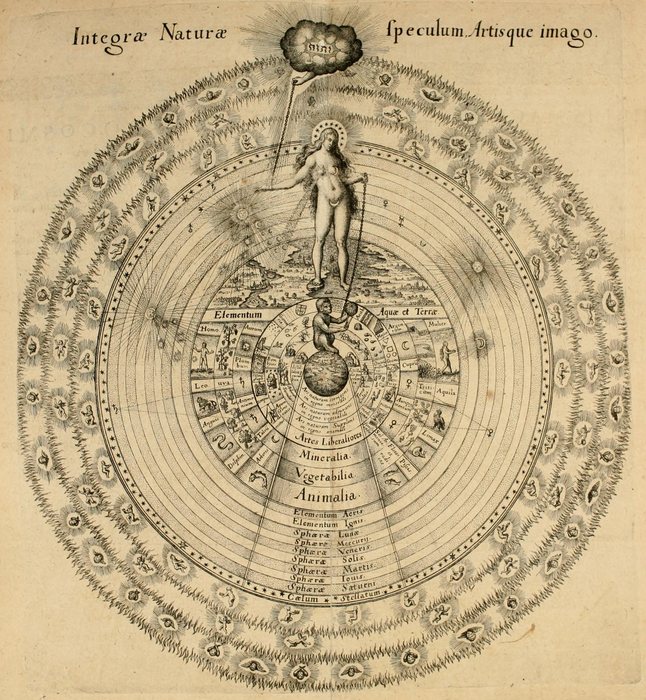
A diagram of everything, drawn so that a person can be found inside it. Note where the human figure stands in the scheme.
In plain words The square has no edge that means anything. The same words run along all four sides, one of them upside down, to say the black goes on in every direction. This is the stuff of the world before the world had a shape, and Fludd says only God knows how far it reaches.
The plate, 1617 “Et sic in infinitum.”
Robert Fludd, 1617 “Quamvis ista materia, etiam quo ad nos infinita dici poterit; nam DEUS tantùm scit, quàm latè sese haec potentia ultra mundi convexitatem extendat.”
Symbolica, 2026 Fludd's Latin, put into English here: Although this matter may be called infinite even as regards us; for God alone knows how far this potency extends beyond the convex surface of the world.
Robert Fludd, 1617 “Atque hinc est, quòd Plato eam infinitam appellavit; scilicet propter inclinationem illius ad infinitas formas.”
Symbolica, 2026 Fludd's Latin, put into English here: And this is why Plato called it infinite; namely for its inclination towards infinite forms.
Also carrying the Heavens
61 works carry it. The 6 where it is the central motif are here. The symbol.
In the same series
Record
One symbol a week, decoded.
This picture is free at full size from its source, linked above. What an address gets is the Sunday letter: one picture, one symbol marked on it, what it meant and who said so, and the master files of the decoded plates as they are verified. Leave any time.
Free, one letter a week, unsubscribe in one click. How the address is used.
Scroll or pinch to zoom · drag to move · double-tap for 1:1 · 1285 by 1400 pixel web copy; the source file is linked under Record